Hiring effective dispatch coordinators is critical in fast-paced transportation and logistics. These 10 essential dispatch coordinator interview questions evaluate multitasking, communication, crisis handling, and tech proficiency. Pair with CloudApper AI Recruiter to automate screening, cut time-to-hire by 90%, and secure top talent efficiently.
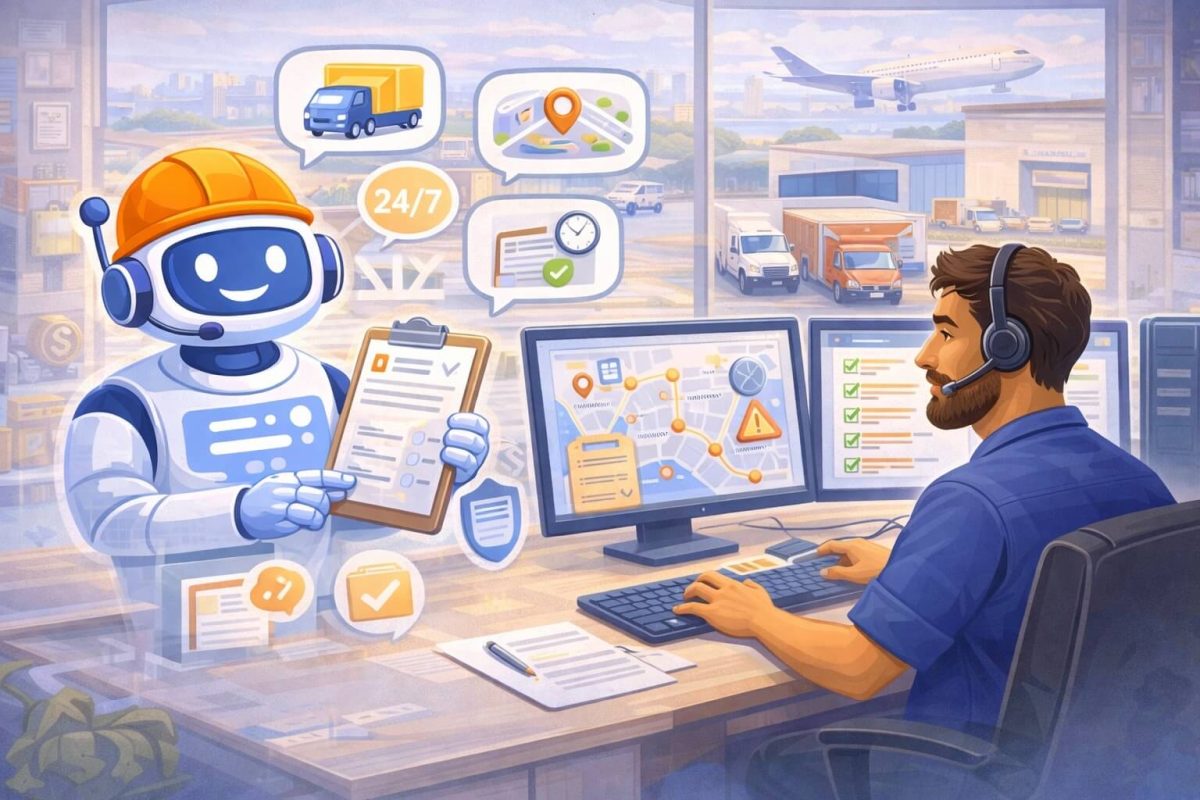
Table of Contents
Dispatch coordinators are the nerve center of transportation and logistics operations, orchestrating the complex choreography of drivers, routes, customer demands, and unexpected crises that define the industry. Yet finding exceptional dispatch talent has become increasingly difficult. According to recent logistics industry reports, the average time-to-fill for dispatch coordinator positions has stretched to 42-50 days, with many companies struggling to find candidates who possess the unique combination of technical skills, communication abilities, and crisis management capabilities the role demands.
The talent shortage is real and growing. As seasoned dispatchers retire, there’s a significant experience gap, with fewer professionals trained in the nuanced art of logistics coordination. Meanwhile, the role’s requirements have exploded in complexity—today’s dispatch coordinators must master transportation management systems (TMS), real-time tracking platforms, route optimization software, electronic logging device (ELD) systems, and customer portals, all while managing human relationships with drivers, customers, and operations teams. It’s a hybrid role requiring both high-tech proficiency and high-touch people skills.

The hiring challenges compound quickly. Candidate drop-off rates for mid-level logistics positions average 60-65%, often because traditional hiring processes move too slowly in a competitive market where top candidates receive multiple offers. The cost to hire a dispatch coordinator ranges from $3,500 to $6,000 when you factor in recruiting time, advertising, background checks, and the operational disruption caused by an understaffed dispatch desk. One bad hire can cost significantly more—a coordinator who can’t handle pressure or lacks systems knowledge creates cascading problems affecting driver satisfaction, customer service, and operational efficiency.
CloudApper AI Recruiter transforms this challenging hiring equation through conversational AI technology that engages candidates instantly via SMS or web chat, conducts sophisticated screening interviews 24/7, and can complete what traditionally takes weeks in just days—all while eliminating unconscious bias and ensuring consistent, thorough evaluation. Our transportation and logistics clients report screening 90% faster while dramatically improving candidate quality.
In this guide, we’ll give you the exact interview questions to identify exceptional dispatch coordinator candidates, plus show you how CloudApper AI Recruiter handles the heavy lifting so your team can focus on making great hiring decisions instead of drowning in initial screenings.
TL;DR
Dispatch coordinators keep logistics operations running smoothly under pressure. Use these 10 proven dispatch coordinator interview questions to identify strong candidates. CloudApper AI Recruiter streamlines high-volume hiring with 24/7 conversational screening, unbiased evaluation, and rapid scheduling—reducing costs and improving retention in transportation roles.
Why These Questions Matter for Dispatch Coordinator Roles
The dispatch coordinator role has evolved from radio communication and paper manifests to sophisticated digital orchestration requiring mastery of multiple complex systems. Today’s coordinators don’t just assign routes—they optimize resources in real-time using TMS platforms, troubleshoot technology failures, manage Hours of Service compliance electronically, respond to customer escalations through multiple channels, and serve as critical communication hubs between operations, drivers, and customers.
Old-school questions like “Are you good at multitasking?” or “Can you handle stress?” provide virtually no predictive value about actual job performance. We need behavioral questions that reveal how candidates have navigated real dispatch challenges, technical questions that assess systems proficiency, and situational questions that demonstrate problem-solving under pressure.
The questions below are specifically designed to uncover the competencies that separate adequate dispatchers from exceptional ones: systems thinking, calm decision-making during crises, driver relationship management, customer service orientation, technological adaptability, and the organizational rigor required to keep complex operations running smoothly when everything seems to be going wrong simultaneously.
Top 10 Essential Dispatch Coordinator Interview Questions (Plus How AI Recruiter Can Automate The Entire Hiring Process)
1. Describe a situation where you had to manage multiple urgent issues simultaneously—perhaps a breakdown, a customer escalation, and a driver calling in sick. How did you prioritize and resolve them?
Why ask this? Dispatch is fundamentally about crisis management and prioritization. This behavioral question reveals decision-making process, pressure management, and organizational thinking.
Sample Strong Answer: “This happened during our peak season when we were already running at capacity. Within a 15-minute window, I had a driver report a mechanical breakdown 100 miles from delivery, a major customer calling about a late delivery, and my supervisor informing me that another driver called in sick for his afternoon route. I took a breath and prioritized based on immediate impact and time-sensitivity. First, I contacted our breakdown driver to confirm he was safe, then immediately called our maintenance provider to get roadside service dispatched while simultaneously checking our TMS for the nearest available backup driver. Second, I called the customer about the late delivery, acknowledged their concern, provided a realistic updated ETA, and explained what we were doing to prevent similar issues—turning a complaint into a demonstration of our responsiveness. Third, I reviewed the sick driver’s route, identified which stops were time-critical, and reassigned those to two other drivers whose routes allowed slight extensions, while moving non-urgent stops to the next day with customer approval. I documented everything in our system and kept my supervisor updated throughout. All three issues were resolved within 90 minutes with minimal customer impact. The key was staying calm, assessing which problems had the highest stakes and shortest timelines, and communicating proactively with everyone involved.”
2. What transportation management systems (TMS) or dispatch software have you used, and how do you leverage technology to improve efficiency and visibility?
Why ask this? Technology proficiency is non-negotiable in modern dispatch. This question assesses systems knowledge and how they use tools strategically, not just operationally.
Sample Strong Answer: “I’ve worked extensively with TMW Systems and more recently McLeod LoadMaster, along with GPS tracking platforms like Samsara and Geotab for real-time visibility. I don’t just use these systems for basic functions—I leverage them strategically. For example, I use the TMS to analyze historical delivery time data to create more accurate ETAs rather than just using default estimates. I set up custom alerts for potential HOS violations so I can proactively address driver availability before it becomes a compliance issue. I also use the geofencing features to automatically notify customers when drivers are approaching delivery windows, which has dramatically reduced ‘where’s my delivery?’ calls. When we implemented a new TMS last year, I volunteered for the pilot program and actually provided feedback that improved the rollout. I also understand the importance of data integrity—I’m diligent about keeping records updated in real-time because outdated information in the system creates problems for everyone. Beyond dispatch-specific systems, I’m proficient in Excel for reporting and analysis, Slack for internal communication, and various customer portal systems. I’m also comfortable learning new platforms—technology changes rapidly in this industry and I see that as an opportunity rather than a burden.”
3. Tell me about a time when you had to deliver difficult news to a customer or manage an angry customer situation. How did you handle it?
Why ask this? Customer service recovery is a critical dispatch skill. This reveals communication abilities, emotional intelligence, and service orientation under pressure.
Sample Strong Answer: “I had a situation where a customer’s time-sensitive shipment was delayed due to our carrier’s mechanical failure, and they were understandably upset because it affected their production schedule. When they called, they were already frustrated and escalating. Rather than getting defensive or making excuses, I first let them vent and acknowledged their frustration—’I completely understand why you’re upset, and I would be too in your situation.’ Then I focused on solutions and transparency. I explained exactly what happened, gave them realistic expectations about when we could deliver, and offered three options: expedite via a different carrier at our expense, partial delivery of whatever was most critical, or full refund if the delay made the shipment unusable. I also committed to hourly updates until resolved. They appreciated the honesty and options rather than vague promises. I expedited through a partner carrier, kept them updated as promised, and the delivery arrived with minimal additional delay. I followed up the next day to confirm everything was satisfactory and documented the entire situation for our team to review. The customer actually became one of our strongest accounts because of how we handled the problem. I learned that customers don’t expect perfection—they expect honesty, solutions, and communication when things go wrong.”
4. How do you build and maintain effective relationships with drivers, especially when you need to ask them to take on challenging routes, handle last-minute changes, or work extra hours?
Why ask this? Driver relationships make or break dispatch success. This question reveals interpersonal skills, empathy, and ability to influence without direct authority.
Sample Strong Answer: “I approach driver relationships from a place of respect and mutual benefit—I know that without good drivers, my job is impossible, and I want them to see me as an advocate, not just someone giving orders. I invest time in building trust during routine operations so I have credibility when I need to make difficult requests. I learn their preferences—some drivers prefer long hauls, others want to be home nightly, some are great with challenging customers—and I try to assign routes accordingly when possible. When I do need to ask for something difficult, I’m honest about why, I acknowledge the inconvenience, and whenever possible, I offer something in return—’I know this is a tough route, but I’ll make sure you get your preferred runs next week’ or ‘This is last-minute and I appreciate your flexibility.’ I also protect drivers from unreasonable demands and advocate for them with customers or management when appropriate. I respond quickly when they need support—whether that’s helping solve a delivery access problem, backing them up with a difficult customer, or adjusting their schedule for personal needs when I can. I had one driver who was initially difficult to work with, but I took time to understand his concerns—he felt previous dispatchers didn’t listen. Once I demonstrated I respected his input and supported him, he became one of my most reliable drivers. The key is treating drivers as partners, not just resources to be deployed.”
5. Describe your process for route planning and optimization. How do you balance efficiency, driver HOS regulations, customer time windows, and unexpected variables?
Why ask this? Route planning is core dispatch competency. This reveals systems thinking, regulatory knowledge, and ability to optimize under constraints.
Sample Strong Answer: “My route planning starts the day before by reviewing the next day’s load assignments, customer delivery windows, and driver availability. I use our TMS optimization features as a starting point, but I don’t blindly follow the suggested routes—I apply real-world knowledge about traffic patterns, difficult delivery locations, and driver capabilities. For HOS compliance, I check each driver’s available hours and plan routes that keep them well within limits while building in buffer time for unexpected delays. I also consider driver preferences and strengths—I don’t send a new driver to our most complicated customer sites, and I try to match challenging routes with experienced drivers. I look for opportunities to consolidate stops geographically to reduce deadhead miles. On the day of, I monitor routes in real-time through GPS tracking and adjust dynamically when issues arise—traffic delays, customer reschedules, or new urgent shipments. I also maintain good communication with drivers throughout the day, so they can alert me to problems early when I have more options to solve them. For example, if a driver is running ahead of schedule, I’ll see if we can move up a delivery window or add a stop from another route. If they’re behind, I’ll contact affected customers proactively and adjust expectations. The key is understanding that route optimization isn’t just about mathematical efficiency—it’s about balancing multiple constraints including regulatory compliance, customer satisfaction, driver well-being, and operational costs.”
6. Tell me about a time when you identified an operational inefficiency or recurring problem and implemented a solution. What was your approach?
Why ask this? Great dispatchers improve processes, not just execute them. This reveals initiative, analytical thinking, and continuous improvement mindset.
Sample Strong Answer: “I noticed we were consistently missing delivery windows at a particular customer location, which was straining the relationship. Rather than just treating it as individual driver issues, I analyzed three months of delivery data for that account and discovered the pattern wasn’t random—we were almost always late during afternoon delivery windows. I investigated further and realized our route optimization algorithm was underestimating the time required because it didn’t account for that customer’s loading dock procedures, which were unusually slow and required waiting time. I documented my findings and proposed a solution to my manager: adjust our delivery time estimates for that location to include an additional 30-minute buffer, and prioritize them for morning delivery slots when possible. I also worked with the customer to understand their dock congestion patterns and identified optimal delivery times. We implemented these changes and our on-time delivery rate at that location improved from 67% to 94% over the next quarter. The customer noticed and actually expanded their business with us. This experience reinforced that when you see recurring problems, there’s usually a systemic cause that can be addressed rather than just handling each incident individually. I’m always looking for patterns and opportunities to improve processes, and I’m comfortable presenting data-driven recommendations to management.”
7. How do you stay organized and maintain accuracy when managing dozens of active shipments, driver assignments, and customer communications simultaneously?
Why ask this? Organization is fundamental to dispatch success. This question reveals systems, discipline, and attention to detail under high-volume conditions.
Sample Strong Answer: “Organization is critical in dispatch because one missed detail can cascade into major problems. I use a combination of systems and personal discipline to stay on top of everything. First, I rely heavily on our TMS as my single source of truth—I update it in real-time rather than letting things pile up to document later, because outdated information creates confusion. I use the task management features to set reminders for follow-ups, and I create custom views that show me critical information at a glance—shipments at risk of being late, drivers approaching HOS limits, pending customer communications. Beyond the TMS, I maintain a daily checklist of key tasks and review it multiple times during my shift to ensure nothing falls through cracks. I also use a simple priority system: urgent and important issues get addressed immediately, important but not urgent gets scheduled, urgent but not important gets delegated when possible, and neither urgent nor important gets eliminated. During my shift, I do quick ‘sweep’ reviews every hour where I check dashboard views for exceptions and outliers. I’m also careful about communication documentation—I document all customer commitments, driver issues, and operational decisions in case notes so anyone covering for me or reviewing later has the context. At the end of each shift, I spend 15 minutes doing a handover note for the next shift highlighting active issues and pending items. This systematic approach has allowed me to manage high-volume operations while maintaining 98%+ delivery accuracy.”
Describe a situation where you had to make a quick decision with incomplete information during a crisis. What was your thought process?
Why ask this? Dispatch requires rapid decision-making under uncertainty. This reveals judgment, risk assessment, and comfort with ambiguity.
Sample Strong Answer: “We had a situation where a driver called reporting that his load had shifted during transport and he heard a concerning noise from the cargo area, but he couldn’t safely inspect it on the highway. He was about 40 miles from the delivery destination. I had to decide quickly whether to have him proceed to delivery, pull over for inspection, or return to our facility—each option had different implications for safety, customer satisfaction, and costs. I didn’t have complete information about the severity, but I made the decision to have him exit at the next safe location and do a full inspection before proceeding. My reasoning was that safety takes priority over delivery schedules, and if there was actual cargo damage or a safety issue, delivering it would create bigger problems than a short delay. I immediately called the customer to alert them to a potential delay while we investigated, framing it as a safety-focused decision. It turned out there was minor shifting but no damage—we were able to resecure the load and complete delivery with only 45 minutes delay. The customer actually appreciated that we prioritized safety and thoroughness. In retrospect, I’m confident it was the right call even though it delayed delivery, because the alternative scenarios if something was seriously wrong could have been much worse—damaged goods, a safety incident, or liability issues. When making quick decisions with incomplete information, I default to risk mitigation and safety, communicate proactively with all stakeholders, and trust my experience and judgment.”
How do you handle the stress of this role, especially during peak seasons or when multiple things are going wrong at once?
Why ask this? Dispatch is inherently high-stress. This question assesses self-awareness, resilience, and sustainable stress management strategies.
Sample Strong Answer: “I recognize that dispatch is a high-pressure role and stress management is essential for long-term success. My primary strategy is maintaining perspective—I remind myself that we’re moving packages, not performing brain surgery. Most problems have solutions, and even when things go wrong, we can usually find a way to recover. During intense situations, I focus on what I can control and let go of what I can’t. I also use a deliberate calm approach—when everyone around me is panicking, I consciously slow down my speech, take deeper breaths, and think through problems systematically rather than reactively. Practically, I take my breaks even during busy periods because I’ve learned that 10 minutes away actually makes me more effective when I return. I also maintain boundaries between work and personal life—when my shift ends, I hand off properly and disconnect mentally so I can recharge. I exercise regularly, get adequate sleep, and have hobbies outside of work that provide balance. I’ve also learned to celebrate small wins during difficult periods—got a late shipment delivered just in time, resolved a customer complaint well, helped a driver solve a problem—acknowledging these victories helps maintain morale during challenging stretches. Finally, I maintain a supportive relationship with my team; we help each other during peak stress and sometimes just venting to someone who understands helps release pressure. I’ve worked through multiple peak seasons and major operational disruptions, and my approach has allowed me to stay effective without burning out.”
10. Why are you interested in this dispatch coordinator position specifically, and where do you see your career in logistics progressing?
Why ask this? This reveals motivation, career trajectory, retention potential, and whether they’ve researched your company or just need any job.
Sample Strong Answer: “I’m specifically interested in this position because of your company’s reputation in the industry and your focus on technology-enabled logistics. I’ve researched your operations and I’m impressed by your investment in TMS technology and your commitment to driver satisfaction—both areas I’m passionate about. I’m also drawn to the complexity of your operation; you handle multiple service levels and diverse customer requirements, which I find more engaging than single-service operations. From what I’ve learned, you promote from within and value operational excellence, which aligns with my career goals. In the short term, I want to establish myself as a trusted, high-performing member of your dispatch team—someone who handles routine operations excellently and steps up during crises or peak seasons. I want to contribute to your operational metrics and be someone management knows they can rely on. Long-term, I’m interested in growing within logistics operations. I see dispatch coordination as a foundational role that touches everything—customer service, driver management, technology, compliance, and problem-solving. I’d like to eventually move into operations management or possibly supply chain planning, where I can apply this operational knowledge to strategic decision-making. I’m also interested in potentially mentoring new dispatchers or contributing to process improvement initiatives as I gain experience with your systems. I’m looking for a company where I can build a long-term career, and from everything I’ve learned about your organization, this seems like an excellent fit.”
How CloudApper AI Recruiter Makes Hiring Dispatch Coordinators Effortless
Here’s the challenge facing every transportation operations manager: you need to find dispatch coordinator candidates who possess a rare combination of technical proficiency, crisis management abilities, communication skills, and logistics industry knowledge—and you need to assess all of this before competitors hire your best prospects. Traditional hiring workflows take weeks, involving phone tag, manual screening, and interviews that may or may not reveal actual dispatch competencies.
CloudApper AI Recruiter transforms this complex hiring process through conversational AI that engages candidates instantly and conducts sophisticated screening 24/7. Here’s exactly how it revolutionizes dispatch coordinator recruiting:
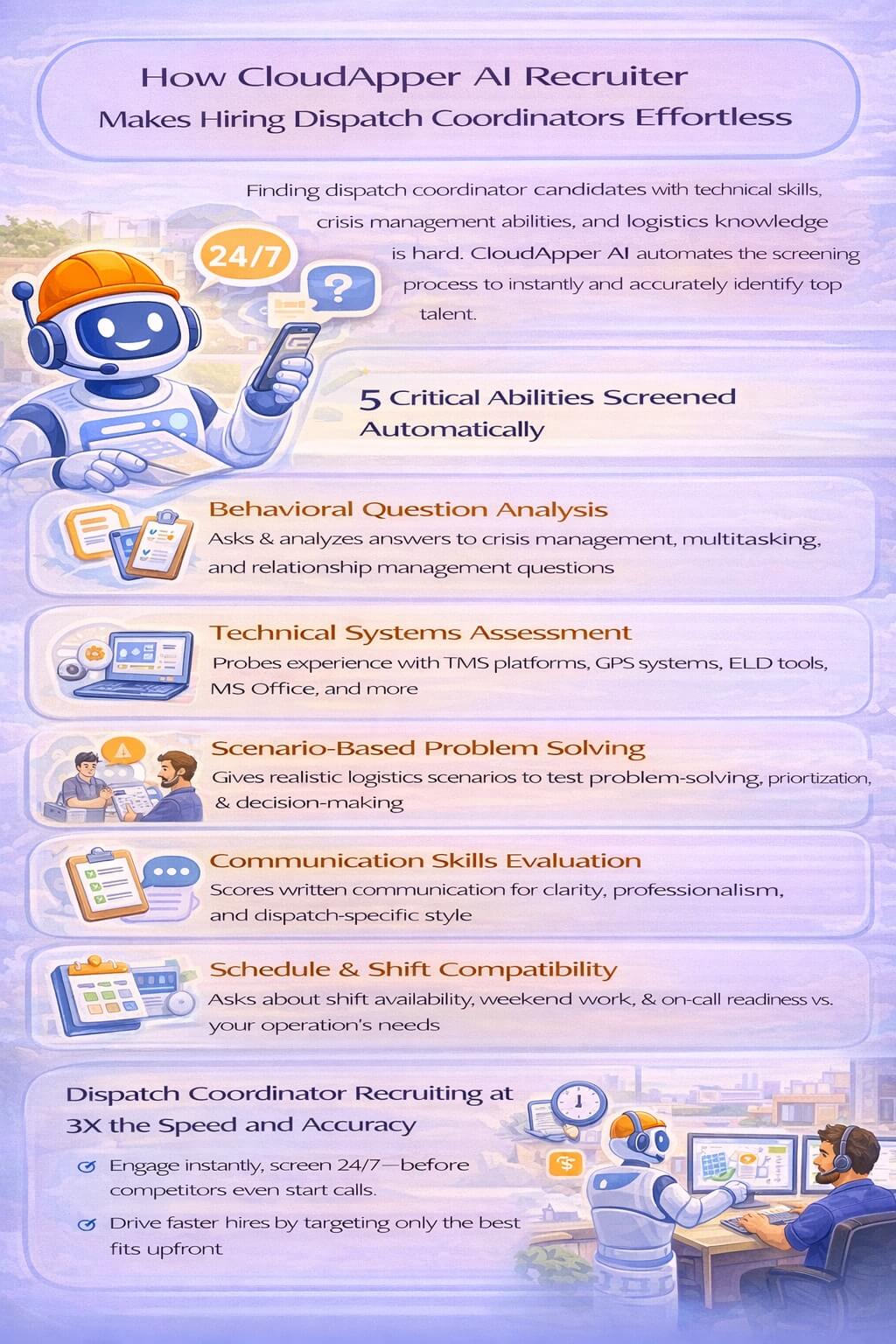
The moment a candidate applies, CloudApper’s AI chatbot engages them via SMS or web chat—immediately, regardless of whether it’s 2 PM or 2 AM. The AI conducts a natural, intelligent conversation asking these exact interview questions (or your customized versions), adapting follow-up questions based on responses to probe deeper into relevant experience just like a skilled recruiter would.
Key features specifically designed for dispatch coordinator recruitment:
- Behavioral Question Analysis: The AI asks sophisticated behavioral questions about crisis management, multitasking, customer service, and driver relationship management, then analyzes responses for depth, specificity, and competency indicators that predict job success
- Technical Systems Assessment: Custom questions probe experience with TMS platforms (McLeod, TMW, Manhattan, etc.), GPS tracking systems, ELD compliance tools, and Microsoft Office proficiency, automatically scoring candidates on technology readiness
- Scenario-Based Problem Solving: The AI presents realistic dispatch scenarios—late deliveries, driver shortages, customer escalations—and evaluates how candidates approach problem-solving, prioritization, and decision-making under pressure
- Communication Skills Evaluation: Because written communication is critical in dispatch coordination, the AI analyzes response quality, clarity, professionalism, and communication style throughout the conversation
- Schedule & Shift Compatibility Screening: The system asks detailed questions about availability for various shifts, weekend work, on-call requirements, and schedule flexibility, immediately identifying candidates whose availability doesn’t match operational needs
- Industry Knowledge Verification: Questions about HOS regulations, DOT compliance, freight terminology, and logistics best practices assess whether candidates have genuine industry experience versus generic operations background
Real-world impact: A regional LTL carrier with 200+ trucks struggled to fill three critical dispatch coordinator positions for over two months using traditional recruiting, receiving mostly unqualified applicants or losing strong candidates to faster-moving competitors. After implementing CloudAapper AI Recruiter, they filled all three positions within 18 days with candidates who scored higher on both technical assessments and cultural fit than their previous hires.
The breakthrough came from two factors: speed and depth. Speed—the AI engaged candidates within minutes of application, conducting comprehensive initial screening before competitors even scheduled phone calls. Depth—the AI asked more thorough, consistent questions than human screeners had time for, revealing competencies and red flags that traditional phone screens often missed. Their operations manager reported that candidates who passed AI screening required 60% less time in final interviews because the heavy-lifting screening work was already completed.
The system also eliminated bias from initial screening. Every candidate received identical questions asked in the same way with consistent evaluation criteria, ensuring hiring decisions were based purely on dispatch competencies rather than factors unrelated to job performance. This improved both hiring quality and compliance documentation.
For transportation companies competing for scarce dispatch talent, CloudApper AI Recruiter isn’t just an efficiency tool—it’s a competitive advantage that helps you identify and secure exceptional coordinators before competitors even complete initial outreach.
Frequently Asked Questions
1. Why are behavioral questions important when interviewing dispatch coordinators?
Behavioral questions reveal how candidates handled real high-pressure situations like delays, route changes, or driver issues—key indicators of performance in logistics coordination.
2. How can I assess a dispatch coordinator’s problem-solving skills?
Ask about past scenarios involving unexpected disruptions (weather, breakdowns) and how they prioritized solutions while keeping stakeholders informed.
3. What questions test communication skills for dispatch roles?
Probe experiences coordinating with drivers, warehouse teams, and customers—looking for clear, calm communication under tight deadlines.
4. How do I evaluate a candidate’s ability to handle stress in dispatching?
Use questions about peak-volume periods or conflicting demands to gauge composure, prioritization, and decision-making in chaotic environments.
5. Why ask about technology and software familiarity?
Dispatch roles rely on TMS, GPS, and routing tools. Questions confirm quick adaptation to systems critical for efficient fleet management.
6. How does CloudApper AI Recruiter automate dispatch coordinator hiring?
It engages candidates 24/7 via SMS/chat, screens for logistics experience, coordination skills, and availability, verifies details, and schedules interviews automatically.
7. What are the benefits of AI recruiting for transportation dispatcher roles?
Cuts time-to-hire by 90%, reduces cost-per-hire, eliminates bias, boosts conversion rates, improves retention, and handles high-volume applications effortlessly.
8. Can CloudApper scale for seasonal or urgent dispatch coordinator hiring?
Yes—it instantly screens thousands of applicants, asks tailored follow-ups (e.g., shift flexibility, crisis experience), and maintains consistent standards.
9. How does AI ensure unbiased screening for dispatch coordinator positions?
Standardized conversational questions focus solely on qualifications, experience, and skills—removing human bias from initial evaluations.
10. Is CloudApper suitable for small fleets or only large logistics companies?
Fully scalable—small operations benefit from affordable, fast hiring; larger fleets manage volume without added HR strain.
11. How fast can CloudApper reduce hiring time for dispatch coordinators?
Clients often cut time-to-hire from weeks to days, securing candidates quickly in competitive transportation markets.
12. Does CloudApper integrate with existing ATS for logistics recruiting?
Yes—seamless integration automates outreach, screening, and data sync across popular platforms.
Ready to Transform Your Dispatch Coordinator Hiring?
Stop losing weeks to traditional recruiting workflows while exceptional candidates accept offers elsewhere. Stop conducting endless phone screens that reveal little about actual dispatch competencies. Stop making expensive hiring mistakes that disrupt operations and impact service quality.
CloudApper AI Recruiter gives you the speed, depth, and consistency to hire exceptional dispatch coordinators efficiently. Our transportation and logistics clients are filling coordinator positions 65% faster with higher-quality candidates who stay longer and perform better.
Book a personalized demo today and we’ll show you exactly how companies like yours are automating dispatch coordinator screening, engaging candidates 24/7, and building stronger operations teams. We’ll customize the platform with your specific questions, technical requirements, and workflow—and you’ll see firsthand how AI recruiting solves the talent challenges that have made dispatch hiring so difficult.
What dispatch coordinator interview questions have worked best for your hiring? Share your insights in the comments below—we’d love to hear what’s uncovering top talent in today’s competitive market!
You might also like to read:
10 Crucial Interview Questions for Warehouse Associate (Last-Mile Hubs) in Transportation & Logistics Industry with AI Recruiter Automation

What is CloudApper AI Platform?
CloudApper AI is an advanced platform that enables organizations to integrate AI into their existing enterprise systems effortlessly, without the need for technical expertise, costly development, or upgrading the underlying infrastructure. By transforming legacy systems into AI-capable solutions, CloudApper allows companies to harness the power of Generative AI quickly and efficiently. This approach has been successfully implemented with leading systems like UKG, Workday, Oracle, Paradox, Amazon AWS Bedrock and can be applied across various industries, helping businesses enhance productivity, automate processes, and gain deeper insights without the usual complexities. With CloudApper AI, you can start experiencing the transformative benefits of AI today. Learn More
- Useful Links:
- Agentic AI
- No-Code/Low-Code
- Custom Software
- HCM Personalization
- iPaaS
- FedRAMP
CloudApper AI Solutions for HR


- Works with








- and more.
Similar Posts

Hiring Freeze? How to Keep Qualified Candidates Engaged Until the…

Hourly Candidates Can’t Take Calls on Shift. Here’s How to…