Your ATS tracks candidates. But who's actually moving them forward? Learn how CloudApper AI Recruiter closes the gap between your system of record and your system of action — from first touch to booked interview.
Table of Contents
- Your ATS Was Built to Store. Not to Act.
- The Numbers Show How Expensive Inaction Is
- The Two Ways Candidates Enter Your Pipeline (And Why Both Break Down)
- What a System of Action Actually Does
- How CloudApper AI Recruiter Closes the Gap
- This Isn’t About Replacing Recruiters
- Frequently Asked Questions About AI Recruiting Automation
- The Real Question Isn’t Whether You Need This — It’s How Long You Can Afford to Wait
Your ATS isn’t enough on its own because it stores candidates without acting on them, which is why AI Recruiter automates hiring end-to-end, from first touch to interview. In teams running Workday, Dayforce or another major ATS, the system shows who applied, but someone still has to reach out, screen and find time on the hiring manager’s calendar.
In the gap between data sitting in the system and the next human action, the best candidates move on. CloudApper AI Recruiter works alongside the ATS to handle that outreach, screening and scheduling automatically, so recruiters step in where their judgment matters.
Your ATS Was Built to Store. Not to Act.
Before anything else, it’s worth being honest about what an Applicant Tracking System actually is. An ATS is a system of record. It was designed to hold candidate data in an organized way, track their progress through stages, and make sure nothing gets completely lost. For that purpose, it works.
But here’s what it doesn’t do on its own: it doesn’t proactively reach out to candidates. It doesn’t ask screening questions. It doesn’t match a candidate sitting in last month’s pipeline to a new job that just opened. It doesn’t nudge someone who went quiet. And it almost certainly doesn’t book the interview for you.

That gap — between the data sitting neatly in your ATS and the actual work of moving a candidate from “applied” to “hired” — is where recruiting teams spend most of their time. And it’s where most of the friction, delays, and drop-off happen.
Research from HR.com found that nearly six in ten recruiters at large organizations say they are not satisfied with their ATS platform. The most common complaint isn’t that the ATS is broken — it’s that it doesn’t do enough. Despite having invested time and money building a database of candidates, many recruiters still turn to LinkedIn or manual outreach because the ATS simply doesn’t act on the data it holds.
That’s not a bug. That’s a fundamental design limitation. An ATS was never meant to be the thing that does recruiting. It was meant to be the thing that remembers recruiting.
The question is: what fills the gap?
The Numbers Show How Expensive Inaction Is
The gap between data and action has a real cost — and it shows up in the metrics recruiting teams track every day.
The average time-to-hire in the US sits at around 44 days across job types. For many high-volume or hourly positions, it runs even longer. At 44 days, you’re not just losing productivity from the open role — you’re actively losing candidates. Research shows that 34% of candidates assume they’ve been ghosted if they haven’t heard back within one week of silence. And 27% of employers now cite candidate drop-out during the hiring process as their single biggest recruiting challenge.
Think about that for a second. Your candidate applied, made it through the initial filter, and is now sitting in your ATS. But it’s been eight days and no one has sent a screening message. In their mind, you’re not interested. They’ve already moved on to the next opportunity.
The cost of that inaction compounds quickly. Only 6% of people who click a job ad actually complete a full application — meaning 94 out of every 100 interested candidates vanish before you even see their resume. Of those who do apply and enter your pipeline, a significant portion will drop out before an offer is made — not because they weren’t interested, but because the process was too slow, too silent, or too complicated.
Interview scheduling alone consumes 38% of total recruiter time, according to GoodTime’s research. The bottlenecks are predictable: delays, limited interviewer availability, cancellations, and hiring manager calendar conflicts all pile on top of each other.
None of this is the recruiter’s fault. It’s a systems problem. The ATS holds the data. The action still depends entirely on human bandwidth — which is finite, and often spread way too thin.
The Two Ways Candidates Enter Your Pipeline (And Why Both Break Down)
Most recruiting teams think about candidates as a single stream: people apply, they go into the ATS, and then the process starts. But in practice, candidates enter your pipeline from very different directions, and each path has its own failure points.
The traditional inbound path: A candidate sees your job on Indeed, LinkedIn, or a job board. They apply. Their data flows into your ATS. Now it sits there, waiting for someone to take the next step. In high-volume environments — think warehouse roles, retail, healthcare support, hospitality — you might have 180 applicants per opening. According to CareerPlug’s recruiting metrics data, employers receive an average of 180 applicants for every hire. Manually screening and reaching out to all of them isn’t possible. So candidates sit, and the good ones leave.
The physical world path: In frontline industries, some of the best candidates aren’t actively browsing job boards at all. They’re already working somewhere, walking past a sign at a grocery store or attending a local job fair. If your only application channel is an online job posting, you’re missing them entirely. These candidates need a different kind of entry point — one that meets them where they are, in the moment, with no friction.
Both paths share the same downstream problem: once a candidate is in the system, something still has to move them forward. And in most organizations, that something is still a human recruiter — already stretched across fourteen open requisitions — doing it manually, one by one.
What a System of Action Actually Does
The concept here isn’t complicated, but it’s worth naming clearly. If your ATS is a system of record, what you actually need alongside it is a system of action — something that takes the data your ATS holds and does something purposeful with it, automatically, at scale.
A true system of action for recruiting would do several things your ATS doesn’t:
It would reach out to candidates the moment they enter the pipeline — not when someone gets around to it. It would ask the right screening questions based on the role, not a generic template copied from three years ago. It would score and rank candidates based on real criteria, not gut feel or whoever got to the top of the inbox. It would match candidates who didn’t quite fit last month’s role to the new opening that just came in. It would nudge the strong candidate who went quiet. And it would handle the scheduling — all of it — without a single back-and-forth email.
That’s not a fantasy. That’s what AI-powered recruiting automation actually does when it’s built to complement your existing ATS rather than replace it.
How CloudApper AI Recruiter Closes the Gap
CloudApper AI Recruiter is designed specifically to be the system of action that sits alongside your ATS. It doesn’t ask you to rip out your existing HCM infrastructure. Whether your organization runs on Workday, Dayforce, UKG, or another major platform, AI Recruiter connects to your existing setup and handles the parts of hiring that require action — not just storage.
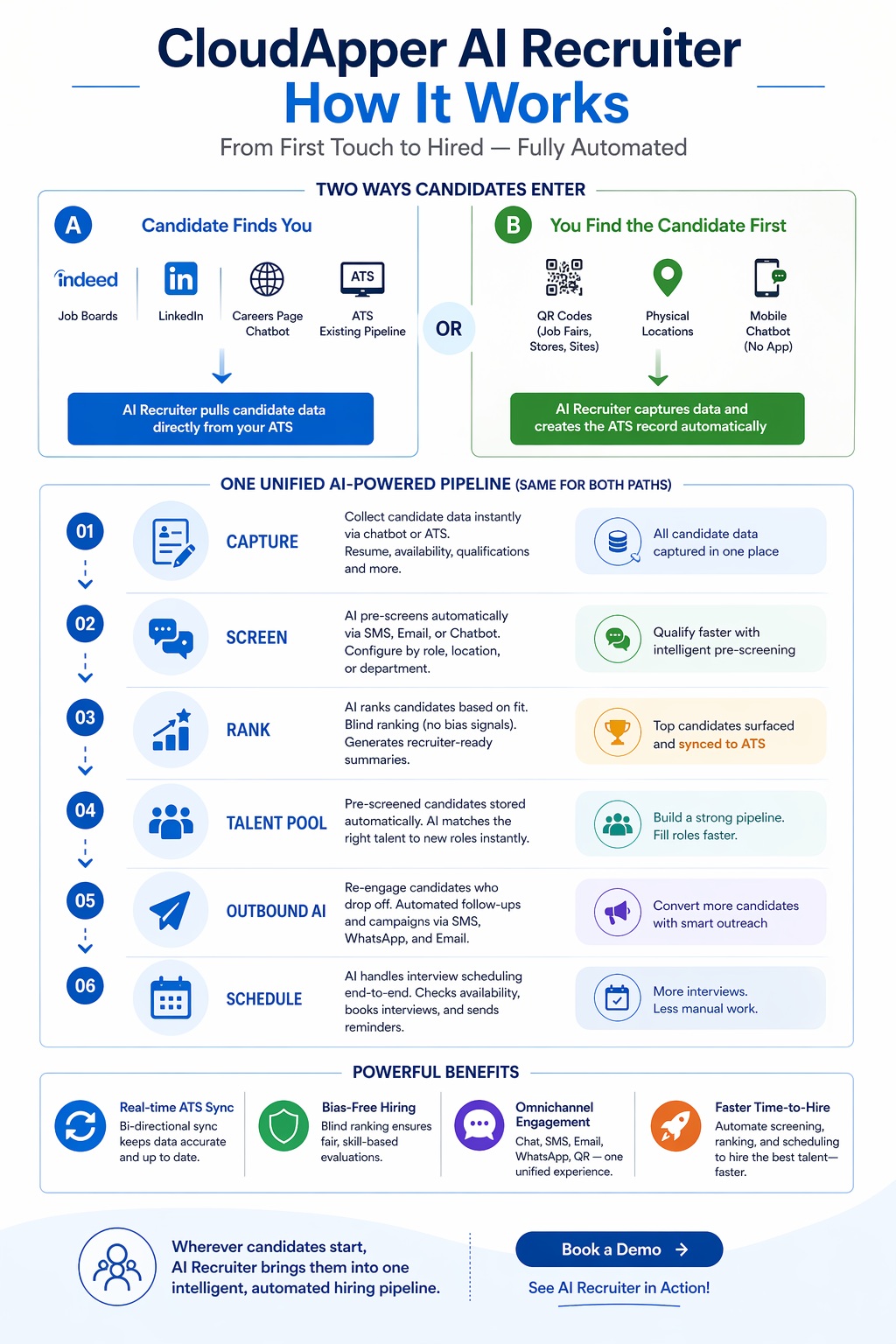
Here’s how the pipeline actually works.
Capturing candidates from every entry point
The first thing AI Recruiter solves is the entry point problem. Candidates don’t have to find your job posting on a job board. If a candidate applies through Indeed, LinkedIn, or any job board, their data flows into your ATS — and AI Recruiter pulls it from there and starts working.
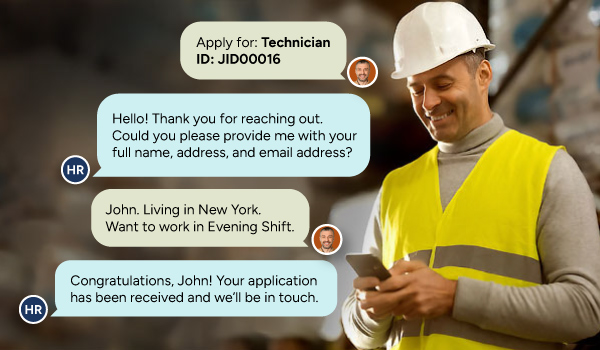
But for frontline and hourly hiring, there’s a second path that’s often more powerful. A QR code on a sign at a job fair, on a poster at a store, or at a physical worksite can open a conversational chatbot directly in a candidate’s mobile browser. No app to download. No account to create. No long form to fill out. The AI walks them through the application, collects whatever information your team needs — including resume uploads — answers their questions, and creates the candidate record in your ATS directly.
This matters a lot for the kinds of roles where drop-off is highest. An hourly candidate who sees a sign at a grocery store and scans a QR code is ready to engage right now. If the experience takes more than a few minutes or requires downloading an app, they’re gone. A conversational chatbot that opens instantly in their phone browser removes every barrier between interest and application.
The same chatbot can live on your careers page, giving web-based applicants the same frictionless experience — applying, asking questions, and getting answers in real time, without ever navigating away from your site.
Pre-screening that actually happens — automatically
This is where most ATS-based processes fall apart. The candidate is in the system. But who sends the screening questions? When? With what cadence?
AI Recruiter solves this by triggering a pre-screening workflow automatically — either during the initial chatbot conversation or immediately after the ATS record is created. The candidate receives an SMS and/or email with a link that opens a screening chatbot. The AI asks personalized or pre-set questions that your team defines — tailored by role, location, department, or whatever criteria matters most to you.
The questions themselves can be whatever you need. Certification verification. Availability and shift preferences. Years of relevant experience. Specific compliance checks. The AI collects the answers, keeps the conversation natural, and doesn’t require the candidate to navigate a clunky form. Research consistently shows that candidates are increasingly comfortable interacting with AI chatbots during the hiring process, especially for high-volume roles where speed matters more than ceremony.
One important note: the full screening can technically happen over SMS, but in practice, opening a chatbot link is more practical and allows for richer conversations. That’s the workflow most organizations end up using.
Blind ranking and AI-generated summaries pushed back into the ATS
Once the AI has collected everything it needs about a candidate, it doesn’t just sit on that data. It does two things that directly reduce recruiter workload.
First, it scores and ranks candidates against your defined criteria — blind to demographic information. The ranking is based on skills, experience, availability, and fit, not on name, gender, or any attribute unrelated to the job. SHRM has noted that AI-assisted screening, when implemented with fairness in mind, can reduce human bias in ways that manual review at scale simply can’t achieve — a human reviewing 200 resumes under time pressure is not reviewing all 200 with equal rigor.
Second, it generates a plain-language summary of each candidate and pushes both the score and the summary back into your ATS. When a recruiter opens the record, they don’t have to read a transcript of a screening conversation. They see a concise summary — four or five sentences — and a score relative to the rest of the pool. The shortlisting decision takes seconds instead of hours.
The talent pool that works while you sleep
One of the most underused concepts in recruiting is the talent pool — a running database of pre-screened, qualified candidates who didn’t quite match a role when they applied but are still great candidates for future openings.
AI Recruiter’s talent pool feature does this automatically. When a new requisition opens, the AI scans the existing pool and surfaces the highest-scoring candidates who match the role, location, and requirements. For high-volume positions in retail, healthcare support, logistics, or manufacturing, this means you may already have qualified candidates ready to move — without posting, sourcing, or starting the screening process over.
This is especially valuable for organizations with seasonal hiring cycles or ongoing backfill needs. The candidates who went through your pipeline six weeks ago — pre-screened, ranked, and summarized — are still there. The AI brings them back to the surface the moment they’re relevant again.
Outbound AI that acts like your best recruiter — at scale
Strong candidates go quiet for all kinds of reasons. Life gets in the way. They got busy. They assumed you weren’t interested. Whatever the reason, the result is the same: a qualified candidate who expressed real interest is now lost to inaction.
AI Recruiter’s outbound agent handles this automatically. It identifies candidates who entered the pipeline but didn’t complete the process, or high-scoring candidates who stopped responding, and sends a personalized follow-up message — through SMS, email, or WhatsApp — at a cadence your team sets.
The message isn’t generic. It references the specific role, acknowledges where the candidate left off, and makes it easy to pick up right where they stopped. For candidates who scanned a QR code at a job fair but didn’t finish, the AI can reach out hours later while the experience is still fresh.
You can also run proactive outbound campaigns — similar to how a sales team pursues prospects — to engage candidates in your talent pool or from external lists. This is particularly effective for filling roles where inbound applications alone aren’t sufficient.
Interview scheduling — the bottleneck that finally gets solved
Ask any recruiter what eats the most time and causes the most frustration, and interview scheduling comes up almost immediately. As SHRM has documented, interview scheduling is a universal pain point — people’s calendars are out of date, interviewers cancel and reschedule constantly, and someone has to absorb all of that chaos while keeping the candidate’s experience intact.
Interview scheduling consumes 38% of total recruiter time — more than sourcing, screening, or any other single activity. The bottlenecks are predictable: delays, limited interviewer availability, cancellations, and calendar conflicts all pile up. Companies using AI-driven scheduling are 1.6 times more likely to achieve their hiring goals.
AI Recruiter handles the entire scheduling process end-to-end. Once a candidate is ready to interview, the AI checks the hiring manager’s real-time availability, presents the candidate with open slots through a conversational message, confirms the chosen time, and sends calendar invites and a video link to all parties. If a reschedule is needed, the AI handles it — no recruiter involved.
Before the interview, the AI sends reminders to both the candidate and the interviewer. After the interview, it can prompt follow-up steps. The scheduling burden that used to eat a full day of recruiter time happens in minutes, automatically.
This Isn’t About Replacing Recruiters
It’s worth saying directly, because this concern comes up every time AI recruiting tools are discussed: the goal isn’t to remove the human from hiring. It’s to remove the parts of hiring that don’t require a human.
Screening 180 resumes manually doesn’t require human judgment. Sending follow-up messages to candidates who went quiet doesn’t require human creativity. Finding a time slot that works for three people’s calendars doesn’t require relationship skills. These are coordination and logistics tasks — important, but not where your recruiter’s judgment and experience create the most value.
According to SHRM, 85% of employers who use automation or AI in talent acquisition say it saves them time and increases efficiency. The experienced recruiters who get their administrative burden reduced are the ones who can focus on what actually requires their skills: building relationships with candidates, working closely with hiring managers, understanding the nuances of what each team really needs, and making the final call on difficult hiring decisions.
Studies show that companies which adopted recruiting automation filled 64% more jobs and submitted 33% more candidates per recruiter compared to those that didn’t. That’s not a sign that automation replaced recruiters — it’s a sign that automation made each recruiter more capable.
Frequently Asked Questions About AI Recruiting Automation
Does AI Recruiter replace our ATS?
No — and this is an important distinction. AI Recruiter is designed to work with your existing ATS, not replace it. Your ATS remains your system of record. AI Recruiter is the system of action that operates alongside it, pulling candidate data from the ATS and pushing scores, summaries, and updated statuses back in. Your HCM platform — whether it’s Workday, Dayforce, UKG, or another system — stays the single source of truth.
How does AI recruiting handle bias in screening?
CloudApper AI Recruiter uses blind ranking — scoring candidates on skills, experience, and role-specific criteria while excluding demographic information from the ranking model. This doesn’t eliminate bias entirely (no system does), but it removes a significant source of it that exists in manual review at scale. As SHRM has noted, when AI is implemented with fairness in mind, it can make hiring more consistent and objective than purely human review under high-volume pressure.
What if candidates aren’t comfortable with AI screening?
Research consistently shows that more than half of candidates are comfortable interacting with AI chatbots during the hiring process, particularly for frontline and hourly roles where speed of response matters most. The key is transparency — candidates should know they’re interacting with an AI and understand what it’s collecting and why. Well-designed conversational AI also creates a better candidate experience than being left in silence for a week.
Can AI Recruiter handle high-volume hiring for seasonal or hourly roles?
That’s actually where it performs best. For roles where you’re receiving dozens or hundreds of applications and need to screen, rank, and schedule quickly — warehouse, retail, healthcare support, hospitality, manufacturing — AI Recruiter is built for that volume. The QR code entry point, in particular, is designed for exactly this use case: getting candidates into the pipeline from physical locations, without requiring them to navigate a job board.
How does interview scheduling automation work in practice?
Once a candidate reaches the interview stage, the AI checks your hiring managers’ real-time calendar availability, sends the candidate a conversational message with available slots, confirms their choice, and sends calendar invites to everyone. No back-and-forth emails. No scheduling coordinator. No missed reschedules. A Phenom study found that 80% of organizations using AI tools to schedule interviews saved 36% of their time compared to those doing it manually.
The Real Question Isn’t Whether You Need This — It’s How Long You Can Afford to Wait
Every week your pipeline sits in the ATS without being acted on is a week where qualified candidates are deciding you’re not interested. Every screening task done manually is time your recruiters could spend on work that actually requires their judgment. Every interview scheduling thread is a coordination tax that compounds across every open role.
In a hiring environment where 60% of companies reported an increase in their time-to-hire and 27% of talent acquisition leaders say their teams face unmanageable workloads, the manual approach to recruiting isn’t just inefficient — it’s unsustainable.
The ATS is not going anywhere. It’s good at what it does. But what it does — storing, organizing, tracking — is only half of what hiring actually requires. The other half is action: reaching out, screening, ranking, matching, nudging, scheduling. That’s the half that’s been left to human bandwidth for too long.
CloudApper AI Recruiter exists to handle that half — automatically, consistently, and in sync with the ATS and HCM platforms your team already uses. Not as a replacement for your recruiters. As the thing that finally lets them do what they’re actually good at.
Ready to see how AI Recruiter connects to your ATS and moves candidates from first touch to booked interview — without adding to your team’s workload? Talk to a CloudApper expert and we’ll walk you through exactly how it works in your environment.

What is CloudApper AI Platform?
CloudApper AI is an advanced platform that enables organizations to integrate AI into their existing enterprise systems effortlessly, without the need for technical expertise, costly development, or upgrading the underlying infrastructure. By transforming legacy systems into AI-capable solutions, CloudApper allows companies to harness the power of Generative AI quickly and efficiently. This approach has been successfully implemented with leading systems like UKG, Workday, Oracle, Paradox, Amazon AWS Bedrock and can be applied across various industries, helping businesses enhance productivity, automate processes, and gain deeper insights without the usual complexities. With CloudApper AI, you can start experiencing the transformative benefits of AI today. Learn More
- Useful Links:
- Agentic AI
- No-Code/Low-Code
- Custom Software
- HCM Personalization
- iPaaS
- FedRAMP
CloudApper AI Solutions for HR

- Works with








- and more.
Similar Posts

Hiring During ATS Migration: How to Keep Your First Round…

Hiring Freeze? How to Keep Qualified Candidates Engaged Until the…