Most enterprise leaders aren't afraid of AI — they're afraid of what happens to their data when they use it. CloudApper's AI platform addresses that fear directly: regional data residency, AES-256 encryption, SOC 2 audits, and a no-code environment your teams actually control.
Table of Contents
- What Do Enterprise Decision-Makers Actually Worry About?
- How CloudApper Answers Them — Technically
- Beyond HR: CloudApper as an Enterprise Personalization Platform
- The Shadow AI Problem
Enterprise AI can be secure, but only when the AI platform for building secure enterprise applications treats data protection as part of the architecture rather than a policy added later. Most enterprise leaders aren’t afraid of AI itself. They are afraid of what happens to payroll, customer records and contracts once AI systems can touch them.
That fear is reasonable. IBM’s 2023 Cost of a Data Breach Report put the average breach at $4.45 million. So the real decision is how to adopt AI without opening a new attack surface. CloudApper was designed around that question, and the sections below cover what decision-makers should check before signing with any vendor.
What Do Enterprise Decision-Makers Actually Worry About?
When a CTO or CISO evaluates an AI platform, they’re not thinking about features. They’re thinking about liability.
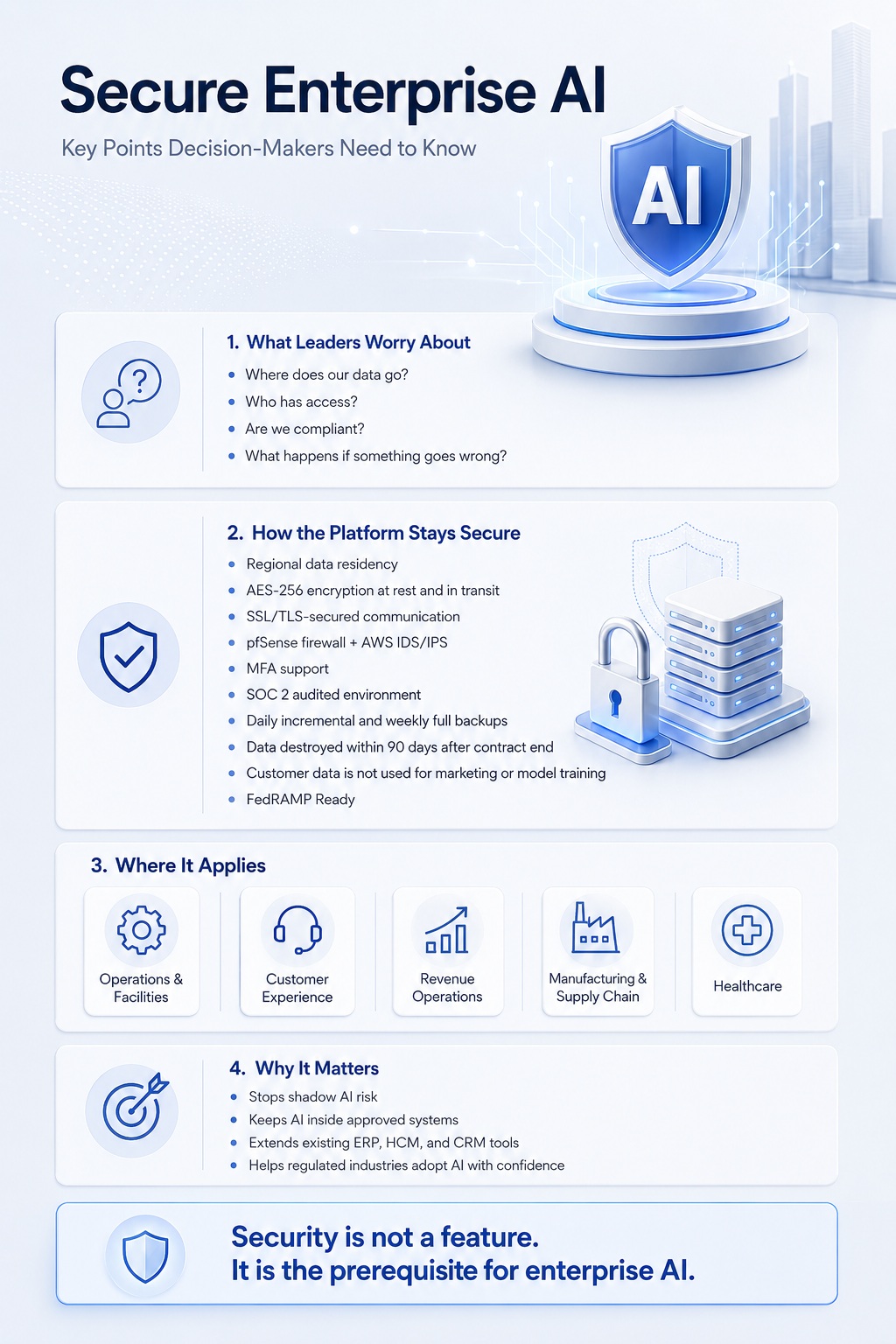
Where does our data go? Is it leaving our region? Is it being used to train someone else’s model?

Who has access? Can employees see data they shouldn’t? What happens when someone gets terminated?
Are we compliant? HIPAA, SOC 2, FedRAMP, GDPR — depending on the industry, any one of these can kill a vendor relationship before it starts.
What if something goes wrong? Breach notification timelines. Recovery procedures. Audit trails.
These are the real questions. Everything else is secondary.
How CloudApper Answers Them — Technically
CloudApper’s security posture isn’t aspirational. The specifics matter here.
Data storage and residency: Customer data stays in regional cloud environments. A given customer’s data lives only in the data center and AWS region local to that customer — it doesn’t flow outside that boundary. For organizations with strict data residency requirements (common in healthcare, finance, and government), this isn’t a nice-to-have. It’s a dealbreaker if it’s missing.
Encryption: All data is encrypted using AES-256 both in transit and at rest. All communication runs over SSL/TLS. AES-256 is the same standard used by financial institutions and government agencies.
Network security: The platform uses pfSense firewall combined with Amazon AWS IDS/IPS services — layered protection that covers both the perimeter and active threat detection.
Multi-Factor Authentication: MFA is supported natively through Google Authenticator or Microsoft Authenticator, which matters for organizations with strict identity management policies.
SOC 2 compliance: The hosting environment has been independently audited. SOC 2 reports are available for customers who need to verify controls before procurement.
Backup and recovery: Incremental daily backups via AWS RDS, full weekly backups. Data is retained for the life of the subscription and destroyed within 90 days of contract termination.
One important thing: CloudApper does not use customer data for marketing or any other purpose outside the contracted service. That’s explicit. It matters, especially as enterprise buyers get savvier about how AI vendors monetize their platforms.
The platform is also FedRAMP Ready, which means organizations building toward federal government contracts — or already serving them — can inherit compliance rather than building it from scratch.
Beyond HR: CloudApper as an Enterprise Personalization Platform
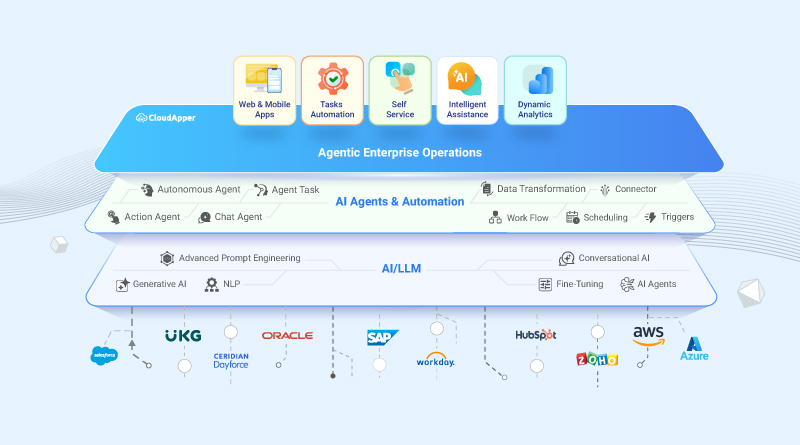
One reason CloudApper often gets pigeonholed as an HR tool is because HR is where the pain is most visible. But the underlying platform does something broader: it lets enterprises extend, personalize, and augment any enterprise system with AI — without replacing what’s already working.
Think of it as a secure layer that sits on top of your existing infrastructure and fills the gaps your ERP, CRM, or HCM can’t fill on their own.
Here’s what that looks like across different functions:
Operations and Facilities
Facility managers deal with asset tracking, maintenance scheduling, vendor management, and compliance documentation — all of which generate data that most enterprise systems handle poorly. CloudApper’s Facility Management and CMMS applications let teams build and automate workflows specific to their sites, without waiting on IT or customizing core ERP. The same platform handles Asset Tracking and Fleet Management, with all data staying inside the organization’s regional environment.
Customer Experience
When customers interact with AI, they’re sharing data — queries, preferences, purchase history, sometimes personal details. That data needs to be handled carefully. CloudApper’s Customer Experience agents are built on the same secure infrastructure as every other CloudApper product. There’s no separate data environment for customer-facing AI. Security isn’t optional for external tools.
Revenue Operations
Sales and marketing teams often run the most patchwork tech stacks in any organization — a CRM here, an email tool there, spreadsheets filling the gaps. CloudApper’s Revenue Operations solution brings AI into that environment without requiring a platform overhaul. Data stays integrated, workflows stay consistent, and sensitive pipeline data doesn’t leak to third-party AI systems.
Manufacturing and Supply Chain
In manufacturing, operational data is often the most sensitive data a company owns. Machine performance records, supplier contracts, production schedules — this is proprietary. CloudApper’s Manufacturing AI agents are designed to work within existing systems rather than extract data into new environments.
Healthcare
Healthcare has its own compliance layer on top of everything else. CloudApper offers HIPAA-ready compliance software for organizations that can’t afford to treat compliance as an afterthought. The platform supports clinical workflows, hospital rounding, EMR data management, and incident tracking — all with the same underlying security architecture.
The Shadow AI Problem
There’s a conversation happening in most enterprises right now that security teams hate: employees finding AI tools on their own.
Someone needs a faster way to summarize contracts. They use a free AI tool. Nobody asked if that tool stores data. Nobody checked where the servers are. Nobody considered whether that contract summary just trained someone else’s model.
This is Shadow AI, and it’s genuinely difficult to stop by telling people “no.” They’ll find another tool.
The better approach — and what CloudApper enables — is giving people a sanctioned, secure alternative that actually works. A no-code platform where teams can build the AI-powered workflows they need, within an environment the organization controls. When the tool is good enough, the workaround disappears.
CloudApper’s enterprise AI platform is built on this logic: secure by design, accessible by anyone on the team, and integrated with existing systems so data doesn’t need to leave the organization to be useful.
Frequently Asked Questions
Is CloudApper’s AI platform SOC 2 compliant?
Yes. The CloudApper hosting environment has been independently audited, and SOC 2 reports are available to customers on request.
Does CloudApper support FedRAMP requirements?
CloudApper is FedRAMP Ready, which allows organizations building federal-facing solutions to inherit compliance controls rather than pursuing authorization from scratch.
Where is CloudApper customer data stored?
Data is stored in the data center and AWS region local to each customer. It does not flow outside the customer’s geographic region.
Does CloudApper use customer data for AI training?
No. Customer data is used exclusively for delivering the contracted service. It is not used for marketing, model training, or any other purpose.
What encryption does CloudApper use?
AES-256 encryption at rest and in transit, with all communication secured over SSL/TLS.
Can CloudApper integrate with existing enterprise systems?
Yes. CloudApper’s iPaaS integration platform connects with ERP, HCM, CRM, and other enterprise systems, enabling AI augmentation without replacing existing infrastructure.
What happens to data after a contract ends?
Data is retained for the duration of the subscription and destroyed within 90 days of contract termination.
Does CloudApper support MFA?
Yes. Multi-Factor Authentication is supported via Google Authenticator and Microsoft Authenticator.
Why This Matters for Regulated Industries
The industries with the most to gain from enterprise AI are often the ones with the least tolerance for security shortcuts.
Healthcare organizations face HIPAA. Financial institutions face SOC 2 and banking regulators. Government contractors face FedRAMP. Manufacturers protecting IP face industrial espionage risks that don’t make headlines but cost real money.
For these organizations, the question isn’t just “is your AI useful?” It’s “can we trust this platform with our most sensitive data?”
CloudApper’s architecture — regional data residency, AES-256 encryption, SOC 2 audits, FedRAMP readiness, MFA support, no data use outside the contracted service — was built to answer that question directly.
The software personalization angle matters here too. Most enterprise buyers don’t want to replace their core systems. They’ve spent years and significant capital on their ERP, their HCM, their CRM. What they want is to make those systems smarter without compromising what already works. CloudApper does that — it layers AI capability onto existing infrastructure rather than requiring a rip-and-replace.
The Real Question
Security in enterprise AI isn’t a feature. It’s a prerequisite.
Any platform that treats encryption as a selling point rather than a baseline probably isn’t ready for enterprise use. The bar is AES-256 at rest, regional data residency, independent compliance audits, and explicit policies about how customer data is used.
CloudApper clears that bar — and builds on it with a no-code platform that makes secure AI accessible to every team in the organization, not just the ones with developers.
If your organization is evaluating AI platforms and security is the first conversation, that’s the right conversation to have. The technical answers are documented. The compliance posture is auditable. The platform is ready.
Explore CloudApper’s enterprise AI solutions or learn more about the AI platform powering secure application development across industries.

What is CloudApper AI Platform?
CloudApper AI is an advanced platform that enables organizations to integrate AI into their existing enterprise systems effortlessly, without the need for technical expertise, costly development, or upgrading the underlying infrastructure. By transforming legacy systems into AI-capable solutions, CloudApper allows companies to harness the power of Generative AI quickly and efficiently. This approach has been successfully implemented with leading systems like UKG, Workday, Oracle, Paradox, Amazon AWS Bedrock and can be applied across various industries, helping businesses enhance productivity, automate processes, and gain deeper insights without the usual complexities. With CloudApper AI, you can start experiencing the transformative benefits of AI today. Learn More
- Useful Links:
- Agentic AI
- No-Code/Low-Code
- Custom Software
- HCM Personalization
- iPaaS
- FedRAMP
CloudApper AI Solutions

- Works with







- and more.
Similar Posts

CMMC Level 2 and Internally Built Applications: The Evidence Gap…

Vendor-Built Internal Applications: The Governance Gap Enterprise IT Inherited From…