HIPAA auditors aren't evaluating your AI tools in a vacuum. They're asking whether the code those tools produced — code that now runs in your systems, touches your databases, processes your patient data — was ever reviewed for security vulnerabilities. For most teams using raw AI coding tools, the answer is no.

Table of Contents
- What HIPAA Actually Requires From Your Software
- The Specific Problem With Copilot in Healthcare Environments
- Why This Gets Harder as You Build More Apps
- What a Governance-First Architecture Actually Looks Like
- The Maintenance Problem Nobody Mentions
- Shadow AI: The Compliance Problem You Can’t Solve With a Policy
- What About Developers Who Want to Write Their Own Code?
- Before Your Next HIPAA Audit: Questions Worth Asking
- A Note on FedRAMP and Multi-Framework Compliance
- The Bottom Line
- Talk to CloudApper About Your AI Coding Compliance Requirements
Most healthcare IT teams adopt GitHub Copilot the same way they adopt most developer tools — a few engineers start using it, productivity goes up, and before long it’s just part of the workflow. Nobody files a compliance assessment. Nobody asks the security team. It’s just a coding assistant, right?
That assumption gets expensive around audit time.

HIPAA auditors aren’t evaluating your AI tools in a vacuum. They’re asking whether the code those tools produced — code that now runs in your systems, touches your databases, processes your patient data — was ever reviewed for security vulnerabilities. And the honest answer, for most teams using raw AI coding tools, is no.
This isn’t a hypothetical problem. It’s a documentation gap that can turn a routine audit into a findings report. It’s also the gap that CloudApper was built to close — by replacing the raw, unreviewed source code that tools like Copilot generate with governed application blueprints that inherit compliance controls at the platform level, rather than requiring per-app security reviews that most healthcare IT teams don’t have the capacity to run consistently.
What HIPAA Actually Requires From Your Software
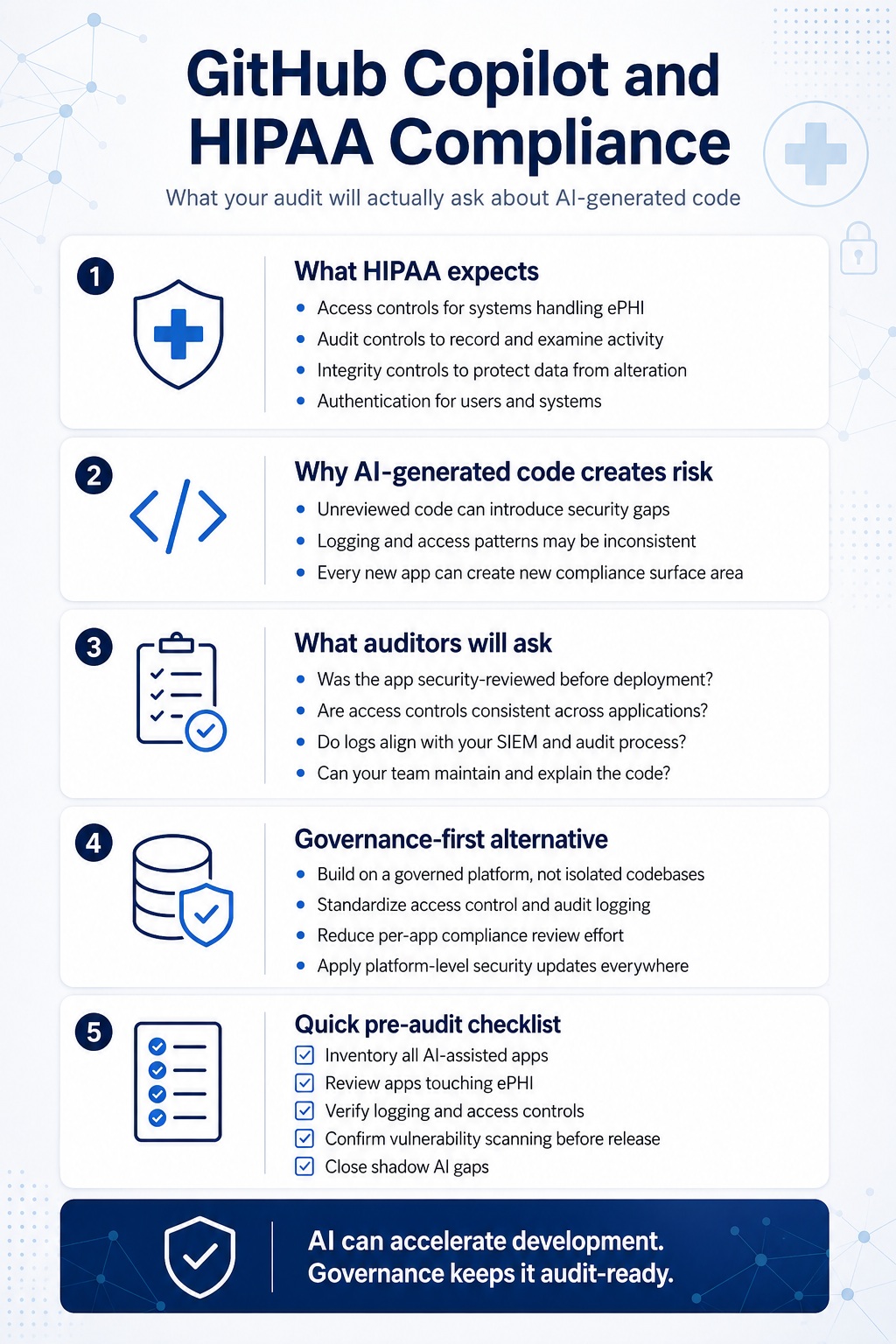
HIPAA’s Security Rule doesn’t mention AI coding tools by name, but it doesn’t need to. The relevant requirements come down to a few core obligations:
Access controls 164.312(a)(1): Systems that create, store, or transmit ePHI must have documented, enforced access controls. If an AI tool generated your data access layer, and no one reviewed what access rules it created, you have a gap.
Audit controls 164.312(b): You need mechanisms to record and examine system activity. AI-generated code frequently creates its own logging patterns — patterns that may not align with your centralized audit architecture.
Integrity controls 164.312(c)(1): ePHI must be protected from improper alteration or destruction. Code you didn’t write and don’t fully understand is difficult to assert control over.
Person or entity authentication 164.312(d): Any system handling ePHI needs verifiable authentication. AI-generated auth logic is a known vulnerability surface.
None of these requirements say “don’t use AI.” But they do require that you can demonstrate control over whatever code runs in your environment. That’s where most GitHub Copilot deployments run into trouble.
The Specific Problem With Copilot in Healthcare Environments
GitHub Copilot generates raw source code. That code gets reviewed (sometimes thoroughly, sometimes not), gets committed, and eventually gets deployed. From that point forward, your team owns it — including every vulnerability, every access control mistake, and every compliance gap it contains.
Research from academic and security sources has documented AI-generated code vulnerability rates in the 40–45% range for common weakness categories. That’s not a reason to avoid AI coding tools. It is a reason to think carefully about where unreviewed AI-generated code ends up.
In healthcare specifically, the problem has two layers:
Layer 1: The code itself: AI tools like Copilot produce black-box output. The logic is plausible, it usually compiles, and it often passes unit tests. It may also contain injection vulnerabilities, insecure data handling patterns, or authentication flaws that only surface under adversarial conditions — or during an audit.
Layer 2: What the code creates: When an AI tool generates a new internal application, it typically creates a new database schema, its own data access rules, and its own logging behavior. In an enterprise with 10 or 20 AI-generated apps, you now have 10 or 20 separate data governance configurations. Each one needs to be audited individually. Each one is a potential HIPAA finding.
This is what auditors mean when they ask about your “data governance posture.” They’re not asking whether you have a policy. They’re asking whether your systems actually enforce it — consistently, across every application. Healthcare organizations using CloudApper answer that question from a fundamentally different position: because every application built on the platform inherits the same access control model, the same audit logging format, and the same data governance layer, the auditor isn’t reviewing twenty separate configurations. They’re reviewing one platform — one that is already SOC 2 audited, FedRAMP Ready, and built with HIPAA-specific controls including AES-256 encryption and regional data residency.
Why This Gets Harder as You Build More Apps
One AI-generated internal app is manageable. Your team can review it, document the access controls, verify the logging aligns with your SIEM, and add it to your asset inventory.
Twenty apps built over 18 months by three different developer teams using Copilot, Cursor, and a few other tools? That’s a different situation entirely.
At that point, you don’t have a software problem. You have a governance problem. And governance problems are exactly what HIPAA auditors are trained to find.
The fragmentation compounds: each app may store data differently, authenticate users differently, and generate audit logs in different formats. There’s no uniform baseline. Every security review starts from scratch. Every new deployment is another compliance surface to manage. This is precisely the problem CloudApper‘s platform architecture eliminates — not by slowing development down, but by ensuring that every new application, regardless of when it was built or which team built it, runs on the same certified runtime with the same inherited compliance posture. Scaling from one app to twenty doesn’t multiply the audit surface. It doesn’t have to.
What a Governance-First Architecture Actually Looks Like
The alternative isn’t to slow down development. It’s to change what the AI is generating.
Instead of producing raw source code, a platform designed for enterprise compliance produces a structured application definition — a governed configuration that runs on a pre-certified runtime. The applications inherit their security posture from the platform, not from whatever the AI happened to generate that day.
This is what CloudApper’s architecture does. Rather than generating black-box source code, the platform produces JSON-based app blueprints that execute on a certified application server. Every application built on the platform automatically inherits the same access control model, the same data governance layer, the same audit logging format, and the same compliance controls.
For a healthcare organization preparing for a HIPAA audit, this means:
- New applications don’t create new compliance surface area
- Access controls are uniform across all applications, not configured per-app
- Audit logs flow into your existing security infrastructure in a consistent format
- Security reviews happen at the platform level, not for each individual app
The CloudApper AI platform runs on infrastructure that is SOC 2 audited, FedRAMP Ready, and built with HIPAA-specific controls in mind — including AES-256 encryption, regional data residency (your data stays in your AWS region), and MFA support across all applications.
The Maintenance Problem Nobody Mentions
There’s a second cost to raw AI-generated code that shows up after the audit: ongoing maintenance.
Code that a developer didn’t write is code they don’t fully understand. When something breaks — and it will break — debugging starts from zero. When a dependency updates and introduces a vulnerability, someone has to trace back through AI-generated logic to understand the exposure. When your compliance requirements change, you’re editing code that was written by a statistical model optimizing for “plausible output,” not for your specific regulatory environment.
CloudApper’s architecture sidesteps this. Because applications run on a governed runtime rather than as standalone codebases, platform-level updates propagate to all applications. A security patch to the runtime applies everywhere, automatically. There are no isolated legacy apps accumulating technical debt in a corner of your environment.
This also matters for team continuity. Healthcare organizations with 10–30 developers frequently deal with turnover. When a developer leaves and takes their understanding of AI-generated code with them, the maintenance burden falls on whoever inherits it. A platform-based approach keeps the knowledge at the infrastructure level rather than in individual developers’ heads.
You can read more about how this affects development workflows in CloudApper’s piece on how AI DevAgents are minimizing friction in the software development lifecycle.
Shadow AI: The Compliance Problem You Can’t Solve With a Policy
There’s a version of this problem that doesn’t involve official tooling at all. Developers use whatever tools help them work faster. If your organization hasn’t sanctioned a specific AI coding platform, they’re using whatever they found — and probably not telling anyone.
This is the Shadow AI problem, and it’s worse than it sounds in a regulated environment. A developer who uses an unsanctioned AI tool to generate a data access module has introduced code with an unknown security profile into a system that processes PHI. The tool may not have appropriate data handling terms. The generated code has never been reviewed against your security baseline. It doesn’t exist in your asset inventory.
The answer here isn’t more restrictions. It’s giving developers a sanctioned, high-productivity alternative that actually works within your compliance requirements. CloudApper’s recent article on whether enterprise AI can be truly secure covers this dynamic in detail — the organizations that successfully manage AI risk aren’t the ones that ban tools, they’re the ones that provide better alternatives.
What About Developers Who Want to Write Their Own Code?
Not everything can or should be built on a governed platform. Some applications require custom logic, specialized integrations, or performance characteristics that a configuration-based approach can’t deliver.
CloudApper accounts for this with a hybrid model: developers can write native code modules that bolt onto the platform’s existing data and security layers. The custom code runs on top of the established security infrastructure rather than replacing it. It inherits access controls and audit logging from the platform. It doesn’t create a parallel governance track.
This matters for healthcare organizations where clinical workflow applications sometimes have genuinely unique requirements. The option to extend the platform without compromising its compliance posture is the difference between a governance layer that developers work around versus one they actually use.
See how CloudApper’s DevOps automation capabilities support development teams without adding compliance overhead.
Before Your Next HIPAA Audit: Questions Worth Asking
If your organization is using GitHub Copilot, Cursor, or similar tools to build internal applications, a few questions are worth going through before your auditors do:
On the code:
- Can you trace every application touching ePHI back to a documented security review?
- Does AI-generated code in your environment have a consistent vulnerability scanning process before deployment?
- Are the access control patterns in AI-generated applications consistent with your organization’s access control policy?
On data governance:
- Do all applications storing or accessing ePHI use the same data access architecture?
- Can you produce a current inventory of every database schema created by AI-generated applications in the last 24 months?
On audit logging:
- Do AI-generated applications write logs in a format compatible with your SIEM?
- Are audit trails from these applications complete enough to satisfy HIPAA’s audit control requirements?
On maintenance:
- If a developer who built an AI-assisted application leaves, can another team member maintain it without reverse-engineering the logic?
- Do your incident response procedures account for vulnerabilities in AI-generated code?
If several of these are unclear, that’s not unusual — most healthcare IT teams that have adopted AI coding tools haven’t worked through the compliance implications systematically. But it’s worth doing before your auditors get there first.
A Note on FedRAMP and Multi-Framework Compliance
Healthcare organizations that also work with government payers, federal programs, or government health agencies often face overlapping compliance requirements: HIPAA plus FedRAMP, or HIPAA plus FIPS 140-2 cryptographic standards.
Raw AI-generated code doesn’t inherit any compliance certification. A platform built with these requirements in mind does. CloudApper’s FedRAMP Ready AI platform is specifically designed for organizations navigating multi-framework compliance, with controls that satisfy requirements across HIPAA, CCPA, FERPA, GDPR, and FedRAMP from a single infrastructure baseline.
For organizations dealing with overlapping audits and multiple compliance frameworks, the operational value of that shared baseline is significant — one set of controls to maintain, one security review process, one audit trail architecture.
The Bottom Line
GitHub Copilot is a useful tool. So is Cursor. So are a dozen other AI coding assistants. None of them are designed with enterprise compliance in mind, and using them in a HIPAA-regulated environment without a governance layer creates real audit exposure.
The question isn’t whether to use AI for application development — the speed advantages are too significant to ignore. The question is whether the AI is generating code that your compliance team can account for, or configuration-based applications that run on an already-certified platform.
That distinction matters a lot when someone from OCR is sitting across the table asking you to walk them through your software development process.
Talk to CloudApper About Your AI Coding Compliance Requirements
If your team is actively building internal applications with AI tools and you’re preparing for a HIPAA, SOC 2, or FedRAMP audit, CloudApper can walk you through how the platform addresses specific compliance requirements.
Schedule a conversation with the CloudApper team →
No pitch deck. Bring your actual audit requirements and we’ll show you specifically how the architecture maps to them. Healthcare and regulated industry teams only.

What is CloudApper AI Platform?
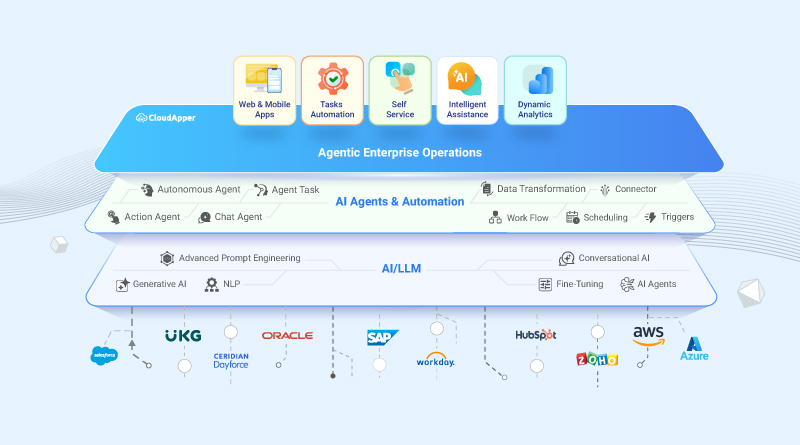
CloudApper AI is an advanced platform that enables organizations to integrate AI into their existing enterprise systems effortlessly, without the need for technical expertise, costly development, or upgrading the underlying infrastructure. By transforming legacy systems into AI-capable solutions, CloudApper allows companies to harness the power of Generative AI quickly and efficiently. This approach has been successfully implemented with leading systems like UKG, Workday, Oracle, Paradox, Amazon AWS Bedrock and can be applied across various industries, helping businesses enhance productivity, automate processes, and gain deeper insights without the usual complexities. With CloudApper AI, you can start experiencing the transformative benefits of AI today. Learn More
- Useful Links:
- Agentic AI
- No-Code/Low-Code
- Custom Software
- HCM Personalization
- iPaaS
- FedRAMP
CloudApper AI Solutions

- Works with








- and more.
Similar Posts

Legacy Modernization Transition: The Compliance Gap That Opens When Both…

Outsourced Legacy Systems: Why Vendor Exit Costs More Than the…