- Why Copilot-Specific Governance Is a Distinct Problem
- The Tradeoff Matrix
- What Most Enterprise Teams End Up Doing
- The Developer Workflow Question
- Practical Decisions Before Your Next Governance Review
- The Honest Assessment
- Talk to CloudApper About Your Copilot Governance Gaps
GitHub Copilot is embedded in most enterprise development environments at this point. The question stopped being “should we adopt it?” about two years ago. The question now — the one that CTOs and compliance teams are actually working through — is what governance needs to sit around it, and whether the options available are operationally realistic.
This article goes through the real options. Not a general argument for or against Copilot — that ship has sailed. A practical breakdown of what governance layers actually exist, what each one addresses, what each one leaves unresolved, and where the tradeoff decisions actually land for enterprise teams with compliance obligations.
Why Copilot-Specific Governance Is a Distinct Problem
Governing GitHub Copilot isn’t the same as governing a SaaS vendor or a piece of enterprise infrastructure. Copilot sits inside the development workflow — it’s active when developers write code, it influences what gets written, and its output becomes part of production systems that carry real security and compliance obligations.
That position in the workflow creates governance challenges that don’t map cleanly to standard IT governance categories.

It’s not a data vendor: Standard vendor governance focuses on how a vendor handles your data — retention, encryption, access controls. Copilot does handle your code as data, but the more significant governance question isn’t about that — it’s about the code it produces and what security characteristics that code carries into your environment.
It’s not a deployment tool: Change management governance covers what gets deployed and when. But Copilot influences code before it reaches change management. By the time an AI-generated application reaches your deployment pipeline, the security decisions embedded in it have already been made.
It’s not a standalone application: Copilot doesn’t have its own security boundary in your environment. It’s a capability layered on top of your development tools. Governing it requires governing the output it produces, not the tool itself in isolation.
This is why bolting standard governance frameworks onto Copilot tends not to work cleanly. You end up with governance that addresses the edges of the problem — the vendor relationship, the deployment step — without addressing the core of it: what the AI generates and whether that output meets your enterprise security standards.
Option 1: GitHub Copilot Enterprise Plan Controls
GitHub offers an Enterprise plan with additional controls designed for organizational governance. This is the first option most teams reach for, and it’s worth understanding clearly what it does and doesn’t address.
What the Enterprise plan provides:
Content exclusions: You can configure Copilot to exclude specific files, directories, or repositories from being used as code context. For organizations with particularly sensitive codebases — systems containing PHI, proprietary algorithms, or credentials — this reduces the surface area of code that Copilot processes.
Policy controls: Administrators can configure which Copilot features are available to which teams, enable or disable specific capabilities, and manage feature rollout across the organization.
Audit logs: The Enterprise plan provides audit logging for Copilot usage events — who used it, in which repositories, with what feature settings. These logs can be integrated into your security event management infrastructure.
IP indemnification: GitHub provides intellectual property protections for Enterprise customers against copyright claims related to Copilot-generated code.
What the Enterprise plan doesn’t address:
The Enterprise plan governs the tool — how it’s configured, how it’s accessed, what it processes. It doesn’t govern the output. Code that Copilot generates on the Enterprise plan carries the same vulnerability profile as code it generates on any other plan. The 40–45% vulnerability rate for common weakness categories applies regardless of which license tier you’re on.
For teams whose compliance obligations require documented evidence that AI-generated code meets specific security standards — HIPAA-aligned access control, SOC 2 control satisfaction, FedRAMP NIST 800-53 control mapping — the Enterprise plan’s governance controls don’t produce that evidence. They produce tool governance documentation, not application security documentation.
When it’s sufficient: Organizations with limited compliance requirements, mature code review processes capable of catching AI-generated vulnerability patterns, and development volumes low enough that per-application security review is operationally manageable.
When it’s not sufficient: Organizations with HIPAA, SOC 2 Type II, FedRAMP, or FIPS requirements, or those building multiple internal applications per month at a pace that outstrips security review capacity.
Option 2: Third-Party Static Analysis and SAST Integration
A common governance approach is to add static application security testing (SAST) tooling to the CI/CD pipeline to catch vulnerabilities in AI-generated code before it reaches production.
Tools like Semgrep, Checkmarx, Veracode, and Snyk can be configured to run on every commit, flag known vulnerability patterns, and block deployments that don’t meet defined security thresholds.
What SAST integration provides:
Known vulnerability detection: SAST tools are effective at catching well-documented vulnerability patterns — SQL injection, XSS, hardcoded credentials, insecure cryptographic functions. AI-generated code that contains these patterns will be flagged before deployment.
Consistent scanning: Running SAST on every commit ensures that no AI-generated code enters production without at least automated review. This addresses the “developer reviewed it quickly and missed something” scenario.
Compliance evidence: SAST scan results can be documented as part of your application security review evidence, supporting compliance arguments that code was assessed before deployment.
What SAST integration doesn’t address:
SAST tools catch known patterns. They’re significantly weaker on application-specific logic vulnerabilities — access control implementations that are technically correct but violate your organizational RBAC policy, data access patterns that don’t match your data governance requirements, logging implementations that don’t satisfy your audit trail requirements.
SAST also doesn’t address the architectural fragmentation problem. An AI-generated application that passes SAST scanning still has its own database, its own access control configuration, its own logging behavior. The scan confirmed there are no obvious code-level vulnerabilities. It said nothing about whether the application fits into your governance architecture.
For regulated environments, SAST scanning is necessary but not sufficient. It addresses one dimension of the governance problem while leaving others — data governance, access control consistency, audit trail architecture — unaddressed.
When it’s sufficient: Teams with well-defined security baselines, mature SAST tool configurations tuned for their specific vulnerability patterns, and separate governance processes for architectural and data governance requirements.
When it’s not sufficient: Teams where the governance gap includes architectural consistency and compliance boundary management, not just code-level vulnerability detection.
Option 3: Manual Security Review Processes
Some organizations address Copilot governance through enhanced manual security review — requiring that AI-assisted code go through dedicated security review before deployment, separate from standard peer review.
What enhanced manual review provides:
Deep understanding: A trained security reviewer can catch vulnerability classes that automated tools miss — subtle access control issues, logic flaws in authentication flows, data handling decisions that violate policy in non-obvious ways.
Compliance documentation: Manual review produces human-readable documentation that maps code decisions to specific compliance requirements — the kind of evidence that satisfies auditors asking for proof that security review occurred.
Organizational context: A reviewer with knowledge of your security baseline, your compliance requirements, and your data architecture can assess AI-generated code against your specific standards, not just generic vulnerability databases.
What manual review doesn’t address:
Scale. This is the fundamental limitation. AI-generated code can be produced faster than manual security review can process it. A team generating multiple internal applications per month, or using Copilot to accelerate a large codebase, will quickly find that the review queue creates a bottleneck that either slows development to pre-AI timelines or gets bypassed under delivery pressure.
Manual review also doesn’t resolve the architectural problem. Reviewed code that creates its own database, its own access control implementation, and its own logging behavior has passed review — but it still fragments your governance architecture.
When it’s sufficient: Teams with low application development volume, dedicated security review resources, and compliance requirements that can be satisfied by documented manual review evidence.
When it’s not sufficient: Teams operating at AI development pace, teams without dedicated security review capacity, or organizations where compliance requirements mandate structural controls rather than review documentation.
Option 4: Copilot Plus a Governed Runtime Platform
The fourth option takes a different approach to the problem. Rather than adding governance layers on top of Copilot, it separates the use cases: Copilot for code that doesn’t require compliance certification, a governed platform for applications that do.
The logic: GitHub Copilot is excellent at what it does — accelerating development of well-understood code in familiar patterns. It’s less suited to producing applications that need to satisfy specific compliance requirements out of the box. Using it for tasks where raw speed is the priority (library development, test writing, scripting, prototyping) and a governed platform for applications that carry compliance obligations allocates each tool to its natural strengths.
What this addresses:
Applications built on a governed platform — one where compliance controls are structural rather than per-application — don’t require the SAST scanning, manual review, and architectural governance work that Copilot-generated applications require. The compliance posture is inherited. The evidence documentation comes from the platform’s certifications, not from per-application review records.
This is where CloudApper’s AI platform fits into the Copilot conversation for enterprise teams. It’s not a Copilot replacement for all development work — it’s the answer to the specific problem Copilot creates in compliance-sensitive contexts.
When a development team uses CloudApper to build internal applications that handle regulated data — instead of building those applications in Copilot — the governance picture changes fundamentally. The application runs on a certified server. Access controls are platform-managed. Audit logging is consistent and SIEM-compatible. The compliance boundary documentation comes from the platform’s FedRAMP Ready, SOC 2 audited, and HIPAA-compliant certifications rather than from per-application security assessments.
Copilot keeps doing what it’s good at. The compliance-critical work goes through infrastructure designed for it.
There’s a useful framing of this in CloudApper’s analysis of enterprise vibe coding — the distinction between AI tools built for speed and AI platforms built for enterprise governance is exactly the tradeoff this option navigates. Copilot is the former. A governed development platform is the latter. Both have a place in a mature enterprise development environment.
When it’s sufficient: Most enterprise organizations with active compliance requirements. The separation of use cases is operationally realistic and aligns tool selection with requirements.
When to think carefully: If your development team’s entire workflow is currently built around Copilot and a parallel platform requires significant process change, the transition cost is worth evaluating honestly.
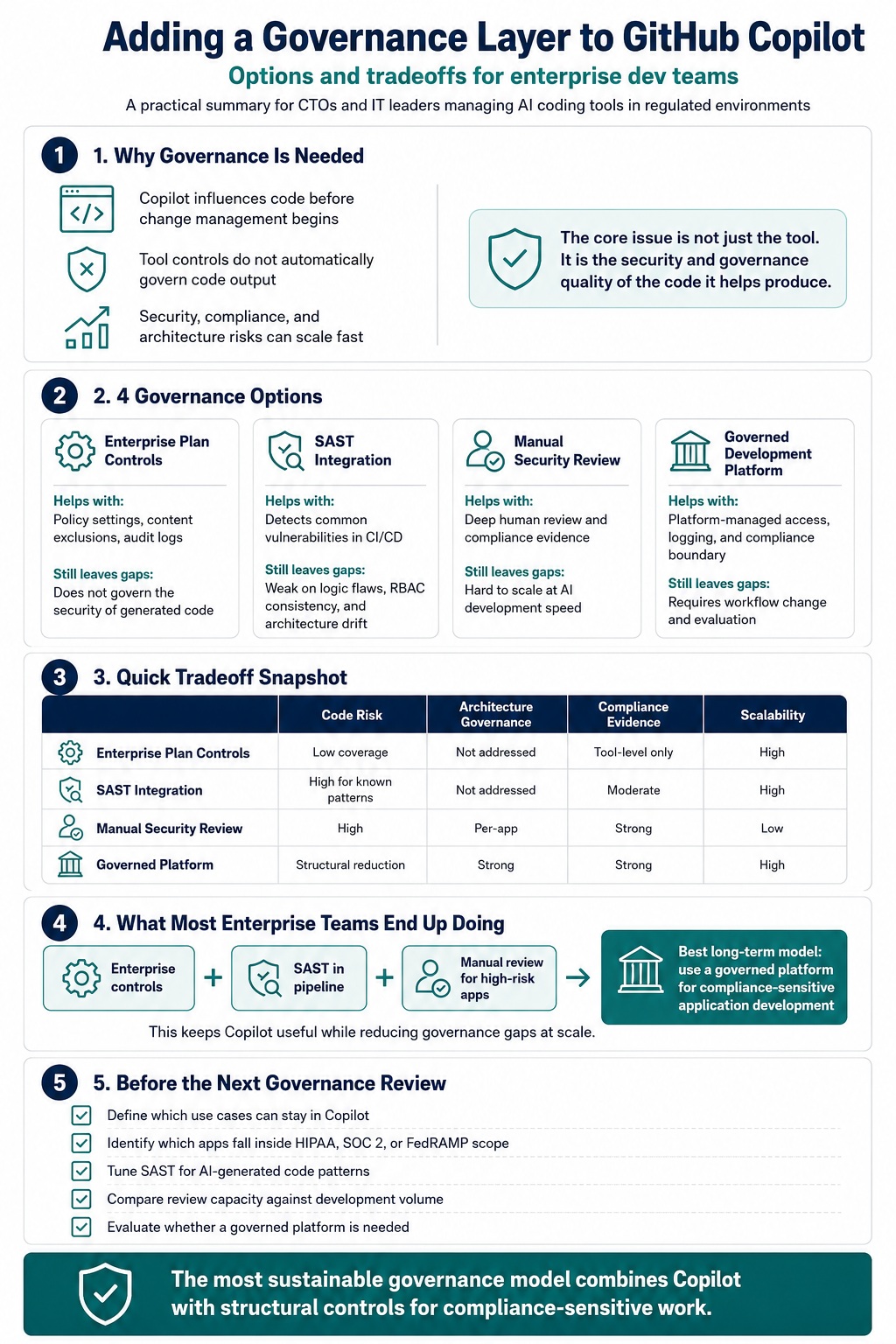
The Tradeoff Matrix
Here’s how the four options compare across the dimensions that actually matter for enterprise compliance teams:
Code-level vulnerability coverage
- Enterprise plan controls: Low (no direct code scanning)
- SAST integration: High for known patterns, weak for logic issues
- Manual review: High when done thoroughly, limited by scale
- Governed platform: Structural (vulnerability surface reduced at architecture level)
Architectural governance (data fragmentation, access control consistency)
- Enterprise plan controls: Not addressed
- SAST integration: Not addressed
- Manual review: Addressed per-application, doesn’t scale
- Governed platform: Structural (all applications share the same data and access architecture)
Audit trail and logging consistency
- Enterprise plan controls: Tool-level logging only
- SAST integration: Scan results only
- Manual review: Review documentation only
- Governed platform: Consistent application-level logging, platform-certified
Compliance evidence quality
- Enterprise plan controls: Tool governance documentation
- SAST integration: Scan results, limited for complex compliance requirements
- Manual review: Strong when comprehensive, limited by reviewer capacity
- Governed platform: Platform certifications plus application-specific documentation
Operational scale
- Enterprise plan controls: Scales with Copilot usage
- SAST integration: Scales with CI/CD pipeline
- Manual review: Bottleneck at high development volume
- Governed platform: Scales with platform capacity, not per-application review
Developer experience impact
- Enterprise plan controls: Minimal friction
- SAST integration: Low friction (automated)
- Manual review: Significant friction at high volume
- Governed platform: Different workflow, not necessarily slower
What Most Enterprise Teams End Up Doing
The practical reality is that most enterprise teams with serious compliance requirements end up combining options. Enterprise plan controls for baseline tool governance. SAST integration in the CI/CD pipeline for automated vulnerability detection. Manual review for high-risk applications and compliance boundary work.
That combination is better than nothing. It addresses code-level vulnerabilities reasonably well. It produces some compliance documentation. It’s operationally manageable at moderate development volumes.
What it doesn’t fully address is the architectural governance problem — the fragmentation of data stores, access control implementations, and audit trails that accumulates as AI-generated applications proliferate. And at the pace that AI development tools enable, “moderate development volume” becomes a temporary condition.
The organizations that are ahead of this problem have made one additional decision on top of the combination above: they’ve designated a governed platform as the default for compliance-sensitive application development, and they treat Copilot as a complement rather than the primary tool for that work.
CloudApper’s approach to enterprise AI security addresses the architectural problem directly — consistent data access, centralized access control, certified audit logging, and compliance certifications that apply across every application built on the platform — in a way that none of the Copilot-specific governance options can match.
The Developer Workflow Question
Any governance option that creates significant friction in the developer workflow will be worked around. This isn’t a cynical observation — it’s an accurate description of how development teams respond to processes that impede delivery.
The options that work in practice are the ones developers can live with. Enterprise plan controls work because they’re invisible. SAST integration works because it’s automated. Manual review creates friction that compounds at scale. A governed platform works if — and this is the critical condition — it enables developers to build what they need to build faster than the alternative.
For internal enterprise applications, CloudApper genuinely satisfies that condition. The development velocity enabled by the platform — applications built in days rather than weeks, DevOps overhead handled by the platform, no per-application security review cycle — is faster than the Copilot-plus-governance-layer workflow for the category of applications it’s designed for.
That changes the developer experience argument. It’s not “use the slower, more compliant tool.” It’s “use the platform that’s faster for this category of work and compliant by default.” That’s a conversation developers can engage with rather than route around.
Practical Decisions Before Your Next Governance Review
If your organization is currently using GitHub Copilot and governance is on the agenda — whether driven by an upcoming audit, a recent finding, or a deliberate program maturity review — a few decisions are worth making explicitly rather than by default:
Use case segmentation: Have you defined which development use cases go through Copilot and which require a governed platform? Without explicit segmentation, the decision gets made ad hoc by individual developers, which means compliance-sensitive work ends up in Copilot by default.
SAST baseline configuration: If SAST is in your pipeline, is it configured for AI-generated vulnerability patterns specifically? Default SAST configurations were tuned for human-generated code. The patterns that matter most for AI-generated code — subtle access control issues, inconsistent data access implementations — may require custom rule sets.
Compliance boundary mapping: Have you mapped which applications in your Copilot-generated portfolio fall within your HIPAA, SOC 2, or FedRAMP compliance boundaries? Applications inside those boundaries need governance documentation that SAST results and Enterprise plan audit logs alone won’t satisfy.
Review capacity vs. development volume: Is your security review capacity keeping pace with your AI-assisted development volume? If not, the backlog is already there — it’s just not visible yet. Enterprise AI governance frameworks address this systematically rather than reactively.
Platform evaluation: Has your organization formally evaluated whether a governed development platform makes sense for compliance-sensitive application development? The evaluation is worth doing deliberately — the answer should be based on your specific requirements and development volume, not on inertia.
The Honest Assessment
GitHub Copilot governance is a solvable problem. The options are real, the tradeoffs are navigable, and the combination of Enterprise plan controls, SAST integration, and manual review for high-risk applications gets most enterprise teams to a defensible compliance posture for moderate development volumes.
The limitation is scale. At the pace AI development tools enable, per-application governance approaches eventually hit capacity limits. The organizations that are building governance programs designed to last are adding a governed platform layer for compliance-sensitive work — not to replace Copilot, but to ensure that the applications most likely to create compliance exposure are built in an environment where compliance is structural rather than applied after the fact.
That’s the governance layer that actually holds at scale. Everything else is a component of it.
Talk to CloudApper About Your Copilot Governance Gaps
If your organization is using GitHub Copilot and working through what governance needs to sit around it — or if you’ve already built a governance framework and want to understand where the residual gaps are — CloudApper can walk through your specific situation.
Schedule a conversation with the CloudApper team →
Bring your current tool inventory, your active compliance frameworks, and your development volume. The conversation will focus on where your current governance approach holds and where it doesn’t — not on replacing what’s working.

What is CloudApper AI Platform?
CloudApper AI is an advanced platform that enables organizations to integrate AI into their existing enterprise systems effortlessly, without the need for technical expertise, costly development, or upgrading the underlying infrastructure. By transforming legacy systems into AI-capable solutions, CloudApper allows companies to harness the power of Generative AI quickly and efficiently. This approach has been successfully implemented with leading systems like UKG, Workday, Oracle, Paradox, Amazon AWS Bedrock and can be applied across various industries, helping businesses enhance productivity, automate processes, and gain deeper insights without the usual complexities. With CloudApper AI, you can start experiencing the transformative benefits of AI today. Learn More
- Useful Links:
- Agentic AI
- No-Code/Low-Code
- Custom Software
- HCM Personalization
- iPaaS
- FedRAMP