- Why This Wave Is Different
- What’s Actually Being Built
- The Specific Risks That Keep CIOs Up at Night
- Why Traditional IT Governance Doesn’t Solve This
- What Governed Business-Led Development Looks Like
- The Window to Get Ahead of This Is Closing
- Starting Points for IT Leaders
- The Bottom Line
There was a period, not long ago, when enterprise IT organizations thought they had shadow IT under control. Cloud governance policies were in place. SaaS procurement required approval. The era of employees signing up for random cloud services on a corporate credit card had been largely reined in — or at least documented well enough that IT knew what was out there.
That control is slipping again. And this time, it’s moving faster than anything IT governance programs were built to handle.

AI tools — coding assistants, low-code platforms, automation builders, workflow generators — have made it genuinely easy for business teams to build functional software without writing a single line of traditional code and without involving IT at all. A operations manager can build a data pipeline. A compliance analyst can automate a reporting workflow. A department head can spin up an internal application that handles sensitive business data, connects to production systems, and gets used by a dozen people — all before IT knows it exists.
This is the new shadow IT. It doesn’t look like someone installing unauthorized software. It looks like a motivated employee solving a real problem with the tools available to them. And that’s exactly what makes it harder to govern.
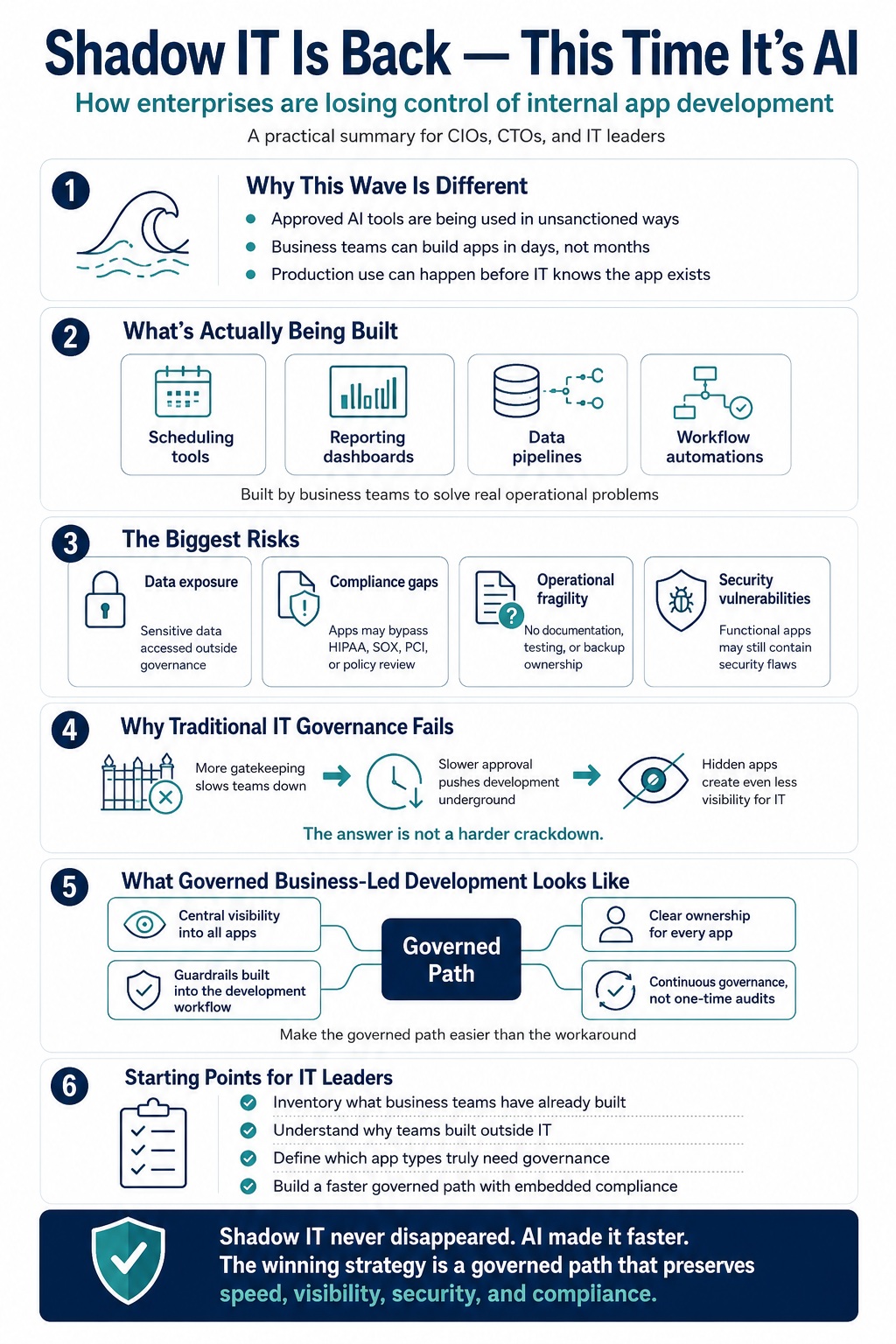
Why This Wave Is Different
The original shadow IT problem was mostly about SaaS adoption. Employees found tools they preferred over the officially sanctioned ones and started using them. The IT response was to build procurement processes, require security reviews, and push approved alternatives.
That approach worked reasonably well because SaaS adoption had a natural friction point: someone had to pay for it. Expense reports and credit card statements gave IT a way to catch unauthorized tool adoption after the fact, even if the discovery was delayed.
AI-assisted development doesn’t have that friction point. Many of the tools involved are already approved — or are features inside tools that are already approved. GitHub Copilot is an enterprise subscription. Microsoft 365 Copilot is part of an existing license. Low-code platforms were often purchased by business units specifically so they could build things without waiting for IT resources. The tools are sanctioned. What’s happening with them isn’t.
The other difference is speed. Shadow IT in the SaaS era meant an employee using a different project management tool or a preferred file-sharing service. The risk was data spillage and license sprawl. Shadow IT in the AI era means an employee building a functional application in an afternoon — one that processes real data, connects to real systems, and gets handed off to colleagues who rely on it for actual work.
The gap between “someone built something” and “something is running in production that IT doesn’t know about” has collapsed from months to days.
What’s Actually Being Built
The pattern shows up differently depending on the industry, but the underlying dynamic is consistent. Business teams have problems. AI tools offer a fast path to solutions. IT is either too slow to help or doesn’t have bandwidth. So the business team builds it themselves.
In healthcare organizations, operations teams are building scheduling tools, patient communication workflows, and internal reporting dashboards. In manufacturing, floor supervisors and operations managers are building quality tracking applications and supply chain automation. In financial services, analysts are building data transformation pipelines and compliance reporting tools. In logistics, regional managers are building route tracking and exception management applications.
None of these people are trying to create compliance problems. They’re trying to do their jobs better. The AI tools make it possible. The business pressure makes it appealing. The absence of a fast IT alternative makes it necessary, from their perspective.
The result is a growing inventory of internally built applications and automations that:
- Handle sensitive, regulated, or proprietary data
- Connect to production systems and databases
- Are used by real teams for real business decisions
- Have no formal documentation, no security review, no change management record, and no designated owner if the person who built them leaves the organization
That inventory exists in virtually every enterprise that has given business teams access to AI tools without building a corresponding governance framework.
The Specific Risks That Keep CIOs Up at Night
Data exposure: When a business user builds an application that connects to a production database and pulls customer records, patient data, or financial information, that connection exists outside the normal data governance framework. There’s no record of what data the application accesses, no access control review, and no logging. If that application is misconfigured, breached, or simply handed off to a colleague with broader access than intended, the organization has a data exposure problem it may not discover until significant damage has been done.
Compliance gaps: Regulated industries operate under frameworks that require documented processes, audit trails, and controlled data handling. An internally built application that processes PHI without going through a HIPAA compliance review isn’t just a governance problem — it’s a regulatory liability. The same applies to financial data under PCI-DSS, FINRA, or SOX requirements. The application may work perfectly from a functional standpoint and still create a material compliance finding.
Operational fragility: Applications built quickly by non-IT teams tend to be built for the immediate problem, not for long-term reliability. There’s no documentation, so when the person who built it leaves, nobody knows how it works. There’s no testing framework, so changes break things unexpectedly. There’s no monitoring, so failures go undetected. These applications become invisible infrastructure — things the organization quietly depends on without acknowledging the dependency.
Security vulnerabilities: Business-led development with AI assistance doesn’t automatically produce secure code. AI coding tools generate code that is statistically likely to be functional. They don’t automatically apply your organization’s security standards, avoid deprecated libraries, or implement proper input validation. Without a security review process, these applications go into production with vulnerabilities that a standard code review would have caught.
Why Traditional IT Governance Doesn’t Solve This
The instinct for many IT organizations is to respond to this problem by tightening controls — requiring IT approval for any AI-built application, restricting access to certain tools, or establishing procurement requirements that slow down the process.
That instinct is understandable and almost entirely counterproductive.
Business teams adopted AI tools because IT couldn’t keep up with their development needs. Responding to AI-driven shadow IT by making IT an even bigger bottleneck doesn’t eliminate the shadow IT — it pushes it further underground. Teams find workarounds. Applications get built anyway, just without anyone telling IT. The governance problem gets worse because now the business teams are actively motivated to avoid IT visibility.
The governance frameworks that actually work in this environment don’t try to stop business-led development. They channel it. The goal is to give business teams a governed path that is fast enough to be the path of least resistance — so that building within the framework is easier than working around it.
That’s a fundamentally different design challenge than traditional IT governance, and it requires tools and processes built for that purpose rather than adapted from a SaaS procurement playbook.
What Governed Business-Led Development Looks Like
Organizations that have successfully addressed this problem share a few common characteristics.
They have a central visibility layer. IT knows what applications exist, what data they touch, who owns them, and when they were last reviewed — not because they approve every build request, but because the development environment automatically surfaces that information. When a new application is created, it appears in a governed inventory with metadata attached.
They have guardrails, not gates. Rather than requiring IT approval before development can begin, they build policy enforcement into the development environment itself. Applications that handle certain data types automatically trigger a security review. Connections to production systems require documented authorization. Deployment to anything beyond a sandbox environment requires a defined approval step. The guardrails are built in, so developers — whether technical or business-side — encounter them as part of the normal workflow rather than as a separate compliance process.
They have clear ownership. Every application in the organization has a designated owner, an IT counterpart who understands what it does, and a documented plan for what happens if the original builder is unavailable. This sounds simple. It’s one of the most consistently missing elements in organizations dealing with AI-driven shadow IT.
They treat this as an ongoing program, not a one-time audit. Shadow IT doesn’t get solved by a quarterly inventory exercise. It requires continuous visibility into what’s being built and a governance model that scales with development activity rather than creating a backlog.
The Window to Get Ahead of This Is Closing
The organizations that build governance infrastructure before this problem becomes acute have a significant advantage over those that discover it during an audit or after a security incident.
Right now, most enterprises are somewhere in the early-to-middle stages of AI tool adoption for internal development. Business teams are discovering what’s possible. The volume of AI-assisted and business-led applications is growing, but it hasn’t yet reached the scale where the governance gap becomes unmistakably visible to senior leadership.
That window — between “this is manageable” and “this is out of control” — is where governance investment pays the highest return. It’s much easier to establish a governed development environment when there are dozens of unsanctioned applications than when there are hundreds.
The question CIOs and IT leaders should be asking right now isn’t whether their organization has AI-driven shadow IT. Almost certainly, it does. The question is whether they’re going to discover the scope of it on their own terms or someone else’s.
Starting Points for IT Leaders
If you’re assessing where your organization stands, a few practical starting points:
Inventory before you govern: Before you can establish governance, you need to know what exists. Survey your business units directly — ask what tools they’re using to build internal applications and automations, and what they’ve built. The answers will be more revealing than any technical scan.
Understand the build motivation: The business teams building outside IT oversight aren’t doing it to cause problems. They’re doing it because the alternative — waiting for IT resources — felt slower than the problem required. Understanding that motivation tells you what the governed alternative needs to offer in order to actually be used.
Define what needs to be governed: Not everything built by a business team represents a governance risk. A simple automation that moves data between two approved SaaS tools is different from an application that connects to a production database and handles regulated data. Define your risk tiers and focus governance investment on the categories that actually matter.
Build a governed path that’s faster than the workaround: If the governed development environment is slower and more painful than working around it, business teams will work around it. The governance model has to compete on speed, not just on compliance. That’s the design constraint that determines whether the governance program actually works.
The Bottom Line
Shadow IT never disappeared. It adapted. AI tools gave it a new form — one that’s faster, more capable, and harder to detect than the SaaS adoption wave that preceded it.
The response that works isn’t a harder crackdown. It’s a better governed path. Enterprise organizations that build development environments where compliance is embedded, visibility is automatic, and business teams can move fast within appropriate guardrails are the ones that capture the productivity benefits of AI-assisted development without accumulating the governance debt that makes the next audit painful.
The alternative is discovering the scope of the problem later, under worse conditions, with fewer options.
CloudApper helps enterprise organizations establish governed AI development environments where internal teams — technical and non-technical — can build quickly within a framework that maintains security, compliance, and IT visibility. Contact us to see how organizations in your industry are managing this transition.

What is CloudApper AI Platform?
CloudApper AI is an advanced platform that enables organizations to integrate AI into their existing enterprise systems effortlessly, without the need for technical expertise, costly development, or upgrading the underlying infrastructure. By transforming legacy systems into AI-capable solutions, CloudApper allows companies to harness the power of Generative AI quickly and efficiently. This approach has been successfully implemented with leading systems like UKG, Workday, Oracle, Paradox, Amazon AWS Bedrock and can be applied across various industries, helping businesses enhance productivity, automate processes, and gain deeper insights without the usual complexities. With CloudApper AI, you can start experiencing the transformative benefits of AI today. Learn More
- Useful Links:
- Agentic AI
- No-Code/Low-Code
- Custom Software
- HCM Personalization
- iPaaS
- FedRAMP