Workday tracks onboarding tasks but doesn't manage Form I-9, E-Verify, or the retention rules tied to it. Here's where the compliance gaps show up, what to fix inside Workday first, and where a connected verification layer closes the rest.
TL;DR
Workday's onboarding module tracks tasks and completion status, but it does not manage Form I-9, E-Verify, or the specific retention and reverification requirements tied to federal I-9 compliance. The most common exposure points are the three-business-day Section 2 deadline, decentralized verification across multiple hiring locations, missed reverification windows for expiring work authorizations, and improper retention or early disposal of I-9 records. Admins can close part of this gap by hard-gating I-9 completion in the onboarding business process and routing reverification alerts off the visa expiration field, but Workday was never built to run E-Verify or serve as the system of record for the I-9 document itself. CloudApper AI Recruiter extends the existing Workday connection to track verification status, flag reverification deadlines, and support document collection before day one, without replacing Workday's role as the core HCM system of record.
Table of Contents
- What Workday Handles Natively
- Where the Friction Shows Up
- What to Do Within Workday First
- Where Native Tools Run Out
An auditor asks for Form I-9 documentation on a new hire from four months ago. The employee record in Workday looks clean — hire date, job profile, onboarding tasks marked complete. But the actual I-9 form, the one with Section 2 signed by whoever verified the employee’s documents in person, lives somewhere else. Maybe a shared drive. Maybe a filing cabinet at the site where the person was hired. Maybe nowhere anyone can locate quickly. This is the moment a lot of Workday admins realize that “onboarding complete” in Workday and “I-9 compliant” are not the same status.
What Workday Handles Natively
Workday’s onboarding module does real work here. It can generate onboarding tasks, route new-hire paperwork, and track completion status for anything configured as a step in the onboarding business process. Some organizations use Workday Extend or a custom onboarding step to prompt for I-9 completion, and Workday can absolutely hold a checkbox or task status that says the I-9 step was marked done.

What Workday does not do natively is manage Form I-9 itself. Workday has no built-in E-Verify integration, no native document retention system built to the specific I-9 recordkeeping standard, and no in-person or remote document inspection workflow that satisfies USCIS requirements for Section 2. Workday is a system of record for employment data. Form I-9 is a federal compliance document with its own retention rules, inspection requirements, and a three-business-day completion deadline that has nothing to do with how Workday’s onboarding business process is configured. The two systems were never designed to be the same thing, and treating a completed onboarding task as proof of I-9 compliance is where organizations get exposed.

Where the Friction Shows Up
The most common failure mode is the completion-date gap. Section 2 must be completed within three business days of the employee’s start date, verified against physical or approved remote documents. If your onboarding task tracks “I-9 submitted” as a checkbox with no linkage to an actual timestamp against the hire’s start date, you have no reliable way to prove the three-day window was met without manually cross-referencing paper files.
The second failure mode is decentralized verification. Organizations with multiple locations often have different people at each site responsible for reviewing I-9 documents in person, and multi-entity Workday configurations tend to make this worse rather than better, because Workday’s org hierarchy tracks reporting structure, not who physically reviewed a document at a given site. There is often no system tying “this manager at this location verified this employee’s passport on this date” back to the Workday record at all.
The third is reverification. Employees with time-limited work authorization need their I-9 reverified before the authorization expires. Workday can hold a visa expiration date as a field, but turning that field into an actual reverification workflow, one that alerts the right person with enough lead time and produces a documented outcome, requires configuration that most Workday tenants were never built with. Miss the reverification window and the organization is out of compliance the day the authorization lapses, regardless of what the Workday record shows.
The fourth is retention and disposal. I-9 forms must be retained for three years after the hire date or one year after termination, whichever is later, and then properly disposed of. Workday’s termination process removes system access and marks a worker inactive, which is a separate lifecycle from I-9 document retention. Without a dedicated tracking mechanism, I-9 records tend to either get deleted too early alongside other offboarding cleanup, or never get purged at all, which creates its own audit exposure.
What to Do Within Workday First
Before treating this as a system gap, most organizations can tighten several things inside their existing configuration.
Build I-9 completion into the onboarding business process as a hard-gated step rather than a soft checkbox, with the start date field driving a calculated due date for Section 2. Route the reverification prompt off the visa expiration date field using Workday’s alert or condition rule functionality, sent to a role, not a named individual, so turnover in the HR team doesn’t silently break the alert. If you’re managing business process routing across multiple approval steps already, add I-9 verification as a discrete, trackable step in that same framework rather than a side process that lives outside it. And build the retention and purge schedule as a recurring report, run against termination dates, so records don’t linger past their legal disposal window or vanish before the required retention period ends. Documenting how your organization approaches this is also worth doing before your next Workday audit, since I-9 documentation gaps are one of the most common findings auditors flag.
Where Native Tools Run Out
Even with tight configuration, Workday was not built to run E-Verify queries, capture remote document inspection under DHS’s alternative procedure, or serve as the system of record for the actual I-9 PDF with its required retention metadata. Organizations with high-volume hourly hiring, seasonal staffing, or hiring across many physical locations feel this gap hardest, because the volume makes manual cross-referencing between Workday and wherever the I-9 documents actually live unsustainable. CloudApper works alongside Workday to close this specific gap without asking teams to replace what Workday already does well for HCM.
Where CloudApper AI Recruiter Fits
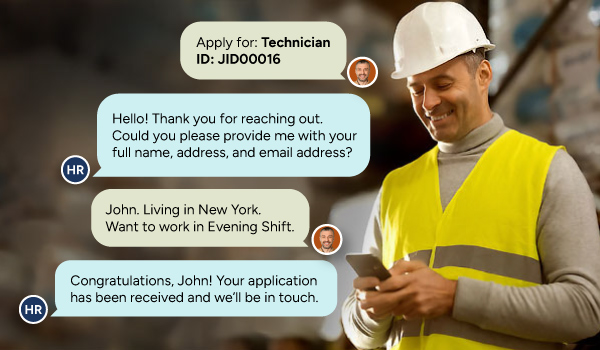
CloudApper AI Recruiter integrates with Workday to pull requisition and applicant data directly from the HCM tenant, and extends that connection into the pre-hire and onboarding compliance layer that Workday doesn’t natively cover. For organizations hiring at volume, the chatbot can guide candidates through document upload and prompt for the information needed to complete Section 1 before day one, reducing how much falls into the three-day compliance window after start date. On the Section 2 side, AI Recruiter can be configured to track verification status against the hire’s actual start date, flag records approaching the deadline, and route reverification alerts before a work authorization expires, tied back to the same requisition and applicant data already synced with Workday.
A useful way to think about the split: Workday remains the system of record for who was hired, when, and into what role. CloudApper AI Recruiter becomes the layer that ensures the compliance-sensitive steps around that hire, document collection, verification timing, reverification, and eventual retention cleanup, actually happen on schedule and leave an auditable trail, without requiring a parallel manual process that someone has to remember to run.

Frequently Asked Questions
Q: Does Workday have built-in I-9 functionality?
No. Workday can track onboarding tasks and hold relevant data fields like work authorization expiration dates, but it does not natively manage Form I-9 completion, E-Verify submission, or I-9-specific document retention.
Q: Can Workday integrate with E-Verify directly?
Workday does not offer a native E-Verify integration. Organizations typically handle E-Verify through a separate system or manual process, then record the outcome as a status field or task in Workday.
Q: What happens if Section 2 isn’t completed within three business days in Workday?
Workday itself won’t flag this as a compliance violation unless you’ve built a condition rule tying Section 2 completion to the hire’s start date. Missing the three-day federal deadline is a compliance violation regardless of what Workday shows as “complete.”
Q: How should Workday handle I-9 reverification for expiring work authorizations?
Workday can hold the expiration date as a field and trigger an alert through a condition rule, but the actual reverification, document inspection and outcome, must happen outside Workday unless a connected tool handles that workflow.
Q: Can remote hires complete I-9 verification through Workday?
Workday doesn’t provide a remote document inspection workflow that satisfies DHS’s alternative procedure requirements. That verification step needs to happen through a separate authorized process, with the outcome recorded back into the employee’s record.
Q: How long do I-9 forms need to be retained, and does Workday track that automatically?
Three years after the hire date or one year after termination, whichever is later. Workday’s termination process doesn’t automatically manage I-9 retention or disposal timing, so this needs a separate tracking mechanism to avoid early deletion or over-retention.
If your organization is hiring at volume across multiple locations and I-9 compliance is living in spreadsheets or someone’s memory, it’s worth talking through what a connected verification workflow could look like alongside your existing Workday setup. The CloudApper team is available here to walk through your specific hiring volume and compliance requirements.

What is CloudApper AI Platform?
CloudApper AI is an advanced platform that enables organizations to integrate AI into their existing enterprise systems effortlessly, without the need for technical expertise, costly development, or upgrading the underlying infrastructure. By transforming legacy systems into AI-capable solutions, CloudApper allows companies to harness the power of Generative AI quickly and efficiently. This approach has been successfully implemented with leading systems like UKG, Workday, Oracle, Paradox, Amazon AWS Bedrock and can be applied across various industries, helping businesses enhance productivity, automate processes, and gain deeper insights without the usual complexities. With CloudApper AI, you can start experiencing the transformative benefits of AI today. Learn More
- Useful Links:
- Agentic AI
- No-Code/Low-Code
- Custom Software
- HCM Personalization
- iPaaS
- FedRAMP
Brochure
CloudApper AI TimeClock
For accurate & touchless time capture experience.
Download Brochure
CloudApper AI Solutions for Workday


- Works with








- and more.
Similar Posts

Piece-Rate Pay and Overtime in Workday: The Calculation Most Payroll…

Workday Meal Break Premium Pay: Who Owes It, When It…