Workday delegation works cleanly for one manager and one absence, but across a large organization with frequent leaves, promotions, and reorgs, tracking who currently holds approval authority becomes a manual, error-prone exercise. Here is where the native gap sits and how a governance layer closes it.

TL;DR
Workday’s native delegation and proxy access features work reliably for the transaction they’re designed for: routing a specific manager’s approvals to a specific backup during a defined absence, with a clean audit trail. The gap appears at scale, when an organization has many managers going on leave, being promoted into interim roles, or having their teams restructured at the same time, since Workday provides no tenant-wide view of every currently active delegation, no automatic flag when a delegation outlives its intended end date, and no reconciliation between existing delegations and a Supervisory Organization that just changed. HR ops teams typically fall back to manually tracking delegation status in a spreadsheet, which holds up for a hundred managers but becomes the actual point of failure across a population of several thousand, spanning constant leaves, promotions, and reorgs. CloudApper AI for HCM Extensibility & Personalization adds a governance layer on top of Workday’s native delegation framework, giving HR ops a single view of every active delegation, flagging ones approaching expiration, and cross-referencing delegation coverage against current org structure after a reorg. Workday continues to execute every delegated approval exactly as it does today; CloudApper AI makes sure the underlying grant of authority doesn’t quietly drift out of date.
Table of Contents
- What Workday Does Natively
- Where the Friction Shows Up
- What to Do Within Workday First
- Where Native Tools Run Out
A regional operations director goes on eight weeks of parental leave. Before she leaves, someone has to decide who approves the 40 time-off requests, six job changes, and a handful of compensation actions that will land in her Workday inbox while she’s out. Someone sets up a delegation. Three weeks in, one of her direct reports gets promoted into an interim role and now needs delegated authority too, layered on top of the first delegation. By week six, nobody in HR ops is fully sure who’s approving what, or whether the original delegation ever specified an end date. CloudApper’s role in this problem is narrow and specific — tracking and enforcing delegation lifecycles Workday leaves largely to manual memory — and it’s worth being clear about what Workday’s delegation feature does well before getting there.
What Workday Does Natively
Workday’s Delegation feature lets a worker temporarily hand off business process approval authority to another worker for a defined set of business process types, over a defined date range. A manager going on leave can delegate hiring approvals, time-off approvals, and compensation change approvals to a designated backup, and Workday will route those specific transaction types to the delegate for as long as the delegation window is active. The delegation can be scoped narrowly — only certain business process types — or broadly, and it can be set up by the manager themselves or by an HR admin with the right security permissions on their behalf.

Proxy access, distinct from delegation, allows a designated user — typically an HR partner or admin — to act on behalf of another worker across a broader set of transactions, generally used for administrative support rather than approval authority specifically. Both mechanisms are built into the standard Workday security and business process framework, so a delegated approval is logged the same way a direct approval would be, and shows up in the same audit trail.
For a single manager, a single leave, and a clearly defined end date, this works close to exactly as intended. The delegate gets the relevant approvals in their inbox, the original manager’s inbox stays clean while they’re out, and the delegation expires automatically on the date specified. Standard business process approval routing otherwise continues to function normally around it.
Where the Friction Shows Up
The friction is almost never about whether Workday’s delegation mechanism functions correctly. It’s about what happens when delegation stops being a single, clean event and becomes a recurring, overlapping, organization-wide condition.
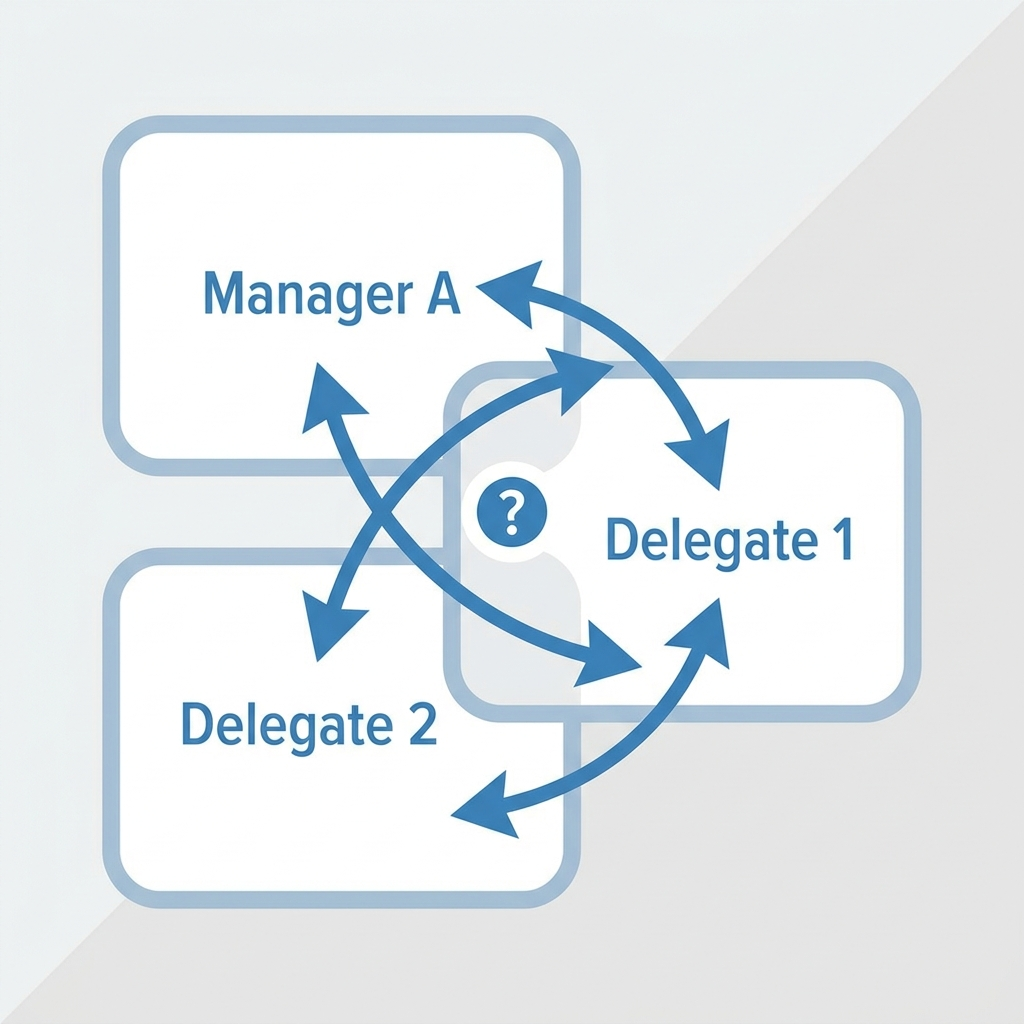
Delegation chains stack without a central view. When a delegate is themselves unavailable, or when an interim promotion adds a second layer of delegated authority on top of an existing one, Workday doesn’t provide an easy, tenant-wide view of every active delegation and how they interact. HR ops ends up tracking this manually, often in a spreadsheet maintained outside Workday entirely, because there’s no native dashboard answering “who currently holds approval authority for this manager’s population, right now, considering every delegation currently in effect.”
Delegations outlive their intended purpose. A delegation set up for a two-week leave sometimes never gets formally ended, either because the return date shifted or because nobody remembered to close it out. The delegate keeps receiving approvals for a manager who’s technically back at work, which creates both a security question — should this person still hold this authority — and a practical one, since two people now believe they’re responsible for the same approval queue.
Reorganizations multiply the problem instead of resolving it. During a reorg, Supervisory Organization changes ripple through approval routing and security access inheritance, and any delegations tied to the old structure don’t automatically reconcile against the new one. A manager whose team was just split across two new Supervisory Organizations may need entirely different delegation coverage than they had the day before, and nothing in Workday flags that the existing delegation no longer matches the current org structure.
What to Do Within Workday First
Before treating this as a gap that needs an external tool, it’s worth tightening a few native practices. First, make delegation end-date discipline a standard part of the leave-of-absence process rather than an afterthought — tying delegation creation to the leave request business process, with the end date pulled directly from the approved leave dates, removes the most common source of delegations that outlive their purpose.
Second, periodically audit active delegations using Workday’s reporting tools. A scheduled report pulling every currently active delegation, refreshed monthly, at least gives HR ops a point-in-time list to review, even without a live dashboard. Third, build reorg checklists that explicitly include a delegation review step — when Supervisory Organizations are restructured, reviewing existing delegations against the new hierarchy should be a standard part of the change process, not something discovered only when an approval routes incorrectly.
Where Native Tools Run Out
These native practices help, but they depend entirely on process discipline holding up across every leave, every promotion, and every reorg, indefinitely, without a single missed step. For an organization with a hundred managers, that discipline is achievable. For an organization with several thousand managers across multiple business units, each with its own leave patterns, promotion cycles, and reorg timelines, manual tracking becomes the actual point of failure, not Workday’s delegation mechanism itself.
Workday’s delegation feature was built to handle the transaction — routing a specific approval to a specific delegate for a specific window. It wasn’t built to give an admin a real-time, organization-wide answer to “show me every delegation active right now, flag anything without an end date, and flag anything that no longer matches current Supervisory Organization structure.” That’s a monitoring and governance layer sitting on top of the delegation mechanism, and Workday doesn’t provide one natively.
Closing the Gap with CloudApper AI
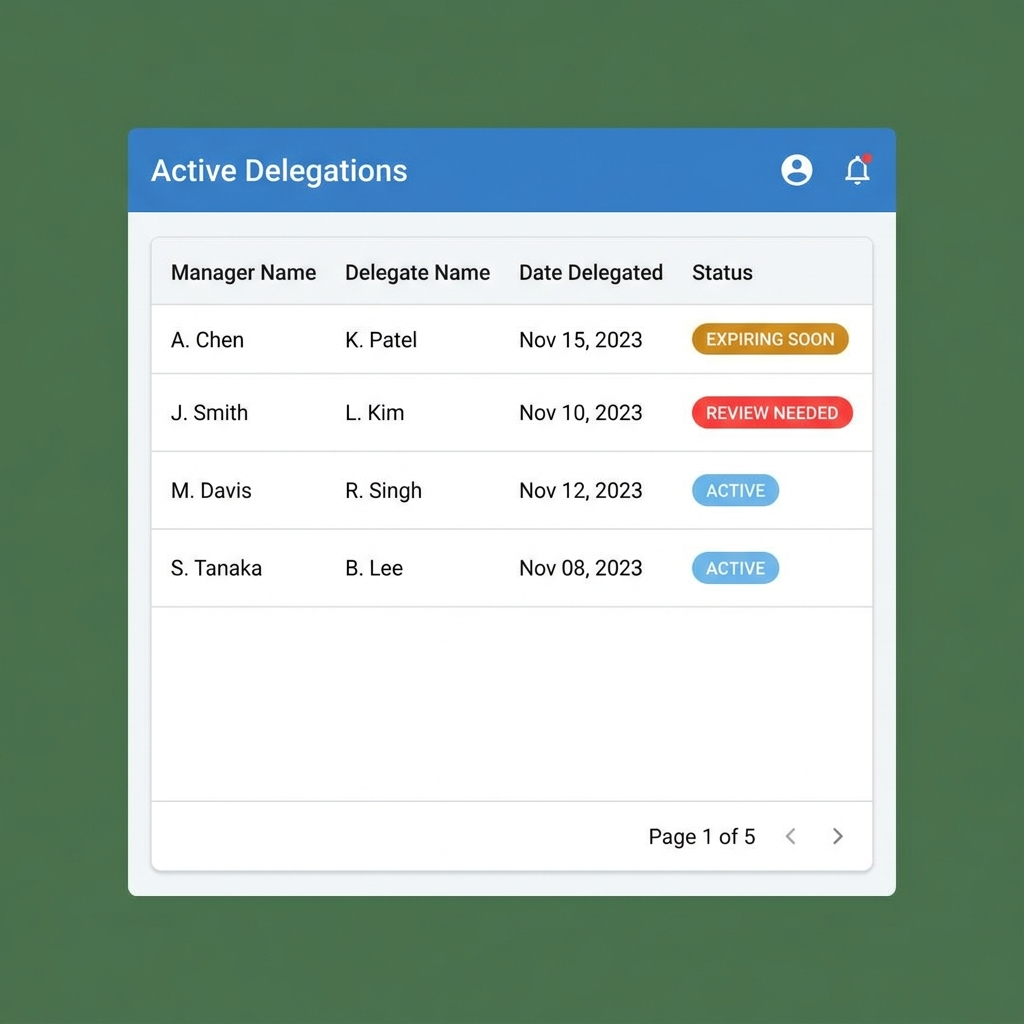
CloudApper AI for HCM Extensibility & Personalization adds a delegation governance layer on top of Workday’s native delegation and proxy access framework. Rather than replacing how delegation works inside Workday, CloudApper AI tracks every active delegation across the tenant in one view, flags delegations approaching or past their intended end date, and cross-references active delegations against current Supervisory Organization structure so a reorg doesn’t leave stale delegation authority in place unnoticed.
For organizations managing frequent leaves, promotions, and reorganizations across a large manager population, this turns a manual spreadsheet exercise into an automated check that runs continuously in the background. When a delegation is set to expire, CloudApper AI can notify HR ops ahead of time rather than relying on someone remembering the original leave return date. When a Supervisory Organization changes, CloudApper AI flags any delegation tied to the old structure that needs review before it causes a misrouted approval.
Workday remains the system executing every delegated approval and maintaining the transaction-level audit trail. CloudApper AI exists to make sure the delegation itself, as a standing grant of authority, doesn’t quietly drift out of alignment with who should actually hold it.
Frequently Asked Questions
Q: What’s the difference between delegation and proxy access in Workday?
A: Delegation temporarily hands off approval authority for specific business process types to another worker, typically during a leave or absence. Proxy access allows a designated user, often an HR partner, to act on behalf of another worker across a broader set of transactions, generally for administrative support rather than approval authority.
Q: Does Workday automatically end a delegation when the return date passes?
A: A delegation set up with a defined end date will expire on that date, but if the return date changes or the delegation was set up without a firm end date, it can remain active well past its intended purpose without anyone being notified.
Q: Can more than one delegation be active for the same manager at the same time?
A: Yes, delegations can stack, particularly during interim promotions or extended leaves where a second layer of authority gets added on top of an existing delegation. Workday doesn’t provide a native, single view showing how overlapping delegations interact.
Q: How does a reorganization affect existing Workday delegations?
A: Supervisory Organization changes during a reorg don’t automatically reconcile against existing delegations. A delegation set up under the previous org structure can remain technically active even after the manager’s team, and their business process routing, has changed.
Q: Can Workday report on all currently active delegations across the tenant?
A: Workday’s reporting tools can be configured to pull a list of active delegations, but this typically requires a scheduled or manually run report rather than a live, continuously updated view.
Q: Does CloudApper AI change how delegated approvals are processed in Workday?
A: No. Workday continues to execute every delegated approval and maintain the transaction audit trail exactly as it does natively. CloudApper AI adds a governance layer that tracks and flags delegation status across the tenant, without altering how the underlying approval routing works.
If delegation tracking has become something your HR ops team manages in a spreadsheet rather than something the system enforces, it’s worth a closer look at how many active delegations are actually still accurate. Contact CloudApper to talk through what that would look like for your Workday tenant.

What is CloudApper AI Platform?
CloudApper AI is an advanced platform that enables organizations to integrate AI into their existing enterprise systems effortlessly, without the need for technical expertise, costly development, or upgrading the underlying infrastructure. By transforming legacy systems into AI-capable solutions, CloudApper allows companies to harness the power of Generative AI quickly and efficiently. This approach has been successfully implemented with leading systems like UKG, Workday, Oracle, Paradox, Amazon AWS Bedrock and can be applied across various industries, helping businesses enhance productivity, automate processes, and gain deeper insights without the usual complexities. With CloudApper AI, you can start experiencing the transformative benefits of AI today. Learn More
- Useful Links:
- Agentic AI
- No-Code/Low-Code
- Custom Software
- HCM Personalization
- iPaaS
- FedRAMP
Brochure
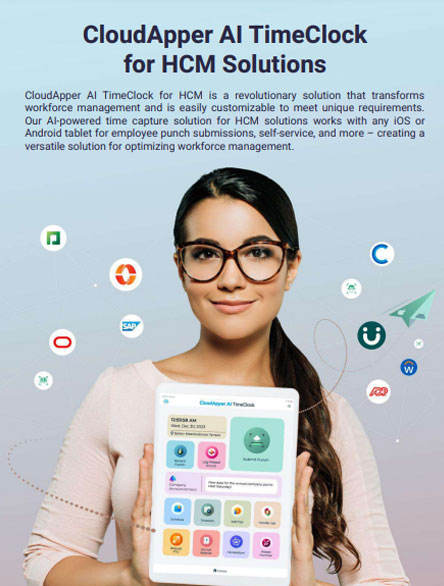
CloudApper AI TimeClock
For accurate & touchless time capture experience.
Download Brochure
CloudApper AI Solutions for Workday


- Works with








- and more.
Similar Posts

Piece-Rate Pay and Overtime in Workday: The Calculation Most Payroll…

Workday Meal Break Premium Pay: Who Owes It, When It…