PCI DSS scope extends to every internal application that could affect your cardholder data environment — not just payment systems. Here's what retail and financial services IT teams need in place before the next assessment finds the gap first.

TL;DR
PCI DSS applies to every internal application that touches or could affect the cardholder data environment — not just payment systems. Most retail and financial services IT teams don't realize how broadly that scope extends until a QSA asks about it. PCI DSS v4.0 imposes specific, auditable requirements on custom application development including documented SDLCs, code review evidence, and vulnerability testing records. AI-generated code compounds the problem because it lacks the audit trail the standard requires. CloudApper provides a governed development platform that produces PCI-ready applications by default, with compliance inherited at the platform level rather than engineered per application.
Table of Contents
- What Brings an Internal Application Into PCI Scope
- What PCI DSS v4.0 Actually Requires From Development Teams
- The AI-Generated Code Problem in a PCI Context
- What Assessors Are Increasingly Asking About
- The Governance Gap That Persists in Most Internal Development Programs
- What to Have in Place Before the Next Assessment
Most retail and financial services IT teams think their internal applications are outside PCI DSS scope. That assumption is the origin of a significant percentage of assessment findings — and fixing a scope misclassification after an audit costs considerably more than preventing it before one.

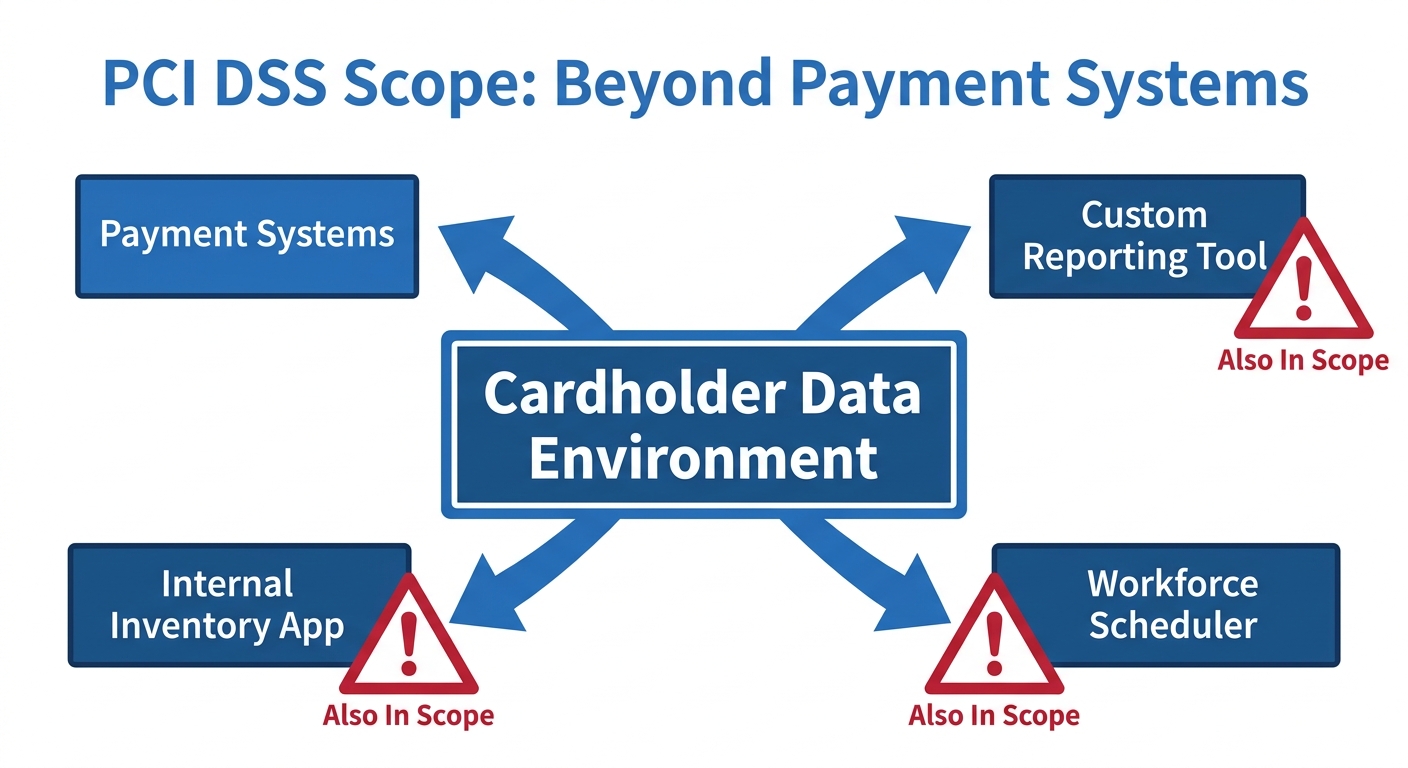
PCI DSS doesn’t apply only to the systems that process payment transactions. It applies to every system, application, and network segment that stores, processes, or transmits cardholder data, or that could affect the security of systems that do. That definition is broader than most development teams realize. An internal workforce scheduling application that sits on the same network segment as a point-of-sale system. A custom reporting tool that pulls aggregated sales data from a database that contains cardholder information. An AI-powered inventory management application that writes to a back-end that payment systems also touch. Each of these is potentially in scope, and each of them needs to satisfy PCI DSS Requirement 6 — the requirement governing how software is developed and maintained.
The development practices that produced those applications probably didn’t account for that.
What Brings an Internal Application Into PCI Scope
The scoping conversation in most organizations centers on payment systems. That’s where the visible cardholder data lives, and that’s where the QSA (Qualified Security Assessor) is expected to focus. But PCI DSS v4.0, which became the mandatory standard in 2024, expanded the emphasis on software security practices throughout the cardholder data environment — and the cardholder data environment is defined by network connectivity and data flow, not by whether an application was designed as a payment system.
An application comes into scope when it shares a network segment with systems that handle cardholder data, when it connects to a database that also stores payment data, when it could be used as a pivot point to access in-scope systems, or when it processes any data that links back to payment records. Applications that meet these criteria need to be built, tested, and maintained according to PCI DSS software security requirements regardless of their primary business function.
For retail organizations with large internal development programs — custom inventory apps, workforce management tools, customer loyalty platforms, store operations software — the scope surface is significantly larger than the payment team typically reports. For financial services firms building internal tools around their core banking or insurance systems, the same problem applies. The applications being built by the IT team to support operations may be in scope for a standard that the IT team has never read in detail.
What PCI DSS v4.0 Actually Requires From Development Teams
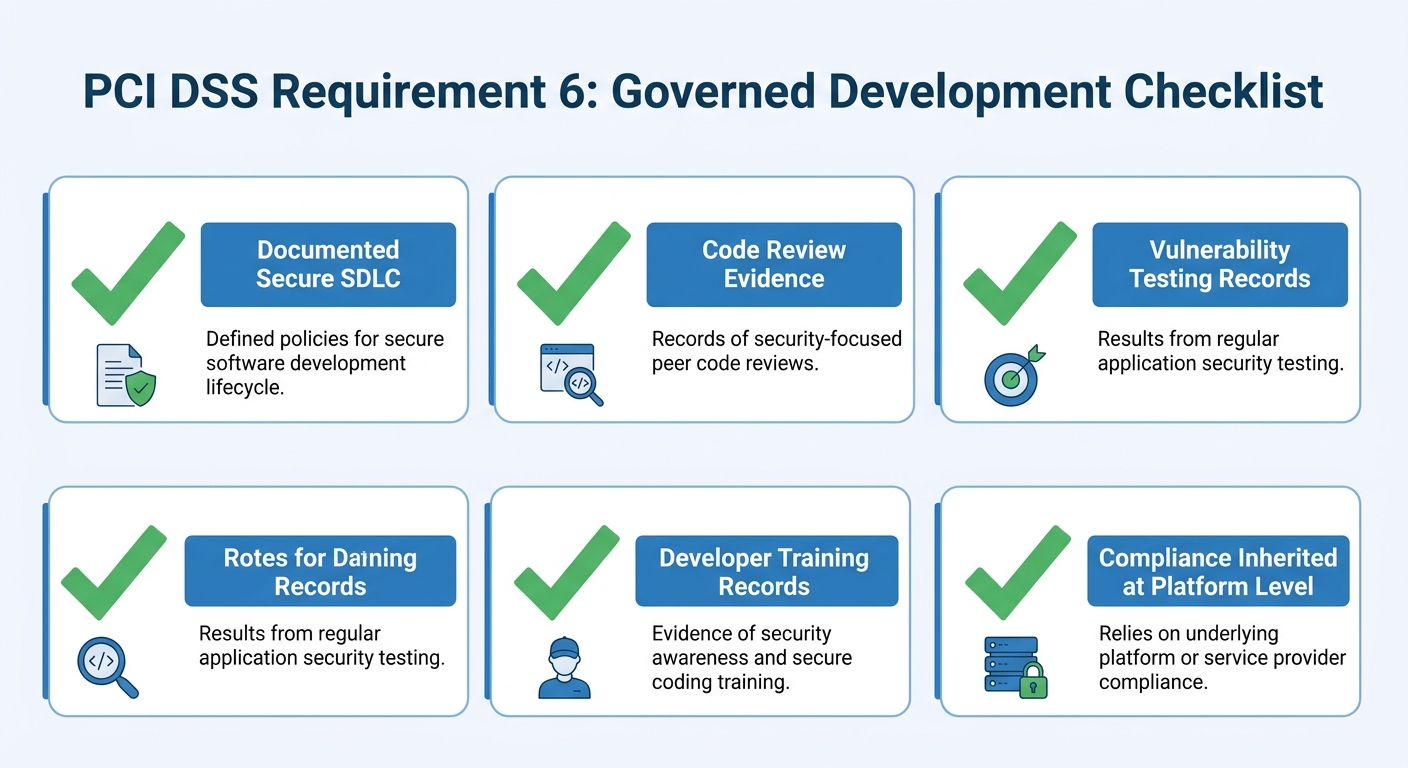
Requirement 6 of PCI DSS v4.0 covers the development and maintenance of all software in scope for the standard. The requirements are specific and operationally demanding for organizations that build applications internally. They include the existence of a formal software development lifecycle with defined security checkpoints, vulnerability management practices applied to all code before deployment, mandatory code review for custom applications, and penetration testing of in-scope systems that includes application-level testing.
Requirement 6.2 specifically requires that all development personnel are trained on secure software development practices annually. Requirement 6.3 requires that all custom and bespoke software is protected from known vulnerabilities, with evidence that the organization has a process for identifying and remediating new vulnerabilities as they emerge. Requirement 6.4 requires that web-facing applications are protected against known attacks — including injection attacks, broken authentication, and insecure deserialization.
These are not abstract policy statements. They are auditable controls. During an assessment, a QSA will ask for documentation of the development process, evidence of code review, training records for developers, records of vulnerability testing, and evidence that findings from testing were remediated. If the internal applications that came into scope were built without this governance structure in place, the documentation doesn’t exist. The controls can’t be demonstrated retroactively. The finding goes in the report.
What makes this particularly costly for organizations using AI-assisted development is that the governance gap is harder to close after the fact. The security risks introduced when developers use AI coding tools without a governance framework compound in regulated environments specifically because the output is harder to audit. AI-generated code doesn’t come with a chain of custody. It doesn’t have author accountability in the traditional sense. And when that code touches systems in a PCI scope, the absence of auditability becomes an assessment problem immediately.
The AI-Generated Code Problem in a PCI Context
PCI DSS v4.0 doesn’t explicitly call out AI-generated code by name — the standard wasn’t written to anticipate every development methodology. But the requirements it imposes apply to all custom and bespoke software, regardless of how that software was produced. The code review requirement, the secure development lifecycle requirement, and the vulnerability management requirement all apply equally to code written by a developer and code generated by an AI coding assistant.
The compliance problem isn’t that AI-generated code exists. It’s that the practices most organizations use when deploying AI coding tools don’t satisfy the requirements the standard imposes. AI-generated code carries injection vulnerabilities at a rate significantly higher than purpose-built enterprise application frameworks — industry analysis consistently puts the vulnerability rate for raw AI-generated code between 40 and 45 percent. For code that enters a PCI cardholder data environment, that vulnerability profile isn’t a technical concern to address eventually. It’s an immediate compliance exposure.
The QSA review process for in-scope applications looks at whether the code was reviewed for security vulnerabilities before deployment, whether known vulnerability types were tested for and addressed, and whether the organization has a documented process for ongoing vulnerability management. An application generated by an AI tool and deployed without a formal review process fails all three criteria at the point of inspection. The standard doesn’t allow for a grace period based on development methodology.
CloudApper approaches this problem structurally. Rather than generating raw code that requires a separate compliance review cycle, CloudApper builds enterprise applications on a governed, pre-certified platform architecture. The platform itself carries HIPAA, SOC 2, GDPR, CCPA, and FIPS 140-2 certifications, and applications built on it inherit that certification posture rather than requiring individual validation. For organizations with PCI-scoped internal applications, this means the compliance foundation is in place before the first line of business logic is added — not retrofitted after a QSA asks about it.
What Assessors Are Increasingly Asking About
PCI DSS v4.0 introduced a customized approach option that allows organizations to demonstrate compliance through alternative controls rather than prescriptive requirements, but this option places a higher burden on the organization to document their control objectives and testing evidence. For most organizations with internal development programs, the prescriptive approach remains the default — which means the documentation and process requirements are largely fixed.
QSAs who specialize in retail and financial services environments report that internal application development practices have become a more frequent focus area since v4.0 became mandatory. The specific questions showing up in more assessments include: what is your secure development lifecycle process for custom applications, how do you track which internal applications are in scope for PCI, what is your code review process and who performs it, how do you test in-scope applications for vulnerabilities after deployment, and what training have your developers completed on secure coding practices.
The dynamic is nearly identical to what SOC 2 auditors now ask about internal application development — the compliance frameworks have converged on the same operational questions even when they approach them from different angles. Organizations that have not formalized their internal application development practices before an assessment typically respond with a combination of policy documents that don’t reflect actual practice and process descriptions that lack supporting evidence. Neither satisfies a QSA.
The Governance Gap That Persists in Most Internal Development Programs
The governance gap in internal application development isn’t unique to organizations that have recently adopted AI tools. It predates AI coding assistants by years. Most large enterprises have a mix of development practices across their internal teams — some projects with formal processes, some without, some documentation maintained consistently and some allowed to drift. The result is a development environment that satisfies compliance requirements in some areas and creates risk in others, often without clear visibility into which is which.
A practical enterprise AI coding governance framework addresses this by establishing consistent controls across all internal development activity — not just projects explicitly tagged as compliance-critical. The logic is the same reason network segmentation works better than application-by-application perimeter controls: consistent enforcement across the entire environment is more reliable and more auditable than selective application of rules to systems already identified as in scope.
For retail organizations, this governance gap appears most often in the operational tools built around store management, inventory, and customer loyalty — applications that don’t obviously look like payment systems but that sit in network environments that do. For financial services firms, it appears in the internal tools built around core systems, reporting infrastructure, and customer service applications that connect to data environments with payment card information. In both cases, the applications were built by teams with development skills but without compliance context.
Evaluating enterprise app development platforms when compliance is non-negotiable means asking not just whether the platform carries relevant certifications, but whether applications built on it inherit those certifications automatically or require separate compliance cycles. The distinction matters significantly for organizations managing large numbers of in-scope applications — each separate compliance cycle adds time, cost, and audit risk. CloudApper’s architecture resolves this at the platform level. The compliance posture is a property of the platform rather than a characteristic that individual applications need to earn independently.
What to Have in Place Before the Next Assessment
The preparation that matters for PCI-scoped internal applications isn’t primarily technical — it’s process and documentation. The technical controls matter, but assessors have limited ability to evaluate source code directly. What they evaluate is evidence that a process existed, that the process was followed, and that the outputs of that process were reviewed.
That means having a documented application inventory that includes all in-scope systems and clearly identifies which custom applications touch or could affect the cardholder data environment. It means having a documented development process for those applications that includes defined security checkpoints — threat modeling, code review, vulnerability scanning, and penetration testing — with records showing those checkpoints were executed. It means having developer training records. And it means having a defined process for how vulnerabilities discovered after deployment are tracked, prioritized, and remediated.
For organizations evaluating whether their current development approach can produce that documentation, the answer is usually that it can — but only if governance is applied prospectively to new projects, and remediated retroactively for existing applications already in scope. The build versus platform decision for internal enterprise application development looks different when compliance is a non-negotiable requirement, because a governed platform produces the compliance evidence automatically while custom development requires it to be engineered separately for each project.
The assessment cycle for PCI isn’t optional and it isn’t deferrable. It comes on schedule regardless of where internal development governance stands. Organizations that treat it as a forcing function for governance improvement tend to find the remediation expensive and disruptive. Organizations that build governance into their development process before the assessment treat PCI as a cost of doing business rather than a periodic crisis.
CloudApper gives retail and financial services IT teams a governed development environment that produces compliant applications by default — including the documentation trail that PCI assessors require. For organizations with active internal development programs and real cardholder data environment exposure, the question isn’t whether to address PCI compliance in internal application development. It’s whether to address it before the next assessment or after the next finding.
CloudApper works with retail and financial services organizations to scope and build governed internal applications that satisfy PCI DSS, SOC 2, and other applicable compliance frameworks without requiring per-application certification cycles. Connect with the CloudApper team to discuss your compliance environment.

What is CloudApper AI Platform?
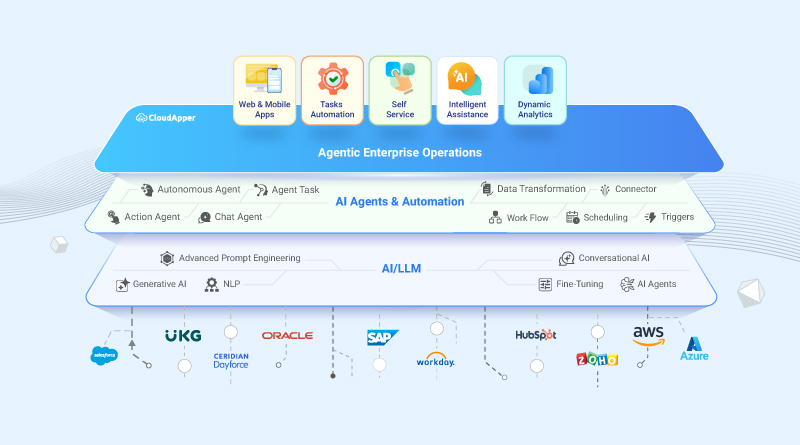
CloudApper AI is an advanced platform that enables organizations to integrate AI into their existing enterprise systems effortlessly, without the need for technical expertise, costly development, or upgrading the underlying infrastructure. By transforming legacy systems into AI-capable solutions, CloudApper allows companies to harness the power of Generative AI quickly and efficiently. This approach has been successfully implemented with leading systems like UKG, Workday, Oracle, Paradox, Amazon AWS Bedrock and can be applied across various industries, helping businesses enhance productivity, automate processes, and gain deeper insights without the usual complexities. With CloudApper AI, you can start experiencing the transformative benefits of AI today. Learn More
- Useful Links:
- Agentic AI
- No-Code/Low-Code
- Custom Software
- HCM Personalization
- iPaaS
- FedRAMP
CloudApper AI Solutions


- Works with








- and more.
Similar Posts

Microsoft Access Modernization: Why the Technical Migration Is the Easy…

When the ISV Disappears: Managing an Orphaned Windows Application With…