Workday computes a time off balance for a point in time, and the worker is asking about a different one. This guide covers what the displayed balance actually is, the four mismatches that generate payroll corrections in hourly populations ranked by cost, the two-step native fix, and the reach problem a report alone cannot solve.

TL;DR
A Workday time off balance is computed for a point in time, by default today, while the worker is asking about a future date, so the number can be accurate when displayed and short when the absence is taken. Four mismatches drive most of the resulting payroll corrections in hourly populations: pending requests not deducted from available balance, carryover expiring between request and take, anniversary-based accrual read against a calendar plan year, and negative-balance rules that differ between plans. The narrowest fix is two steps: set pending requests to deduct on every plan where a worker can hold more than one open request, then build a single custom report with a date prompt returning balance as of that date, hours expiring before it, and pending deductions, exposed on the worker profile and in the manager approval view. The remaining problem is reach rather than calculation, and CloudApper hrPad puts that forward-looking balance on a shared tablet for workers who do not open Workday.
Table of Contents
- What the Displayed Balance Actually Is
- The Four Mismatches That Reach Payroll
- The Narrowest Native Fix
- Where CloudApper Fits
A Workday time off balance can be accurate when displayed and wrong by the time the days are taken, which is why payroll ends up reversing approved absences. A worker sees forty hours, the supervisor approves against forty, then the plan year rolls and part of that balance no longer exists. Nobody entered anything wrong. That is a configuration problem inside the tenant, and it should be fixed there first. After that, CloudApper hrPad puts the correct number in front of workers who never log in.
What the Displayed Balance Actually Is
Workday computes a balance for a point in time. The default view is as of today: accruals posted so far, minus absences already taken. That number is correct and also incomplete, because the worker is not asking about today. He is asking about a week in March.

Everything that happens between now and then, further accrual, carryover expiry, other pending requests, sits outside the figure he is reading.
The Four Mismatches That Reach Payroll
Not all of them cost the same. Ranked by the corrections they generate in hourly populations:
Pending requests not deducted. If the plan does not subtract submitted-but-unapproved time, two requests can each be validated against the same hours. This is the highest-volume dispute and the easiest to remove.
Carryover expiring between request and take. A worker requests in December against hours that lapse on 1 January. The request passes validation because the balance is real today, then the days evaporate before they are used.
Anniversary plans read against a calendar year. Where accrual resets on hire date rather than plan year, the balance a worker sees in month eleven behaves differently from a colleague’s on a calendar plan, and the two compare notes.
Inconsistent negative-balance rules. One plan permits a negative balance, another blocks it. The same request succeeds for one worker and fails for another, which reads as arbitrary and escalates to a supervisor rather than a ticket. Under a collective bargaining agreement it escalates further than that.

The Narrowest Native Fix
Two changes, in this order.
First, set pending requests to deduct from available balance on every plan where a worker can hold more than one open request. That single setting removes most of the double-spend disputes and needs no reporting work.
Second, build one report and expose it. A custom report on time off balances with a date prompt, returning balance as of that date, hours expiring before it, and pending requests already deducted. Put it on the worker profile and in the manager’s approval view so both parties are approving against the same forward-looking number rather than today’s. This is also where accrual problems that started at go-live and accrual changes after a job move become visible before they turn into a correction.
Where CloudApper Fits
The boundary is a reach problem, not a calculation one. A report only helps a worker who opens Workday, and populations on a plant floor or a delivery route mostly do not, which is why finding a PTO balance stays an HR question no matter how the plan is configured.
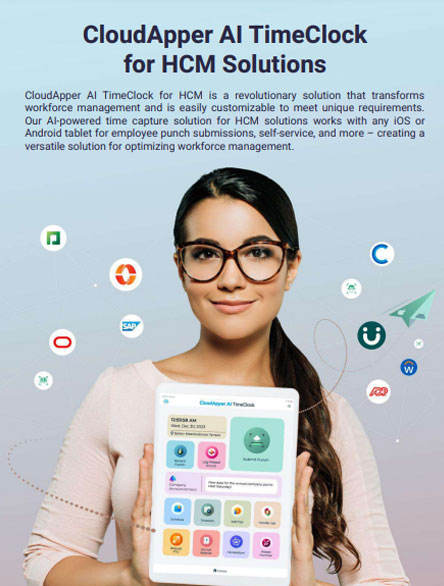
CloudApper hrPad puts that same forward-looking balance on a shared tablet where the shift starts. A worker checks what they will have on the date they want, sees what expires before it, and requests against that number, with the request written into Workday. Fewer approvals go through against a figure that will not survive the plan year, which is the volume that currently lands in retro and off-cycle corrections.

Frequently Asked Questions
Q: What is the difference between available, accrued, and projected time off balance in Workday?
Accrued is what has posted to the plan so far. Available is accrued minus time already taken and, depending on configuration, minus pending requests. Projected is the balance calculated as of a future date, including accrual expected between now and then. The default worker view shows a balance as of today, not as of the date being requested.
Q: Why was a Workday time off request approved and then the balance came up short?
Usually because something changed between the request and the take. Carryover hours expired at the plan year boundary, another pending request consumed the same hours, or accrual did not post as expected. The balance was accurate when displayed and the validation passed against it.
Q: Does Workday deduct pending time off requests from the available balance?
Only if the plan is configured to. Where it is not, a worker holding two unapproved requests can have both validated against the same hours, which is the most common source of balance disputes in populations that book time well in advance.
Q: How do I show employees their time off balance as of a future date?
Build a custom report on time off balances with a date prompt that returns the balance as of that date, hours expiring before it, and pending requests deducted, then expose it on the worker profile and in the manager approval view so both approve against the same number.
Q: Why do two employees on the same policy see different time off behavior?
Most often because one is on an anniversary-based accrual and the other on a calendar plan year, or because negative balances are permitted on one plan and blocked on the other. Both are legitimate configurations, but they produce visibly different outcomes for workers who compare.
Before changing anything, pull last year’s time off corrections and sort them by reason. If most trace to pending requests or expiring carryover, the fix is a plan setting and one report rather than a policy conversation. If they cluster in populations that never open Workday, the CloudApper team can walk through how the balance reaches a shared device. You can reach them through the CloudApper contact page.

What is CloudApper AI Platform?
CloudApper AI is an advanced platform that enables organizations to integrate AI into their existing enterprise systems effortlessly, without the need for technical expertise, costly development, or upgrading the underlying infrastructure. By transforming legacy systems into AI-capable solutions, CloudApper allows companies to harness the power of Generative AI quickly and efficiently. This approach has been successfully implemented with leading systems like UKG, Workday, Oracle, Paradox, Amazon AWS Bedrock and can be applied across various industries, helping businesses enhance productivity, automate processes, and gain deeper insights without the usual complexities. With CloudApper AI, you can start experiencing the transformative benefits of AI today. Learn More
- Useful Links:
- Agentic AI
- No-Code/Low-Code
- Custom Software
- HCM Personalization
- iPaaS
- FedRAMP
Brochure
CloudApper AI TimeClock
For accurate & touchless time capture experience.
Download Brochure
CloudApper AI Solutions for Workday


- Works with








- and more.
Similar Posts

Moving Acquired Employees into Workday: Service Dates, Year-to-Date Wages, and…

Replacing Time Clocks for Workday Time Tracking: A Cutover Plan…