Enterprise service account audits stall not because machine identities are hidden but because nobody documented their owners, dependencies, or business context. AI-built and low-code applications create non-human identities faster than governance can track them, and the remediation resistance is political, not technical.

TL;DR
Enterprise service account audits routinely surface machine identities whose owners, business dependencies, and connection maps were never documented. The root cause is structural: AI-assisted development, low-code tools, and citizen developer environments create credentials at a rate that conventional identity governance was not designed to absorb. The harder obstacle is not discovery but remediation authorization, as many of these identities are actively embedded in business-critical workflows whose owners will resist the downtime required to rotate or revoke them. A defensible audit requires five documented fields per identity, including a named owner who can authorize action, not just an enumerated list of accounts. CloudApper AI addresses the problem at the source by building identity records, access scope, and ownership metadata into every application at build time.
Table of Contents
The request looked routine. A service account tied to a legacy workflow integration was flagged during a quarterly access review, and the security team queued it for rotation. Before the credential changed, someone ran a dependency check. The tool returned forty-one active connections: workflows, app registrations, and API consumers spread across systems that had never been mapped to that identity. Three of them touched a live clinical data pipeline. Two were embedded in a finance reconciliation process that ran monthly.

Nobody built a map for those connections. Nobody was asked to.
That is the condition most enterprise security teams discover when a service account audit actually runs. The problem is not that machine identities are invisible. Most of them appear in an Active Directory export or a cloud identity report. The problem is that their connections, owners, and business dependencies exist nowhere in documented form. For organizations building or extending applications with AI agents and low-code tools that provision access without formal identity intake, CloudApper AI builds those applications on a governed platform where access scope and ownership records are part of the architecture from the start, not reconstructed after the dependency check returns forty results nobody expected.
Why AI-Built Apps Changed the Rate of Non-Human Identity Creation
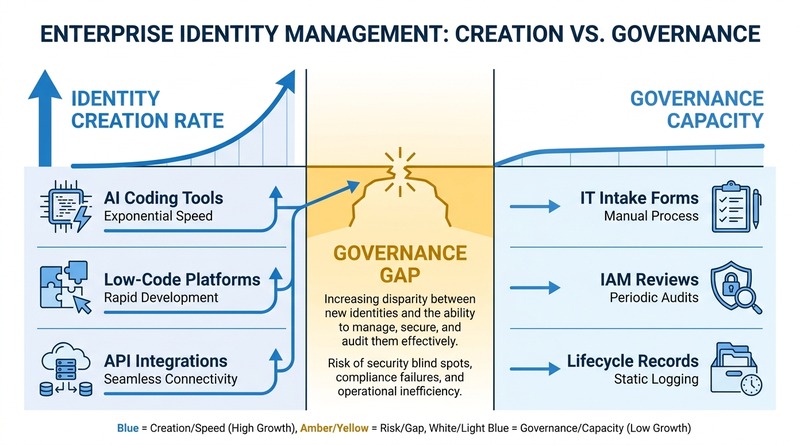
AI-assisted development and citizen developer tools have extended the shadow IT problem into machine identity. A business analyst connects a Power Automate flow to SharePoint using a service account created in three clicks. An IT manager provisions an AI workflow agent with application-level access to a CRM to meet a Friday deadline. A developer using a coding assistant wires three integrations to an internal data service in an afternoon. Each action creates a non-human identity. None of them generates ownership metadata, a data classification record, or a lifecycle expiration as a required step in the process.
This is not negligence. It is the expected output of tools built to make integration fast. The governance gap is structural, not behavioral, and it compounds with every application that bypasses a formal identity intake. The machine identity trail left by AI-built and low-code applications joins an existing pool of undocumented credentials that no team has the time or the mandate to map retroactively. When the developers or business analysts who created these connections leave, the ownership gap becomes permanent until something breaks or an auditor asks.
The Political Problem Security Teams Inherit
The larger obstacle in any enterprise service account audit is not discovery. Most identities are findable. The problem is authorization for what comes after the list is produced.
Many of the accounts surfaced in a structured audit are not orphaned. They are actively depended upon by finance, logistics, or clinical operations teams whose owners did not create them, do not maintain them, and will not authorize downtime to replace them. The Director of Revenue Operations who built a quarterly reconciliation workflow around an API key that has never been rotated is not available for a two-hour service window without escalation to a CIO. The cost of remediation falls on the security team. The resistance is owned by the business unit that provisioned the credential two years ago without an intake form and has been relying on it since.
This is what centralized non-human identity platforms cannot resolve. They can govern identities they can authenticate and discover. They cannot settle the political gap between the team carrying audit exposure and the process owner protecting an informal dependency they built and have no incentive to disrupt. The same friction that slows security reviews of new applications compounds when applied retroactively to credentials already embedded in live workflows.
What a Defensible Audit Actually Requires
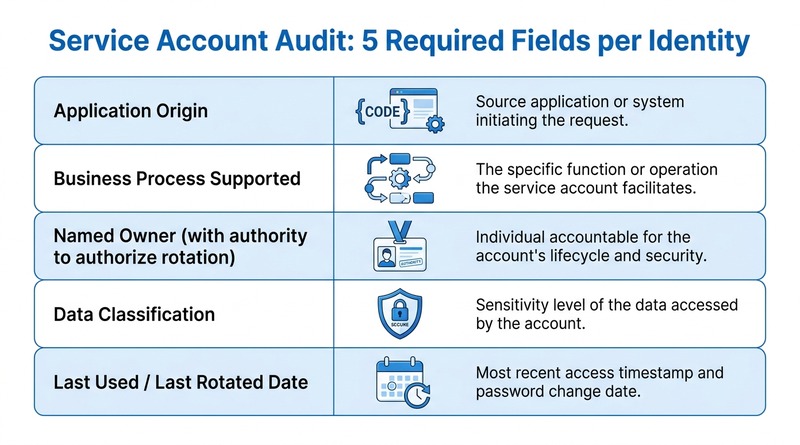
A service account audit that produces something an auditor can act on needs five data points per identity: the application that created it, the business process it supports, the named owner who can authorize rotation or revocation, the data classification of what it accesses, and the last-used and last-rotated dates. Most enterprise IT teams can produce the last two from system logs. The first three require deliberate outreach to business process owners who have no structural incentive to respond without executive framing and a defined accountability model above them.
For SOC 2 reviewers, ITGC auditors, and HIPAA compliance teams, a machine identity inventory without documented ownership is not a control. It is a list. The audit becomes defensible when ownership is established and acknowledged, not when credentials are enumerated. That distinction is the difference between a finding that closes and one that reappears every cycle while the list grows longer.
The Architecture That Stops the Next Accumulation Cycle
Service account sprawl compounds because the standard application development workflow creates credentials before governance catches up. The audit problem is downstream of an architecture problem: applications were built without identity records, so the records have to be reconstructed under audit pressure after the fact.
When a Director of IT or an IT Security Manager describes what they need to CloudApper AI, the application is built on a governed platform where the identity model, access scope, and data classification mapping connect to the enterprise IAM layer before the first integration goes live. There is no credential created outside that record. There is no ownership field left blank. A service account audit in a CloudApper-governed environment returns the same dependency check with ownership, classification, and business process context already attached. That is not a post-hoc cleanup tool. It is what prevents the next audit from starting with forty-one unexpected connections and no one to call.
If your enterprise is running an access review and finding more machine identities than your application inventory can account for, the gap grows with every AI-built or low-code application that reaches production without a governed identity record. A Director of IT who describes their requirements to CloudApper AI gets an application built where non-human identity governance is part of the architecture from day one, not a documentation task assigned to someone who no longer works there. Talk to the CloudApper team to see what that looks like in your environment.

What is CloudApper AI Platform?
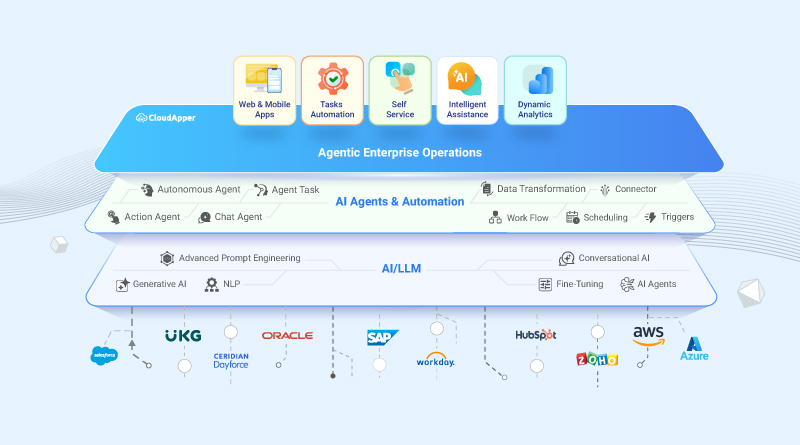
CloudApper AI is an advanced platform that enables organizations to integrate AI into their existing enterprise systems effortlessly, without the need for technical expertise, costly development, or upgrading the underlying infrastructure. By transforming legacy systems into AI-capable solutions, CloudApper allows companies to harness the power of Generative AI quickly and efficiently. This approach has been successfully implemented with leading systems like UKG, Workday, Oracle, Paradox, Amazon AWS Bedrock and can be applied across various industries, helping businesses enhance productivity, automate processes, and gain deeper insights without the usual complexities. With CloudApper AI, you can start experiencing the transformative benefits of AI today. Learn More
- Useful Links:
- Agentic AI
- No-Code/Low-Code
- Custom Software
- HCM Personalization
- iPaaS
- FedRAMP
CloudApper AI Solutions


- Works with








- and more.
Similar Posts

AI Agent Over-Permission: The Access Control Problem Nobody Scoped When…

Power Apps Orphaned App: The IT Ownership Problem That Starts…