Manual review breaks quietly as applicant volume grows. This article lists seven signs you've outgrown manual resume screening, from skimming and uneven scores to slow replies, and shows how consistent scoring, automatic updates, and self-service scheduling give recruiters time back.


Table of Contents
- TL;DR
- 1. Your Recruiters Skim Instead of Read
- 2. Two Recruiters Score the Same Resume Differently
- 3. Applicants Wait Days for a First Reply
- 4. Nobody Can Explain Why a Candidate Was Rejected
- 5. Hiring Managers Keep Sending Shortlists Back
- 6. Recruiters Spend the Day on Scheduling and Follow-Up
- 7. Every Hiring Surge Needs Overtime or Temp Help
- How CloudApper AI Recruiter Addresses Each Sign
- Count Your Signs, Then Decide
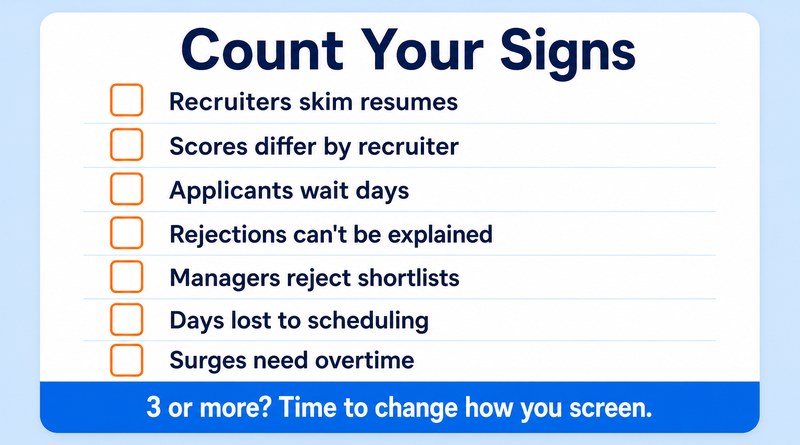
Most recruiting teams don’t notice the day manual review stops working. The stack just keeps growing, and everyone adjusts: recruiters stay late, managers wait a little longer, and candidates hear back a little slower. Because the slide is gradual, it rarely gets flagged as a problem until a strong hire accepts an offer somewhere else. These are the signs you’ve outgrown manual resume screening, and if three or more sound familiar, it is time to change how your team screens. Below, you’ll see what each sign looks like, why it happens, and how CloudApper AI Recruiter handles it inside the ATS you already run, so you can fix the process without replacing anything.
TL;DR
- Manual review stops working when volume outgrows what a team can read.
- Seven signs show it: skimming, uneven scores, slow replies, unexplained rejections, rejected shortlists, scheduling overload, and surge overtime.
- Three or more signs means the process needs to change.
- AI Recruiter scores every resume against one rubric, sends status updates, and books interviews.
- Recruiters still set the criteria and make every hiring decision.
1. Your Recruiters Skim Instead of Read
Start with what you see at the desk. When the queue gets long, recruiters scan for a title or a company name and move on. That is the earliest of the signs you’ve outgrown manual resume screening, and it means strong candidates with unusual career paths get passed over in seconds. The skills that make someone a good hire rarely sit in the first line of a resume, so a fast scan favors familiar job titles over actual ability. Nobody means to work this way. It is simply what happens when one person faces hundreds of files and a deadline.
2. Two Recruiters Score the Same Resume Differently
Skimming leads straight to the next problem. When each recruiter looks for different things, one says yes and another says no to the same resume. That is inconsistent resume screening, and it makes your shortlist depend on who opened the file. Try a quick test: hand the same ten resumes to two recruiters and compare their picks. If the lists barely overlap, you don’t have a screening standard. You have personal preferences, and candidates feel that unfairness even when they can’t name it.
3. Applicants Wait Days for a First Reply
Uneven reviews are also slow reviews. When applicants hear nothing for days, they tend to move on to whichever employer answered first. High-volume applicants rarely wait, and many apply to several employers on the same afternoon. A slow first reply quietly shrinks your pool before a recruiter ever opens the file, so the best candidates may be gone by the time you get to them.
4. Nobody Can Explain Why a Candidate Was Rejected
Speed is one problem. Accountability is another. When a manager or auditor asks why someone was screened out, a recruiter’s memory is not much of an answer. Of all the signs you’ve outgrown manual resume screening, this one carries the most risk, because explainable hiring is quickly becoming the expectation. Without a written reason tied to the role’s criteria, you can’t show that two similar candidates were treated the same way, and that gap is hard to close after the fact.
5. Hiring Managers Keep Sending Shortlists Back
Unclear reasons show up downstream too. Managers who receive shortlists full of low-fit applicants ask for another round, which restarts the review and delays the hire. Each rejected shortlist also costs trust. After a couple of rounds, managers start searching on their own, and your team loses its place as the group that finds talent.
6. Recruiters Spend the Day on Scheduling and Follow-Up
Rework eats time, and so does coordination. When recruiters lose hours to calendar back-and-forth and status emails, little is left for screening or talking to candidates. That administrative time tax grows with every opening you add. A recruiter who spends the morning rescheduling interviews has the afternoon left for a stack of resumes, and that is exactly when skimming starts.
7. Every Hiring Surge Needs Overtime or Temp Help
Leaders usually notice this sign first. If each new contract or seasonal push means overtime or temporary reviewers, the process can’t scale on its own. A ramp-up for a new contract shouldn’t start with extra headcount. Temporary reviewers also need training and bring their own personal standards, which makes the uneven scoring in the second sign even worse.

These signs rarely show up alone. A team that skims usually has uneven scores, and a team with slow replies usually has overloaded recruiters, so each problem feeds the next. Check the list below and count honestly.
How CloudApper AI Recruiter Addresses Each Sign
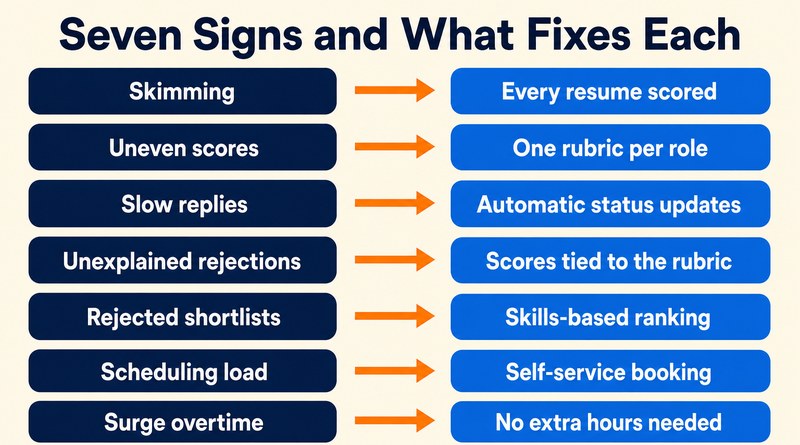
CloudApper AI Recruiter lets your team build a scoring rubric for each role, so every resume is read against the same criteria. Each ranked shortlist shows why a person scored the way they did, which gives you a clear answer when a manager or auditor asks. Skimming stops being a risk because every resume gets scored, not just the ones that catch an eye.
Candidates get status updates automatically, so nobody waits days in silence. Self-service scheduling with reminders takes calendar work off your recruiters, and the same setup absorbs a surge without overtime or temporary reviewers. Your recruiters still set the criteria, review the shortlist, and make every hiring decision. It seamlessly connects with all major ATS and HR systems including UKG, Dayforce, Oracle, iCIMS, Greenhouse, Lever, Bullhorn, and more, so you add it to the system you already use.
Count Your Signs, Then Decide
Count how many of the seven signs match your team. One or two is worth watching. If you found three or more signs you’ve outgrown manual resume screening, the answer is a better process around the people you already have, not more tired reviewers. Your recruiters keep the judgment calls, and the repetitive reading, scoring, and scheduling moves to software, which is where a growing team needs the most help.
CloudApper AI Recruiter brings consistent scoring, faster replies, and time back to your recruiters, and it works with the ATS you already run. Contact us to book a demo and see it on your own roles.

What is CloudApper AI Platform?
CloudApper AI is an advanced platform that enables organizations to integrate AI into their existing enterprise systems effortlessly, without the need for technical expertise, costly development, or upgrading the underlying infrastructure. By transforming legacy systems into AI-capable solutions, CloudApper allows companies to harness the power of Generative AI quickly and efficiently. This approach has been successfully implemented with leading systems like UKG, Workday, Oracle, Paradox, Amazon AWS Bedrock and can be applied across various industries, helping businesses enhance productivity, automate processes, and gain deeper insights without the usual complexities. With CloudApper AI, you can start experiencing the transformative benefits of AI today. Learn More
- Useful Links:
- Agentic AI
- No-Code/Low-Code
- Custom Software
- HCM Personalization
- iPaaS
- FedRAMP
CloudApper AI Solutions for HR

- Works with








- and more.
Similar Posts

Manual, Rule-Based or AI Resume Screening: What Changes at 100,…

Off-the-Shelf vs Customizable AI Recruiting Software: What Enterprise Teams Should…