AI vs manual resume screening comes down to volume. Manual review works at 100 applicants, rules help at 1,000, and AI resume screening becomes necessary by 10,000. This article shows the hours and costs at each level and where recruiters stay in control.

TL;DR
AI vs manual resume screening depends on applicant volume. Manual review works at 100 applicants. Rule-based screening helps at 1,000 but misses wording differences and varies by recruiter. By 10,000 applicants, manual review takes about 500 hours per opening, so AI resume screening is needed. Recruiters still set the rubric and make the final call, which matters because laws on automated hiring tools expect human oversight.
Table of Contents
- How Manual, Rule-Based and AI Resume Screening Compare at Each Volume
- What Manual Screening Costs as Applicants Grow
- Where Rule-Based Screening Stops Working
- Why AI Resume Screening Wins at High Volume
- Why Human-In-The-Loop is Important
- How CloudApper AI Recruiter Keeps Your Team in Control
- Frequently Asked Questions
- Match the Method to Your Volume
Every recruiter knows the feeling of opening a requisition and watching the applications pile up. The next question is usually whether to keep reading resumes by hand, add filters, or bring in software. The answer to AI vs manual resume screening comes down to volume: manual review works at 100 applicants, rules help at 1,000, and AI resume screening is the only practical option by 10,000. CloudApper AI Recruiter lets your team make that move while keeping people in charge of every decision, and this article shows you what changes at each level.
How Manual, Rule-Based and AI Resume Screening Compare at Each Volume
Each method asks something different from your recruiters as applications climb, and the table below shows where each one starts to strain for a single opening. Once you reach the bottom row, most teams move to AI resume screening, which reads each resume for skills and scores it against a rubric.
| Applicants per opening | Manual review | Rule-based screening | AI resume screening |
|---|---|---|---|
| 100 | About 5 hours. Works well, and recruiters can judge each resume. | Optional. Little time saved. | Not needed yet. |
| 1,000 | About 50 hours. Reviewers tire, and standards drift. | Cuts obvious mismatches. Misses wording differences. | Useful. Scores every resume against one rubric. |
| 10,000 | About 500 hours. Not realistic for one team. | Rules pile up and conflict between recruiters. | Needed. Ranks the full pool the same way each time. |
What Manual Screening Costs as Applicants Grow
The hours in that table are based on a simple estimate you can rerun with your own numbers. Say each resume takes 3 minutes to read and your loaded recruiter cost is $30 an hour. At 100 applicants, you spend 5 hours and $150. At 1,000 applicants, it is 50 hours and $1,500. At 10,000 applicants, it is 500 hours and $15,000, which is about 12 workweeks for one person on one opening. Multiply that by every opening you run, and it becomes easy to see how resume overload slows hiring.
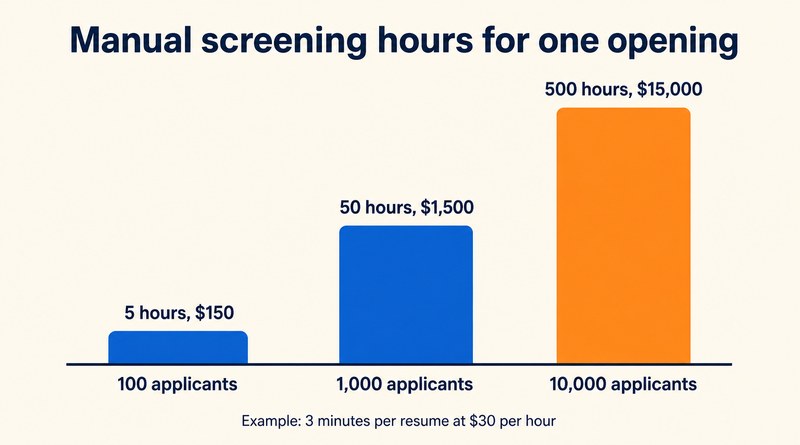
Manual screening time and cost for one opening grow tenfold with each jump in volume.
Where Rule-Based Screening Stops Working
Sitting between AI and manual resume screening, rule-based screening uses knockout questions, required keywords, and other filters to remove clear mismatches. That makes it a sensible step at 1,000 applicants. At higher volume, the cracks show. Rules match words, not skills, so a candidate who writes “stocked and rotated inventory” can miss a rule that looks for “supply chain.” That is inconsistent resume screening, and it is hard to explain when a manager asks why someone was dropped.
Why AI Resume Screening Wins at High Volume
So what holds up at 10,000 applicants? In AI vs. manual resume screening, the winner at this size is the one that scores every applicant against the same rubric. It reads every resume, so good candidates in the bottom half of the pile still get seen. It looks for skills, so the person who describes the same work in different words still gets credit. It applies identical criteria at 9 a.m. and 9 p.m. And it is fast enough that a lean team can handle a high volume of applications without skimming, while candidates still hear back when they are interested.
Why Human-In-The-Loop is Important
Speed alone is not the goal, though. Rules for automated hiring tools are growing. New York City, for example, requires employers to have certain automated employment decision tools audited for bias and to notify candidates. A screening process that runs without any human involvement leaves you, as the employer, carrying that risk.

There is a practical reason too. A score is only useful if someone can explain it. When a hiring manager, a candidate, or an auditor asks why a person ranked where they did, “the software said so” is not an answer. A recruiter who reviews the shortlist, sets the criteria, and makes the final call can give a real one. So the question is not whether to use AI resume screening at high volume. It is how to use AI while keeping humans in the loop.
How CloudApper AI Recruiter Keeps Your Team in Control
CloudApper AI Recruiter lets you tailor the screening rubric for each role, then screens, scores, and ranks every applicant against it, so your team starts from a ranked shortlist instead of a pile. It seamlessly integrates with all major ATS and HR systems, including UKG, Dayforce, Oracle, iCIMS, Greenhouse, Lever, and Bullhorn.
People stay in charge where it matters. Your recruiters set the rubric, so the criteria come from the job. Each score ties back to that rubric, so you can see why a candidate ranked where they did. Recruiters review the shortlist, handle edge cases, and make every hiring decision, which is the human oversight automated hiring rules look for. Standard scoring also reduces the room for bias that creeps in with subjective review. Keep a record of how automated screening for hourly jobs reaches each decision, review score patterns on a regular schedule, and you will have answers ready when someone asks.
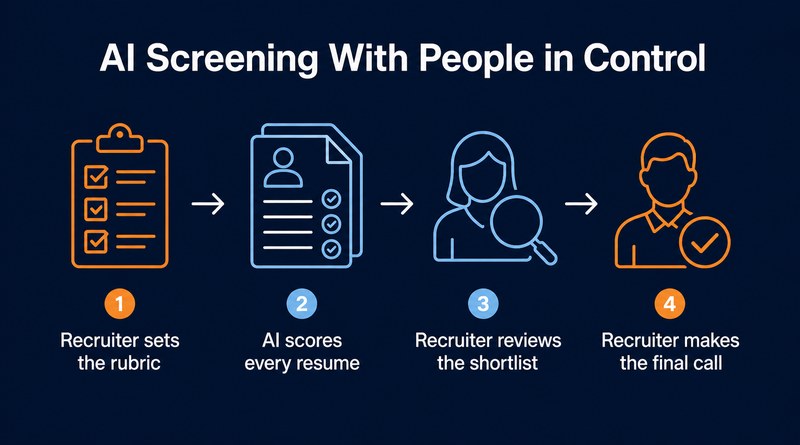
AI scores the pile, and your recruiters set the rules and make every decision.
Frequently Asked Questions
At What Volume Does Manual Resume Screening Stop Working?
There is no universal number, but most teams feel it’s around 1,000 applicants per opening. At 3 minutes per resume, that is 50 hours of reading before a single interview is scheduled.
Is Rule-Based Screening Enough for High-Volume Hiring?
It helps remove clear mismatches. It struggles when candidates describe the same skill in different words, so most high-volume teams pair it with AI resume screening.
Does AI Resume Screening Replace Recruiters?
No. AI scores every applicant the same way and returns a ranked list. Recruiters set the criteria, review the shortlist, and decide who moves forward, which is the human oversight laws on automated hiring tools expect.
How Do I Check That AI Screening Is Fair?
Tie the scoring criteria to the job, review score patterns on a regular schedule, and keep a record of how each score was reached. A recruiter should review every shortlist before anyone is contacted.
Match the Method to Your Volume
AI vs manual resume screening comes down to volume. Manual review fits 100 applicants; rules help with around 1,000; and AI-based resume screening with human review is the practical choice at 10,000, where manual review would take about 500 hours per opening. CloudApper AI Recruiter gives you that last stage on top of your existing HR system, with your recruiters in control.
Contact us for a demo and see how it screens your own roles.

What is CloudApper AI Platform?
CloudApper AI is an advanced platform that enables organizations to integrate AI into their existing enterprise systems effortlessly, without the need for technical expertise, costly development, or upgrading the underlying infrastructure. By transforming legacy systems into AI-capable solutions, CloudApper allows companies to harness the power of Generative AI quickly and efficiently. This approach has been successfully implemented with leading systems like UKG, Workday, Oracle, Paradox, Amazon AWS Bedrock and can be applied across various industries, helping businesses enhance productivity, automate processes, and gain deeper insights without the usual complexities. With CloudApper AI, you can start experiencing the transformative benefits of AI today. Learn More
- Useful Links:
- Agentic AI
- No-Code/Low-Code
- Custom Software
- HCM Personalization
- iPaaS
- FedRAMP
CloudApper AI Solutions for HR

- Works with








- and more.
Similar Posts

Off-the-Shelf vs Customizable AI Recruiting Software: What Enterprise Teams Should…
Video Screening Questions: Scorecard and Templates by Role