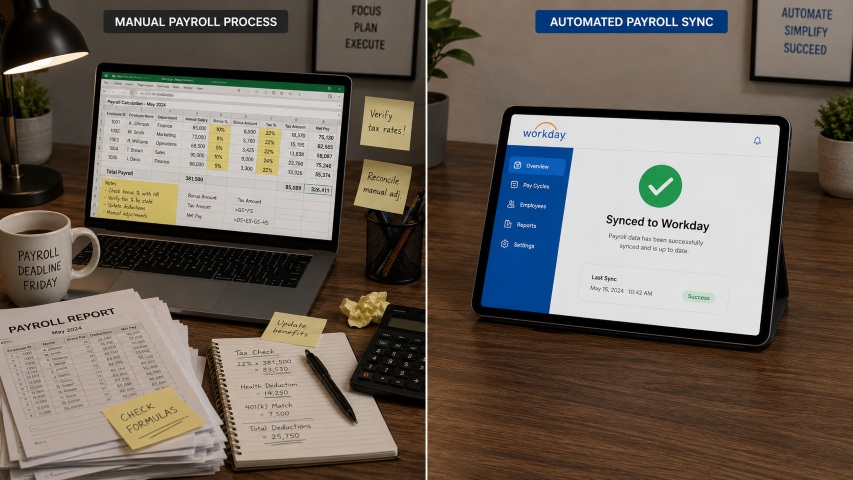
CloudApper hrPad enhances job satisfaction by automating HR tasks, reducing administrative burdens, and empowering employees. Its features like self-service portals and AI support foster autonomy and trust, leading to a more satisfied and productive workforce.


Table of Contents
- What hrPad is (and why it’s built for frontline reality)
- 1) Satisfaction rises when pay and time feel accurate and fair
- 2) Satisfaction improves when employees can self-serve (without begging HR)
- 3) Satisfaction rises when HR support is instant, not “submit a ticket”
- 4) Satisfaction improves when scheduling feels transparent and predictable
- 5) Satisfaction increases when compliance feels protective, not punitive
- How hrPad fits into your existing HCM ecosystem
- What to measure after rollout (so you can prove satisfaction impact)
- The bottom line: hrPad improves satisfaction by removing friction, not adding tech
- FAQ
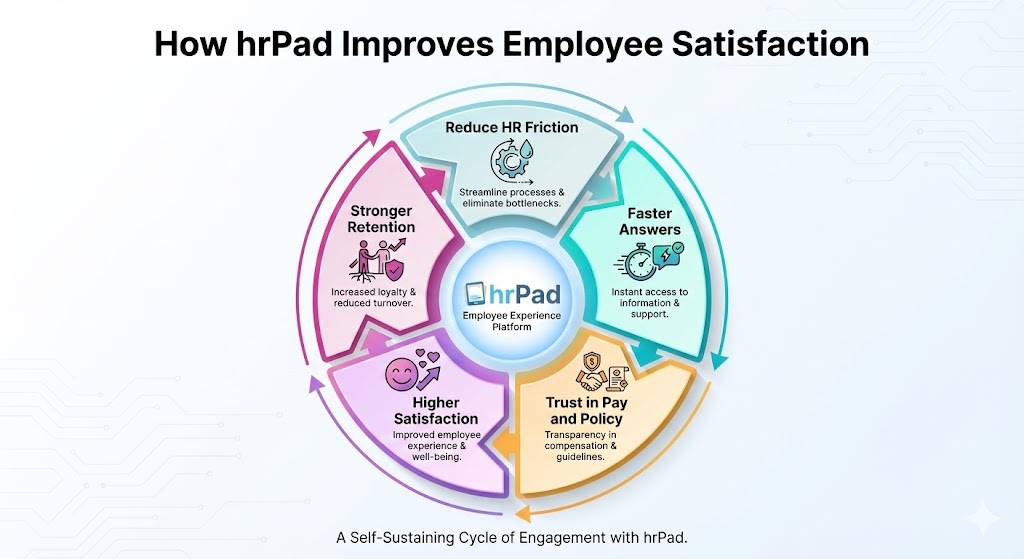
Employee satisfaction is rarely about one big perk. It’s about whether work feels fair, simple, and supported every single day—especially for frontline teams who don’t sit at a desk, don’t live in email, and don’t have time to chase HR for basic answers.
That daily experience matters financially. Gallup’s long-running research connects higher engagement to measurable performance outcomes, including stronger profitability. Harvard Business Review has also highlighted market outperformance among companies scoring higher on employee happiness measures over time. So the real question becomes: what are the repeatable levers that improve satisfaction? In practice, it’s reducing the “micro-frictions” employees face—unclear schedules, payroll mistakes, slow HR responses, and clunky processes.

That’s exactly where CloudApper hrPad fits: it’s a frontline-friendly HR self-service kiosk experience (tablet-based) that helps teams handle the most common HR moments—time, schedules, policy questions, PTO requests—without waiting in line for HR.
Quick answer
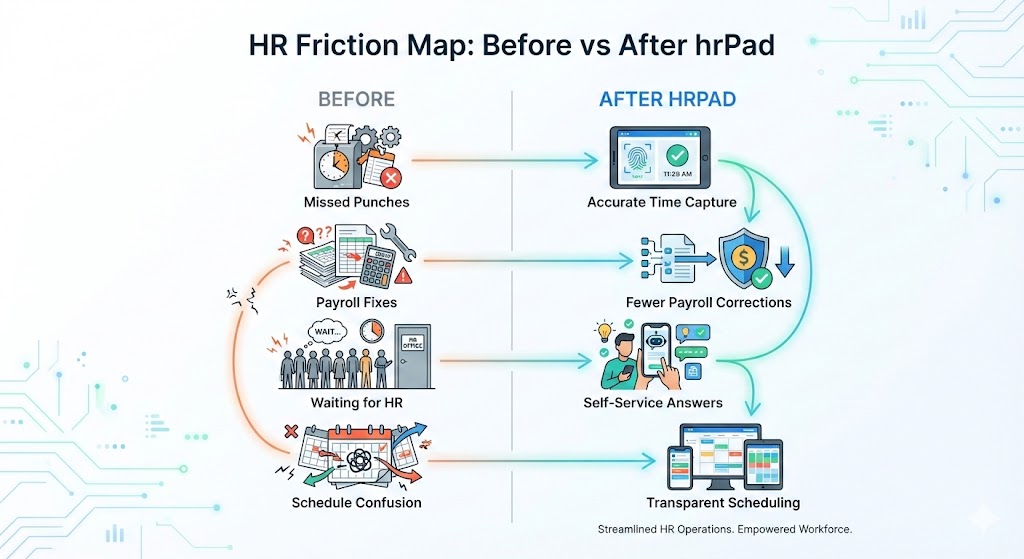
CloudApper hrPad improves employee satisfaction by reducing daily HR friction: it makes time capture more accurate, gives employees self-service access to common tasks, provides instant answers via AI support, and helps HR enforce consistent workflows across sites.
What hrPad is (and why it’s built for frontline reality)
Many employee experience tools assume every worker has a laptop, a corporate inbox, and time to navigate a portal. Frontline organizations know that’s not the norm.
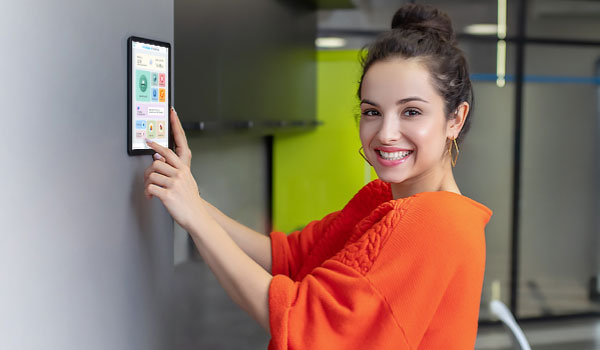
hrPad is a tablet-based HR self-service kiosk experience designed for high-volume environments—manufacturing, retail, healthcare, field services—where speed, simplicity, and consistency matter. Employees can complete common tasks in seconds, right where work happens, without hunting down a manager or calling HR.
The experience is intentionally practical: quick authentication, guided workflows, and “do the thing right now” design.
1) Satisfaction rises when pay and time feel accurate and fair
Nothing damages trust faster than payroll surprises.
When employees believe timekeeping is inconsistent—or that someone else can game the system—satisfaction drops quickly because the workplace feels unfair. “Buddy punching” and time theft aren’t just operational problems; they create cultural resentment.
Independent research has estimated that biometric verification can reduce “buddy punching” losses by helping organizations save around 2.2% of gross payroll in some deployments.
How hrPad helps in the real world
-
Captures time in a controlled, consistent flow (reducing missed punches and cleanup).
-
Supports modern clock-in methods such as Face ID-style verification and QR-based options (depending on configuration), which reduces “someone punched for me” scenarios.
-
Reduces payroll corrections—one of the most common frontline trust killers—by improving the quality of time data upstream.
Why this improves satisfaction: employees don’t have to fight to get paid correctly, managers spend less time fixing exceptions, and HR isn’t stuck doing forensic work every pay period.
2) Satisfaction improves when employees can self-serve (without begging HR)
Frontline employees often experience HR as “a locked door”: forms they can’t find, policies they can’t access, and requests that disappear into a queue.
Self-service flips that experience. Employees get autonomy, and HR gets fewer repetitive tickets.
Research on employee engagement consistently shows that better employee experience and engagement correlate with stronger business outcomes. More specifically, studies on employee self-service (ESS) have found positive relationships with autonomy, reduced administrative delays, and improved access to HR services.
What hrPad self-service looks like
Instead of “email HR,” employees can handle common needs on the spot:
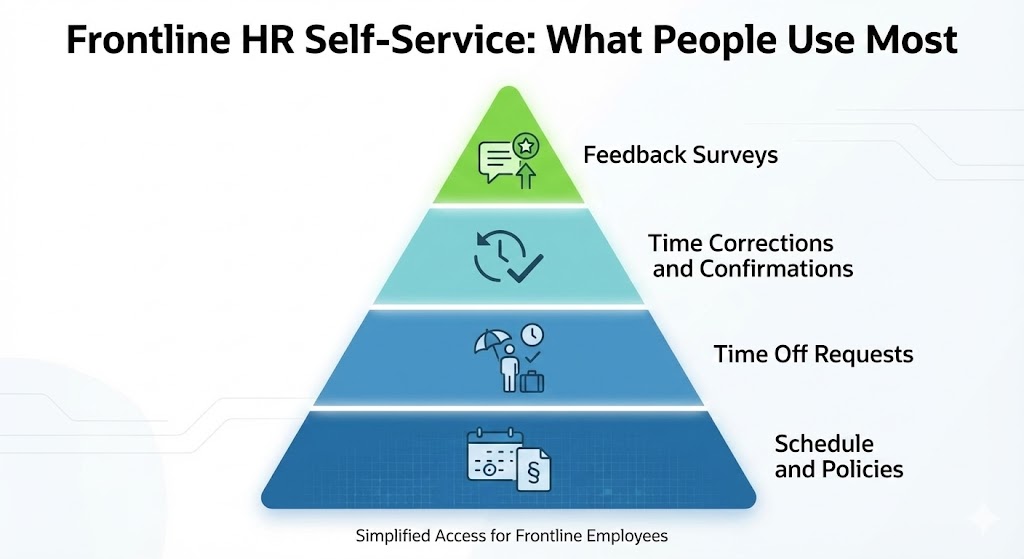
- View schedules and key shift details
- Request time off (and reduce back-and-forth)
- Access policy guidance and HR FAQs
- Complete simple confirmations and workflow steps without hunting down forms
Why this improves satisfaction: autonomy is a retention lever. People feel respected when the organization trusts them with basic tasks and doesn’t make them wait for routine answers.
3) Satisfaction rises when HR support is instant, not “submit a ticket”
If you want a simple way to measure HR friction, track this: how long does it take for an employee to get a straight answer? On the frontline, even small delays create outsized frustration because employees are working in the flow of operations.
Gallup’s global reporting on engagement continues to emphasize the economic impact of disengagement and lost productivity at scale. In practical terms, faster answers reduce frustration and help employees feel supported.
hrPad’s approach to support
hrPad can provide 24/7, on-demand guidance through an AI assistant experience—so employees can get help with policies, processes, and “what do I do next?” questions immediately, without waiting for HR office hours.
This isn’t just convenience. It changes how employees emotionally experience the organization: less uncertainty, less waiting, fewer dead ends.
4) Satisfaction improves when scheduling feels transparent and predictable
Schedules are one of the biggest drivers of frontline stress. Unclear shift information, last-minute surprises, and confusing swaps can make employees feel like they have no control over their lives.
A better employee experience here usually comes down to two things:
-
Clear visibility of shifts and expectations
-
Fewer manual handoffs that create mistakes
hrPad supports a more consistent “single path” for schedule-related actions so employees aren’t bouncing between text messages, paper notes, and unanswered calls.
Why this improves satisfaction: predictability is stability. Stability is retention.
5) Satisfaction increases when compliance feels protective, not punitive
Most employees don’t think in terms of “compliance,” but they absolutely notice when rules protect them—or when rules are inconsistently applied.
hrPad can support structured workflow steps that help organizations consistently apply policies (for example, capturing acknowledgements, guiding required attestations, or ensuring the right prompts appear at the right time). The key benefit isn’t bureaucracy—it’s fairness and clarity.
Important note on biometrics and trust
Biometric tools can improve accuracy, but they must be implemented with respect for privacy, consent, and proportional use. Regulators have taken action when workplace biometric processing is not handled appropriately, and public backlash is real when employees feel surveillance pressure.
If you position identity verification as “we don’t trust you,” satisfaction drops. If you position it as “we’re protecting your pay accuracy and preventing fraud, with safeguards,” satisfaction rises.
How hrPad fits into your existing HCM ecosystem
Frontline tools often fail because they become yet another silo.
hrPad is designed to connect into established HCM environments (for example, UKG ecosystems and others) so time, attendance, and workflow outcomes don’t live in a disconnected side system. That matters for employee experience because it prevents the classic problem: “the kiosk says one thing, payroll says another.”
When data flows cleanly, employees experience the organization as consistent—and consistency is a trust builder.
What to measure after rollout (so you can prove satisfaction impact)
If you want this page to build authority and help buyers, you need measurement guidance. These are the metrics HR leaders actually track:
- Payroll correction rate (before vs. after)
- Missed punch volume
- Time-to-answer for common HR questions
- HR ticket volume for routine requests
- Schedule-related disputes / last-minute escalations
- Employee sentiment pulse focused on fairness, ease, and responsiveness
When these improve, satisfaction tends to rise because the “daily annoyances” shrink.
The bottom line: hrPad improves satisfaction by removing friction, not adding tech
Employee satisfaction doesn’t rise because a tool is “AI-powered.” It rises when work becomes easier, pay becomes more reliable, and getting help stops being a hassle.
CloudApper hrPad supports that outcome by:
-
Improving time capture accuracy and reducing downstream payroll issues
-
Enabling practical frontline self-service that reduces administrative delays
-
Providing faster access to HR guidance, which reduces day-to-day frustration
-
Supporting more consistent, policy-aligned workflows without creating more complexity
If your goal is a more satisfied workforce, start by eliminating the small friction points employees fight every week. That’s where satisfaction becomes sustainable—and where performance follows.
If you want to see how hrPad can work in a frontline environment like yours, explore CloudApper hrPad and map the highest-friction HR moments you want to eliminate first.
FAQ
What is an HR self-service kiosk?
An HR self-service kiosk is a shared, easy-to-use device (often a tablet) that lets employees complete common HR tasks—like time capture, schedule checks, and requests—without needing a computer, email account, or HR assistance.
How does hrPad improve employee satisfaction?
It reduces HR friction by improving time accuracy, enabling self-service, and giving employees faster access to answers—leading to fewer payroll disputes, fewer delays, and a more predictable day-to-day experience.
Does biometric timekeeping improve payroll accuracy?
It can, when implemented responsibly. Research has reported savings tied to reducing buddy punching, and organizations often see fewer time disputes when identity verification is consistent.
How do we avoid privacy backlash with biometrics?
Use clear consent, offer alternatives where needed, minimize data retention, secure storage, and explain the purpose as pay protection and fraud prevention—not surveillance. Regulators have acted when employers used biometrics without appropriate safeguards.
What is CloudApper AI Platform?
CloudApper AI is an advanced platform that enables organizations to integrate AI into their existing enterprise systems effortlessly, without the need for technical expertise, costly development, or upgrading the underlying infrastructure. By transforming legacy systems into AI-capable solutions, CloudApper allows companies to harness the power of Generative AI quickly and efficiently. This approach has been successfully implemented with leading systems like UKG, Workday, Oracle, Paradox, Amazon AWS Bedrock and can be applied across various industries, helping businesses enhance productivity, automate processes, and gain deeper insights without the usual complexities. With CloudApper AI, you can start experiencing the transformative benefits of AI today. Learn More
- Useful Links:
- Agentic AI
- No-Code/Low-Code
- Custom Software
- HCM Personalization
- iPaaS
- FedRAMP
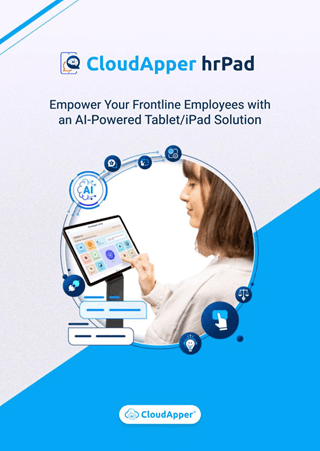
Brochure
CloudApper hrPad
Empower Frontline Employees with an AI-Powered Tablet/iPad Solution
Download Brochure
CloudApper AI Solutions for HR
- Works with







- and more.
Similar Posts
Certified Payroll Compliance: Why Davis-Bacon Failures Start at the Time…
Shift Swap Pay Rate Accuracy: Confirming Who Actually Worked Before…