UKG, Workday, and Dayforce weren't built to capture tip declarations or calculate pool distributions. Most restaurant operators fill that gap with spreadsheets — and pay for it in admin hours and IRS exposure. CloudApper automates restaurant tip pooling and payroll integration without replacing your existing HCM.
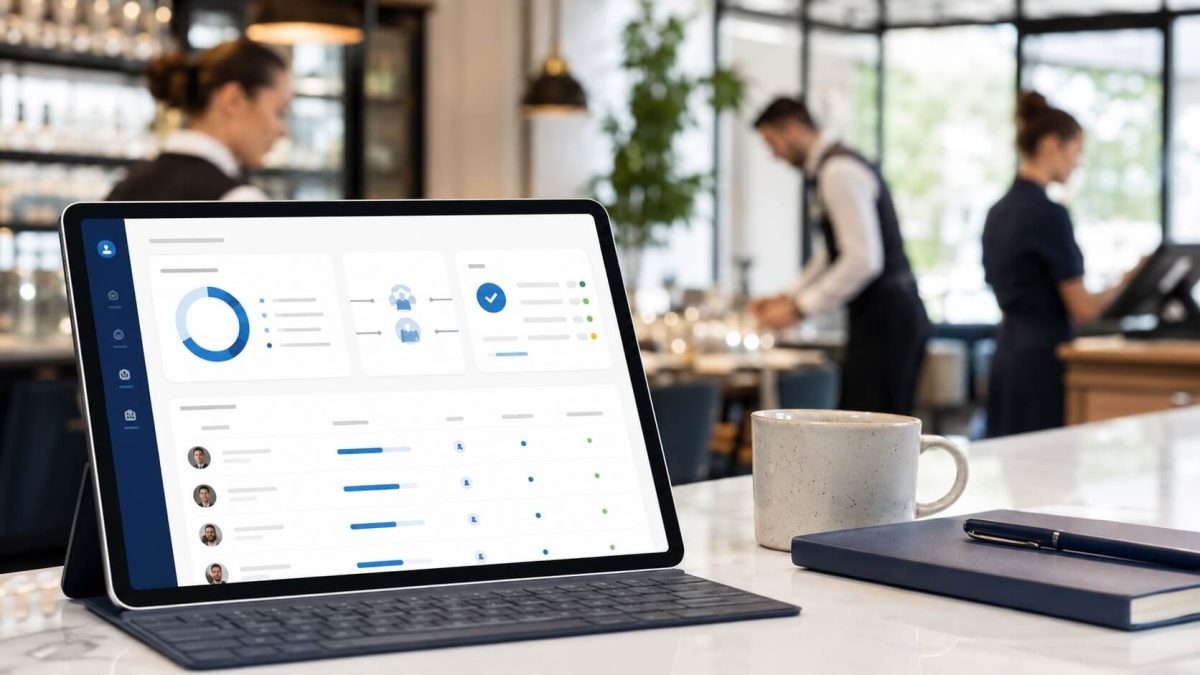
Table of Contents
- TL;DR
- What “Restaurant Tip Pooling Payroll Integration” Actually Means
- The Specific Gap in UKG, Workday, and Dayforce
- Why the Spreadsheet “Solution” Is a Compliance Liability
- What Automated Restaurant Tip Pooling Payroll Integration Looks Like
- Who This Actually Affects
- Adding the Integration Layer Without Replacing Your HCM
- FAQ
- Worth Looking At If Any of This Sounds Familiar
Ask any payroll manager at a restaurant group running UKG or Workday how tip pooling gets into payroll, and you’ll get one of two answers. Either a long pause, or a spreadsheet name.

That spreadsheet — whatever it’s called, wherever it lives — is doing a job that nobody officially assigned to it. It’s the bridge between what happened on the floor and what ends up in your HCM. It’s also where tip pooling errors start, where IRS audit exposure builds quietly, and where half an hour of nightly math turns into a permanent staffing cost nobody budgeted for.
Restaurant tip pooling and payroll integration isn’t a feature gap that snuck up on anyone. It’s a structural problem that the major HCM platforms were never designed to solve — and most operators are working around it every single day.
TL;DR
UKG, Workday, and Dayforce process payroll well but have no native way to capture tip declarations, calculate pool distributions, or route that data to payroll automatically. Most restaurant operators fill that gap with spreadsheets and manual entry — creating hours of daily admin work and real IRS audit exposure. CloudApper’s Tip Management Solution plugs directly into your existing HCM, automates the full tip pooling workflow from employee declaration to payroll sync, and keeps per-shift audit records without replacing your platform.
Effortlessly Manage Employee Tips & Gratuities for HCM Compliance CloudApper Tip Management Solution
What “Restaurant Tip Pooling Payroll Integration” Actually Means
Strip away the jargon and you’re describing a three-step problem. First, someone has to collect tip declarations from every tipped employee at the end of every shift. Second, those raw numbers have to be run through your pooling rules — whatever split your org uses across servers, bussers, bartenders, hosts, kitchen staff — to calculate what each person actually earns. Third, those calculated amounts have to land in your payroll system as the right type of earning, in the right field, before the next pay run.
When that pipeline works automatically, tip pooling is a background process. When it doesn’t, it’s a daily manual job.
In most restaurant groups, it doesn’t. Not natively, anyway. The HCM handles step three reasonably well. Steps one and two are still being done by a person with a calculator.
The Specific Gap in UKG, Workday, and Dayforce
These are serious, enterprise-grade platforms. That’s not in question. But none of them were built for the restaurant floor, and that shows up sharply in how they handle — or don’t handle — tip pooling.
UKG Pro and UKG Ready have tip earning codes. M001, M002, or however your configuration maps them. They’ll accept tip amounts and process them through payroll correctly. What they won’t do is ask your server to declare their end-of-shift tips, calculate the pool split for that shift, or build the manager approval step that creates an audit trail. UKG sees the output. Someone else has to produce it.
Workday is similar. Tip data can go in as compensation supplements or expense line items depending on how your org has structured it. But Workday doesn’t have a tip declaration interface, a pool calculation engine, or a way for a floor manager to review and approve distributions before they hit payroll. It processes whatever comes in. Getting that data in correctly is entirely on your team.
Dayforce handles scheduling and time-tracking well, which is part of why hospitality operators like it. But tip pooling with configurable distribution rules — especially across multiple locations with different state requirements — isn’t native functionality. Most Dayforce users end up with a spreadsheet or a third-party tool sitting between their POS and their HCM, with manual import steps at each end.
The pattern is consistent: the HCM is downstream of the actual problem. The actual problem is capture, calculation, and routing — and that’s happening offline.
Why the Spreadsheet “Solution” Is a Compliance Liability
It’s easy to underestimate how much risk sits in that spreadsheet. Here’s what it actually carries:
IRS daily recordkeeping: The IRS requires daily records of employee-declared tips and employer tip allocations. A spreadsheet that gets filled in at the end of each shift might technically satisfy this — until someone asks for 90 days of it, all consistent, all timestamped, with the pool calculation logic documented. At that point, “we have it in a file somewhere” is not a strong position.
State law variation: California prohibits managers and supervisors from participating in tip pools. Several other states have their own restrictions on which roles can be included, how often distributions have to be made, and what records employers must keep. A multi-location operator running a single spreadsheet template across all locations may be compliant in some states and not in others — without knowing it.
Payroll entry errors: Manual re-keying is where numbers go wrong. A transposed digit, a missed employee, a pool percentage that got updated in the rules but not in the formula — these are small errors that compound. And when a tipped employee notices their pool share has been consistently short, even by a few dollars, you’re one complaint away from a Department of Labor inquiry.
No audit trail: If a dispute arises over a tip pool distribution, “we ran it through the spreadsheet” doesn’t tell you who approved it, what the inputs were, or whether the calculation matched your stated policy. A proper system timestamps every declaration, every calculation, and every manager approval. A spreadsheet doesn’t.
What Automated Restaurant Tip Pooling Payroll Integration Looks Like
The right architecture is straightforward. You need something that sits between your restaurant floor and your HCM — capturing tip data at the source, running the math automatically, routing approved distributions to payroll without human re-entry.
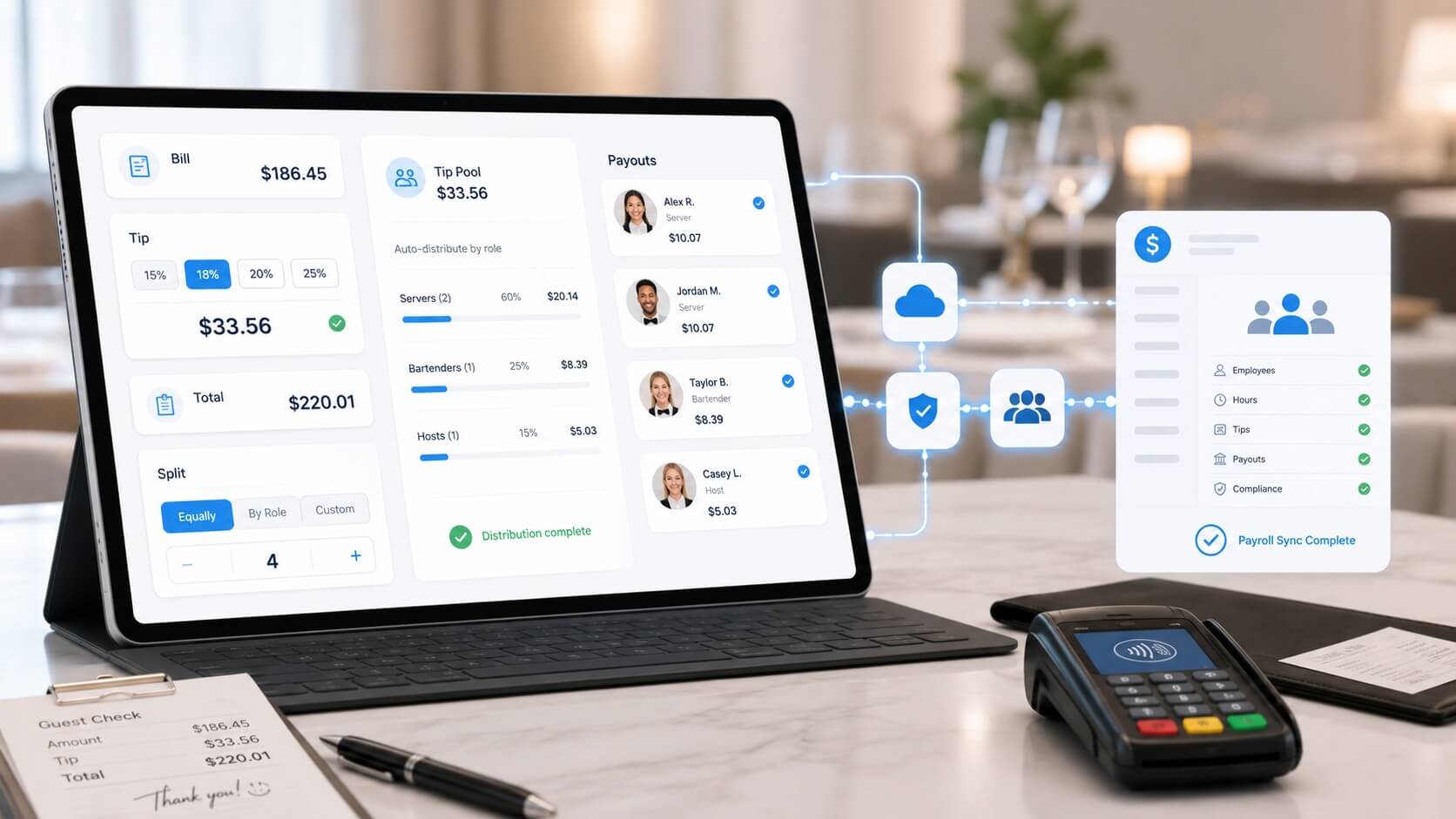
In practice, that means employees declare tips at shift end through a mobile app or a manager-facing kiosk. The system takes those declarations, applies your pool rules, and produces a distribution breakdown for each employee. A manager reviews it, adjusts anything that looks off, and approves. Approval triggers a sync to your HCM — structured payroll entries that map to the right fields in UKG, Workday, Dayforce, or whichever platform you run.
The manager’s review step matters more than it might seem. It’s not just a quality check — it’s what creates a defensible audit trail. Every approval is timestamped. Every adjustment is logged. The calculation logic is documented against a specific set of rules. If the IRS or a state labor board asks for records, you have them, organized by employee, by shift, by location.
What doesn’t happen: nobody exports a spreadsheet. Nobody re-keys numbers. The payroll team receives tip data the same way they receive timecard data — as a structured input from a system, not as a file from someone’s desktop.
Who This Actually Affects
The operators who feel this most acutely tend to share a few characteristics: they’re running 50 or more tipped employees, they have multiple locations, and they’re on an enterprise HCM that handles everything except this.
Restaurant groups are the most obvious case — high declaration volume, complex pool rules, daily cadence. But the same problem shows up in hotel F&B operations managing pooled gratuities across banquet staff and room service. In casinos, where dealer tip pools run across multiple shifts and pit configurations. In resort spas tracking therapist gratuities. In any operation where tips are a meaningful part of compensation and the manual process has quietly become someone’s full-time side job.
The size that tends to trigger a real solution: somewhere around the point where manual tip entry is taking more than an hour a day. Below that, people tolerate it. Above it, they start looking.
Adding the Integration Layer Without Replacing Your HCM
The hesitation most operators have is reasonable: they’ve invested in UKG, Workday, or Dayforce, and they don’t want to introduce another platform that creates more complexity rather than less.
The right approach isn’t replacement — it’s extension. A purpose-built tip management layer that connects to your existing HCM through its payroll API handles the capture-and-calculate problem without touching anything else you’ve built. Your HCM still runs payroll. Your team still uses the same interfaces. The tip data just arrives in the right format, automatically, instead of being typed in by hand.
CloudApper’s Tip Management Solution works this way. It runs on the CloudApper CloudApper AI platform and integrates directly with UKG Pro, UKG Ready, Workday, Dayforce, Oracle HCM, SAP SuccessFactors, and other major platforms. Tip declarations come in through mobile or kiosk. Pool rules run automatically. Managers approve through a review interface that builds the audit trail as they work. Approved distributions sync to payroll as structured entries, mapped to your platform’s earning codes or compensation elements.
Operators who’ve implemented it typically describe two immediate changes: daily tip entry stops being a staffing cost, and audit readiness stops being a concern they push off.
FAQ
Q1: What is restaurant tip pooling payroll integration?
It’s the automated workflow that captures employee tip declarations at shift end, calculates pool distributions based on your org’s rules, gets manager approval, and syncs those amounts directly to your payroll system as structured earning entries — without manual data entry at any step.
Q2: Why doesn’t UKG, Workday, or Dayforce handle tip pooling natively?
These platforms are built for payroll processing, not tip data capture. They can receive and process tip amounts once someone puts them in, but they have no interface for employees to declare tips, no pool calculation engine, and no manager approval workflow. That part of the process still happens offline for most operators.
Q3: What are the IRS requirements for restaurant tip pooling records?
The IRS requires daily records documenting what each employee declared, what the employer allocated, and how pool distributions were calculated. Employers must withhold taxes on tip income each pay period and report accurately on W-2s. Reconstructed or approximate records — common with manual spreadsheet processes — often don’t satisfy close audit scrutiny.
Q4: How does tip pool calculation work across multiple restaurant locations?
Pool calculations typically run per location per shift, applying rules specific to that location’s staff mix and state law. California, for example, prohibits managers from participating in tip pools. A multi-location system needs to support location-specific distribution rules rather than applying a single template across all sites.
Q5: How does CloudApper’s tip pooling integration connect to UKG, Workday, or Dayforce?
CloudApper’s Tip Management Solution uses each platform’s payroll API to push approved tip distributions as structured payroll entries — mapped to UKG earning codes, Workday compensation supplements, Dayforce wage types, or Oracle payroll elements depending on your platform. No spreadsheet export or manual import is required.
Q6: How long does it take to implement restaurant tip pooling payroll integration?
Implementation timelines vary by platform and configuration complexity, but most operators are live within a few weeks. The setup primarily involves configuring your pool rules, connecting to your HCM via API, and training managers on the approval interface — not a rip-and-replace of your existing payroll infrastructure.
Worth Looking At If Any of This Sounds Familiar
If your tip pooling workflow involves a spreadsheet, a manual payroll import, or someone spending meaningful time each day on data entry that your HCM should theoretically handle — that’s the gap this solves.
Contact CloudApper to schedule a 30-minute demo and see how the integration maps to your specific HCM setup. The conversation is about your actual workflow, not a generic product walk-through.
CloudApper’s Tip Management Solution integrates with UKG Pro, UKG Ready, Workday HCM, Ceridian Dayforce, Oracle HCM, SAP SuccessFactors, and other enterprise HCM platforms. Learn more about the solution.

What is CloudApper AI Platform?
CloudApper AI is an advanced platform that enables organizations to integrate AI into their existing enterprise systems effortlessly, without the need for technical expertise, costly development, or upgrading the underlying infrastructure. By transforming legacy systems into AI-capable solutions, CloudApper allows companies to harness the power of Generative AI quickly and efficiently. This approach has been successfully implemented with leading systems like UKG, Workday, Oracle, Paradox, Amazon AWS Bedrock and can be applied across various industries, helping businesses enhance productivity, automate processes, and gain deeper insights without the usual complexities. With CloudApper AI, you can start experiencing the transformative benefits of AI today. Learn More
- Useful Links:
- Agentic AI
- No-Code/Low-Code
- Custom Software
- HCM Personalization
- iPaaS
- FedRAMP
Brochure
CloudApper hrPad
Empower Frontline Employees with an AI-Powered Tablet/iPad Solution
Download Brochure
CloudApper AI Solutions for HR

- Works with








- and more.
Similar Posts
Free Restaurant Tip Calculator — And Why Your Team Shouldn’t…
Tip Distribution in Restaurants: Why UKG, Workday, and Dayforce Users…