- What SOC 2 Is Actually Testing
- The Specific Problems AI Coding Tools Create for SOC 2
- Why “We’ll Just Review the Code” Isn’t Enough
- What Structural Governance Looks Like in Practice
- The Shadow AI Problem in SOC 2 Contexts
- The Maintenance Finding Nobody Anticipates
- Your SOC 2 Pre-Audit Checklist for AI Coding Tools
- Multi-Framework Compliance: When SOC 2 Isn’t the Only Standard
- The Honest Assessment
- Talk to CloudApper Before Your Next SOC 2 Audit
To pass a SOC 2 audit when your dev team uses AI coding tools, you need to show that AI-generated code meets the same security and governance standards as everything else in your environment. Auditors don’t much care whether you use AI. They care whether you can prove that what it wrote was reviewed and controlled.
For years, SOC 2 prep followed a predictable pattern built around access controls, encryption and incident response. AI-generated code added a question most IT directors weren’t ready for, and for many teams the honest answer is still sort of. CloudApper is one option for internal apps, since apps built on it inherit platform-level controls, but the steps below apply whatever tools you use.
What SOC 2 Is Actually Testing
SOC 2 is built around five Trust Service Criteria: security, availability, processing integrity, confidentiality, and privacy. The audit evaluates whether your controls actually satisfy those criteria — not whether you have a policy document that says they do.
When AI coding tools enter the picture, three criteria get complicated fast.

Security (CC6 and CC7): Your logical access controls and system monitoring requirements apply to everything in your environment — including applications built with AI assistance. If an AI tool generated your authentication module, your session management logic, or your data access layer, those components need to meet the same standards as code a senior engineer reviewed line by line. Auditors will ask how you verified that.
Processing Integrity (PI1): Your systems need to process data completely, accurately, and in accordance with applicable requirements. AI-generated code that creates its own data handling patterns — outside your established architecture — introduces processing integrity risk. Each new application with its own database schema and its own access rules is another component you have to account for.
Confidentiality (C1): If your applications handle confidential information (and most enterprise applications do), you need controls that protect it. AI tools that generate data access logic without visibility into your confidentiality requirements can produce code that technically works but doesn’t enforce the boundaries you think it does.
None of this is theoretical. These are the gaps that show up as findings.
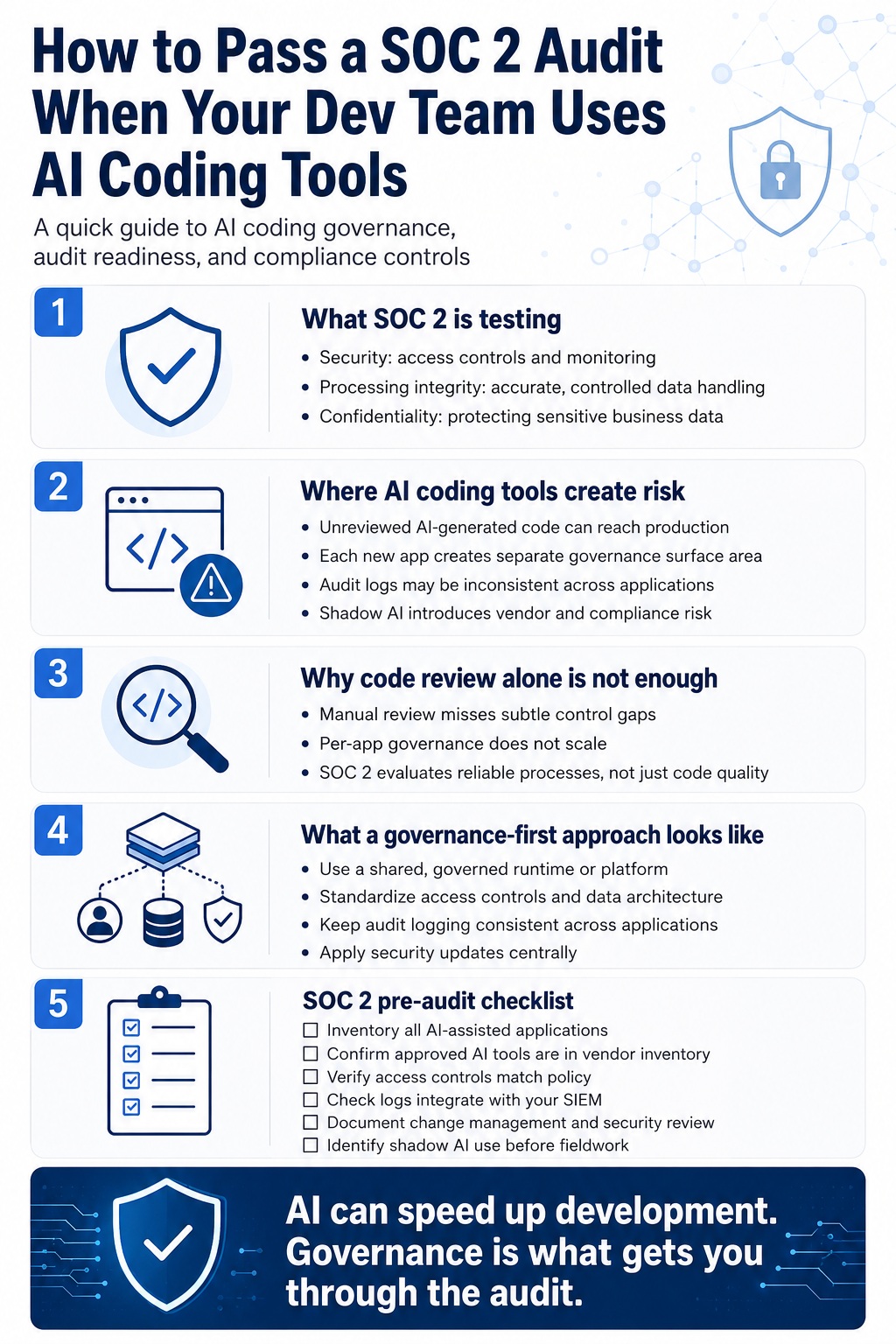
The Specific Problems AI Coding Tools Create for SOC 2
Here’s what actually goes wrong, in the order it usually goes wrong.
Unreviewed code enters production: Development moves fast when AI is writing code. A developer prompts Cursor or Copilot, gets something that looks right, reviews it quickly, and commits. Under time pressure, “quickly” sometimes means not at all. That code ends up in a production system that handles customer data, and nobody has formally assessed it against your security baseline.
Each application creates new governance surface area: Standard AI coding tools generate standalone applications — each with their own database, their own access control rules, their own logging behavior. Build ten internal apps over a year and you have ten separate configurations to audit. Your SOC 2 auditor wants to see consistent controls. What you have is ten different implementations of the same controls, some better than others.
Audit trails are inconsistent: SOC 2 requires you to log and monitor activity in your systems. AI-generated applications frequently write logs in whatever format the AI decided made sense — which may not integrate cleanly with your SIEM or log management system. During an audit, “we have logs but they’re in a different format for this application” is not a comfortable answer.
Vendor management gets murky: SOC 2 CC9.2 requires you to monitor and manage third-party risks. If your team is using multiple AI coding tools — some sanctioned, some not — you have a vendor management problem layered on top of the code quality problem. Auditors will ask which tools were used, what their data handling practices are, and whether you assessed them before developers started using them.
Remediation creates new complexity: When a finding comes up on a system built with an AI tool, the team that needs to fix it is often dealing with code they didn’t fully write and don’t fully understand. That slows remediation timelines and can turn a minor finding into a material weakness if it drags on.
Why “We’ll Just Review the Code” Isn’t Enough
The standard response to this problem is to add a code review step — every AI-generated component gets reviewed before deployment. That’s better than nothing, but it has limits.
Code review catches obvious problems. It’s much worse at catching subtle data access issues, inconsistent access control implementations, or logging gaps that only become apparent when you try to reconstruct an incident. It also doesn’t solve the governance fragmentation problem: reviewed or not, that application still has its own database and its own access rules that diverge from your established architecture.
The deeper issue is that SOC 2 isn’t just asking whether your code is good. It’s asking whether your processes for controlling how software is built and deployed are reliable. A process that depends on thorough manual review of AI-generated code, at the pace most development teams work, is a fragile process. Auditors know this.
What actually satisfies SOC 2’s intent is a development environment where security controls are structural — built into the platform rather than applied after the fact by reviewers who are working under deadline.
What Structural Governance Looks Like in Practice
This is where the architecture of your AI development platform matters more than the code review process around it.
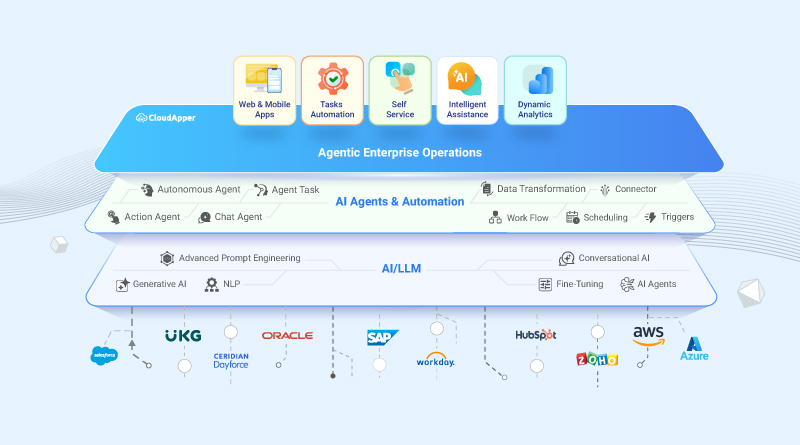
CloudApper’s approach is different from raw AI coding tools in one fundamental way: instead of generating source code that your team then has to govern, the platform generates a structured application definition — a governed configuration — that runs on a pre-certified application server. Every application built on the platform runs on the same runtime. Every application inherits the same security controls. Every application writes logs in the same format.
For a SOC 2 audit, this changes the conversation considerably.
Instead of explaining how you reviewed AI-generated code from ten different applications, you’re explaining that all applications run on a single certified runtime with documented controls. Instead of mapping ten different database configurations to your access control policy, you’re pointing to one uniform data access layer that all applications share. Instead of hoping your log formats are consistent, you can demonstrate that they are — because they all come from the same platform.
This is what the CloudApper AI platform was built to address. The security controls aren’t applied to AI-generated output after the fact. They’re the environment the applications run in.
Read more on how this rethinks enterprise software development from the ground up.
The Shadow AI Problem in SOC 2 Contexts
There’s a version of this that doesn’t involve officially sanctioned tools at all.
Developers use what works. If your organization hasn’t given them a clear, high-productivity AI development option, they’re finding their own. Some are using Copilot on personal accounts. Some are using Cursor. Some are using tools you’ve never heard of. None of this is in your vendor inventory, none of the data handling has been assessed, and none of the code has been evaluated against your security baseline.
In a SOC 2 context, this is a CC9.2 problem before it’s anything else. You have unapproved vendors processing data in your development environment. That’s the finding.
The practical answer isn’t stricter enforcement. Developers will route around restrictions faster than you can implement them. The answer is providing a sanctioned alternative that’s actually better — faster, more capable, and built in a way that doesn’t create compliance exposure.
That’s a harder product problem than it sounds, which is why most AI coding tools haven’t solved it. CloudApper’s enterprise AI security overview covers why the architecture decision matters more than the policy decision here.
The Maintenance Finding Nobody Anticipates
SOC 2 Type II audits cover a period of time — typically six to twelve months. Your controls need to be operating effectively for the entire period, not just on the day of the audit.
AI-generated code that was fine at deployment can develop problems over time. Dependencies update. Vulnerabilities get discovered in patterns the AI commonly generates. The logic that seemed correct turns out to have edge cases. In each of these situations, your team needs to be able to understand, modify, and remediate code they may not have written themselves.
For most teams, this is a slow-burning problem. The original developer who reviewed the AI-generated code moves on. The person who inherits the system is dealing with logic they didn’t write and documentation that may be thin. When something needs to change — for a security patch, for a compliance requirement, for a finding — the remediation takes longer than it should.
CloudApper avoids this entirely by design. Because applications run on a platform rather than as standalone codebases, platform-level security updates propagate automatically. There’s no inventory of AI-generated legacy applications accumulating technical debt. Your enterprise software stays maintained, updated, and governed without ongoing DevOps overhead per application.
Your SOC 2 Pre-Audit Checklist for AI Coding Tools
If your team has been using AI tools to build internal applications and a SOC 2 audit is coming up, work through these before your auditors do.
Inventory:
- Can you list every application built with AI assistance that’s currently in your environment?
- Do you know which AI tools were used for each?
- Are all those tools in your vendor inventory with completed security assessments?
Access controls:
- Does each AI-generated application enforce access controls consistent with your documented policy?
- Are those controls implemented consistently across applications, or does each one have its own approach?
Data governance:
- Do AI-generated applications create their own database schemas outside your established data architecture?
- Can you map the data flows in each AI-generated application accurately?
Logging and monitoring:
- Do AI-generated applications write audit logs that integrate with your SIEM?
- Are the log formats consistent enough to reconstruct user activity across applications?
Change management:
- Is AI-generated code going through your standard change management process before deployment?
- Do you have documentation of security review for AI-assisted components?
Vendor management:
- Have you assessed the data handling practices of every AI coding tool in use, including by individual developers?
- Are there tools being used that aren’t in your approved vendor list?
If the honest answer to several of these is “not really,” that’s useful information — better to know it now than to walk into fieldwork with gaps.
Multi-Framework Compliance: When SOC 2 Isn’t the Only Standard
Many enterprise technology organizations face overlapping compliance requirements. Healthcare companies dealing with SOC 2 and HIPAA. Organizations working with government clients dealing with SOC 2 and FedRAMP. Manufacturers with SOC 2 and FIPS 140-2 cryptographic requirements.
Raw AI-generated code satisfies none of these by default. A platform with certified controls can satisfy all of them from a shared baseline — one security architecture, one audit trail, one set of controls to maintain.
CloudApper’s platform is SOC 2 audited, FedRAMP Ready, and built with controls for HIPAA, FIPS, CCPA, FERPA, and GDPR. The compliance posture is structural, not applied per-application. That’s not a minor operational convenience — for organizations managing multiple audit cycles simultaneously, it’s a significant reduction in compliance overhead.
Learn more about building custom enterprise solutions within a compliance-ready architecture, and how enterprise application development platforms have evolved to handle these requirements.
The Honest Assessment
SOC 2 with AI coding tools in the mix is harder than SOC 2 without them — not because AI is inherently insecure, but because most AI coding tools were designed for developer productivity, not for enterprise governance. The security work gets left to the team, and the team is usually already stretched.
The organizations that handle this well aren’t necessarily the ones doing the most thorough code review. They’re the ones that made a better architectural decision upfront — choosing a platform where the governance is built in rather than bolted on.
That distinction shows up clearly at audit time. Either you’re explaining your review process for each AI-generated application, or you’re explaining your platform’s certified controls. One of those conversations is a lot shorter.
Talk to CloudApper Before Your Next SOC 2 Audit
If you’re preparing for a SOC 2 Type I or Type II audit and AI coding tools are part of your development environment, CloudApper can walk through the specific control gaps and how the platform’s architecture addresses them.
Schedule a conversation with the CloudApper team →
Bring your current audit scope and your list of tools in use. We’ll map the gaps specifically — no general pitch, just the architecture review your compliance team needs.

What is CloudApper AI Platform?
CloudApper AI is an advanced platform that enables organizations to integrate AI into their existing enterprise systems effortlessly, without the need for technical expertise, costly development, or upgrading the underlying infrastructure. By transforming legacy systems into AI-capable solutions, CloudApper allows companies to harness the power of Generative AI quickly and efficiently. This approach has been successfully implemented with leading systems like UKG, Workday, Oracle, Paradox, Amazon AWS Bedrock and can be applied across various industries, helping businesses enhance productivity, automate processes, and gain deeper insights without the usual complexities. With CloudApper AI, you can start experiencing the transformative benefits of AI today. Learn More
- Useful Links:
- Agentic AI
- No-Code/Low-Code
- Custom Software
- HCM Personalization
- iPaaS
- FedRAMP