When an outsourced vendor exits a legacy system, enterprises inherit the code but not the understanding. This article examines why vendor exit costs exceed the original build — and why repeated re-platforming cycles are a capital allocation problem, not just an IT operational risk.

TL;DR
When an outsourced development vendor exits a legacy application, the organization inherits code but not architectural understanding — the real cost surfaces at the first change request, compliance audit, or modernization scoping session. More than a third of legacy modernization programs fail or restart, largely because knowledge transfer documents describe what a system does, not why it was built that way or where the informal dependencies live. The compounding cost across repeated re-platforming cycles is the capital allocation problem most IT organizations avoid naming: each cycle begins with the same discovery tax and prices the next engagement higher as the baseline degrades. The governance answer is not to avoid outsourcing but to retain architectural control — a governed internal platform — throughout every external engagement, so that no vendor's exit can take the organization's understanding of its own systems with it.
Table of Contents
Outsourced legacy application modernization after a vendor exit is a governance problem, not a technical one, because architectural ownership left with the vendor. The organization receives a handover document and repository access and assumes the application is now theirs.

In healthcare, manufacturing and financial services, IT learns otherwise at the first major change request, the first audit that needs architectural evidence, or the first modernization scoping session. It never appears at the start of a project. It appears under pressure. CloudApper AI is built on the view that governed internal platforms keep this failure mode from forming in the first place.
The Handover Document Is Not the Knowledge
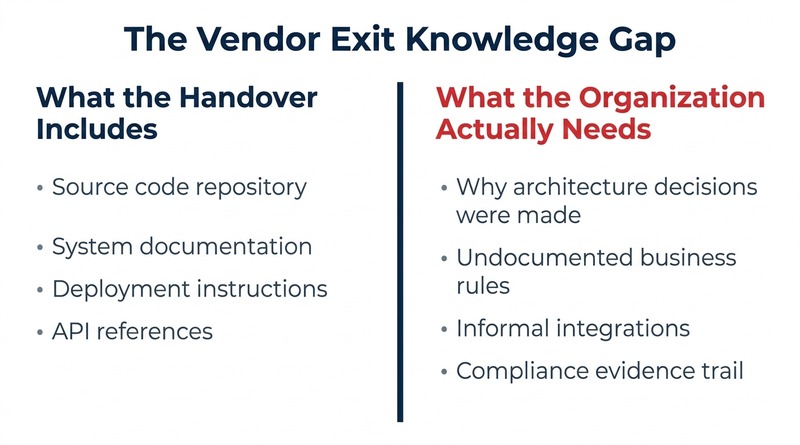
When a vendor exits a legacy application, the standard deliverable is documentation. In practice, what the organization receives is a description of what the system does at the moment of exit — not why it was built that way, not which business rules are encoded in the code versus which are maintained in spreadsheets operated by people who have since left, and not which dependencies were created informally during the engagement and were never formalized. The institutional knowledge problem that surfaces when internal developers leave is compounded when the knowledge was never inside the organization in the first place.
The first re-scoping session after vendor exit typically costs two to three months and produces a discovery report that should have been a project input. Teams reverse-engineer behavior the vendor understood natively, identify integrations nobody logged formally, and find that one third of their assumptions about the system are wrong. That is the minimum cost. In regulated industries — healthcare, finance, pharma — the discovery phase must also produce compliance evidence that was never structured for audit in the first place.
The Capital Problem in Repeated Re-Platforming
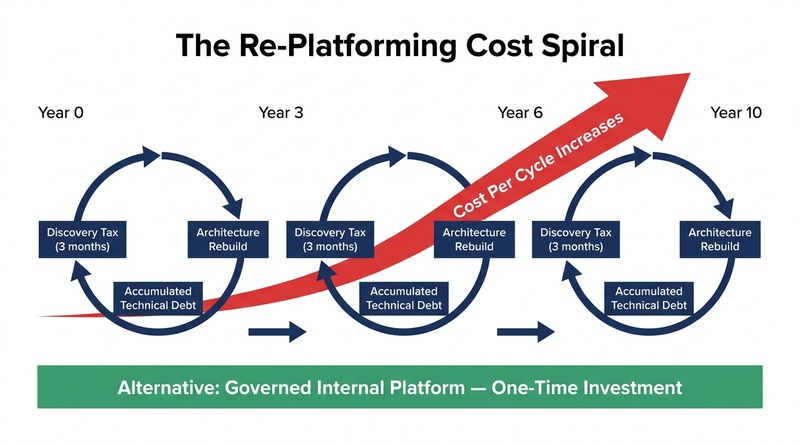
The more consequential number is not the cost of a single vendor exit. It is the cumulative cost across two or three re-platforming cycles over a decade. Each cycle begins with the same discovery tax, compounds the technical debt that was not resolved in the prior cycle, and prices the next engagement higher because the baseline has degraded. ERP customization debt follows the same compounding pattern — deferred governance decisions accumulate and arrive together as the upgrade bill. Outsourced legacy modernization debt works identically, except the accountability is even less clear because the decision-maker who originally contracted the vendor is usually not in the room when the re-platforming is scoped.
The CFO-level argument is straightforward once the numbers are lined up: a permanently funded internal architecture function with veto authority over every external build — and a governed platform that makes that standard enforceable — is cheaper than two re-platforming cycles at market rates for a system the organization no longer fully understands. The lift-and-shift fallacy demonstrates the same dynamic — migration projects are measured on delivery, not on what the next governance cycle will cost when the architectural debt arrives.
What Governance Rights Actually Mean
The answer to the vendor exit problem is not “never outsource.” Enterprises with 500 to 5,000 employees cannot always hire and retain the architecture talent needed to build and maintain every critical system internally. The real question is whether the organization retained architectural control — not just code ownership — throughout the engagement. That means a governed internal platform as the deployment target, standards that the external vendor is required to meet (not negotiate), and audit-ready documentation that the organization produces continuously rather than requests at contract end.
The API integration problem that blocks AI automation roadmaps is almost always worse when the legacy system was vendor-built without internal governance standards, because there is no documentation of what the system exposes and no owner who can authorize changes. Data migration governance debt follows the same pattern: the classification and ownership decisions were never made formally, and they surface as a crisis when the migration is already scoped and funded.
CloudApper provides a governed platform where business logic is separated from the deployment layer and every application carries the architectural evidence a modernization or compliance audit requires — regardless of whether the team that built it is still under contract. For organizations scoping a modernization project where a vendor exit is part of the history, the platform establishes the governance baseline the original engagement never created.
For enterprises managing legacy applications where the original development vendor has exited or is approaching contract end, CloudApper provides a governed modernization platform that rebuilds architectural control without repeating the same re-platforming cycle. To discuss your modernization approach, visit CloudApper’s contact page.

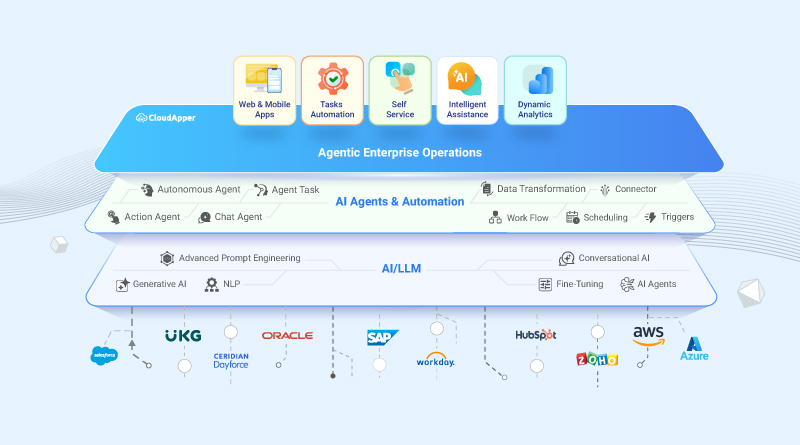
What is CloudApper AI Platform?
CloudApper AI is an advanced platform that enables organizations to integrate AI into their existing enterprise systems effortlessly, without the need for technical expertise, costly development, or upgrading the underlying infrastructure. By transforming legacy systems into AI-capable solutions, CloudApper allows companies to harness the power of Generative AI quickly and efficiently. This approach has been successfully implemented with leading systems like UKG, Workday, Oracle, Paradox, Amazon AWS Bedrock and can be applied across various industries, helping businesses enhance productivity, automate processes, and gain deeper insights without the usual complexities. With CloudApper AI, you can start experiencing the transformative benefits of AI today. Learn More
- Useful Links:
- Agentic AI
- No-Code/Low-Code
- Custom Software
- HCM Personalization
- iPaaS
- FedRAMP
CloudApper AI Solutions

- Works with







- and more.
Similar Posts

Your SAST Tool Scanned It. Your DAST Tool Tested It.…

CMMC Level 2 and Internally Built Applications: The Evidence Gap…