When a HIPAA compliance deadline arrives before your EHR modernization closes, you have three options — and only one that survives an OCR audit. Here is the decision model healthcare CIOs need.

TL;DR
When a HIPAA Security Rule update lands with a 240-day compliance window, most EHR modernization timelines cannot close the gap. Healthcare IT leaders face three options: compliance theater with bolt-on controls that fail OCR audits, absorbing enforcement penalties, or delivering a governed minimum viable compliant system as a discrete layer while the full modernization continues. The third path is the only one that produces an audit-defensible record. CloudApper’s HIPAA-certified platform deploys the governed compliance layer alongside legacy clinical systems without compressing the main modernization timeline.
Table of Contents
The project plan says go-live in Q3. The regulation says compliance by Q1. Nobody in the room has done the subtraction yet — or if they have, they have not said it out loud.

This is the moment most healthcare IT leaders mismanage. Not because the CIO lacks information, but because the governance structure has no clean path for acknowledging that two formally approved plans are irreconcilable. The EHR modernization project has budget. The compliance roadmap has executive sign-off. The HIPAA Security Rule update has the Office for Civil Rights behind it. What does not exist yet is the decision that reconciles all three.
When a major HIPAA Security Rule update is finalized, it typically carries a compliance window of roughly 240 days from final publication — enough time for a targeted remediation effort, not enough for a platform replacement. The rule introduces mandatory MFA, network segmentation documentation, updated encryption standards, and defined restoration timelines for critical systems. The average enterprise EHR modernization, the kind involving meaningful re-architecture rather than a lift-and-shift that simply moves the compliance problem to a different infrastructure address, runs 18 to 36 months. That math does not work inside a 240-day compliance window. And yet most healthcare organizations are acting as if it does.
That decision cannot be avoided. The only variable is who makes it: you, deliberately, before the enforcement window closes — or the OCR auditor, on the record, after it does.
Two Timelines. One Enforcement Date.
The issue is not that healthcare IT leaders are caught off guard by regulation. Most compliance teams track rulemaking and flag incoming changes. The issue is that the EHR modernization project was scoped and budgeted when the enforcement date was still abstract — a future consideration rather than a calendar entry. Once the rule is finalized, the project plan does not automatically compress. The legacy clinical system — still running, still unable to satisfy mandatory MFA requirements or produce network segmentation documentation — becomes the organization’s primary compliance liability while the modernization team continues working toward a go-live that is months past the enforcement window.
CloudApper’s enterprise platform teams encounter this pattern regularly in healthcare: a hospital mid-modernization, a finalized HIPAA requirement the legacy system cannot satisfy, and a project timeline that cannot compress without cutting scope that introduces new audit risk. The legacy EHR’s integration architecture and access control model were not designed for requirements that did not exist when the system was built — not a planning failure, but the structural reality of clinical systems operating in an evolving regulatory environment. It requires a governance decision, and that decision has not been made yet at most healthcare organizations.
The Three Choices and the One That Fails the OCR Audit
When a HIPAA enforcement window closes before modernization is complete, healthcare IT leadership faces three actual options. The first is compliance theater: export access logs to a SIEM, draft a memo asserting that existing controls are substantially equivalent, submit a checklist to the compliance officer. This preserves the fiction that the EHR modernization is on track and that the organization is managing the gap. It is also the option OCR investigators find first — because bolt-on controls leave evidence trails that a purpose-built audit will not accept. The compliance exposure during a parallel-run period with bolt-on controls is precisely where findings accumulate.
The second option is to absorb the enforcement consequence — formally document the gap, accept potential civil monetary penalties, and continue toward the go-live date. This is rarely chosen explicitly but is the de facto result of option one failing the audit.
The third option requires acknowledging that the original modernization scope will not close the compliance gap in time: deliver a governed minimum viable compliant system. A narrower system purpose-built to satisfy the specific controls the rule requires — mandatory MFA, network segmentation documentation, access control attestation, audit log retention with defined retrieval timelines — while the full EHR modernization continues on its realistic timeline. This is the only path that produces a defensible audit record. It requires formally de-scoping parts of the modernization, which is politically uncomfortable, but it separates HIPAA compliance evidence from project aspiration. The governance decisions deferred during the original scoping process must be made now — the enforcement window removes the political cover that made deferral possible.
What a HIPAA-Compliant Slice of a Legacy Clinical System Looks Like
The governed compliant layer addresses the specific controls a HIPAA update requires — mandatory MFA enforced at the application layer, network segmentation documented through access control policy, audit logs with defined retention and retrieval timelines, encryption updated for data at rest and in transit — without requiring full replacement of the legacy EHR in the enforcement window. The legacy clinical system continues operating. The HIPAA compliance record runs through the governed layer. Business associate agreements, which HIPAA rule updates typically require organizations to refresh within one year of the effective date, are tracked and enforced at the platform level rather than managed manually across disparate systems.
CloudApper’s platform is built for exactly this scenario. Its security-by-design architecture — HIPAA, SOC 2, FIPS 140-2, and OWASP ZAP certified — deploys the compliance-specific controls as a governed application layer alongside the legacy system, producing the access control records, audit trails, and data governance documentation OCR enforcement reviews require. The data governance work that surfaces late in most EHR modernization projects — patient data classification, record retention policy enforcement, BAA update tracking — can be front-loaded into this layer, making it productive for the full replacement when it arrives rather than a parallel sunk cost. The EHR modernization continues on its original timeline without being asked to compress in ways that introduce the new risks it was designed to eliminate.
HIPAA compliance deadlines do not adjust for project plans. OCR does not extend enforcement windows because a modernization program is mid-flight. What changes is whether the organization has a defensible record of what it did in the gap — or an audit finding that explains why it didn’t.
If your EHR modernization timeline extends past an approaching HIPAA compliance deadline, CloudApper can help you scope and deploy the governed compliant layer your OCR audit record requires before enforcement arrives. Talk to the team.

What is CloudApper AI Platform?
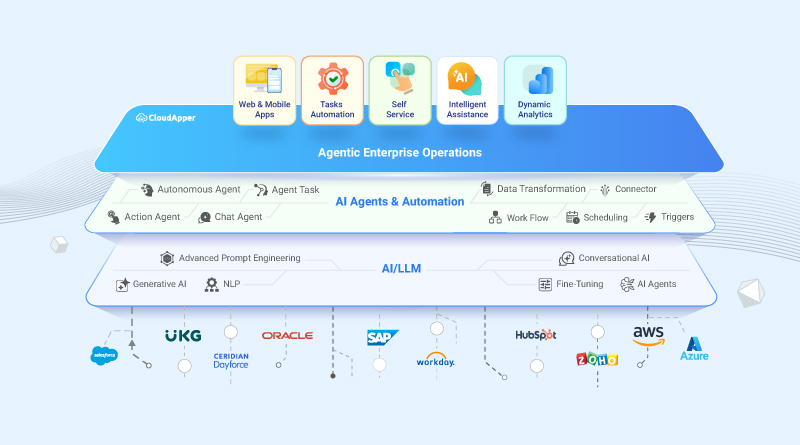
CloudApper AI is an advanced platform that enables organizations to integrate AI into their existing enterprise systems effortlessly, without the need for technical expertise, costly development, or upgrading the underlying infrastructure. By transforming legacy systems into AI-capable solutions, CloudApper allows companies to harness the power of Generative AI quickly and efficiently. This approach has been successfully implemented with leading systems like UKG, Workday, Oracle, Paradox, Amazon AWS Bedrock and can be applied across various industries, helping businesses enhance productivity, automate processes, and gain deeper insights without the usual complexities. With CloudApper AI, you can start experiencing the transformative benefits of AI today. Learn More
- Useful Links:
- Agentic AI
- No-Code/Low-Code
- Custom Software
- HCM Personalization
- iPaaS
- FedRAMP
CloudApper AI Solutions

- Works with








- and more.
Similar Posts

Legacy Modernization Transition: The Compliance Gap That Opens When Both…

Outsourced Legacy Systems: Why Vendor Exit Costs More Than the…