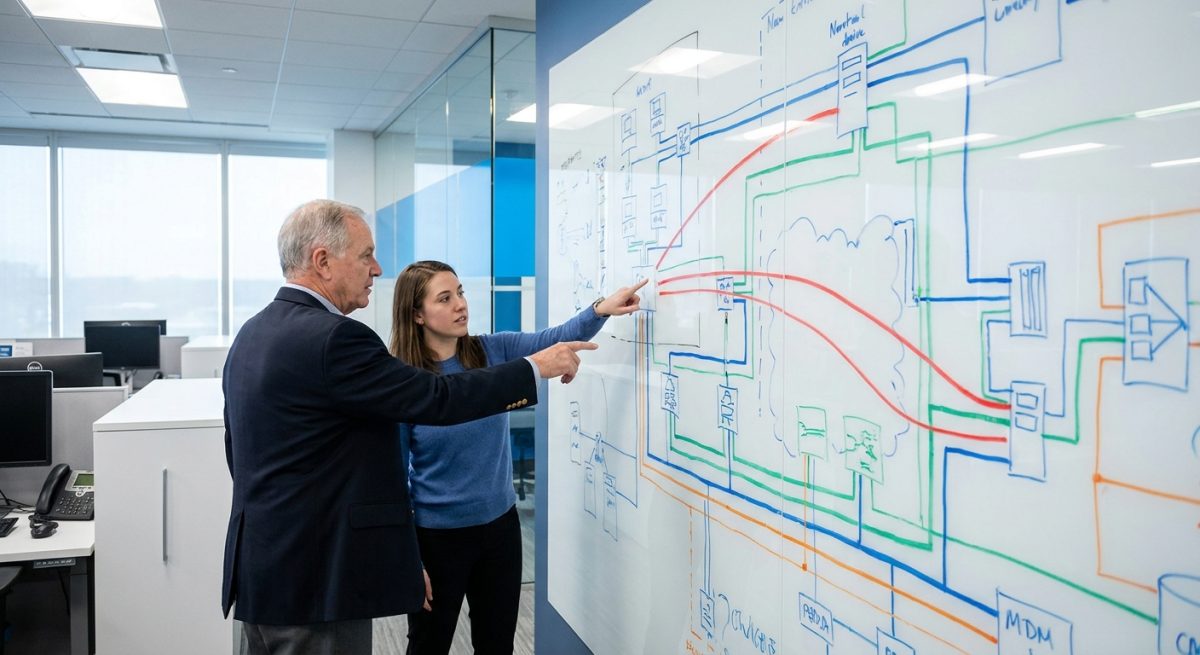
Every legacy system modernization project scopes around the documented integrations. The dependency scan finds three to five times more. This article examines what legacy system dependency mapping actually reveals — including the undocumented connections no automated tool surfaces, and the line-of-business processes no IT ticket ever created.
TL;DR
Legacy system dependency mapping consistently returns more connections than any architecture diagram or CMDB records. The gap is not a documentation failure — it is the accumulated result of workarounds, informal processes, and informal power structures built up over years of production use. Automated discovery tools surface active network connections but miss dormant batch jobs, manual operational workflows, and business-unit processes with no IT record. The real output of a dependency mapping exercise is a political map: every undocumented integration is someone's operational workaround, and that person has no incentive to surface it during a scoping interview. CloudApper AI Platform treats dependency discovery as the first governed deliverable of a modernization engagement, converting the integration map into a named, owned scope document before any replacement code is written.
Table of Contents
- Why the Architecture Diagram Is Always Out of Date
- What the Dependency Scan Actually Returns
- The Line-of-Business Feed That Owns the Stall
- Why Automated Discovery Cannot Replace the Structured Audit
The architecture diagram was confirmed by the application owner, signed off by the vendor, and attached to the modernization kickoff deck. It showed four integrations: the ERP data feed, the HR sync, the reporting pull, and the nightly backup job. The project was scoped around four connection points. Three months in, the legacy system dependency mapping exercise returned twenty-three. Not four. Twenty-three active connections — including a file drop feeding a regional warehouse’s inventory reconciliation process, a service account being used by three other applications as a silent authentication proxy, and a scheduled database query running from a business unit no one in IT had spoken to during scoping. The diagram was not wrong when it was drawn. It was simply never updated after the system was put into service in 2011.
Why the Architecture Diagram Is Always Out of Date
Enterprise architecture diagrams document a system’s intended design at a specific point in time. What they cannot document is everything that happened after go-live: the workarounds that became permanent, the undocumented connections that bypassed a vendor limitation, the batch jobs added by a contractor who left the following year. Legacy systems in active production for a decade or more accumulate integration debt in layers, and none of it appears in the original documentation. The governance debt that surfaces at data migration is the same debt that surfaces during dependency mapping — both reveal what was never inventoried because no one was responsible for inventorying it.

What the Dependency Scan Actually Returns
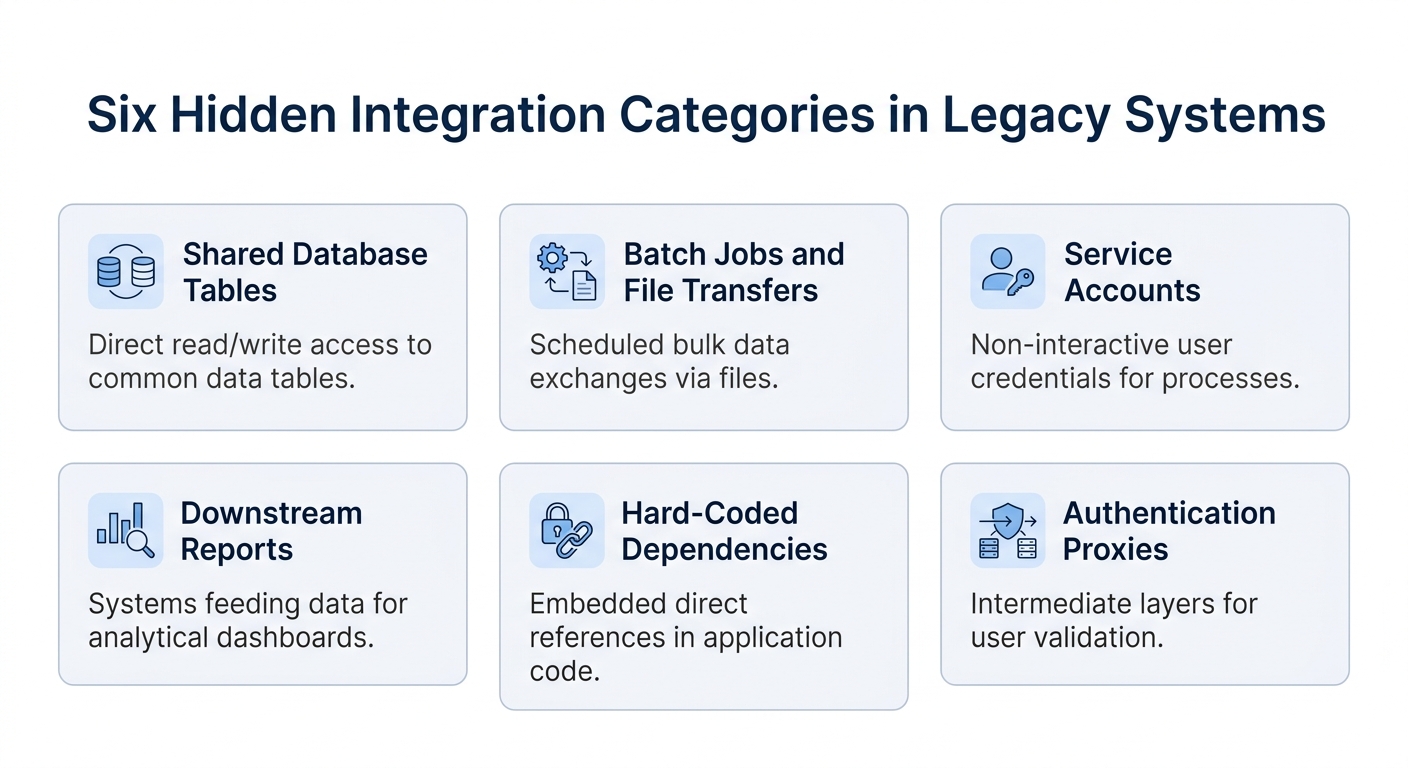
When enterprise IT teams run a structured dependency discovery against a legacy application slated for decommission, the findings typically fall into six categories. Shared database tables: other applications with direct read or write access to the same schema, often undocumented because the access was granted informally to solve a one-time problem. Batch jobs and file transfers: nightly exports, CSV drops to shared file paths, scheduled queries consuming outputs that appear in no interface catalog. Service accounts: credentials embedded in configuration files being used by systems that have no formal integration documentation. Downstream reports: business logic embedded in the SQL layer feeding report writers and BI tools consuming live data from the legacy system. Hard-coded dependencies: IP addresses, UNC paths, and ODBC connection strings embedded in code or scripts referencing the legacy system’s infrastructure directly. And authentication proxies: cases where the legacy system’s identity layer is being used by adjacent applications as a de facto SSO mechanism.
The Line-of-Business Feed That Owns the Stall
The technical categories above are manageable. The harder problem is the category that does not appear in any scan: the business unit that built a quiet dependency on the legacy system’s outputs and has no incentive to surface it. A regional operations manager whose team pulls a nightly export to a shared drive, reformats it in Excel, and sends it to three supplier contacts every morning — that process has no IT ticket, no formal integration record, and no named owner in the system registry. It appears only when the legacy system stops producing the file. The institutional knowledge that documents these undocumented connections often retires before the system does. What the dependency mapping exercise actually reveals is not just a technical list — it is a map of informal processes that exist because the formal system could not accommodate them. Every undocumented feed is someone’s operational workaround, and the owner of that workaround has no budget for a replacement and no incentive to volunteer it during a scoping interview.
Why Automated Discovery Cannot Replace the Structured Audit
Runtime monitoring tools, code scanners, and network traffic analysis are useful inputs to dependency discovery. They are not substitutes for a structured audit. Automated scans return false positives, miss dormant connections that only activate on month-end cycles, and cannot identify the Excel-and-email workaround that a business unit runs manually. The AI automation roadmap that stalls on a legacy system with no API is the same problem: the blocker is never purely technical. Automated tools surface what is active and visible in network logs. The structured audit surfaces what people are actually doing — and those two maps rarely match.
From Dependency Register to Real Project Scope
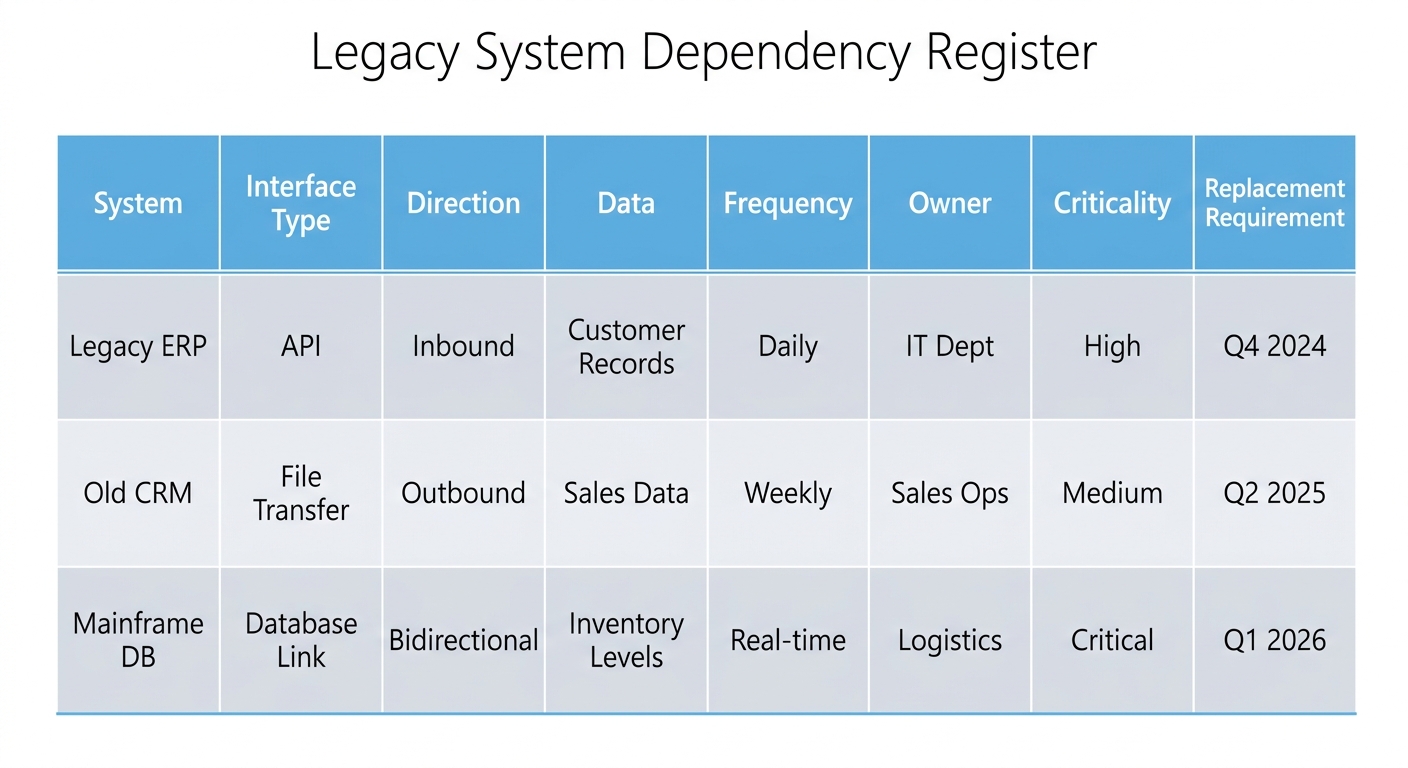
A complete dependency register — system, interface type, direction, data exchanged, frequency, owner, criticality, evidence source, and replacement requirement — is not an artifact of the discovery phase. It is the project scope document. Every connection in the register is a decommission prerequisite: replace it, redirect it, retire it, or document why it was left in place. The cost comparison between maintaining a legacy system and replacing it rarely accounts for the dependency resolution work, which is why project estimates built from architecture diagrams consistently underestimate the actual effort. CloudApper AI Platform approaches legacy modernization by treating dependency discovery as the first governed deliverable, not a background task. The platform’s requirements extraction layer produces a structured integration inventory before any replacement code is written — converting what was a scoping variable into a documented, named, owned list of commitments that both IT and the business units sign off on before the project proceeds.
If your organization is preparing a legacy system for decommission and has not yet run a structured dependency mapping exercise, CloudApper can assist with the discovery and scoping process. Contact the CloudApper team to scope the dependency audit before the modernization project begins.

What is CloudApper AI Platform?
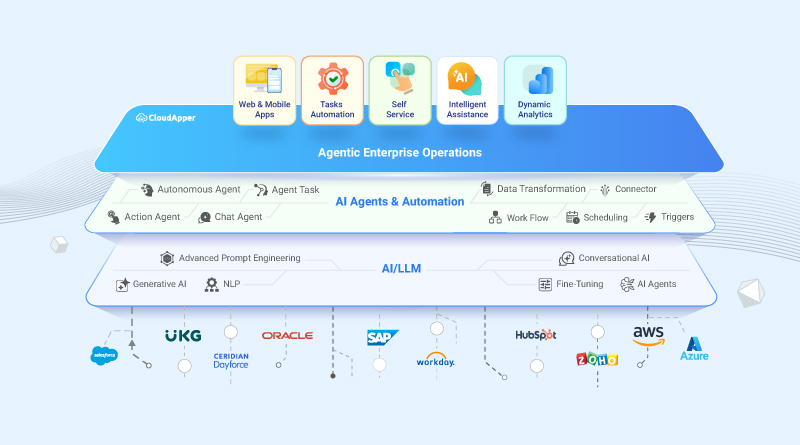
CloudApper AI is an advanced platform that enables organizations to integrate AI into their existing enterprise systems effortlessly, without the need for technical expertise, costly development, or upgrading the underlying infrastructure. By transforming legacy systems into AI-capable solutions, CloudApper allows companies to harness the power of Generative AI quickly and efficiently. This approach has been successfully implemented with leading systems like UKG, Workday, Oracle, Paradox, Amazon AWS Bedrock and can be applied across various industries, helping businesses enhance productivity, automate processes, and gain deeper insights without the usual complexities. With CloudApper AI, you can start experiencing the transformative benefits of AI today. Learn More
- Useful Links:
- Agentic AI
- No-Code/Low-Code
- Custom Software
- HCM Personalization
- iPaaS
- FedRAMP
CloudApper AI Solutions

- Works with







- and more.
Similar Posts

When Patching Breaks Production: The Documentation Problem With Legacy Windows…

Legacy Database Migration Blocked by Stored Procedures: What Enterprise IT…