SR 11-7 was written for discrete quantitative models. AI-assisted internal app development in financial services is creating hundreds of embedded logic deployments that qualify as models but sit outside the formal inventory. Here is why the validation math breaks — and how a governed platform creates the single audit surface model risk teams need.
TL;DR
SR 11-7 was written for discrete quantitative models — credit scoring, fraud detection, capital models. AI-assisted internal application development is creating a second tier of embedded logic deployments that qualify as models under the guidance but sit outside most banks' formal model inventories. MRM teams were not staffed for this volume, and the documentation gaps in AI-generated code make independent validation nearly impossible after the fact. The scalable answer is building internal applications within a governed platform that captures decision logic, version history, and audit evidence at the architecture layer — not after deployment. Financial services IT leaders using CloudApper AI gain a single, bounded model-risk perimeter that examiners can assess once, rather than chasing individually built applications with no common documentation standard.
Table of Contents
Most banks have a formal model inventory. Credit scoring, loan pricing, capital models, fraud detection — these are catalogued, validated, and monitored on a defined cycle. The documentation is detailed, the process is expensive, and the model risk management function exists precisely because these systems make consequential decisions at scale. Most CIOs in financial services can point to the inventory and name the person responsible for it.

What most banks do not have is a second inventory. The one that would include the internal applications built by the IT team, operations, or compliance analysts over the last few years — the ones that now route exception approvals, flag high-risk counterparty transactions, or determine which claims move to manual review. Some were built with AI coding tools. Some were built by people who would not describe themselves as building models at all. That distinction matters less than most IT leaders assume.
SR 11-7 defines a model as a quantitative method, system, or approach that applies statistical, economic, financial, or mathematical theories to process input data into quantitative estimates. That definition has never excluded internally built applications. What changed is the pace at which financial services teams are building them — and how much decision logic AI coding tools are embedding inside.
When an Internal Application Crosses the SR 11-7 Line
An approval-routing application that applies weighted criteria to flag a counterparty transaction for review is processing input data into a consequential estimate. An eligibility engine that evaluates field values against scoring logic to determine whether a customer qualifies for a credit offer is a model under any practical reading of the guidance. The fact that a developer built it with an AI coding tool — rather than a quantitative analyst submitting it through formal model development — does not change what it does in production.
What an OCC or Federal Reserve examiner asks is not who built the application. It is whether the application makes consequential decisions, what data it processes, and whether it has been subjected to documentation and validation proportionate to its use. The shadow IT dynamic that AI coding tools accelerated inside most enterprises did not stop at the door of regulated industries. It created exactly this compliance ambiguity — applications deployed at speed by people who never asked whether the logic inside qualified as a model under applicable guidance.
The Validation Math That Does Not Work
SR 11-7 requires conceptual soundness review, outcome analysis, independent validation, and ongoing monitoring. Applied to a large credit model with a dedicated team, this is expensive but tractable. Applied to a growing portfolio of internally built applications — many of which lack documentation of their logic, their assumptions, or their data inputs — the resource math breaks entirely.
MRM teams at most regional banks are staffed for a relatively static model universe. They were not sized for an environment where the internal development team ships AI-assisted applications on a monthly cadence. The technical debt that accumulates in undocumented AI-generated code compounds this: you cannot independently validate logic that was never captured when it was built. FINRA and GLBA governance requirements already demand audit evidence for AI-assisted development pipelines. SR 11-7 creates a parallel track with its own documentation standard — and most internal development pipelines satisfy neither.
Two paths are equally costly. A compliance bottleneck that throttles the productivity benefits of AI development tools. Or systemic undocumented model risk that examiners will eventually classify as a governance failure. Neither is a solution. Both are the consequence of building at speed inside a framework that was written for a different era of application development.
What a Governed Platform Changes
The scalable answer is not adding model validators. It is building internal applications in an environment where governance is architectural rather than procedural — baked into how the application is built, not applied after deployment when the documentation gap has already grown.
A director of IT at a regional bank described the conversation his MRM team kept initiating: who validated the logic in the latest application his team had shipped? The answer — AI-generated code, briefly reviewed before go-live, never formally documented — was not one that satisfied a model risk examination. He described the requirement to CloudApper AI. The platform built the application within a constrained, auditable framework: AI generation operating on reviewed blueprints, automatic documentation of decision logic, version-controlled change history, and an evidence trail his MRM team could work with directly rather than reconstructing after the fact.
The governed platform does not eliminate model risk. It creates a bounded, single-surface perimeter that examiners can assess once, rather than chasing individually built applications with no common documentation standard. What auditors ask about internally built applications is increasingly the same question SR 11-7 examiners ask: can you show the documentation? The access control and permission governance that AI-assisted workflows require is part of the CloudApper architecture, not a retrofit. A Head of Applications describes the business need; CloudApper AI builds within a governed framework that already anticipates the examiner’s question — before the application ever reaches production.
Financial services IT leaders navigating SR 11-7 requirements for internally built AI applications are using CloudApper AI to build within a governed framework from the start. If your internal development pipeline is generating logic your model risk team cannot document or validate, the time to address that is before your next examination. Reach out to the CloudApper team to see how a governed platform changes the model risk conversation.

What is CloudApper AI Platform?
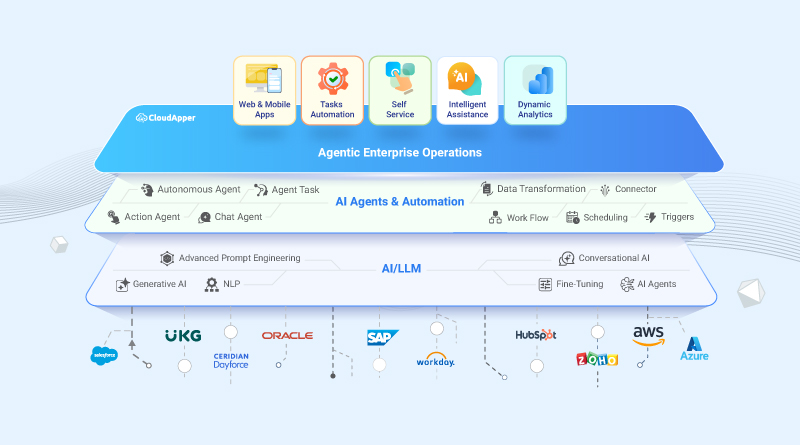
CloudApper AI is an advanced platform that enables organizations to integrate AI into their existing enterprise systems effortlessly, without the need for technical expertise, costly development, or upgrading the underlying infrastructure. By transforming legacy systems into AI-capable solutions, CloudApper allows companies to harness the power of Generative AI quickly and efficiently. This approach has been successfully implemented with leading systems like UKG, Workday, Oracle, Paradox, Amazon AWS Bedrock and can be applied across various industries, helping businesses enhance productivity, automate processes, and gain deeper insights without the usual complexities. With CloudApper AI, you can start experiencing the transformative benefits of AI today. Learn More
- Useful Links:
- Agentic AI
- No-Code/Low-Code
- Custom Software
- HCM Personalization
- iPaaS
- FedRAMP
CloudApper AI Solutions


- Works with







- and more.
Similar Posts
Legacy Application Decommissioning and the Compliance Evidence Trap

ISO 27001:2022 Application Security Controls: What Enterprise IT Actually Owes…