Five operational signals that a vibe-coded app already in production has become a governance liability -- discoverable through support tickets, offboarding workflows, vendor questionnaires, and audit prep, not dedicated security scans.


TL;DR
Vibe-coded applications that succeed in production accumulate users, business logic, and compliance obligations before IT governance ever reviews them. Five operational signals -- SSO requests at scale, departed employees with active accounts, customer SOC 2 inquiries, builder succession gaps, and undisclosed data scope expansion -- each reveal a structural governance absence that cannot be retroactively closed without data loss. The fix is not remediation of individual applications but governed development from the first deployment. CloudApper AI builds applications where access control, change management, data classification, and succession documentation are structural outputs, not post-deployment projects.
Table of Contents
- 1. IT Is Being Asked to Add SSO to an App That Already Has 100 Users
- 2. Someone Who Left the Company Three Months Ago Still Has Access
- 3. A Customer or Partner Is Asking for a SOC 2 Report That Covers It
- 4. The Person Who Built It Has Moved to a Different Team
The ticket came in on a Tuesday. A business unit needed their new scheduling tool connected to Active Directory — just basic SSO, nothing complicated. IT opened it to scope the work and found a production application handling 200 users, running on a service account with domain admin privileges, with no documentation, no security review record, and no one in IT who knew it existed two weeks ago.

The app works. That is the problem. When an internally built AI tool fails at deployment, IT stops it. When it succeeds, it accumulates users, business logic, and dependencies before anyone with governance responsibility has seen it. By the time IT encounters it, the question is no longer whether to build it — it is whether to fix it, replace it, or accept the liability it represents.
What follows are five signs that a vibe-coded app already in your enterprise production environment has crossed from useful tool into governance liability. Each one is discoverable through normal IT operations — support tickets, offboarding workflows, audit prep, and vendor questionnaires — not through dedicated security scans.
CloudApper AI is an enterprise application platform where governed development is the starting point, not the remediation project. Applications built on the platform carry the security and governance baseline from day one, so these five signs never surface in the first place.
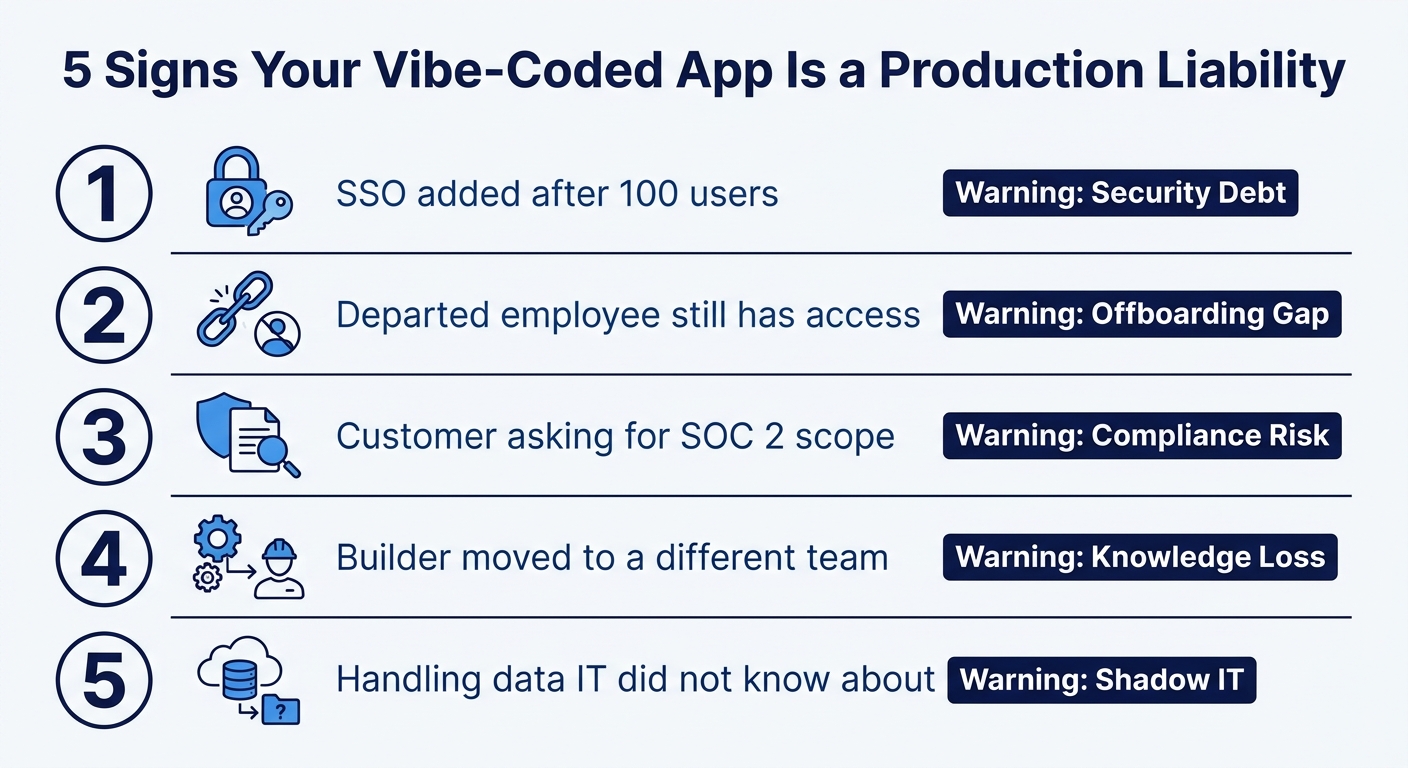
1. IT Is Being Asked to Add SSO to an App That Already Has 100 Users
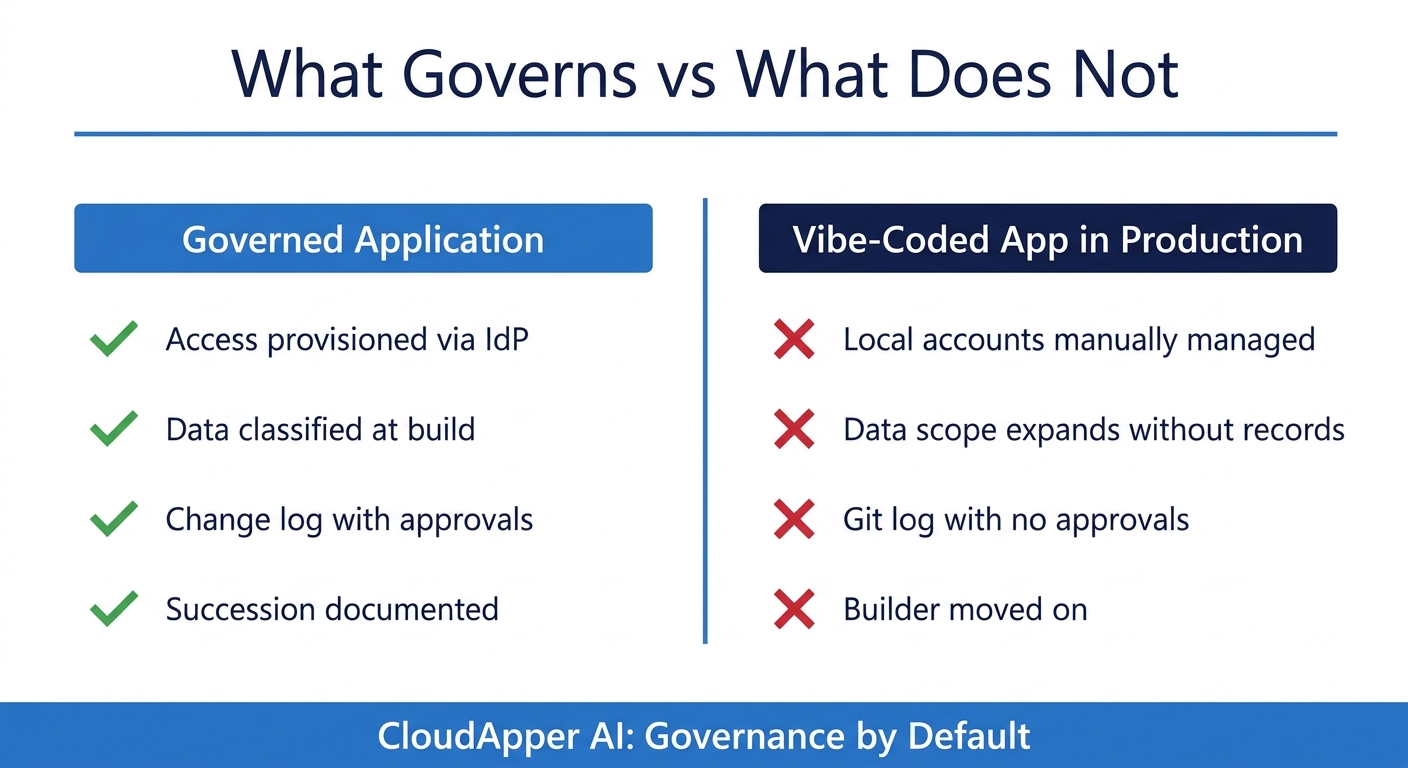
When a vibe-coded application reaches the point where the business unit asks IT to connect it to the identity provider, the access control problem has already been running for months. Users have local accounts. Passwords were set manually, shared in Slack, or never rotated. There is no provisioning record, no deprovisioning process, and no audit log matching user actions to authenticated identities.
Adding SSO does not undo the access history that accumulated before it. Every user who had an account under the unmanaged system had access that IT cannot retroactively document. For SOC 2 CC6.1, HIPAA access controls, or ISO 27001 A.9, that history is a gap — not a misconfiguration, but a structural absence in the governance record. The access control problems that appear at 100 users are not new — they are the original build choices becoming visible at scale.
2. Someone Who Left the Company Three Months Ago Still Has Access
This one surfaces in offboarding audits. The departing employee’s IT offboarding checklist is complete. Every provisioned system was deprovisioned. But the vibe-coded application the operations team built uses a database with its own user table, managed by whoever built it, with no connection to the identity management system IT controls.
Three months after departure, that account is still active. It has never been used since the employee left. It may never be used. But the access record exists, the account exists, and nobody in IT knew to close it because nobody in IT knew the system existed as a separately managed identity store. The service account audit problem extends to every application that manages its own credentials outside the governed identity layer.
3. A Customer or Partner Is Asking for a SOC 2 Report That Covers It
This is the sign that tends to escalate fastest. A vendor questionnaire arrives, or an enterprise customer’s security team asks which SOC 2 controls apply to the application handling their data. The business unit points to IT. IT points to the application owner. The application owner points to the AI coding tool that built it three months ago.
There is no SOC 2 scope declaration for the application. There is no vendor assessment for the cloud environment it runs in. There is no data processing record for the customer data it touches. The business unit closed the deal and built the tool to service it; nobody scoped the compliance obligations that came with it. What SOC 2 auditors ask about internally built applications is structurally different from what a vendor certification covers — and a vibe-coded app has neither.
4. The Person Who Built It Has Moved to a Different Team
This sign is quiet until it isn’t. The application runs. Users don’t complain. Then a configuration needs to change, a dependency breaks, or a compliance team asks for an architecture diagram. The person who built it is six months into a different role, doesn’t remember the specific deployment decisions, and no longer has time to support it.
What exists in the organization’s asset register for this application is whatever was self-reported when someone thought to report it. What exists in IT’s configuration management database is nothing. What exists in the security team’s vulnerability scan history is nothing — because the application never went through the intake process that would have added it to scan scope. Application ownership transfer requires documented succession to work. A vibe-coded application has no succession plan because it was never registered as an organizational asset.
5. It Is Handling Data That IT Did Not Know It Was Handling
This is the sign that creates the largest gap between the business unit’s understanding of the application and IT’s governance obligations. The scheduling tool that started as a simple calendar replacement is now collecting employee health disclosures for accommodation requests. The exception-tracking app that started in one warehouse is now processing customer payment references. The scope grew incrementally, one feature request at a time, and nobody updated the data classification record — because there was no data classification record to update.
When HIPAA, GDPR, or SOC 2 applies to the data the application is now processing, the compliance obligation retroactively covers the entire history of that data in the system. Data classification at build time is not a documentation exercise — it is the event that determines which regulatory obligations attach to the application from the first record it touches. Vibe-coded applications skip that event by design.
What These Five Signs Have in Common
None of them require a security incident to become visible. Each one surfaces through the routine friction of IT operations: a support ticket, an offboarding workflow, a vendor questionnaire, a team reorganization, a data classification audit. The application was not negligently built — it was built quickly, by someone solving a real problem, using tools that made speed the priority.
The liability is not the application itself. It is the gap between what the application does and what the governance record says it does — which, for most vibe-coded tools in production, is nothing. Fixing that gap retroactively is expensive and time-limited. The access history before SSO cannot be reconstructed. The data processing before classification cannot be retroactively scoped. The change history before version control was added cannot be recovered.
When enterprise professionals describe what they need to CloudApper AI, the application that gets built carries access controls, change management records, data residency configuration, and compliance inheritance as structural outputs — not as remediation projects after the fact. The technical debt vibe-coded applications generate compounds precisely because the governance layer that would have constrained it was never built. CloudApper AI makes that layer the foundation, not the fix.
If your enterprise is managing one or more AI-built applications that bypassed IT governance, the conversation about what to do next starts with what you actually have. Talk to the CloudApper AI team.

What is CloudApper AI Platform?
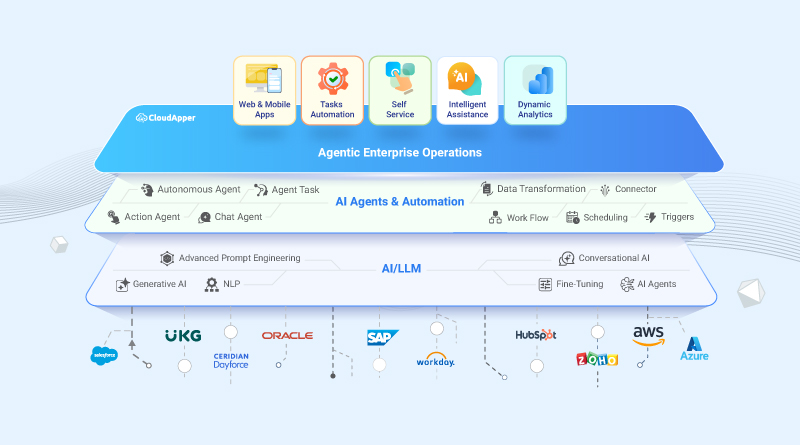
CloudApper AI is an advanced platform that enables organizations to integrate AI into their existing enterprise systems effortlessly, without the need for technical expertise, costly development, or upgrading the underlying infrastructure. By transforming legacy systems into AI-capable solutions, CloudApper allows companies to harness the power of Generative AI quickly and efficiently. This approach has been successfully implemented with leading systems like UKG, Workday, Oracle, Paradox, Amazon AWS Bedrock and can be applied across various industries, helping businesses enhance productivity, automate processes, and gain deeper insights without the usual complexities. With CloudApper AI, you can start experiencing the transformative benefits of AI today. Learn More
- Useful Links:
- Agentic AI
- No-Code/Low-Code
- Custom Software
- HCM Personalization
- iPaaS
- FedRAMP
CloudApper AI Solutions

- Works with









- and more.
Similar Posts

7 Questions to Ask Before Choosing a Legacy Application Modernization…

7 Audit Questions Your Internally Built Enterprise Applications Can’t Answer…