Enterprise IT teams lose 30–40% of engineering capacity to DevOps overhead before writing a single line of app logic. Here's what zero DevOps actually eliminates — and what it means for compliance, staffing, and the internal tool backlog.

Table of Contents
- What DevOps Overhead Actually Consists Of
- Why Most “Low-Code” Platforms Don’t Actually Solve This
- What Actually Disappears Under a Zero DevOps Model
- The Business Case: What Zero DevOps Is Actually Worth
- Where the Tradeoffs Are
- The Staffing and Institutional Knowledge Implications
- A More Useful Frame for the Evaluation Conversation
Vendors use zero DevOps loosely, but for a CIO running internal enterprise app development the useful definition is narrow and testable: which infrastructure work disappears, and which does not. At a 2,000-person manufacturer or regional health system, the work that moves off the team is runtime management, provisioning, patching and updates.
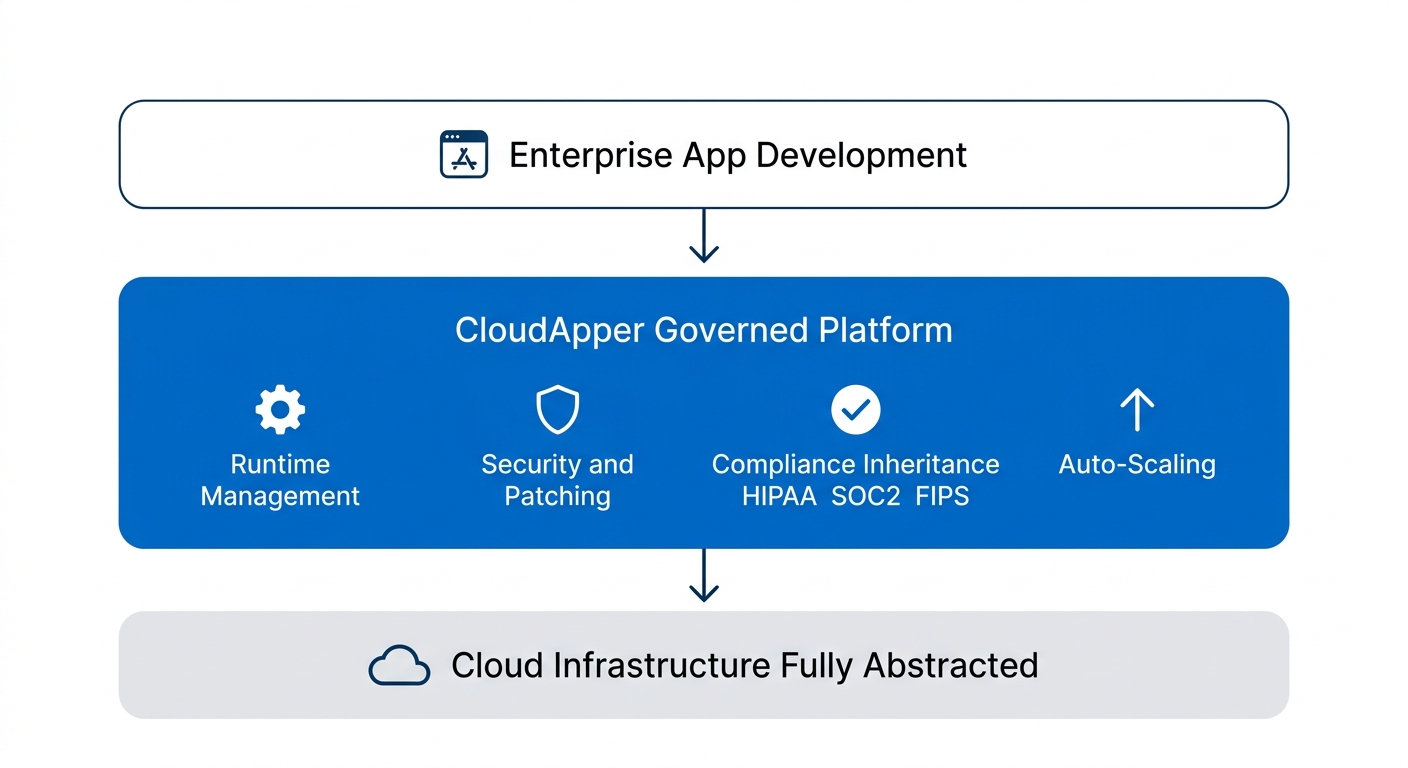
CloudApper handles that work at the platform level, including compliance inheritance, so the development team’s scope narrows to building the application itself. What follows is specific about what changes operationally and financially once that shift happens, and what it means for compliance.
What DevOps Overhead Actually Consists Of
Before “zero DevOps” can mean anything, it helps to be specific about what DevOps overhead is for a team building and maintaining internal enterprise applications.
At minimum, it includes: provisioning and managing server infrastructure or cloud compute, configuring and maintaining deployment pipelines, handling runtime environments for each app, managing OS-level and dependency-level patching, maintaining uptime monitoring and alerting, scaling infrastructure in response to usage, and managing security configuration across environments.

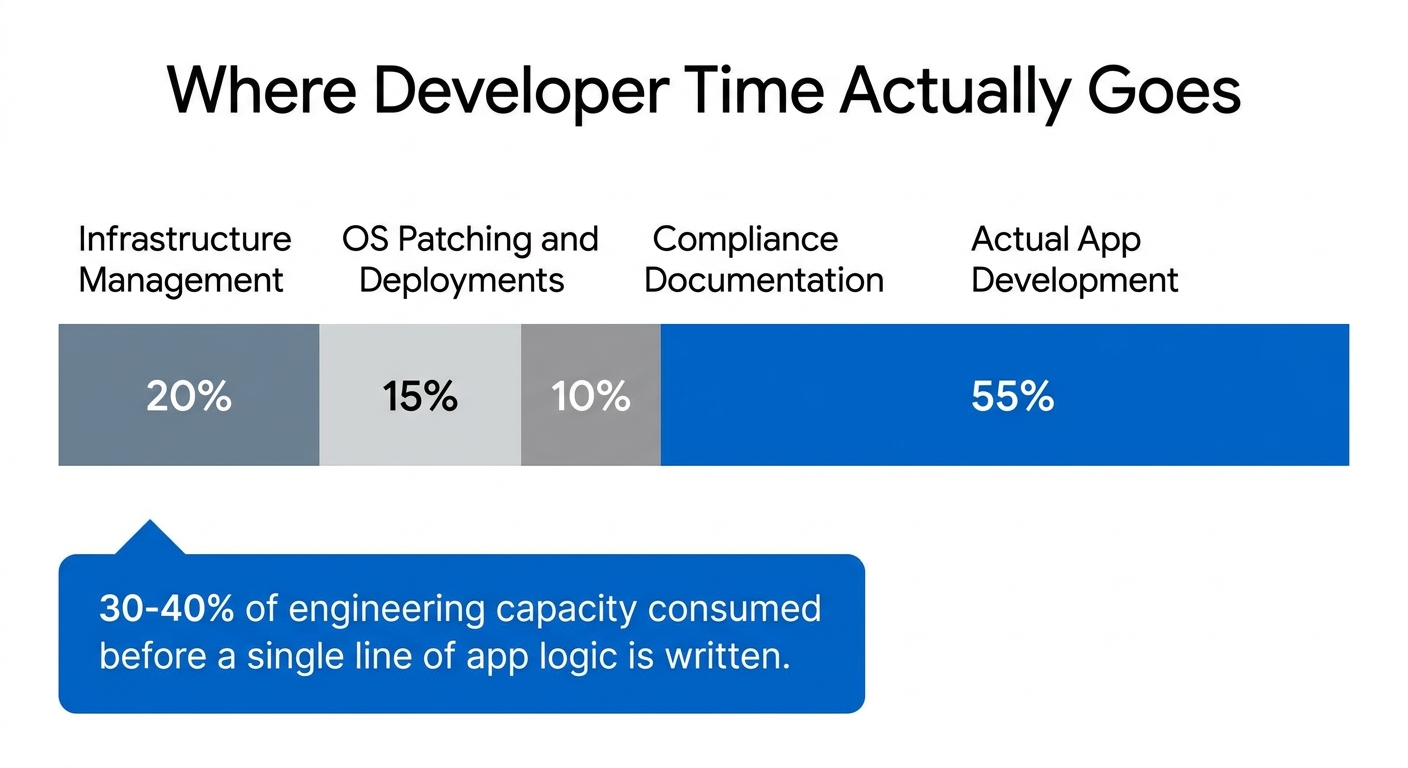
This is before you touch the application itself. A team of five developers building three internal tools — say, a workflow app for HR, a scheduling tool for operations, and a data intake form for compliance — is spending a meaningful share of its engineering time not building those tools but keeping the underlying infrastructure running. Internal IT teams commonly report that 30–40% of development effort goes toward environment setup, deployment management, and maintenance — work that adds no direct value to the business users those apps serve.
That number compounds when the team is also responsible for compliance. Every infrastructure component needs to be in scope for SOC 2, HIPAA, or whatever audit framework the organization operates under. Servers need hardening configurations documented. Deployment pipelines need access controls logged. Patching schedules need to be evidenced. The compliance burden doesn’t sit only with the application — it sits with every layer of the stack the team manages.
Why Most “Low-Code” Platforms Don’t Actually Solve This
The promise of low-code and no-code development tools is real, but it’s frequently misapplied. A platform that lets non-developers build simple forms or approval workflows is useful — but it doesn’t resolve the infrastructure problem for teams building more complex internal apps that need to integrate with ERP systems, HCMs, or operational data sources.
More critically, most low-code platforms abstract the application layer but still require the IT team to manage the deployment environment. The app runs somewhere — a cloud instance, a container, a virtual machine — and someone needs to own that. If that someone is your internal IT team, the DevOps overhead hasn’t been eliminated. It’s been repackaged.
The actual test for whether a platform delivers zero DevOps is straightforward: when a critical OS vulnerability is disclosed, does your team need to do anything? When a dependency needs updating, who patches it? When usage spikes and the app needs more compute, who provisions it? If the answer to any of those questions is “your team,” you’re still carrying DevOps overhead regardless of what the product brochure says.
As enterprises have learned from the parallel challenge of AI-driven shadow IT and ungoverned internal app development, adding new tools doesn’t automatically reduce complexity — it can just distribute it in less visible ways.
What Actually Disappears Under a Zero DevOps Model
When a platform genuinely manages the runtime, the list of tasks that leave the IT team’s plate is specific and substantial.
Infrastructure provisioning goes away. The team doesn’t decide whether to deploy on EC2, ECS, or a Kubernetes cluster. The platform manages that. Capacity planning goes away. The platform scales based on demand. OS patching goes away. The platform handles it on a schedule the organization doesn’t need to track. Deployment pipeline management goes away. The team pushes changes through a governed workflow and the platform handles the mechanics of moving code into production. Runtime monitoring goes away — or at minimum, the responsibility for building and maintaining it does.
What remains is the work the team was actually hired to do: understanding what the business needs, translating that into application logic, testing, and iterating.
The compliance implications of this shift are significant and frequently underweighted in the evaluation conversation. When a platform inherits compliance posture — meaning that SOC 2, HIPAA, or FIPS 140-2 controls are built into the platform’s operation rather than layered on by the tenant — the IT team doesn’t need to document, evidence, or defend the infrastructure configuration in an audit. The platform vendor carries that audit scope. For a team preparing for its second SOC 2 surveillance audit while also trying to ship four new internal tools, this is not a minor convenience. It’s a material reduction in audit preparation time and risk.
The article on building internal enterprise apps with AI without creating a compliance liability explores the broader governance dimension — but the infrastructure layer is where compliance liability most often originates, because it’s where configurations drift, patches get delayed, and audit evidence goes undocumented.
The Business Case: What Zero DevOps Is Actually Worth
Framing zero DevOps as a feature obscures its financial value. The real question is what the saved capacity is worth.
Consider an internal IT team with eight developers and two DevOps-focused engineers whose primary function is environment management and infrastructure maintenance. At fully loaded compensation of $120,000–$140,000 per person, those two engineers represent $240,000–$280,000 in annual spend on work that zero DevOps eliminates. The remaining developers who were spending 30% of their time on infrastructure tasks — that time becomes available for application development.
The indirect value is harder to quantify but often larger. Internal applications that get built faster reach business users faster. Workflow tools that replace manual processes, data collection apps that reduce errors, automation that removes administrative burden — these have real productivity effects that accumulate. A team that previously took four months to deliver a new internal app because of infrastructure setup and deployment overhead can, under a zero DevOps model, cut that timeline significantly. The backlog of internal tools that business units have been waiting on starts to clear.
CloudApper’s platform is designed with this efficiency model as a core architectural principle. HIPAA, SOC 2, GDPR, CCPA, FIPS 140-2, and OWASP ZAP compliance are built into the platform’s operation — not add-ons that tenants configure. When a CloudApper customer undergoes an audit, the infrastructure configuration is already documented and defensible because the platform maintains it, not the customer’s IT team. That distinction changes the math on how much engineering time gets redirected toward audit preparation each year.
There’s also a risk-adjusted value to governance. Internal apps built and deployed without proper infrastructure controls expose the organization to audit findings, security incidents, and remediation costs. When the governance framework for AI-assisted development extends to the infrastructure layer, those exposure points shrink. The cost of a single significant audit finding — remediation, legal review, potential regulatory action — frequently exceeds the annual cost of a governed platform.
Where the Tradeoffs Are
Zero DevOps is not the right model for every use case. Enterprises with highly customized infrastructure requirements — specific network topology constraints, sovereign cloud mandates, or deeply bespoke integration architectures — may find that a managed platform doesn’t accommodate their edge requirements. Teams building applications that need sub-millisecond latency for operational systems may need infrastructure control that a shared managed environment can’t provide.
These are real constraints, but they apply to a narrow slice of internal enterprise applications. The workflow tool, the compliance form, the HR self-service app, the operational data intake system — these don’t require custom infrastructure. They require a reliable, secure, governed environment that the team doesn’t have to manage. That’s what most internal IT teams are actually building, and that’s where zero DevOps platforms deliver their value.
The evaluation question, when assessing any platform claiming zero DevOps, is to push past the marketing and ask the operational questions directly: who patches the OS when a vulnerability is disclosed? Who manages scaling when usage spikes? Whose name is on the infrastructure controls in the audit? The answers will quickly distinguish platforms that genuinely abstract infrastructure from those that have moved it from one column to another.
When evaluating enterprise app development platforms where compliance is non-negotiable, this infrastructure ownership question deserves as much attention as the feature checklist.
The Staffing and Institutional Knowledge Implications
One consequence of zero DevOps that gets discussed less than it should is the talent implication. The shortage of experienced DevOps and platform engineers is well-documented. Hiring, retaining, and managing infrastructure engineers is competitive and expensive. Enterprises that remove the need for dedicated infrastructure management for their internal app development program also reduce their exposure to that talent market.
This isn’t an argument for eliminating DevOps roles at organizations that have them for good reasons — enterprises with significant public-facing infrastructure or complex cloud architectures will always need that expertise. But for teams whose primary function is building and maintaining internal tools for business operations, the requirement for dedicated infrastructure engineering can be reduced substantially. That’s a meaningful staffing and budget implication, particularly for enterprises in industries where technology talent competes with better-compensated software companies.
The institutional knowledge problem is also reduced when infrastructure is platform-managed rather than team-configured. Internal knowledge about specific deployment configurations, environment-specific workarounds, and infrastructure quirks is a liability when the person who holds it leaves. A platform that manages infrastructure by design removes that dependency.
As explored in the context of why AI-generated code in the enterprise is fast to build but expensive to trust, the hidden costs of development approaches that seem efficient on the surface often materialize in maintenance, compliance, and staffing continuity — and infrastructure management is no exception. The same logic applies to teams that own their own infrastructure for internal app development: the visible cost is the server bill, but the real cost is the engineering time, the compliance exposure, and the dependency on specific people who understand how it all fits together.
A More Useful Frame for the Evaluation Conversation
IT leaders evaluating platforms for internal app development often approach the conversation the wrong way. They ask about the feature set — what integrations are available, how the UI builder works, what AI capabilities are included. These are legitimate questions, but they’re secondary to a more fundamental one: what does this platform expect your team to own, and what does it own itself?
A platform that expects your team to manage the runtime, own the patching cycle, configure the monitoring, and evidence the infrastructure controls in an audit is not a zero DevOps platform. It’s a development tool that runs on infrastructure your team still has to care about.
The distinction matters because it determines where your engineering capacity actually goes. Teams that are still carrying infrastructure overhead — even partially — are teams that can’t fully redirect that capacity toward the application backlog that business units are waiting on. The promise of zero DevOps is only as real as the platform’s actual ownership of the runtime.
CloudApper was built from the ground up to carry that ownership completely. Every customer’s internal application runs on infrastructure that CloudApper provisions, patches, scales, and evidences for compliance purposes — without the customer’s IT team needing to track, maintain, or defend any of it. For an enterprise that has been asking how to ship more internal tools faster without adding headcount or accumulating compliance debt, that’s the practical definition of what removing infrastructure overhead actually delivers.
If your internal IT team is spending a meaningful share of its engineering capacity managing infrastructure instead of building the tools your business actually needs, that’s a solvable problem. CloudApper’s enterprise application platform is built to remove that overhead entirely — with compliance inheritance included. Reach out to see how it works in practice.

What is CloudApper AI Platform?
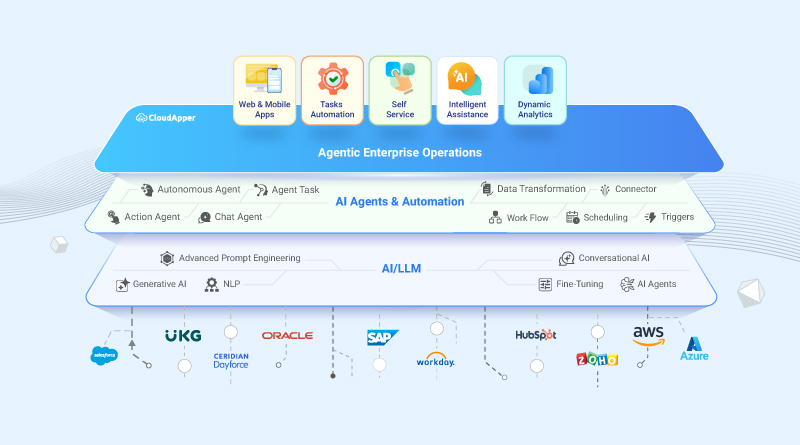
CloudApper AI is an advanced platform that enables organizations to integrate AI into their existing enterprise systems effortlessly, without the need for technical expertise, costly development, or upgrading the underlying infrastructure. By transforming legacy systems into AI-capable solutions, CloudApper allows companies to harness the power of Generative AI quickly and efficiently. This approach has been successfully implemented with leading systems like UKG, Workday, Oracle, Paradox, Amazon AWS Bedrock and can be applied across various industries, helping businesses enhance productivity, automate processes, and gain deeper insights without the usual complexities. With CloudApper AI, you can start experiencing the transformative benefits of AI today. Learn More
- Useful Links:
- Agentic AI
- No-Code/Low-Code
- Custom Software
- HCM Personalization
- iPaaS
- FedRAMP
CloudApper AI Solutions


- Works with







- and more.
Similar Posts

Your SAST Tool Scanned It. Your DAST Tool Tested It.…

CMMC Level 2 and Internally Built Applications: The Evidence Gap…