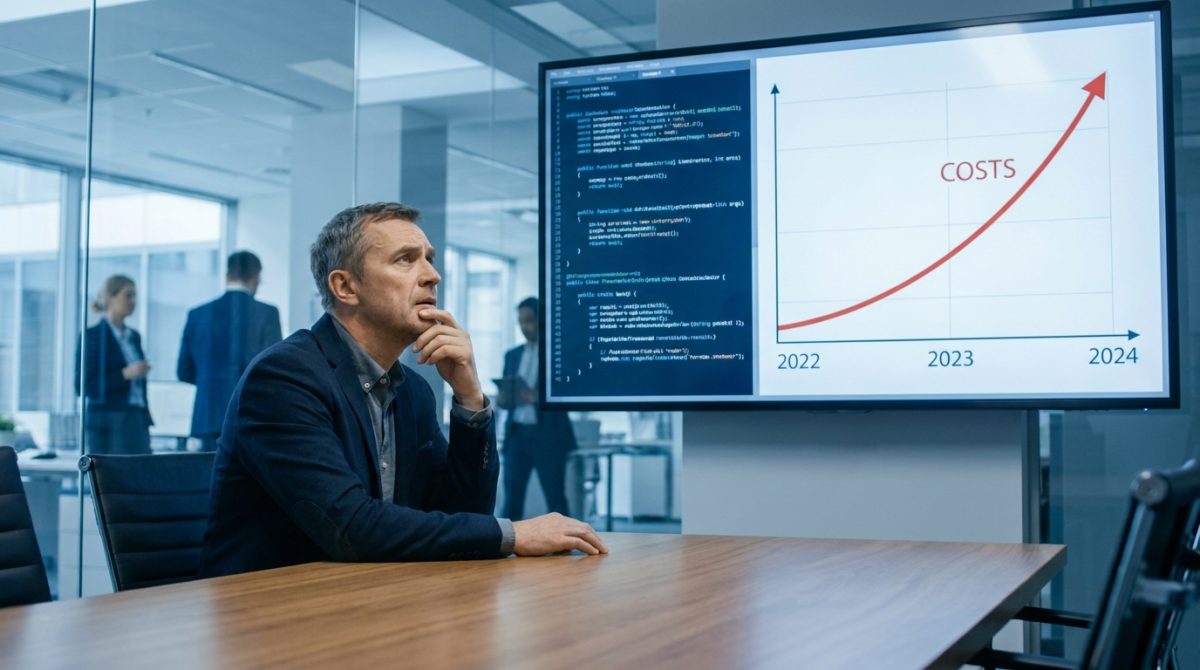
Vibe-coded applications look like wins at launch. The real costs — dependency decay, maintenance burden, compliance gaps, and orphaned ownership — surface months later. Here is what enterprise IT leaders are discovering as the first generation of ungoverned AI-built applications ages into production.
TL;DR
Vibe-coded applications — those built by prompting AI tools to generate functional code without structured governance — produce immediate results but accumulate significant hidden costs over time. By the two-year mark, enterprises typically encounter dependency decay with unpatched vulnerabilities, disproportionate maintenance costs from unstructured code, compliance gaps as regulations evolve, and orphaned ownership where no one is clearly accountable for the application's behavior. The root cause is not the use of AI tools but the absence of a governed development framework. CloudApper AI addresses this by making compliance artifacts, access controls, audit trails, and dependency management platform-level defaults — so the governance work is done at build time, not discovered as a liability two years later.
Table of Contents
- Why Vibe-Coded Applications Feel Different at Two Years
- The Dependency Decay Problem
- The Maintenance Cost That Wasn’t in the Estimate
- Compliance Obligations Don’t Wait for Clean Code
- The Ownership Problem
- What Governed Development Prevents
- The Conversation Worth Having Before the Next Application Gets Shipped
When a developer ships a working application in a week using AI-assisted coding tools, the immediate organizational response is usually positive. The business got what it asked for. The timeline was short. The developer looks capable and efficient. In the moment of delivery, vibe coding — the practice of prompting AI tools to generate functional code without deep engagement with the underlying architecture — registers as a net win.
The accounting problem is that the costs do not arrive at delivery. They arrive later, distributed across time, spread across people who may not have been involved in the original build, and often misattributed to other causes when they finally become visible. An application that was cheap to build is not the same as an application that is cheap to own. That distinction, largely invisible at launch, is what enterprise IT leaders are now discovering as the first generation of vibe-coded production applications ages past its initial deployment.
CloudApper AI is built around the premise that the governance architecture of an application matters as much as its initial functionality — and that the cost of skipping that architecture does not disappear just because it is deferred. What follows is an honest account of what that cost looks like, based on patterns that are emerging consistently across enterprises that moved fast without a governed development framework.
Why Vibe-Coded Applications Feel Different at Two Years
Every software application accumulates obligations over time. Security patches need to be applied. Dependencies need to be updated. Business requirements change, and the code needs to change with them. Compliance audits require documentation that has to come from somewhere. These are not exceptional events — they are the normal operating cost of software that stays in production.
What makes vibe-coded applications different is not that these obligations exist. It is that the applications were not built in a way that makes fulfilling those obligations tractable. The AI-generated code that produced a working feature in hours may have done so by making choices — about data models, dependency selection, error handling patterns, authentication approaches — that are defensible for a prototype but create compounding problems in production.

The specific pattern that emerges at the two-year mark is this: the developer who built the application is no longer maintaining it, or is no longer at the organization, or is maintaining it alongside a dozen other things that didn’t exist when the application was first shipped. The documentation that was going to be written never was. The code review that was supposed to happen was skipped in the rush to deliver. And now something needs to change — a dependency has a critical vulnerability, a regulation has been updated, or the business needs a new capability — and the team responsible for making that change is starting from scratch.
This is the institutional knowledge problem applied to AI-generated code: the person who knows why a vibe-coded application works the way it does is often the AI tool itself, which is no longer accessible in its original form, and the developer who executed the prompts, who may no longer be around to explain them.
The Dependency Decay Problem
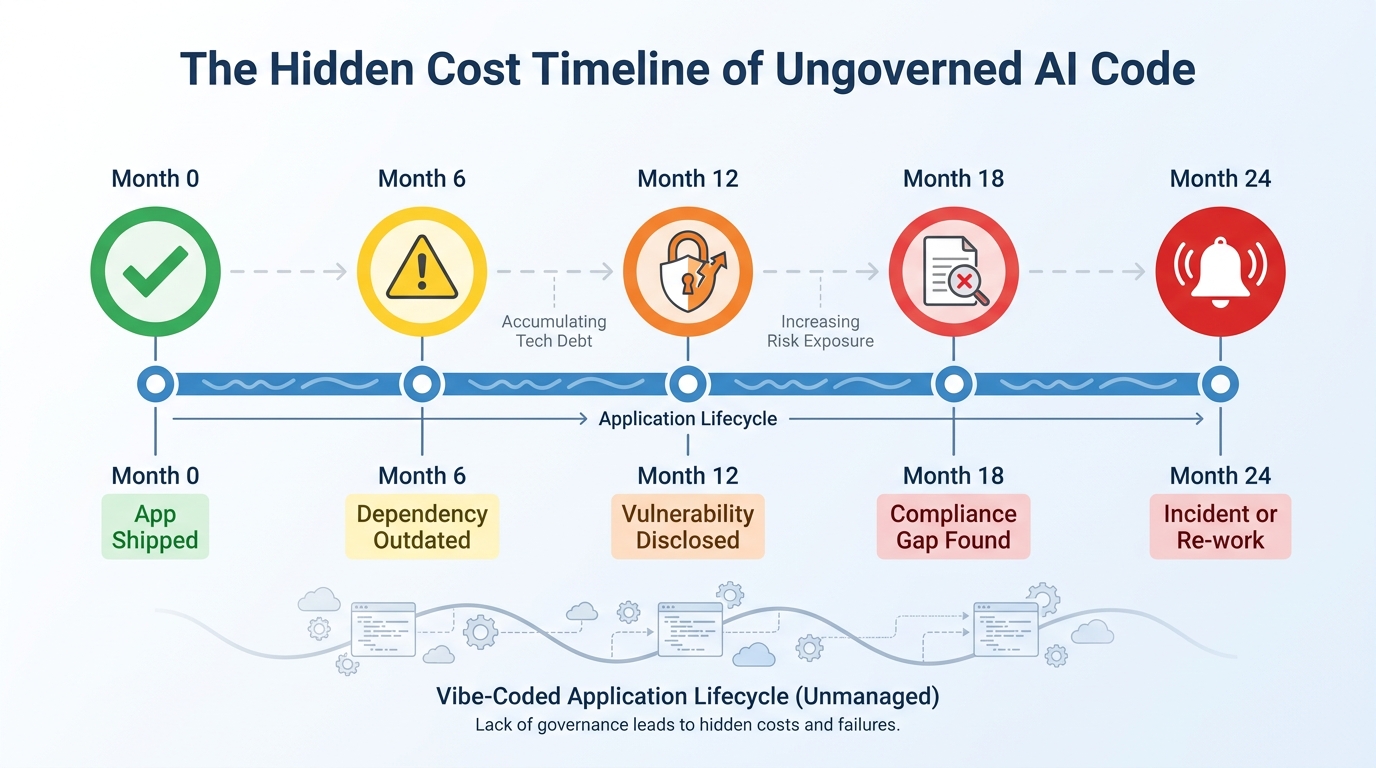
AI coding tools generate code that uses libraries and dependencies, and they do so based on training data that reflects what was current and popular at the time the model was trained. A large language model trained eighteen months ago will reach for dependency versions that were standard eighteen months ago. By the time the application built with its output is two years old, some of those dependencies are outdated. Some are deprecated. Some have known vulnerabilities that have been publicly documented for months.
In a governed development environment, dependency management is a continuous process. Teams track what their applications depend on, monitor for vulnerability disclosures, and have a process for applying updates in a controlled way. In a vibe-coded environment — particularly one where individual developers built applications without connecting them to a central governance framework — dependency tracking often does not exist at all.
The result is an application portfolio where IT cannot answer a fundamental question: what versions of what libraries are running in our production systems, and are any of them carrying known vulnerabilities? For organizations subject to SOC 2, HIPAA, or PCI DSS requirements, this question has a direct compliance implication. For any organization that experienced a security incident, it is usually one of the first things an investigator asks.
The hidden security risks of AI coding assistants without governance are not hypothetical. They are operational realities that surface in vulnerability scans, audit findings, and — in the worst cases — breach investigations. Dependency decay is one of the most consistent and least visible of those risks.
The Maintenance Cost That Wasn’t in the Estimate
When organizations evaluate whether to build an application, they typically estimate development cost. They rarely estimate maintenance cost with the same rigor — and for vibe-coded applications, the gap between those two numbers is particularly large.
Maintaining AI-generated code that was not written with maintainability as a design goal is disproportionately expensive. Code that was generated to satisfy a prompt often lacks the consistent patterns, naming conventions, and structural choices that make code navigable to someone other than its original author. A developer who inherits a vibe-coded application frequently describes the experience the same way: the code works, but understanding why it works — and what will break if you change it — requires reverse-engineering decisions that were never consciously made.
The time required to make a change to an application like this is higher than the time required to make the equivalent change to a well-structured application. The risk of introducing a regression is higher. The testing burden is higher, because the test coverage that should have been written alongside the original code often wasn’t. These costs accumulate with every change request, and change requests do not stop arriving just because the application is difficult to change.
For enterprise applications that serve real business processes — workflows that finance depends on, data capture that operations requires, integrations that feed downstream systems — maintenance difficulty is not a minor inconvenience. It is a constraint on the organization’s ability to adapt those processes as the business evolves. The organizations that have learned this lesson most viscerally are usually the ones that encountered it through a failure — an incident that required rapid changes to a system that turned out to be nearly impossible to change quickly.
Compliance Obligations Don’t Wait for Clean Code
Regulatory requirements evolve. HIPAA guidance gets updated. SOC 2 control frameworks are revised. New state privacy laws create obligations that didn’t exist when an application was built. An application that was compliant at launch — or that was never formally evaluated for compliance — may find itself in a different position two years later under a regulatory environment that has moved.
Meeting updated compliance requirements often requires changes to application behavior: new data handling logic, updated consent mechanisms, additional logging, changes to retention policies. In a governed application environment, these changes can be made systematically and documented in a way that satisfies auditors. In a vibe-coded application, making compliance-driven changes requires first understanding what the application currently does with data — which requires reading and interpreting code that may not have been designed to be readable — and then making changes to that code in a way that doesn’t break existing functionality.
The compliance cost of vibe-coded applications is not just the cost of the changes themselves. It is the cost of the archaeological work required before the changes can be made, multiplied across every application in the portfolio that faces the same requirement. For an enterprise with dozens of internally developed applications, that multiplication produces numbers that were nowhere in the original business case for moving fast.
This is one of the central arguments for a formal AI coding governance framework: not to slow development down, but to ensure that the applications coming out of the development process are ones that compliance teams can actually work with when the regulatory environment changes.
The Ownership Problem
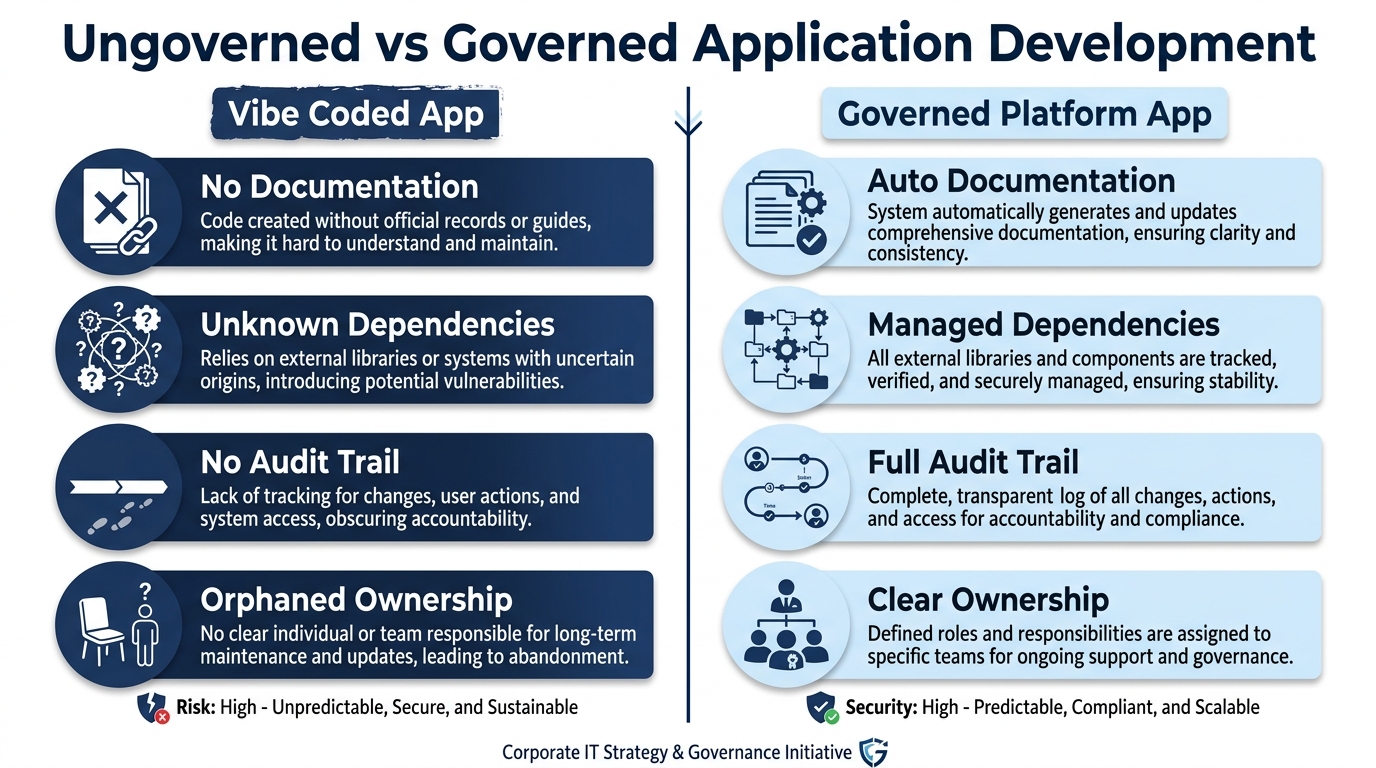
In traditional application development, ownership is usually clear. A team built the application, that team maintains it, and accountability for its behavior sits with identifiable people. Vibe-coded applications frequently have murkier ownership structures, because the way they were built didn’t require the organizational investment that typically creates ownership accountability.
A developer who spent a week prompting an AI tool to build a departmental workflow application may not think of themselves as the owner of that application in any durable sense. The application works. Their involvement felt temporary — more like configuration than authorship. Two years later, when something goes wrong, the question of who is responsible for that application may not have a clean answer.
This matters operationally when something breaks and needs to be fixed quickly. It matters for compliance when an auditor asks who is responsible for a specific application’s data handling. It matters for security when a vulnerability is discovered and someone needs to own the remediation. Ungoverned applications often have ungoverned ownership, and ungoverned ownership is a risk that does not show up in any deployment metric.
The shadow IT problem that AI-assisted development creates is not just about applications that IT doesn’t know about. It is also about applications that IT technically knows about but has no real governance over — no documented owner, no change management process, no audit trail, no formal assessment of what it does with data or how it handles failure.
What Governed Development Prevents
The case for governed enterprise application development is not an argument against speed or against using AI tools. It is an argument about where the cost of ungoverned development actually lands — and when.
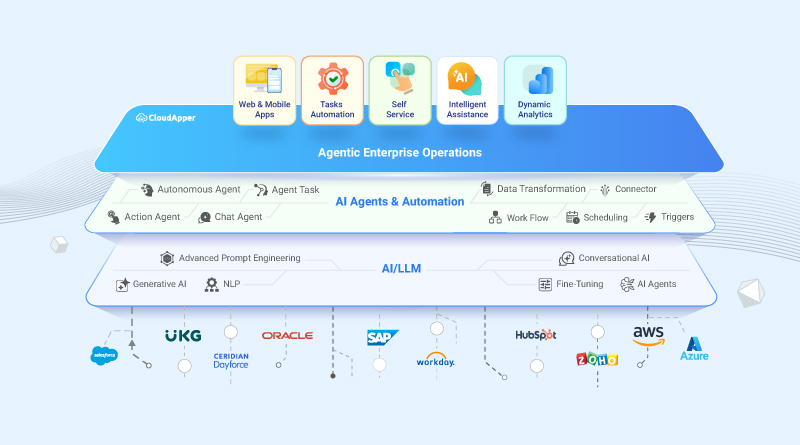
CloudApper AI provides a development environment where the governance artifacts that future teams will need — access controls, change history, deployment records, dependency management, compliance certifications — are produced as a byproduct of building on the platform, not as additional work that gets skipped under delivery pressure. Applications built on CloudApper inherit security controls, audit logging, and compliance frameworks at the platform level. The developer building a departmental workflow application does not have to make governance decisions; the platform has already made them.
The two-year view changes the economics of this significantly. When the full cost of an application includes maintenance, compliance adaptation, security patching, and eventual re-work — not just initial development — a governed platform that produces maintainable, auditable applications at comparable development speed is the lower-cost option. Building internal enterprise apps with AI without creating a compliance liability is not a constraint on what can be built. It is a different answer to the question of how.
The Conversation Worth Having Before the Next Application Gets Shipped
Most enterprises that are currently sitting on a portfolio of vibe-coded applications did not make a deliberate decision to accept the risks described here. They made a series of small decisions — to prioritize speed, to skip the governance step, to treat the application as temporary even when it wasn’t — that accumulated into a structural problem over time.
The useful question is not how to retroactively fix applications that have already been built without governance. That work is expensive and slow, and it competes with new development demand. The useful question is how to ensure that the next application shipped — and the one after that — does not add to the problem.
That question has a straightforward answer: build on a platform that makes governance the default rather than the exception. The speed advantage of vibe coding is real, but it is not unique to ungoverned approaches. What is unique to ungoverned approaches is the two-year cost that nobody priced into the original business case.
CloudApper AI gives enterprise development teams the speed of AI-assisted application building within a governance framework that makes those applications maintainable, auditable, and compliant from the start — not two years later when the cost of the alternative becomes clear. Reach out to see how CloudApper approaches governed enterprise application development.

What is CloudApper AI Platform?
CloudApper AI is an advanced platform that enables organizations to integrate AI into their existing enterprise systems effortlessly, without the need for technical expertise, costly development, or upgrading the underlying infrastructure. By transforming legacy systems into AI-capable solutions, CloudApper allows companies to harness the power of Generative AI quickly and efficiently. This approach has been successfully implemented with leading systems like UKG, Workday, Oracle, Paradox, Amazon AWS Bedrock and can be applied across various industries, helping businesses enhance productivity, automate processes, and gain deeper insights without the usual complexities. With CloudApper AI, you can start experiencing the transformative benefits of AI today. Learn More
- Useful Links:
- Agentic AI
- No-Code/Low-Code
- Custom Software
- HCM Personalization
- iPaaS
- FedRAMP
CloudApper AI Solutions


- Works with







- and more.
Similar Posts
Legacy Database Migration Blocked by Stored Procedures: What Enterprise IT…

Windows Server 2016 End of Support: What to Do When…