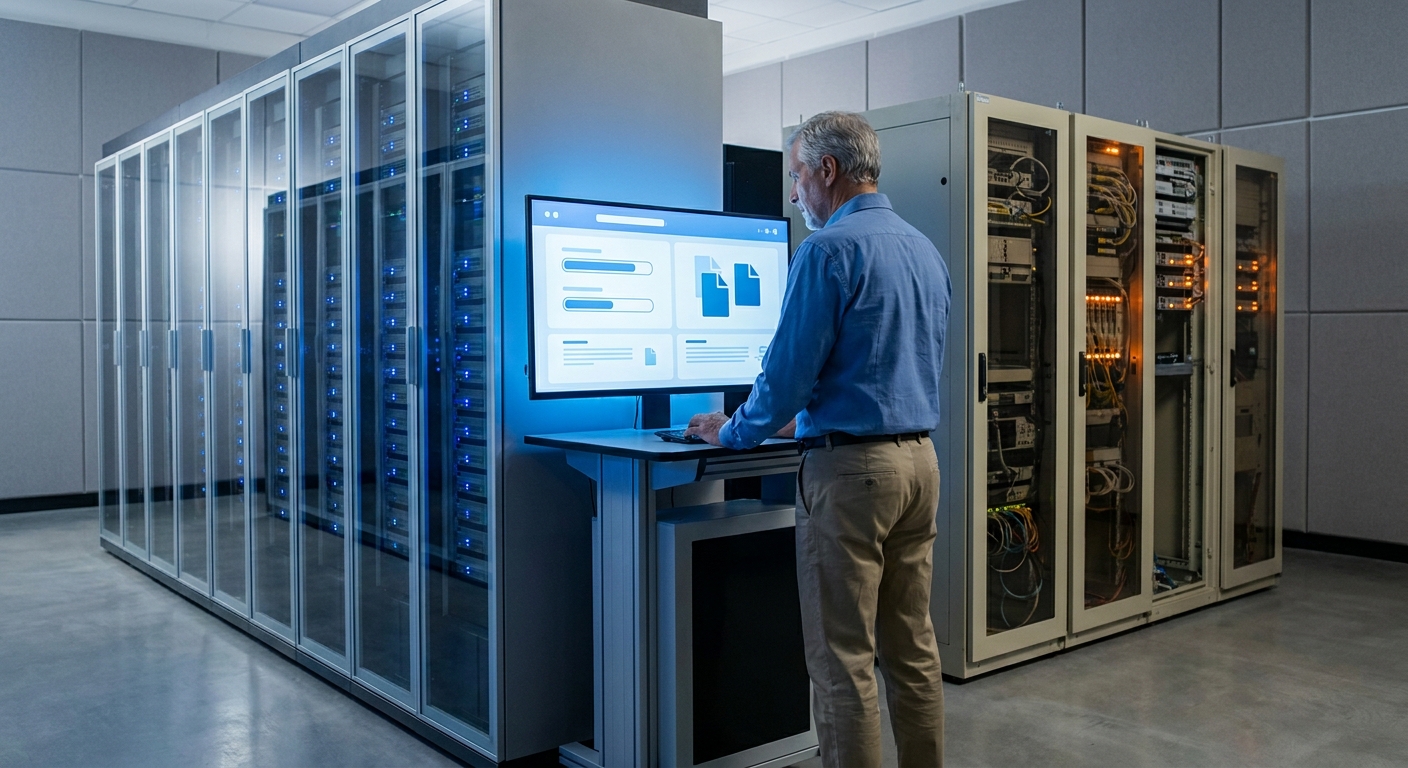
Every conversation about AI-generated code has been a security conversation. Underneath it sits a licensing exposure that behaves differently: vendor indemnities are conditional, SBOMs have no field for generated code, and provenance questions now arrive from customers and acquirers rather than from your own legal team.

TL;DR
Security defects in AI-generated code can be patched, but a licensing defect is a legal condition attached to software you have already shipped. Vendor IP commitments are real and conditional, requiring specific mitigations to be configured and evidenced, and coverage can lapse where content is flagged retroactively and the cited license is not honored. The doctrine is unsettled, with the Ninth Circuit having heard the identicality question in Doe v. GitHub in February 2026 and no decision yet issued. The practical exposure is not the appeal outcome but provenance: SBOMs record what you sourced and are silent on what a model generated inside your own repository, while customer questionnaires and diligence checklists increasingly ask. CloudApper's answer is governed construction, where the provenance record exists as a byproduct of how the application was built.
Table of Contents
- What the Copyleft Risk Actually Is, and Where It Is Not
- The Indemnity You Think You Have
- Provenance Became a Procurement Problem
- Governed Blueprints Instead of Generated Snippets
- How to Establish License Provenance for Internally Built Applications
- The Position Worth Taking
- Frequently Asked Questions
The question rarely arrives from your own legal team. It shows up in a customer’s vendor security questionnaire, somewhere around item forty: identify all third-party and open-source components in the software used to process our data, including license terms. Or it shows up in a data room during diligence, phrased more bluntly, asking you to warrant that the company owns or has properly licensed the code in its internally developed applications.
Either way, somebody on your team now has to answer a question about provenance for an application that was assembled over three weeks with an AI coding assistant. The honest answer is that nobody knows. The code works. It passed review. There is no record of where any particular block of it came from, because at no point in the process did anything create one.

Almost every conversation about AI-generated code in the enterprise has been a security conversation. Vulnerability rates, injection risk, unreviewed dependencies. That conversation is worth having, and CloudApper has spent a lot of time in it. But there is a second exposure sitting underneath it that gets very little airtime, and it does not behave like a security problem at all. Security defects can be found and patched. A licensing defect is a legal condition attached to your software, and you cannot scan your way out of one you have already shipped.
What follows is a practitioner’s framing, not legal advice. Your counsel owns the conclusions. IT owns whether the facts are knowable at all.
What the Copyleft Risk Actually Is, and Where It Is Not
Start by narrowing the problem, because the version of it that circulates in conference talks is broader than the version that will affect most enterprises.
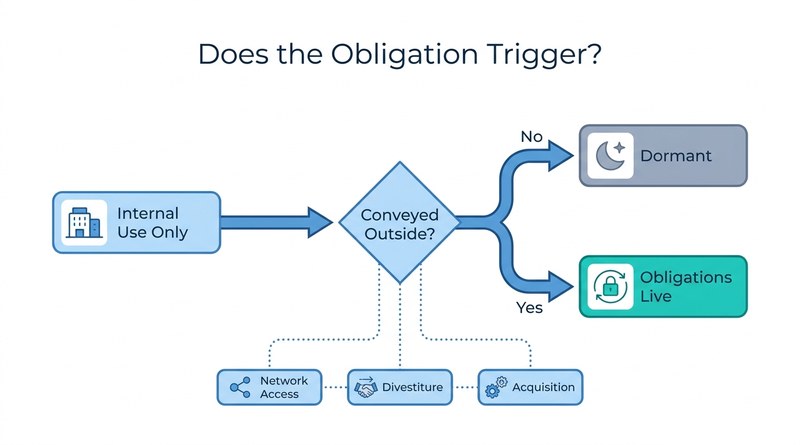
Reciprocal licenses in the GPL family attach obligations that trigger on distribution. If you convey the binary or the source outside your organization, you owe recipients the corresponding source of the covered work and the rights that come with it. That is the mechanism people are describing when they talk about contamination. For a purely internal application, used only by your own employees on your own infrastructure and never conveyed to anyone, the distribution trigger generally is not pulled. A fair amount of enterprise anxiety about copyleft in internal tools is anxiety about an obligation that has not activated.
Then there are the qualifiers, and they are the part worth writing down.
The Affero variant closes the network gap deliberately. If users interact with your application remotely, AGPL section 13 treats that as the trigger, which matters the moment an internal tool gets exposed to a partner portal, a patient-facing page, or a contractor VPN. Corporate boundaries also move. A subsidiary you divest, a business unit you carve out, a joint venture you spin up, an acquirer running its own diligence: each of these can turn an internal application into a conveyed one, and the analysis you did this year gets redone by somebody else’s counsel under time pressure. Weak copyleft in the LGPL family carries lighter but real obligations around linking. And permissive licenses are not free of duties either. MIT and BSD both require you to reproduce the notice and the license text, which sounds trivial until you cannot say which files the notice belongs to.
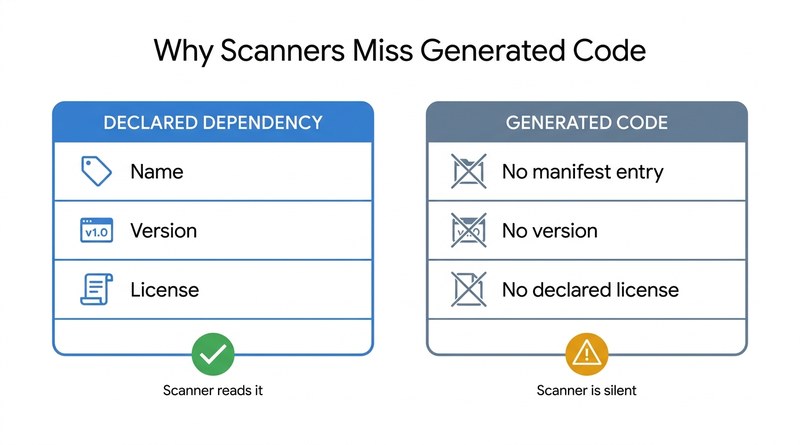
None of that is exotic. Software teams have managed it for two decades using dependency manifests, license scanners, and approval workflows. Those controls work because dependencies announce themselves. A package appears in a manifest with a name, a version, and a declared license, and a scanner reads it.
Generated code announces nothing. It arrives as text in your editor with no manifest entry, no version, and no declared license. Your software composition analysis tool will happily confirm your dependency tree is clean while saying nothing at all about the four hundred lines a model produced inside your own repository. The control was built for a supply chain that declares itself, and this input does not.
The Indemnity You Think You Have
The reasonable next thought is that the vendors have handled it. Most major assistants now advertise some form of IP protection, and enterprise buyers have understandably filed that under solved.
Read the actual terms. Microsoft’s Customer Copyright Commitment is explicit that eligibility is conditional on the customer implementing every required mitigation, and for code generation through Azure OpenAI those mitigations are specific: the protected material code model configured in annotate or filter mode, jailbreak filtering enabled, a system message directing the model away from infringement, and a testing and evaluation report that you retain and produce to Microsoft if you ever tender a claim. Miss one and the commitment does not apply. There is a further provision worth reading twice: where content is flagged retroactively by an asynchronous filter, coverage falls away unless the customer complies with the cited licenses. The obligation lands back on you.
So the protection is real, and it is narrower than the marketing summary. It is a defense against a third-party claim, conditioned on documented controls, offered by a vendor whose own exposure is still being litigated. In Doe v. GitHub, the district court dismissed most of the claims in June 2024, including the DMCA claim about stripped copyright management information, on the view that the outputs were not identical enough to the originals. Two claims survived: breach of contract and violation of open-source license terms. The identicality question was certified for interlocutory appeal, the Ninth Circuit accepted it, and the panel heard argument in February 2026 with no decision issued yet. The doctrine that governs this is unsettled and is being settled right now.
Which is why the enterprise question is not who wins that appeal. It is whether your organization can produce a coherent account of its own code if the answer goes the wrong way. This is the same structural gap as the one in a cyber insurance policy that may not cover a breach caused by AI-generated code. In both cases the organization believes it has transferred a risk, and in both cases the transfer is conditioned on evidence and controls that nobody checked before signing.
Provenance Became a Procurement Problem
Here is what changed the urgency, and it has nothing to do with copyright doctrine.
Software bills of materials moved from a federal procurement curiosity into a routine commercial expectation. Enterprises now ask their vendors for component inventories, and every enterprise is itself a vendor to somebody. A hospital system supplies data to payers. A manufacturer integrates with customer systems. A financial services firm answers third-party risk reviews every quarter. The questionnaire that used to ask about your infrastructure now asks about your components, and the honest answer for internally built applications is increasingly incomplete.
The reasoning in what federal supply chain guidance means for enterprise IT teams applies with an extra turn here. An SBOM records what you assembled. It has no field for code that was generated rather than sourced, which means the artifact you hand a customer to demonstrate transparency is silent on the fastest-growing part of your codebase. That silence reads as a gap to anyone doing serious diligence.
Contract language has moved too. IP warranties and non-infringement representations in customer agreements are frequently unqualified, warranting that the software does not infringe third-party rights. Signing that while holding no provenance record for a meaningful share of your code is a position your general counsel would want to know about, and often does not, because the code was written by a four-person internal team that never came near the contract.
Governed Blueprints Instead of Generated Snippets
The architectural answer is to stop producing artifacts whose origin is unknowable.
This is the distinction CloudApper draws between generated code and governed construction. When an application is assembled from platform components with known provenance and a documented license position, the provenance question has an answer before anyone asks it. The application is configuration and composition over a maintained runtime, not a pile of text whose lineage nobody recorded. There is nothing to reconstruct after the fact, because nothing was ever unaccounted for.
That property compounds across a portfolio. A team running fifteen internally built applications on CloudApper answers a provenance question once, at the platform layer, rather than fifteen times through forensic reconstruction. When a customer questionnaire arrives, when an acquirer opens a data room, when counsel needs a representation supported by something, the evidence exists as a byproduct of how the applications were built. It is the same argument made in evaluating development platforms when compliance is non-negotiable, applied to a category of risk most evaluation checklists still omit entirely.
For teams that intend to keep using assistants directly, and many will and should, the requirement is a documented pipeline rather than a prohibition. That is the substance of adding a governance layer to an AI coding assistant, and license provenance belongs in that layer alongside the security controls that usually get there first. A broader control set appears in a practical AI coding governance framework for IT and compliance teams, which is worth rereading with the licensing lens switched on.
How to Establish License Provenance for Internally Built Applications
For teams that need to close this gap on applications that already exist, the sequence below produces defensible answers rather than reassuring ones.
- Inventory which applications contain generated code and roughly how much. Ask the builders directly. You are establishing scope, not assigning blame, and an honest estimate from the person who wrote it beats any tool output at this stage.
- Turn on public code matching filters across every assistant in use. Configure blocking or flagging of suggestions that match public repositories, and confirm the setting is enforced at the organization level rather than left to individual preference.
- Determine your actual distribution posture per application. Document whether each one is internal only, network-accessible to outside users, or conveyed to third parties. This single fact determines which license obligations are live and which are dormant.
- Run license-aware scanning against your own source, not only your dependencies. Standard composition analysis reads manifests. Add snippet-level matching against public corpora so first-party files are examined too.
- Record the vendor terms you are actually relying on, with their conditions. Capture which indemnity applies to each tool, what mitigations it requires, and who owns keeping those mitigations in place. An indemnity nobody can evidence is not a control.
- Route the findings to counsel before the next contract cycle. Give legal the inventory and the distribution posture so warranties and questionnaire responses are written against reality. Discovering this during diligence costs far more than disclosing it early.
The Position Worth Taking
Two years from now, provenance will be an ordinary question, asked the way encryption at rest is asked today. Nobody argues about that one anymore. You either have it and can show it, or you explain yourself.
Organizations that get there early gain something more useful than compliance. They gain the ability to say yes quickly. A customer questionnaire stops being a two-week scramble across four teams. An acquisition target with clean provenance closes on schedule instead of negotiating an escrow against unknown IP exposure. A business unit that needs to expose an internal tool to a partner does it in a week, because somebody already knows what the license position is. Speed, in a governed organization, is mostly the absence of unanswered questions.
The teams that will struggle are the ones treating this as a legal department problem. Counsel can interpret an obligation. Counsel cannot manufacture a provenance record that was never created, and by the time the question is formally asked, the window for creating one cheaply has closed. This is the same lesson enterprises learned about what vibe-coded applications cost two years after deployment: the bill arrives later, denominated in something other than what you were tracking, and it is expensive precisely because the cheap moment to act has passed. The pattern in code that is fast to build and expensive to trust holds here with the word security swapped for the word ownership.
There are real people at the end of this, which is easy to lose in a discussion about license text. The internal team that built something useful should not discover two years later that their work created a liability nobody warned them about. That outcome is not a failure of the builders. It is a failure to give them a way of working where the record keeps itself.
Frequently Asked Questions
Can AI-generated code be copyrighted?
In the United States, copyright requires human authorship, so purely machine-generated output is generally not protectable on its own, while the human-authored selection, arrangement, and modification around it can be. The practical consequence for enterprises is asymmetric: you may hold weaker rights in what you generated while still carrying obligations attached to whatever it reproduced.
Does using an AI coding assistant violate open-source licenses?
Using one does not. The exposure arises if the output reproduces a substantial portion of licensed code and you then fail to meet that license’s conditions, such as attribution or source disclosure. Whether any particular output crosses that line is exactly the question the courts are currently working through.
Does the GPL apply to an application we only use internally?
The GPL family attaches its principal obligations to distribution, so an application used solely by your own employees on your own infrastructure often does not trigger them. The AGPL is the exception, treating remote network interaction as the trigger, and corporate events such as a divestiture or an acquisition can convert an internal application into a distributed one.
Does the vendor indemnity cover us if AI-generated code infringes?
Sometimes, conditionally, and never automatically. These commitments typically require specific mitigations to be configured and evidenced, and coverage can fall away where content is flagged after the fact and the underlying license is not honored. Read what your specific agreement requires and confirm somebody owns keeping those conditions satisfied.
Will an SBOM show us AI-generated code?
No. A software bill of materials records components you sourced and their declared licenses. Generated code enters your repository as first-party source with no manifest entry, so it sits outside what the artifact describes, which is why snippet-level scanning of your own files is a separate control.
What should we do about applications already in production?
Establish scope before remediation. Inventory which applications contain generated code, document the distribution posture of each, run snippet-level scanning against first-party source, and bring the results to counsel ahead of your next contract or diligence cycle rather than during one.
CloudApper is the process layer that closes the gaps enterprise software cannot, across HR, ERP, CRM, and the internal applications your team builds around them, on any platform and in weeks rather than quarters. If your organization cannot currently answer where the code in its internal applications came from, talk to us about building the next ones so the answer exists by default.

What is CloudApper AI Platform?
CloudApper AI is an advanced platform that enables organizations to integrate AI into their existing enterprise systems effortlessly, without the need for technical expertise, costly development, or upgrading the underlying infrastructure. By transforming legacy systems into AI-capable solutions, CloudApper allows companies to harness the power of Generative AI quickly and efficiently. This approach has been successfully implemented with leading systems like UKG, Workday, Oracle, Paradox, Amazon AWS Bedrock and can be applied across various industries, helping businesses enhance productivity, automate processes, and gain deeper insights without the usual complexities. With CloudApper AI, you can start experiencing the transformative benefits of AI today. Learn More
- Useful Links:
- Agentic AI
- No-Code/Low-Code
- Custom Software
- HCM Personalization
- iPaaS
- FedRAMP
CloudApper AI Solutions
- Works with








- and more.
Similar Posts

Microsoft Access Modernization: Why the Technical Migration Is the Easy…
When the ISV Disappears: Managing an Orphaned Windows Application With…