CISA's guidance on software supply chain security now applies to AI-generated code. Enterprise IT teams that used AI coding tools to build internal apps may have compliance gaps — unverifiable dependencies, hallucinated packages, and missing audit trails — that need to be addressed before their next security review.

Table of Contents
- What CISA Is Actually Saying
- The Specific Risk That AI Coding Tools Introduce
- What the Auditor Will Ask
- How Governed Platforms Address This Differently
CISA’s guidance puts software supply chain security inside enterprise IT governance, and AI-generated code written by internal teams falls within it. Most IT teams already run vendor assessments and third-party risk reviews, yet few have mapped AI-assisted internal development into that same framework.
The guidance that followed Executive Order 14028 covers the Secure Software Development Framework, Software Bills of Materials and, more recently, AI-generated code. For healthcare, financial services, manufacturing and logistics organizations using AI coding tools, the test is whether internal practices hold up under questioning. Platforms like CloudApper run on governed infrastructure with compliance inheritance across HIPAA, SOC 2, FIPS 140-2 and OWASP ZAP for this reason. That starts with what supply chain risk looks like when AI writes the code.
What CISA Is Actually Saying
Executive Order 14028, signed in 2021 and implemented through a series of CISA and NIST publications, established minimum expectations for software security in federal procurement. Its reach has since extended well beyond government contracting. Many large enterprises and regulated industries — particularly those that supply to federal agencies, operate under sector-specific regulators, or hold certifications like FedRAMP or SOC 2 — now face indirect pressure to align with these standards as part of their vendor risk posture and audit readiness.
The core SSDF guidance (NIST SP 800-218) requires that software producers document how software is developed, how vulnerabilities are identified and remediated, and how third-party components are tracked. NIST then published SP 800-218A, the SSDF Community Profile specifically for generative AI and foundation models, which extends these requirements into AI-assisted development. The document is explicit: when AI tools are used to generate code, the organization is still the software producer. The governance obligations do not transfer to the AI vendor.

CISA’s AI SBOM guidance adds another layer. Traditional SBOMs document software components — libraries, dependencies, versions. The AI SBOM concept extends that to document AI models, training datasets, code generation tools, and the provenance of AI-produced outputs. For an enterprise that has used GitHub Copilot, Cursor, Amazon Q, or a similar tool to build internal applications, this means a potentially significant audit surface that most IT teams have not inventoried.
The practical implication: if your team used an AI coding tool to build or modify an internal application — a workflow system, an employee-facing portal, a supply chain dashboard — and you cannot document what that tool generated, what dependencies it introduced, and how those were reviewed, you have a supply chain gap that is increasingly visible to auditors and security reviewers.
The Specific Risk That AI Coding Tools Introduce
Supply chain risk in traditional software development is primarily about what your vendors ship. In AI-assisted development, the risk profile is different and, in some ways, harder to control.
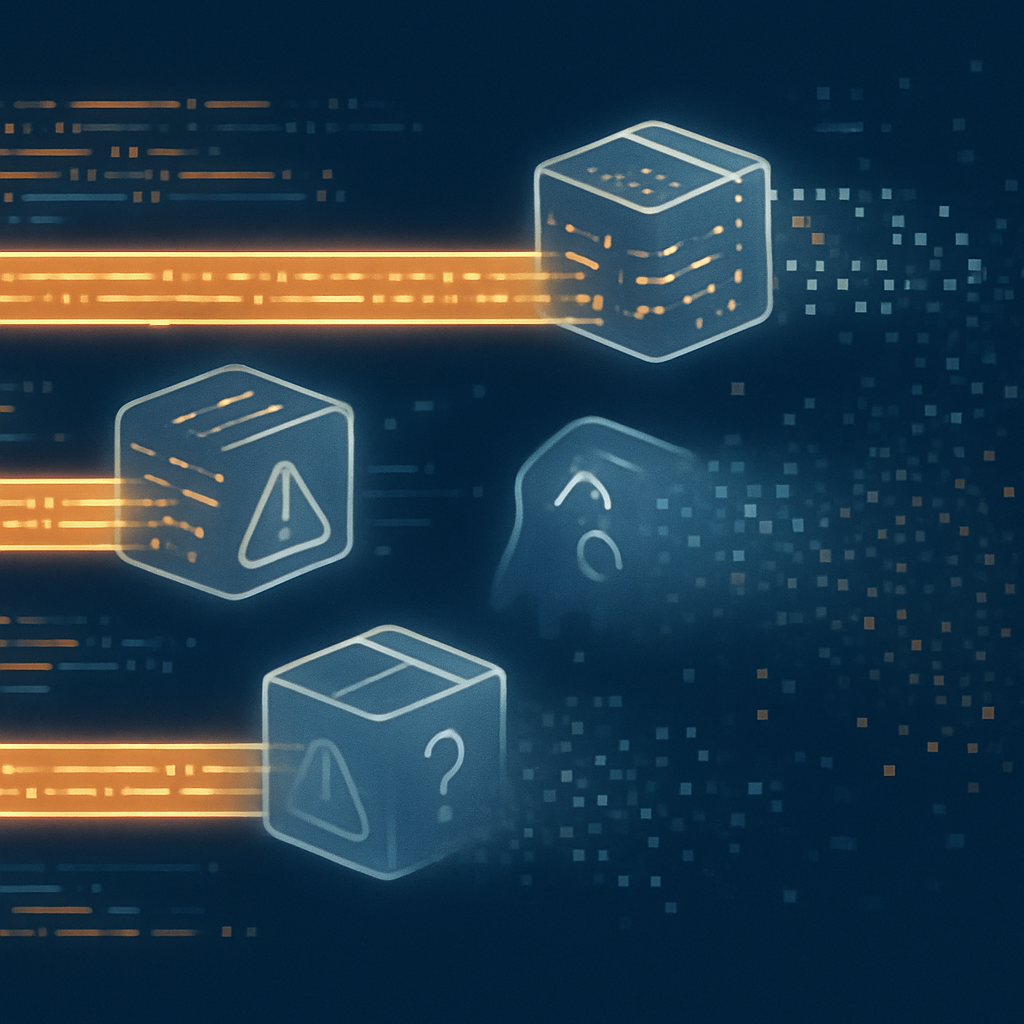
Hallucinated packages and slopsquatting. Research from multiple sources in 2025 and 2026 has documented a category of attack that did not exist before AI coding tools became mainstream. When a developer prompts an AI coding assistant to write code that requires an external library, the model sometimes invents package names that do not exist. Security researchers have named this pattern slopsquatting. Malicious actors register those fictional package names on public registries. Developers who follow the AI’s suggestions install the malicious package without realizing it was never the package the model intended to suggest, because the model invented it. Across 16 major LLMs tested, none was free of package hallucination. Commercial models hallucinated packages in at least 5.2% of cases. Open source models hit 21.7%.
For an enterprise IT team building internal applications with AI coding tools, this is a concrete and measurable supply chain exposure. An internal HR workflow app, a manufacturing floor data collection tool, a customer-facing portal — any of these built with AI assistance could include dependencies your team never explicitly reviewed, sourced from registries your security team never approved.
Unverifiable code provenance. SBOM requirements assume you can document where your software components came from. AI-generated code does not produce provenance. A model does not cite its training data or disclose which existing code it reproduced or adapted. If your security team needs to trace a vulnerability back to its source — as NIST’s SSDF requires — AI-generated code makes that investigation substantially harder. This is not theoretical. Veracode’s 2025 GenAI Code Security Report found that AI-generated code contains 2.74 times more vulnerabilities than human-written code, with 45% of sampled outputs introducing OWASP Top 10 vulnerabilities.
Compliance inheritance gaps. Organizations that operate under HIPAA, SOC 2, FedRAMP, or FIPS 140-2 tend to assume their compliance certification covers their internal applications. That assumption holds when applications are built on certified infrastructure with documented controls. It does not automatically hold when code is generated by an external AI tool and deployed without a structured review process. What SOC 2 auditors are now asking about internal app development has evolved considerably in the past two years, and AI-generated code has become a specific audit focus rather than an afterthought.
What the Auditor Will Ask
Whether the audit is SOC 2, HIPAA, FedRAMP, or an internal security review, the questions converging around AI-assisted development are predictable. IT leaders who prepare for them in advance have a materially better outcome.
Can you produce a software inventory for your internally built applications? This means naming every application built or modified in the past 24 months, the tools used to build it, and the external libraries or dependencies it includes. For teams that have used AI coding tools, this inventory is often incomplete.
Do you have a review process for AI-generated code before deployment? CISA’s SSDF guidance requires organizations to verify that third-party components meet security requirements before use. AI-generated code that includes unreviewed dependencies does not satisfy this requirement. Adding a governance layer to AI coding tools like GitHub Copilot is one approach, but it requires deliberate implementation — it does not happen by default.
How do you handle vulnerabilities discovered in AI-generated code? If your team cannot trace a vulnerability back to its source because the code was AI-generated and undocumented, your incident response process is incomplete by definition. This is a specific gap auditors are flagging in enterprise environments that adopted AI coding tools quickly.
Does your cyber insurance policy cover breaches involving AI-generated code? This question is increasingly on the agenda in security reviews. Cyber insurance exclusions for AI-generated code vulnerabilities are a real and expanding category, and IT teams that have not reviewed their policy language in the past 18 months may be carrying uninsured exposure.
How Governed Platforms Address This Differently
The fundamental difference between building on a governed enterprise application platform and generating code with an AI coding tool is what the organization can document and inherit.
CloudApper is built on AWS Bedrock, certified under HIPAA, SOC 2, GDPR, CCPA, FIPS 140-2, OWASP ZAP, and FERPA. Applications built on the platform inherit those controls from the infrastructure layer. The compliance posture does not depend on individual developers following the right review processes or catching the right vulnerabilities in code review. It is embedded in the platform’s architecture and verifiable through the platform’s own certification documentation.
This distinction matters specifically for software supply chain audits. When an auditor asks for evidence of secure software development practices, a CloudApper-built application has a documented answer: the platform’s certified infrastructure, its integration controls, its access management, and its compliance documentation are all available as audit evidence. An application built with an AI coding tool and deployed without a governance framework does not have an equivalent answer.
The SBOM question also resolves differently on a governed platform. Because CloudApper’s platform manages the runtime, handles patching and updates, and controls the integration layer through its iPaaS, the dependency surface for applications built on the platform is known, documented, and maintained centrally. The hallucinated package problem — where an AI coding assistant invents a dependency that a developer installs without verification — does not apply in the same way. The real cost of AI-generated code in enterprise environments is concentrated precisely in this verification gap, and platform-level governance is one of the few reliable ways to eliminate it structurally rather than process-by-process.
For organizations extending existing systems — Workday, UKG, SAP, Oracle — the same logic applies. The integration layer on a governed platform carries its own security controls and audit trail. Custom extensions built ad hoc with AI coding tools do not.
What IT Teams Should Do Now
The CISA guidance and NIST SP 800-218A are not mandates for most private-sector enterprises. But they represent the direction audit expectations are moving, and they describe a set of practices that security reviewers, insurance underwriters, and increasingly large enterprise customers are beginning to require.
For IT Directors and CISOs at non-software enterprises, the practical steps are clear. First, inventory every internal application built or materially modified in the past two years, noting which were built using AI coding tools. This inventory is the starting point for any supply chain conversation with an auditor. Second, establish a dependency review process for any AI-generated code currently in production — identify every external library the application calls, verify those packages against their registry of origin, and document the review. Third, review your cyber insurance policy language for exclusions related to AI-generated code or unreviewed third-party components.
Finally, evaluate whether your current internal development approach can produce the documentation your next audit will require. FedRAMP-ready application development is a useful reference frame even for organizations not pursuing FedRAMP, because the documentation requirements mirror what SOC 2 and HIPAA auditors are increasingly expecting. If the answer to the documentation question is no, the time to address that is before the audit, not during it.
The organizations that will handle the next wave of supply chain scrutiny well are those that made architecture decisions early — choosing platforms whose governance is built in rather than retrofitting controls onto AI-generated code after the fact. CloudApper’s governed platform approach is designed for exactly that outcome: applications with a verifiable compliance posture, a documented dependency surface, and audit evidence that does not depend on individual developer discipline.
If your organization is evaluating how to build or extend enterprise applications in a way that satisfies current and emerging supply chain security requirements, the CloudApper team is available to walk through your specific compliance context. Contact us here.

What is CloudApper AI Platform?
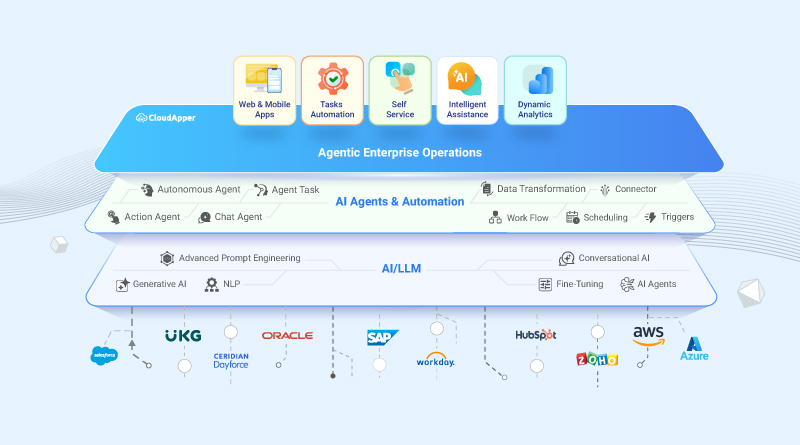
CloudApper AI is an advanced platform that enables organizations to integrate AI into their existing enterprise systems effortlessly, without the need for technical expertise, costly development, or upgrading the underlying infrastructure. By transforming legacy systems into AI-capable solutions, CloudApper allows companies to harness the power of Generative AI quickly and efficiently. This approach has been successfully implemented with leading systems like UKG, Workday, Oracle, Paradox, Amazon AWS Bedrock and can be applied across various industries, helping businesses enhance productivity, automate processes, and gain deeper insights without the usual complexities. With CloudApper AI, you can start experiencing the transformative benefits of AI today. Learn More
- Useful Links:
- Agentic AI
- No-Code/Low-Code
- Custom Software
- HCM Personalization
- iPaaS
- FedRAMP
CloudApper AI Solutions

- Works with







- and more.
Similar Posts

CMMC Level 2 and Internally Built Applications: The Evidence Gap…

Vendor-Built Internal Applications: The Governance Gap Enterprise IT Inherited From…