HITRUST certification exposes the internally built applications health system IT never planned to validate. When custom tools — scheduling apps, referral trackers, care coordination platforms — are built outside a governed stack, they fall into scope the moment they touch patient data. Platform governance is the only mechanism that produces the evidence an assessor requires without a per-application remediation cycle.

TL;DR
HITRUST certification applies to a defined scope boundary, and internally built applications that handle sensitive health information are in scope whether or not they appear on the scope document. Health systems that build operational tools outside a governed platform typically discover this during the assessment cycle, after the control evidence gap has already delayed certification. HITRUST’s inheritance mechanism allows organizations to leverage documented controls from certified platform providers rather than validating each application independently. Enterprise application platforms certified to HIPAA, SOC 2, and FIPS 140-2 standards create the inheritance path that lets internal applications enter an assessment scope without triggering a per-application remediation cycle. The governance decision that determines certification timeline is made when the application is built, not when the assessor arrives.
Table of Contents
- What HITRUST Scope Actually Requires
- The Application Inventory Problem
- What Assessors Find When They Look
- Control Inheritance and Why Platform Architecture Changes the Math
- The Certification Preparation Organizations Skip
- How to Assess Whether an Internally Built Application Is in HITRUST Scope
- Frequently Asked Questions
HITRUST certification assesses a defined environment, not an organization, so the applications built around your certified stack can decide whether you pass. Two similar health systems pursued HITRUST e1 with the same assessor organization: one certified on the first cycle, the other was delayed six months and needed a second review cycle.
Both ran certified EHRs. The difference was what internal IT had built around them over three years, including scheduling automation, a referral management app, a care coordination tracker pulling ADT feeds and a workforce scheduling app writing back to the HCM. None were in scope, and all touched sensitive health information. Platforms like CloudApper, which build compliance governance into the application development layer, exist because this gap is structural.
What HITRUST Scope Actually Requires
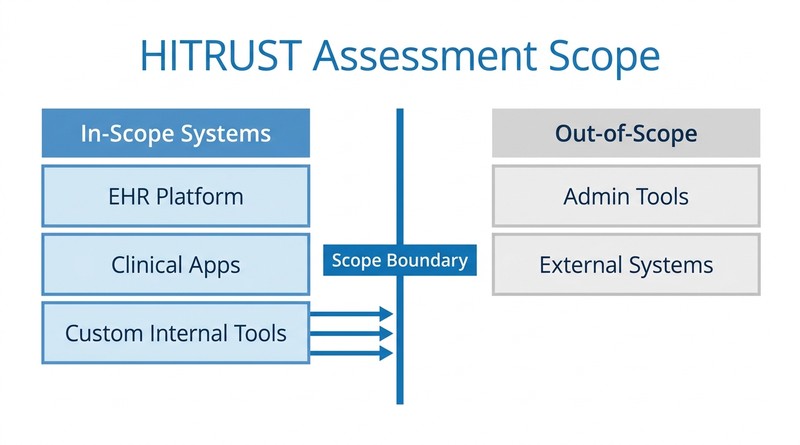
The HITRUST Common Security Framework operates through assessed environments. When an organization pursues certification, it defines a scope boundary: the systems, processes, and data flows included in the assessment. The external assessor validates that everything within that boundary meets the applicable control requirements for the chosen assessment type — e1 (44 essential requirements), i1 (182 implemented requirements), or r2 (375-plus risk-based requirements).
What makes scope definition consequential is that the assessor doesn’t automatically enumerate your systems. The organization proposes the boundary, and the assessor evaluates whether that boundary is complete. If an application processes, stores, or transmits sensitive health information — the HITRUST term for data that includes ePHI — it is, by definition, in scope regardless of whether it appears on the scope document.

This is where health systems face a structural problem. EHR platforms, cloud infrastructure providers, and major clinical systems maintain their own HITRUST certifications or provide detailed control documentation that organizations can map to assessment requirements. Internal applications — the tools IT teams build to fill gaps the primary systems can’t fill — have no such documentation, no inherited certification status, and often no security assessment history at all.
When your custom applications extend an Epic or Oracle Health environment by pulling patient data, routing clinical workflows, or surfacing census information to operational staff, they are functioning as adjunct clinical systems. The HITRUST assessor sees them exactly that way.
The Application Inventory Problem
Most health systems cannot produce an accurate inventory of every application that receives or sends patient data. This is not a criticism — it is a structural consequence of how enterprise IT evolves. A department requests a tool. IT builds it or enables a vendor to integrate it. The integration works through existing API connections. Over time, the application becomes critical infrastructure, but its security posture was never documented at the level an assessor requires.
The question an assessor asks is not “was this application built securely?” It is “what controls govern how this application handles SHI, and how do you evidence those controls?” For applications built on governed platforms — cloud providers with established HITRUST programs, certified infrastructure layers — that evidence exists and can be inherited. For custom-built applications running on ad-hoc infrastructure, the organization has to produce that evidence from scratch.
Shadow development — teams building applications outside centralized IT governance — compounds the problem. A care coordination tool built by a clinical operations team using a low-code platform the IT department didn’t provision is still in scope the moment it touches patient data. The organizational boundary of who built it is irrelevant to the compliance boundary of what it handles.
This is what the organization that delayed its HITRUST certification discovered. The applications were real. The data flows were real. The security controls were, at best, inconsistent — and at worst, undocumented. Including them in scope extended the assessment timeline. Remediating the control gaps extended it further.
What Assessors Find When They Look
HITRUST external assessors conduct structured interviews with system owners and review architecture documentation, data flow diagrams, and control evidence. An application that appears in a data flow diagram but is not in the assessed environment is a material discrepancy. Assessors are trained to ask about integration points, and every integration point is a potential scope expansion.
The practical sequence unfolds like this: the organization submits its scope boundary. The assessor reviews network diagrams and integration documentation. An application appears in a data flow that isn’t on the scope list. The assessor asks the system owner to describe how ePHI flows through it and what controls govern access and transmission. The system owner describes the application but cannot produce documented control evidence because the application was built without assessment planning.
At that point, the organization has three options. Include the application in scope and extend the assessment timeline while controls are documented and validated. Exclude the application and provide documented evidence that SHI does not actually flow to it — which requires either architectural changes or a defensible data flow analysis. Accept a finding and remediate before certification completes.
The parallel with SOC 2 assessments is direct: the auditor’s question is always about evidence, not intent. What you believed about an application’s security posture is not what certifies it. The gap between belief and documentation is where health system IT teams spend unplanned months before certification completes.
Control Inheritance and Why Platform Architecture Changes the Math
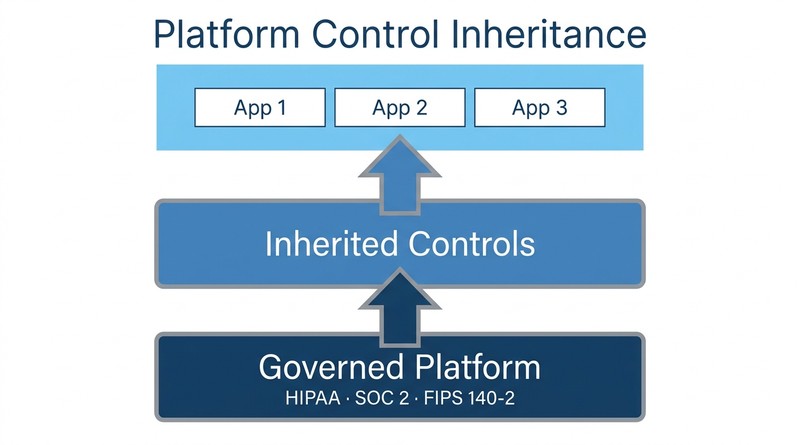
HITRUST’s inheritance mechanism is the most important concept for organizations that build internally. Formally, inheritance allows an organization to leverage controls implemented and managed by a service provider — a cloud host, a platform operator, a technology vendor — rather than implementing and evidencing those controls independently for each system.
A health system running workloads on a cloud provider with a HITRUST program can inherit the controls that provider manages: physical security, infrastructure configuration, patch management, certain access controls. The application owner still owns application-layer controls — access management within the application, audit logging of user actions, data handling at the application level — but the infrastructure layer is inherited rather than independently validated.
This mechanism applies equally to enterprise application platforms. When every internally built application runs on a governed platform that maintains its own compliance certifications and documented control implementations, the platform’s control posture extends to the applications built on it. The application owner inherits infrastructure-layer controls. The platform handles runtime security, configuration management, and encrypted data handling. The assessor reviews the platform’s documentation once, not an ad-hoc implementation for each application.
CloudApper provides this architecture for health systems and other regulated enterprises building internal applications. Applications built on CloudApper operate within a governed environment certified to HIPAA, SOC 2, FIPS 140-2, and OWASP ZAP standards — the same control categories that HITRUST requirements map to. When an assessor asks how a custom scheduling application governs access to patient census data, the answer comes from CloudApper’s documented control framework rather than from a per-application security review that was never conducted.
The practical difference is significant. An organization with forty internal applications built on CloudApper presents the assessor with one platform’s control documentation covering all forty applications. An organization with forty applications built on disparate tools, frameworks, and hosting configurations presents forty separate evidence packages — and often cannot produce complete packages for any of them.
When department teams become application builders, platform governance is the only mechanism that keeps the application portfolio inside a defensible compliance boundary. The alternative — reviewing each application independently as it comes up in an assessment — is a timeline problem that compounds with every tool built without governance in mind.
The Certification Preparation Organizations Skip
Most HITRUST readiness programs focus on the primary clinical systems, the cloud infrastructure, and the network boundary. Internal applications are often treated as an afterthought — or not treated at all — until the assessor’s data flow review surfaces them.
The organizations that certify cleanly on the first cycle are not necessarily the ones with fewer internal applications. They are the ones whose internal application development happened inside a governance framework that produced evidence by default. Every application deployment was logged. Every access control configuration was documented. Every data flow was part of a governed integration pattern rather than a one-off connection.
Evaluating enterprise application development platforms through a compliance lens — before the development happens, not before the assessment — is what changes the certification timeline. The question is not “can we remediate our internal apps before the assessor arrives?” It is “did we build our internal apps on a platform that produces the evidence the assessor needs?”
The health system that delayed its certification had competent developers, well-designed applications, and genuine institutional commitment to HIPAA compliance. What it didn’t have was a platform architecture that made compliance evidence automatic rather than reconstructed after the fact. That distinction — between evidence generated continuously by a governed system and evidence assembled retrospectively from incomplete records — is what separates a first-cycle pass from a six-month delay.
Healthcare organizations that haven’t started their HITRUST readiness work yet have a practical advantage: the development decisions they make now determine which category they fall into. Organizations that are mid-assessment with ungoverned internal applications have fewer options, but the same underlying solution applies — platform governance as the mechanism that brings the application portfolio into a defensible scope boundary. The governance layer that HIPAA auditors now expect from AI-assisted development is the same layer that HITRUST assessors expect from any internal application touching ePHI — and the platform is the only way to apply it at portfolio scale.
How to Assess Whether an Internally Built Application Is in HITRUST Scope
The following steps apply to any health system conducting a preliminary scope analysis before engaging an external assessor organization. This is a practical assessment framework, not formal compliance counsel — consult a qualified HITRUST assessor for your specific certification requirements.
- Map all data flows from primary clinical systems to any downstream application. Include direct API integrations, file-based HL7 or FHIR feeds, database replication, and any interface that receives or transmits sensitive health information. Start with the EHR interface engine and work outward through every connection.
- For each application identified, determine actual data handling — not intended data handling. An application designed to aggregate census data by unit is handling ePHI whether it permanently stores patient records or not. Determine what data the application receives, displays, logs, and whether any of that constitutes SHI under the HITRUST definition.
- Review the access control and audit logging configuration of each in-scope application. HITRUST control categories include access control requirements and audit logging standards. Applications without documented, enforced access controls and audit trails cannot satisfy these requirements regardless of other security measures in place.
- Document the hosting environment and assess what inherited controls are available. Applications running on certified cloud infrastructure or governed enterprise platforms can leverage the inheritance mechanism. Applications running on departmental servers, unmanaged virtual machines, or ad-hoc hosting configurations have no inheritance path and require independent control validation.
- Identify the control gaps between each application’s current posture and HITRUST requirements. For each gap, classify the remediation effort: architectural change, configuration change, or documentation gap only. Architectural changes that require code modifications or platform migrations require the most lead time and should be identified well before an assessment begins.
- Decide the scope strategy for each application before the assessment begins. Include applications in scope with a documented remediation plan, exclude with evidence that SHI does not flow to them, or migrate to a governed platform before the scope boundary is set. Decisions made after the assessor begins work carry higher cost and fewer options.
Frequently Asked Questions
What is HITRUST certification and which organizations pursue it?
HITRUST is an independent certification framework for information security in regulated industries, with the largest adoption in healthcare. Organizations that process, store, or transmit sensitive health information — including hospitals, health systems, payers, healthcare technology companies, and business associates handling ePHI — may pursue HITRUST certification as evidence of security program maturity. Many payers and health systems now require business associates to hold HITRUST certification as a contracting condition.
Do all internally built applications need to be independently HITRUST certified?
No. Applications included in an organization’s HITRUST assessment scope are validated as part of that assessment — they do not require separate certification. The question is whether the organization’s HITRUST certification boundary covers the application’s environment. Applications built on platforms that maintain their own HITRUST programs may leverage inherited controls, reducing the independent validation burden for each application.
Can an organization inherit HITRUST controls from its platform provider?
Yes. HITRUST’s inheritance mechanism allows organizations to leverage controls implemented by service providers — cloud hosts, platform operators, and certified technology vendors — rather than implementing those controls independently for each system. The extent of inheritance depends on which controls the provider manages versus which controls remain the customer’s responsibility.
What happens when an assessor discovers an internal application that wasn’t included in the scope boundary?
If the application handles SHI, the organization must either retroactively include it in scope — extending the assessment timeline — or provide documented evidence that SHI does not actually flow to the application. Out-of-scope applications confirmed to handle SHI without a remediation plan are a material finding that prevents certification from completing on the original timeline.
How does building on a governed enterprise platform affect HITRUST assessment preparation?
Applications built on a governed enterprise platform with documented compliance certifications can leverage the platform’s control documentation during assessment. Instead of producing per-application security evidence, the organization presents the platform’s compliance framework as the governing control environment. This reduces assessment preparation time and eliminates documentation gaps that arise from applications built without governance infrastructure.
What compliance certifications should a healthcare enterprise application platform hold?
Relevant certifications for healthcare application platforms include HIPAA, SOC 2 Type II, FIPS 140-2, and OWASP ZAP. Platforms certified against these frameworks produce documentation directly mappable to HITRUST control requirements, supporting the inheritance mechanism during assessment and reducing the remediation burden for each internally built application.
This article addresses IT governance and platform architecture considerations in the context of HITRUST certification planning. It does not constitute legal advice or formal compliance guidance — healthcare organizations should engage a qualified HITRUST-authorized external assessor for their specific certification requirements.
Health systems and enterprise organizations building internal applications in regulated environments can connect with the CloudApper team to review how the platform’s compliance architecture maps to their HITRUST readiness scope and control inheritance requirements.

What is CloudApper AI Platform?
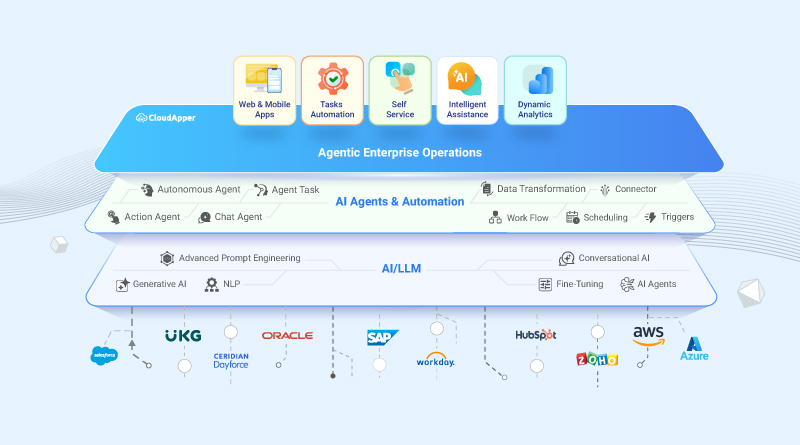
CloudApper AI is an advanced platform that enables organizations to integrate AI into their existing enterprise systems effortlessly, without the need for technical expertise, costly development, or upgrading the underlying infrastructure. By transforming legacy systems into AI-capable solutions, CloudApper allows companies to harness the power of Generative AI quickly and efficiently. This approach has been successfully implemented with leading systems like UKG, Workday, Oracle, Paradox, Amazon AWS Bedrock and can be applied across various industries, helping businesses enhance productivity, automate processes, and gain deeper insights without the usual complexities. With CloudApper AI, you can start experiencing the transformative benefits of AI today. Learn More
- Useful Links:
- Agentic AI
- No-Code/Low-Code
- Custom Software
- HCM Personalization
- iPaaS
- FedRAMP
CloudApper AI Solutions


- Works with








- and more.
Similar Posts

The Service Account Audit Nobody Runs: When AI-Built Apps Turn…

AI Agent Over-Permission: The Access Control Problem Nobody Scoped When…