ERP customization debt is not a technology problem — it is the accumulated cost of process decisions that were too politically difficult to make. Every modification deferred a governance decision; the upgrade bill is the invoice for all of them arriving at once.

TL;DR
Enterprise ERP upgrades consistently overrun budget when the modification inventory has not been reviewed since initial implementation, because each customization carries a lifetime cost two to five times its initial development cost and consumes the majority of developer time during migration. The core problem is not technical: ERP modifications represent deferred organizational decisions — process redesigns and policy standardizations that were avoided in favor of a cheaper short-term workaround. The business unit sponsors who demanded those modifications are almost never present when the upgrade is estimated, which is why the debt goes unrecognized until go-live pressure makes it undeniable. Organizations that manage this well treat each modification as a capital allocation decision with an assigned process owner, a logged business case, and a mandatory review date tied to the next major release cycle. CloudApper AI provides a governed extension platform that separates business logic from ERP core code, so enterprises can extend their systems without accumulating the customization layer that determines upgrade risk.
Table of Contents
ERP customization debt is the upgrade cost of organizational decisions that were too politically difficult to make, and the enterprise upgrade estimate is where that bill arrives. Each modification was a cheaper short-term alternative to redesigning a process or telling a business unit the standard capability was enough.

A purchase order routing change approved in 2011, and hundreds like it, can push an upgrade to three times the initial scoping fifteen years later. The modification records survive. The business cases do not, and the units that asked for them are rarely in the room. CloudApper AI, a governed platform for building, extending and modernizing enterprise applications, works from the same observation: the most expensive customizations solved a political problem, not a real one.
How Modifications Convert Into Upgrade Cost
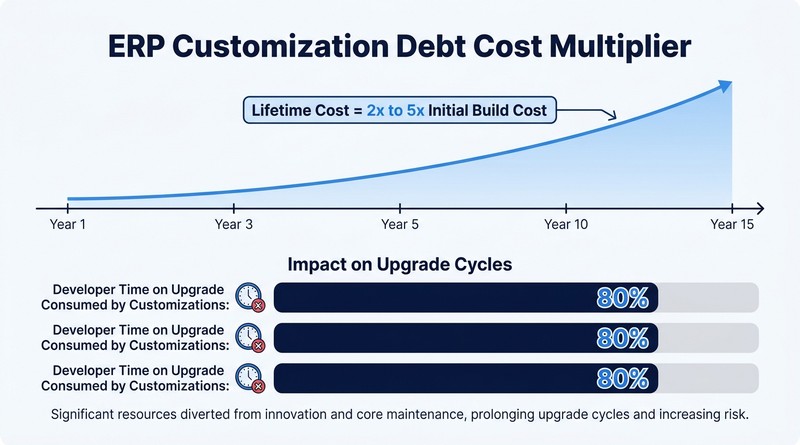
The mathematics of ERP customization debt are unambiguous. Research on ERP customization effects indicates that the lifetime cost of a significant modification runs two to five times its initial development cost — a multiplier that grows with each upgrade cycle the customization must survive. Handling problems arising from modifications during an upgrade consumes roughly 80% of a developer’s time for the duration of the project. In heavily customized systems, the upgrade is not an upgrade — it is a re-implementation with a compatibility constraint the vendor did not design for.
The common framing misses the more consequential problem. Customizations do not just break during upgrades — they freeze the processes they encode. A workflow modified in 2011 now determines how the entire organization handles approvals at upgrade time. The governance debt that surfaces at migration time follows exactly the same pattern: decisions never made formally become structural constraints on the project budget.
The Stakeholder Who Was Never in the Room
Upgrade estimation meetings are attended by IT, the vendor, the implementation partner, and the CIO. The business unit process owners who demanded the original customizations are rarely present. This absence reflects the same incentive structure that created the modifications.
From the business unit’s perspective, the original modification was rational: it preserved local efficiency and avoided a change management effort nobody wanted to fund. Nobody in that 2011 meeting understood they were making a 15-year capital commitment. When the people who built those modifications have left the organization, the upgrade team inherits decisions they cannot explain, serving processes they cannot identify, for business units who may not remember why the exception was needed.
The lift-and-shift fallacy applies here too — migrating an unreviewed customization layer forward to a new version does not retire the debt; it refinances it.
What the Budget Should Have Included From the Start
Upgrade cost overruns by 60% in the majority of projects involving significant legacy modifications. The more consequential figure for the CFO is what customization debt costs in enterprise optionality: every year a heavily modified ERP is not rationalized increases the probability that the next acquisition or compliance mandate will require a parallel system rather than an integrated upgrade — doubling integration cost and extending time-to-value by 18 to 24 months. AI automation programs attempting to connect to a heavily customized ERP do not encounter the standard documented system — they encounter 15 years of local decisions encoded as constraints.
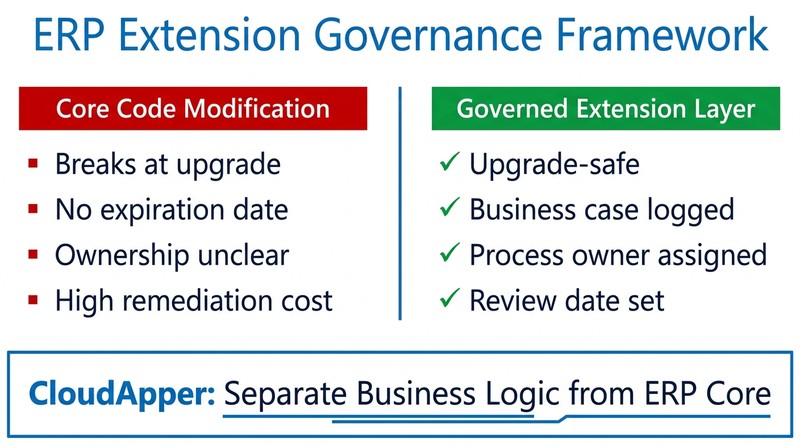
The organizations that manage this well do not stop customizing. They stop customizing without expiration dates. Every modification is logged with the business case that justified it, the process owner accountable for it, and a review date tied to the next major release cycle. That is a capital allocation practice, not an IT governance checkbox. The real cost of maintaining a legacy system includes not just infrastructure overhead but the expanding upgrade risk carried by every unreviewed modification in the stack.
CloudApper provides a governed platform that separates business logic from ERP core code, so organizations can extend their systems without accumulating the customization layer that determines upgrade risk. For enterprises facing an upgrade where the modification inventory is the primary unknown, that architectural distinction is where the budget conversation changes.
For organizations scoping an ERP upgrade or modernization where the customization inventory is the primary risk factor, CloudApper provides a governed extension platform that protects upgrade timelines and makes business logic portable. To discuss your modernization approach, visit CloudApper’s contact page.

What is CloudApper AI Platform?
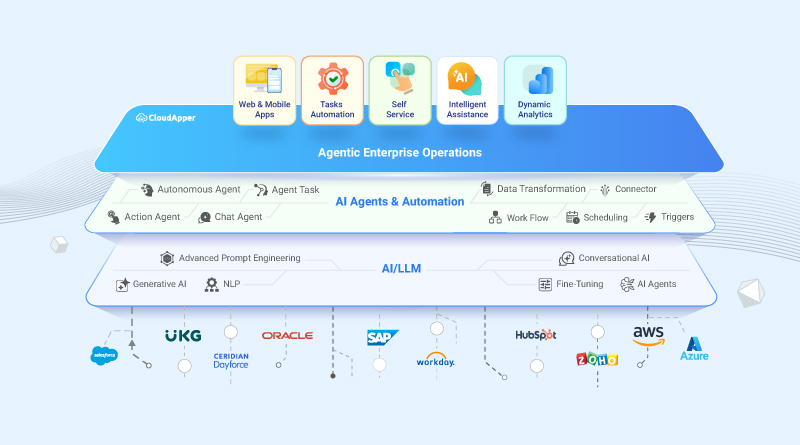
CloudApper AI is an advanced platform that enables organizations to integrate AI into their existing enterprise systems effortlessly, without the need for technical expertise, costly development, or upgrading the underlying infrastructure. By transforming legacy systems into AI-capable solutions, CloudApper allows companies to harness the power of Generative AI quickly and efficiently. This approach has been successfully implemented with leading systems like UKG, Workday, Oracle, Paradox, Amazon AWS Bedrock and can be applied across various industries, helping businesses enhance productivity, automate processes, and gain deeper insights without the usual complexities. With CloudApper AI, you can start experiencing the transformative benefits of AI today. Learn More
- Useful Links:
- Agentic AI
- No-Code/Low-Code
- Custom Software
- HCM Personalization
- iPaaS
- FedRAMP
CloudApper AI Solutions

- Works with







- and more.
Similar Posts

Vendor-Built Internal Applications: The Governance Gap Enterprise IT Inherited From…

What Your AI Development Platform Vendor’s Security Review Should Actually…