When patching a legacy Windows application breaks production, the real liability is the missing documentation — not the vulnerability. HIPAA, SOC 2, and cyber insurance frameworks distinguish between unpatched systems and unpatched systems with no managed decision record. Here is what IT teams must document before the next audit cycle.

TL;DR
Legacy Windows application patching creates a specific enterprise risk when security updates break production integrations built on COM, early .NET, or ODBC dependencies. The real compliance liability is not the vulnerability itself — it is the absence of a documented decision trail explaining why the patch was deferred. IT teams need a formal patch exception record covering the CVE, compatibility failure, a director-level approver, compensating controls, and a review date with an escalation timeline. When exceptions are renewed repeatedly, that record becomes the evidence base that justifies modernization budget to a CFO or board risk committee. CloudApper AI Platform converts that exception history into a governed replacement specification, deploying applications where security controls are inherited at the platform level.
Table of Contents
- Why the Patch Breaks
- The Real Liability Is the Undocumented Deferral
- What a Defensible Patch Exception Record Contains
- Why Containerization Does Not Close the Exception
The CVE advisory arrives at 7:14 a.m. CVSS score: 8.8. Critical. Vendor recommendation: apply the patch immediately. You pull up the change log from the last time your team touched the servicing stack on this Windows Server — three hours of production downtime when the application’s COM-based database driver stopped resolving its registry paths. That was a minor patch. This is a critical security fix. You flag it for review and set it aside. In making that rational, experienced decision to defer, you have just created the specific liability that surfaces in compliance reviews: a CVSS 8.8 vulnerability deferred with no documented justification for why. That is where legacy Windows application patching actually creates enterprise risk. Not the vulnerability itself. The missing record.
Why the Patch Breaks
Legacy Windows applications built before Windows 8 depend on COM/DCOM component registration, hard-coded registry paths, VB6 or early .NET runtimes, embedded Internet Explorer rendering engines, and ODBC drivers tied to specific kernel builds. A servicing stack update that touches any of these breaks functionality that has run without incident for a decade. The original developer embedded those assumptions in 2008, and they are baked into the binary. What makes this worse is that the application vendor may still be charging annual maintenance fees while declining to issue new binaries compatible with current Windows. The patching problem and the vendor support problem are the same problem.

The Real Liability Is the Undocumented Deferral
HIPAA, SOC 2, FIPS, and the criteria that govern cyber insurance underwriting increasingly distinguish between organizations with unpatched systems and organizations with unpatched systems and no evidence of a managed decision. The first is a quantifiable risk. The second is a control failure. The cost of each deferred patch decision compounds not because the vulnerability worsens, but because every renewal cycle without documentation converts a managed exception into apparent negligence. CloudApper encounters this pattern consistently during legacy modernization assessments — applications with years of deferred patches and no formal exception trail, each deferral treated as routine rather than recorded as deliberate risk acceptance. By the time an auditor or cyber insurer asks for the decision record, there is none.
What a Defensible Patch Exception Record Contains
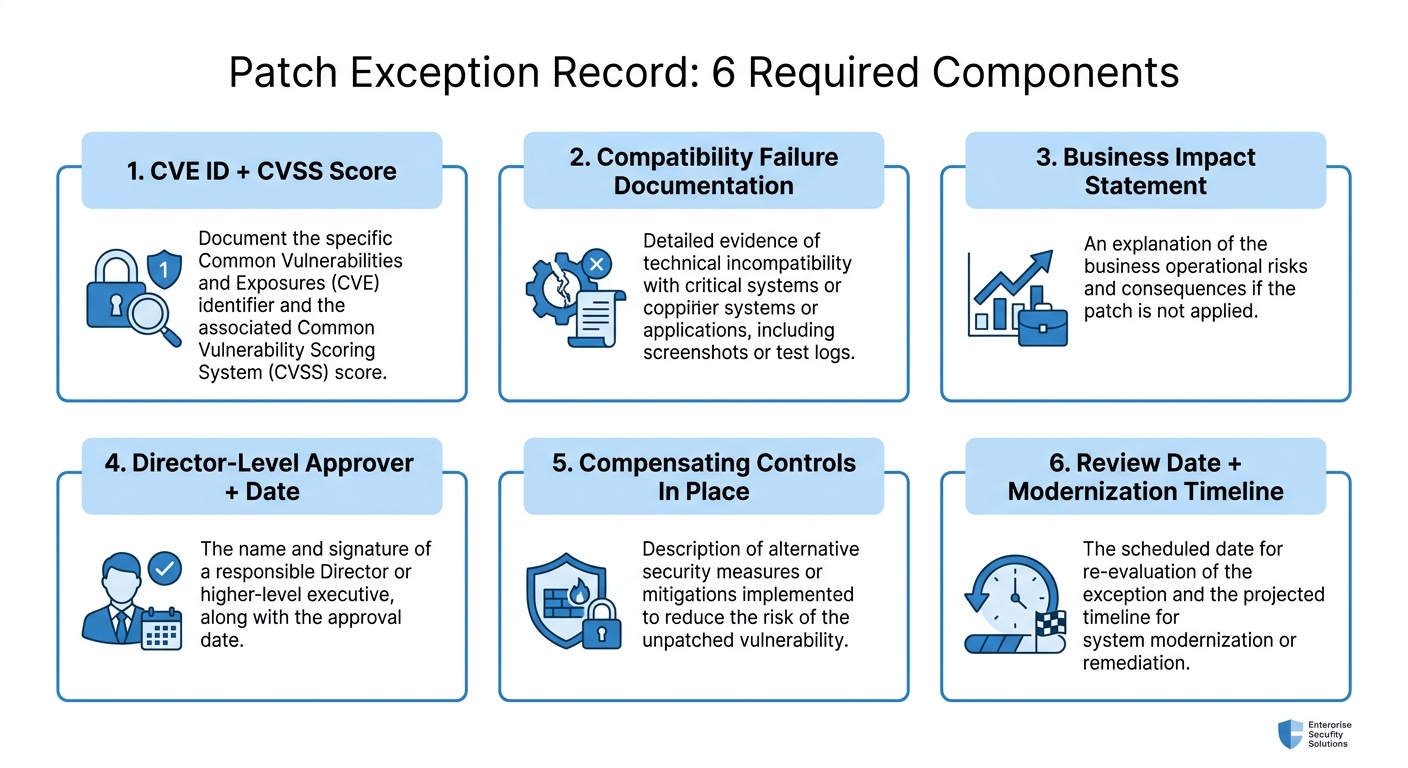
A patch exception that holds under audit review typically contains: the CVE identifier and its CVSS severity; documentation of the specific compatibility failure with enough detail to reproduce it in a test environment; a business impact statement explaining why production continuity takes precedence; a named approver at director level or above with a signature date; compensating controls currently in place — network segmentation, application allowlisting, restricted access, enhanced endpoint monitoring; a review date at 30 to 90 days; and when the exception has been renewed more than twice, a modernization or replacement timeline with a named owner and a committed budget cycle. The same discipline applies to Windows Server end-of-support decisions: the central question is not whether to apply extended security updates — it is whether the application itself can reach a supportable, patchable state within the window that extended support buys.
Why Containerization Does Not Close the Exception
The instinct to virtualize or containerize a legacy Windows application is understandable. It also tends to extend the timeline rather than resolve the dependency. As the host OS receives security updates, the containerization layer eventually collides with the same COM and kernel assumptions the original developer baked into the application. The exception log continues — now applied to the host environment rather than the application directly. The same conversation happens eighteen months later, with a longer audit trail and higher remediation costs.
How the Exception Log Becomes the Modernization Business Case
An application generating repeated, unresolvable patch exceptions is not a patching problem. It is a modernization event without a scope document. The cost comparison between maintaining an unsupported system and replacing it shifts decisively once the exception log has entries in double digits and compensating controls are generating their own audit findings. Each documented exception renewal builds the evidence record that justifies modernization budget in front of a CFO or board risk committee — the paper trail that proves the organization knew, evaluated, and escalated.
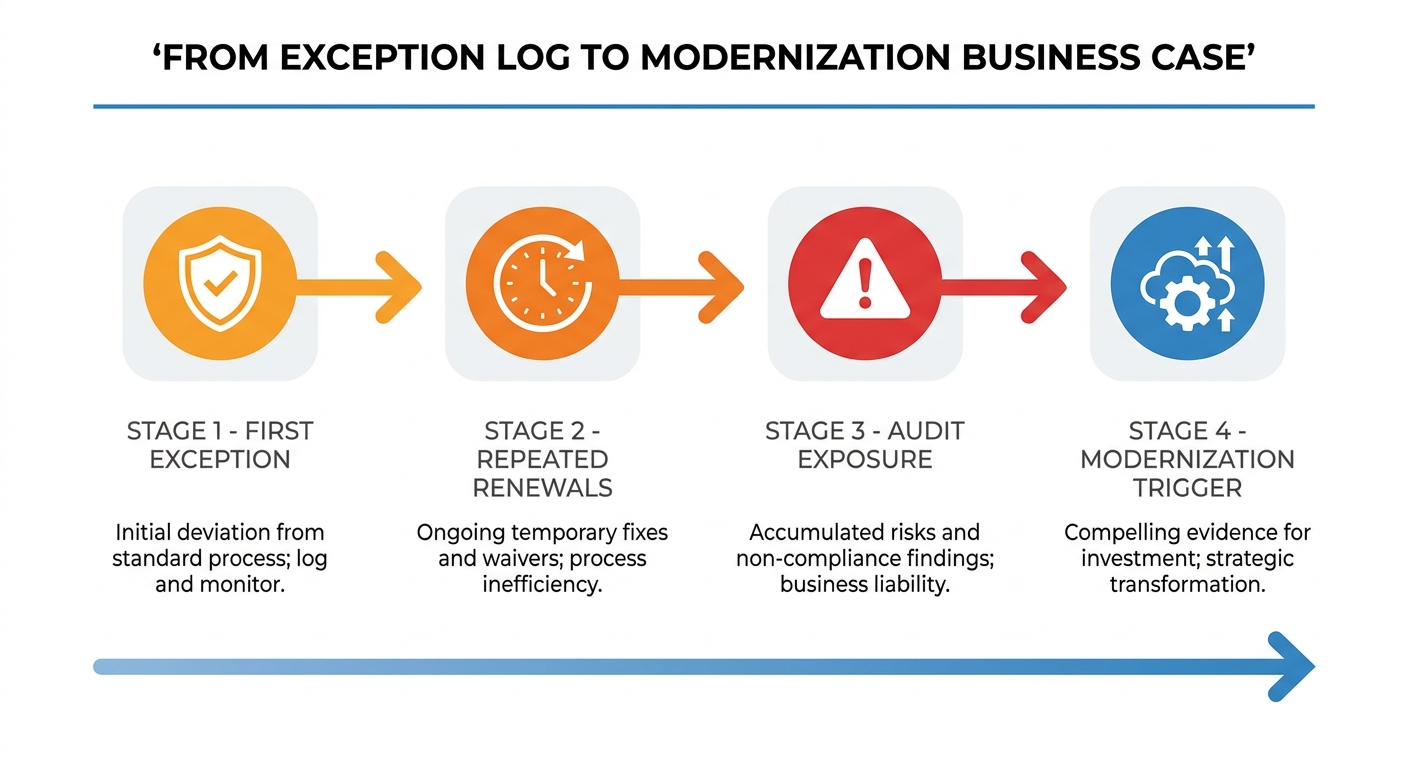
CloudApper AI Platform converts that exception record into a working modernization specification. The platform approaches legacy Windows application replacement through governed requirements extraction — pulling the current application’s functionality, dependencies, and exception history into a structured replacement scope — and deploying governed replacements where security controls are inherited at the platform level rather than retrofitted application by application. Each application built on CloudApper inherits the compliance posture of the platform, eliminating the patch compatibility trap for everything deployed on it going forward.
If your organization is managing repeated patch exceptions for legacy Windows applications, CloudApper can help convert that exception record into a modernization specification before the next audit cycle. Contact the CloudApper team to scope the replacement.

What is CloudApper AI Platform?
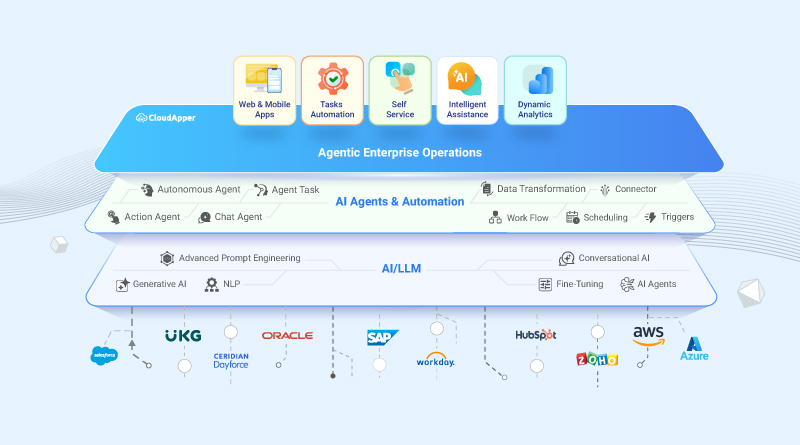
CloudApper AI is an advanced platform that enables organizations to integrate AI into their existing enterprise systems effortlessly, without the need for technical expertise, costly development, or upgrading the underlying infrastructure. By transforming legacy systems into AI-capable solutions, CloudApper allows companies to harness the power of Generative AI quickly and efficiently. This approach has been successfully implemented with leading systems like UKG, Workday, Oracle, Paradox, Amazon AWS Bedrock and can be applied across various industries, helping businesses enhance productivity, automate processes, and gain deeper insights without the usual complexities. With CloudApper AI, you can start experiencing the transformative benefits of AI today. Learn More
- Useful Links:
- Agentic AI
- No-Code/Low-Code
- Custom Software
- HCM Personalization
- iPaaS
- FedRAMP
CloudApper AI Solutions

- Works with







- and more.
Similar Posts
Legacy Database Migration Blocked by Stored Procedures: What Enterprise IT…

Windows Server 2016 End of Support: What to Do When…