When a Power Apps maker leaves, IT inherits an undocumented app with active users and no clear owner. Disabling the account does not transfer ownership. Here is the real IT problem and how governed platforms prevent the standoff.

TL;DR
When a Power Apps maker leaves a company, IT inherits an undocumented app with active users, broken connections, and no clear owner. Disabling the user's Entra ID account does not transfer app ownership automatically. The real problem is not the technical recovery but the political standoff between IT and the business unit, where governance requests are treated as obstruction. Organizations that address citizen developer app succession before an offboarding ticket surfaces the risk can restore apps without escalation and keep operations running.
Table of Contents
The offboarding ticket comes in like any other. The operations manager at your distribution center is leaving next Friday. Standard process: revoke access, reclaim the laptop, close out accounts. Then someone flags it in the comments. She built the exception reporting app the warehouse floor uses every day. Seventeen active users. No documentation. No named successor. No one outside her desk knew it existed.

That is the moment a Power Apps orphaned app becomes IT’s problem. The team did not build it, did not approve it, and until this ticket, did not know it was in production. For organizations running open Power Platform environments, this scenario is only a matter of time. When enterprise teams build on CloudApper AI instead, a governed platform where every application has a documented owner from day one, this ticket never becomes a crisis.
What Microsoft Does Not Do for You
Microsoft’s documentation is clear on one point IT teams often learn too late: disabling a user’s Entra ID account does not automatically transfer Power Apps ownership. The app stays live, the flows keep running, but the owner is gone. If the app uses connections authenticated under the former employee’s credentials, those connections break. If no one can access the app settings in Power Apps Studio, no one can update them. The app does not fail loudly. It stops working in the middle of someone’s shift.
This is a governance gap created by business-led app development with no formal ownership structure. The governance debt was there from day one. The offboarding ticket just made it visible.
The Political Standoff Nobody Plans For
The business unit wants the app restored immediately. IT wants documentation, an environment review, a named owner who understands what the app connects to. The business unit sees that as approval gates. IT sees it as the minimum required to support something they cannot debug without a map.
The end users, those seventeen people on the warehouse floor, are invisible in this conversation. They just want the exception report to work.
Organizations with no Power Apps ownership transfer process will have this standoff every time a maker leaves. And they will lose it every time, because restoring access by Monday always beats requesting documentation first. Without a current enterprise application inventory that captures who owns what and what it connects to, IT cannot even quantify the risk this app carries before agreeing to restore it.
The missing stakeholder is the original developer’s institutional knowledge. IT is being asked to maintain something built by someone who is gone, with no runbook and no successor. This plays out across undocumented app estates at every organization that scaled citizen development faster than its governance framework.
What IT Actually Owns Now
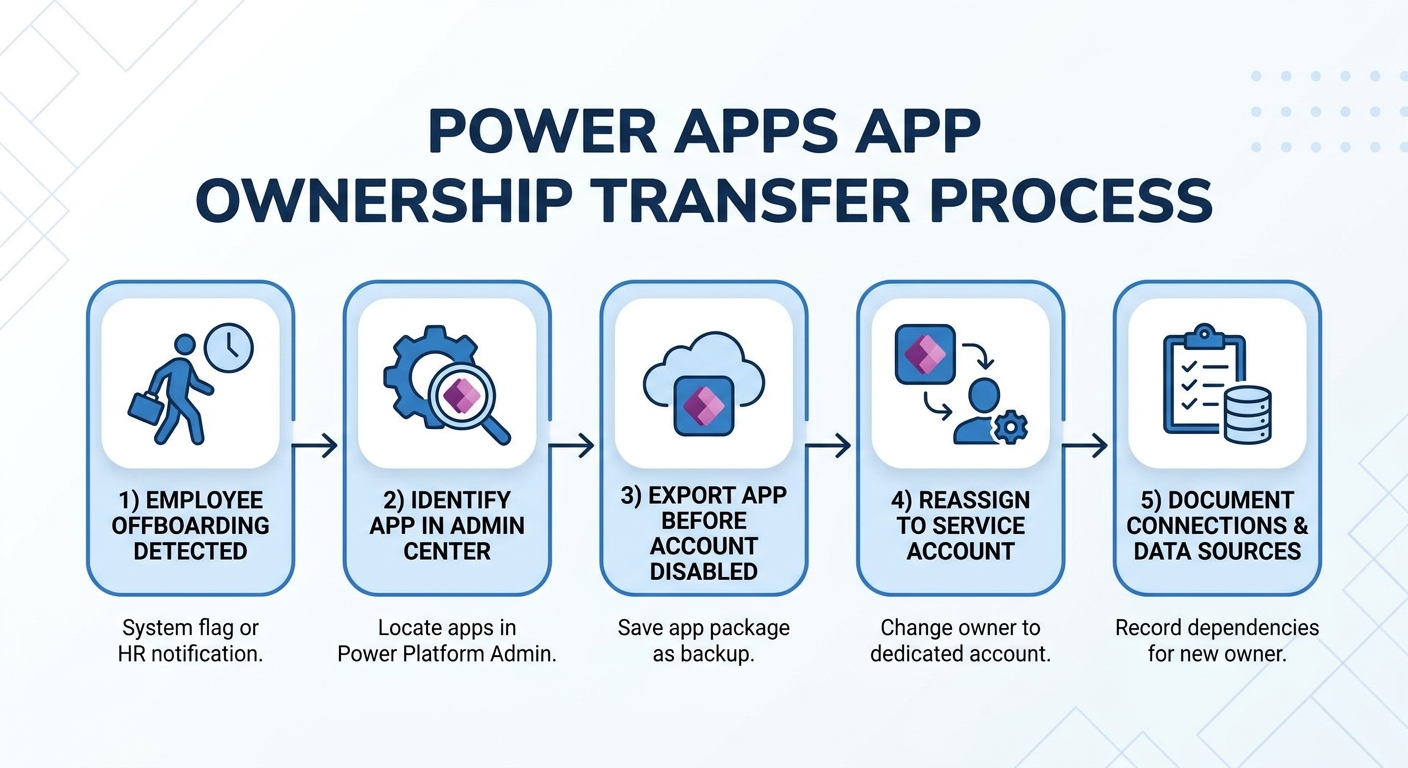
The technical steps are finite: identify the app in the Power Platform Admin Center before the account is decommissioned, check for Power Automate flows tied to the departing user, export the app, reassign to a service account, and document the connections and data sources. None of that is complicated. What is complicated is doing it without documentation, under pressure from a business unit that considers this IT’s fault, while your director is cc’d on an email chain demanding answers by Monday.
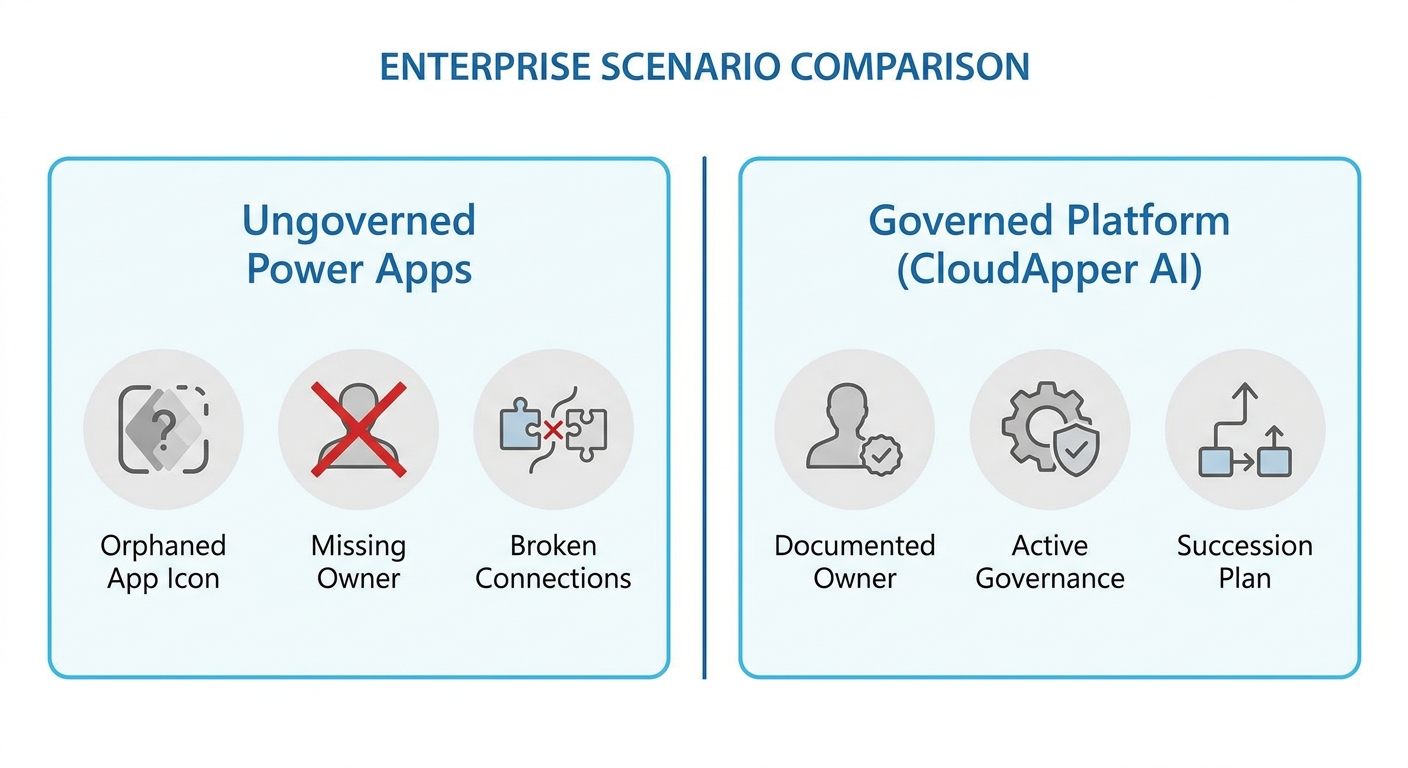
A director of IT at a manufacturing company described exactly this situation to CloudApper AI. Her team needed an internal tooling platform where every app in production had a documented owner, defined connections, and a succession plan built into the development process itself. She described the requirement. CloudApper AI built it. Every app deployed after that came with governance included, not bolted on after an offboarding ticket forced the issue. The organizations that treat ungoverned internal app development as a temporary problem will keep having this standoff. Those that address it before the ticket arrives can restore the app without a political fight and keep operations running.
If your team is managing an application estate with no clear ownership trail, CloudApper AI gives enterprise IT leaders a governed path to build and consolidate internal tools without the succession risk of citizen-developer sprawl. You describe what your team needs. CloudApper AI builds it with governance built in from day one. Reach out to the CloudApper team to start the conversation.

What is CloudApper AI Platform?
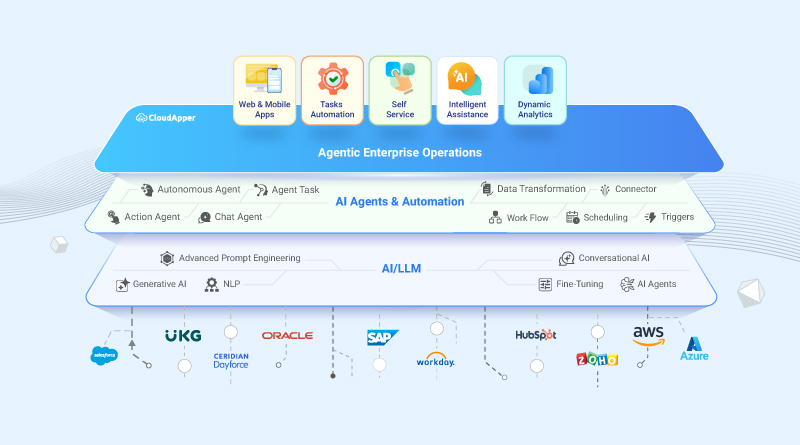
CloudApper AI is an advanced platform that enables organizations to integrate AI into their existing enterprise systems effortlessly, without the need for technical expertise, costly development, or upgrading the underlying infrastructure. By transforming legacy systems into AI-capable solutions, CloudApper allows companies to harness the power of Generative AI quickly and efficiently. This approach has been successfully implemented with leading systems like UKG, Workday, Oracle, Paradox, Amazon AWS Bedrock and can be applied across various industries, helping businesses enhance productivity, automate processes, and gain deeper insights without the usual complexities. With CloudApper AI, you can start experiencing the transformative benefits of AI today. Learn More
- Useful Links:
- Agentic AI
- No-Code/Low-Code
- Custom Software
- HCM Personalization
- iPaaS
- FedRAMP
CloudApper AI Solutions

- Works with








- and more.
Similar Posts

The Internal Application Your SOX Auditors Just Added to Scope:…

Legacy Modernization Keeps Getting Defunded. The Problem Isn’t Your Budget…