One afternoon of non-farm work can cost a worker the agricultural overtime exemption for the whole week. Tagging each task at the punch gives payroll the hours it needs to apply the exemption only to weeks that qualify.

TL;DR
- Treat the agricultural overtime exemption as a weekly test: one shift of covered non-farm work can remove it for that whole week.
- Packing another grower's crops, retail shifts and hauling for neighbors are the usual sources of mixed weeks.
- Tag every hour with a task at the punch so your HR system can apply the exemption only to all-farm weeks.
- Run task-tagged punches on everyday tablets that work offline in fields and sync to Workday, UKG, Oracle or Dayforce.
Table of Contents
- Why Mixed Farm and Non-Farm Weeks Are Hard to Track by Hand
- How Task Tagging Protects the Agricultural Overtime Exemption
- CloudApper AI TimeClock: Task-Level Punches for Farm Operations
- Keeping Every Farm Week Exempt When It Should Be
A single afternoon of non-farm work can cost an employee the agricultural overtime exemption for the whole week, and most payroll teams only find out after the hours are paid. The rules judge each workweek as a whole, so a worker who harvests Monday through Thursday and packs fruit for a neighboring grower on Friday may be owed overtime for every hour over 40. The way out is to record what kind of work each hour was when it happens. If every punch carries a task, payroll can see which weeks were all farm work before anyone cuts a check. CloudApper AI TimeClock captures that task at the punch on iPads and Android tablets, and it is compatible with the HR systems most agricultural employers already run, including Workday, UKG, Oracle and Dayforce.
Why Mixed Farm and Non-Farm Weeks Are Hard to Track by Hand
The exemption is all or nothing. If an employee does covered, non-exempt work in the same workweek as farm work, the farm hours generally lose their exempt status too, and the employer has to show that each week qualified. A timecard showing eight hours a day can’t prove it.

Mixed weeks are common. A cellar hand pours in the tasting room on Saturdays, a packing shed takes in another grower’s fruit for a few weeks, or a feedlot hand hauls cattle for a neighbor. Work on someone else’s crops, or selling bought-in product, can fall outside the definition of agriculture even on your own property.
Paper doesn’t keep up. Supervisors write task notes from memory on Friday, nobody logs crews moving between field and shed, and payroll either pays overtime every week to be safe or applies the exemption broadly and hopes nobody audits it. State thresholds add another layer: Oregon sits at 48 hours through 2026 and New York at 52, so a mixed week can drop a worker onto the standard 40-hour rule. Growers with ranches in more than one state juggle several sets of rules on top of their usual overtime calculations.
How Task Tagging Protects the Agricultural Overtime Exemption
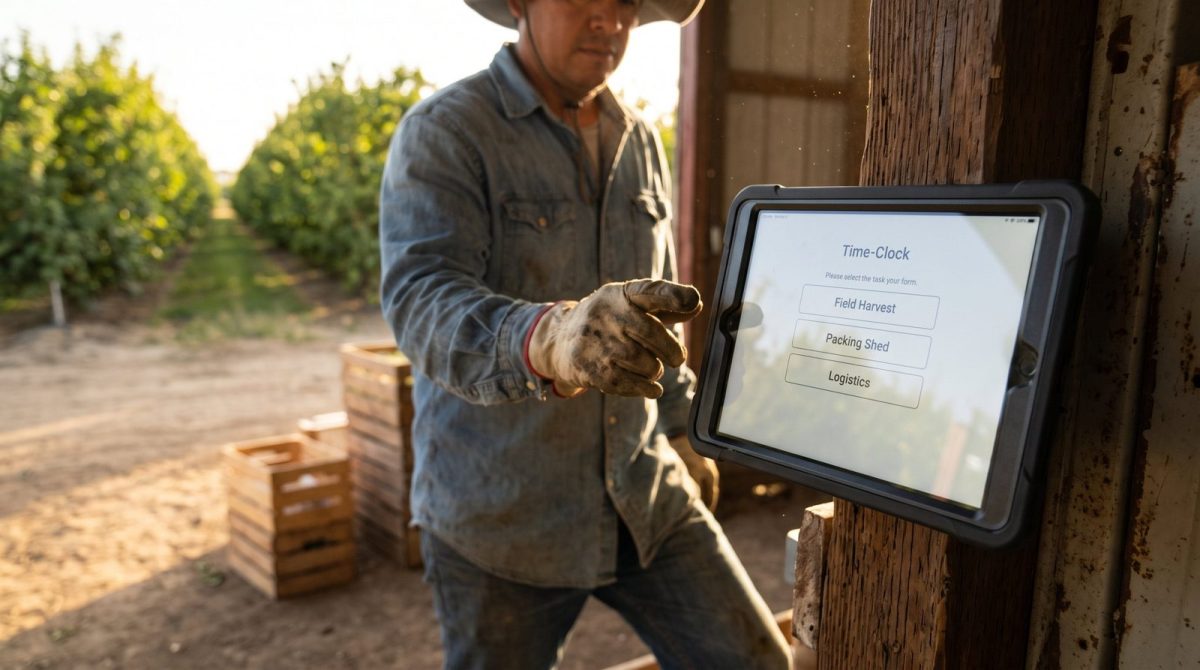
The fix starts at the punch. A worker clocks in and picks a task from a short list, such as field work, packing, retail or hauling. A transfer punch records any switch mid-shift. Hours reach your HR system already split by task, so payroll applies the exemption only to all-farm weeks and supervisors can spot a mixed week before payroll closes. Fields rarely have good signal, so punches are stored on the device and sync later with every tag intact.
Regulators are watching. In fiscal year 2025, the Department of Labor’s Wage and Hour Division recovered more than $6.8 million in back wages for 8,602 agricultural workers.
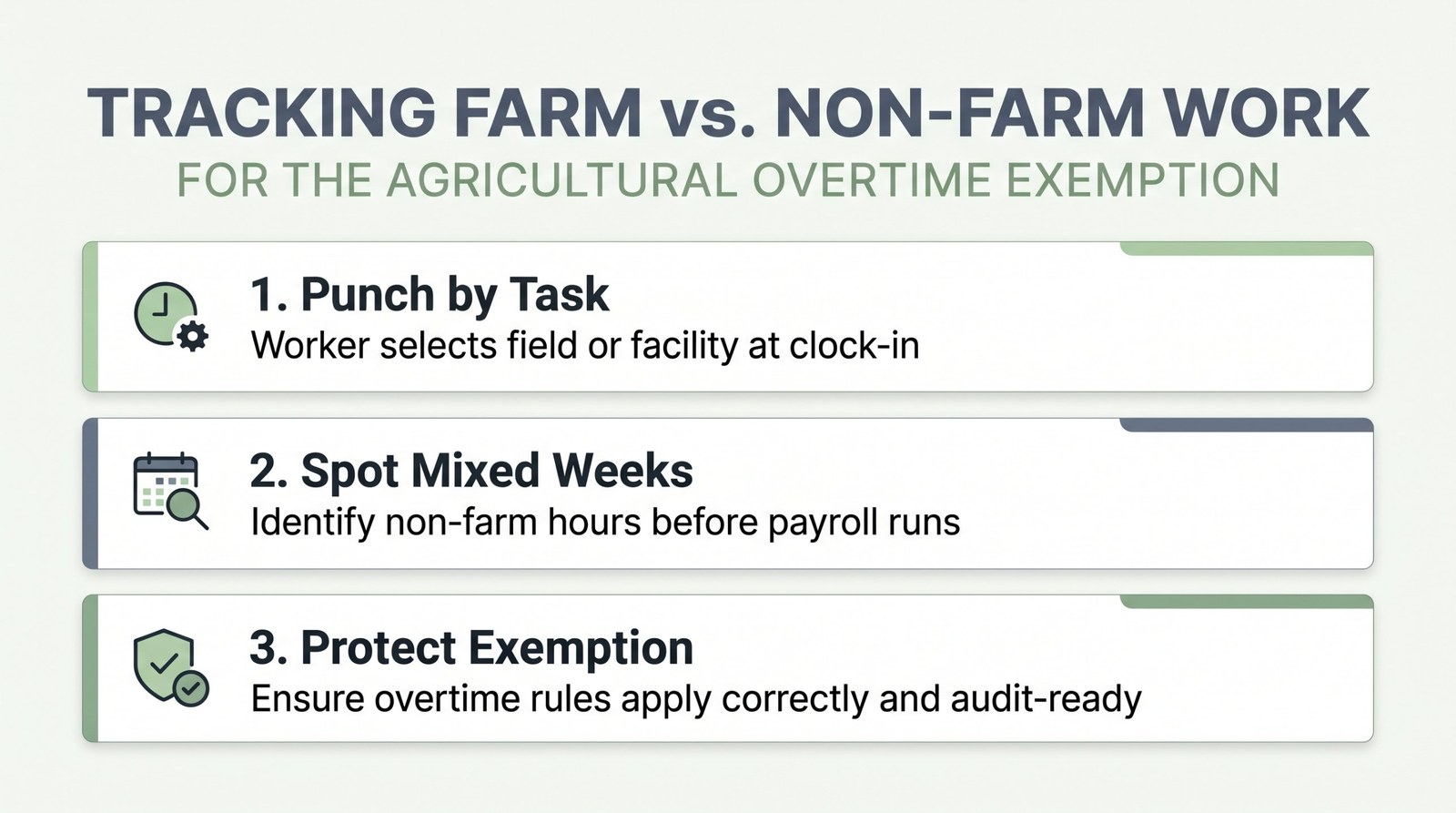
It scales because one task list runs across every ranch, shed and retail site, with each worker’s weekly record ready for an audit. Good time tracking software makes task tagging part of normal employee time tracking instead of a supervisor’s side job. It fits wineries, packing houses, nurseries with garden centers, dairies, feedlots, orchards with farm stands, agritourism businesses and inventory management providers serving farm co-ops.
CloudApper AI TimeClock: Task-Level Punches for Farm Operations
Your HR system already handles pay rules, overtime and payroll well. What it needs from the field is a clean record of which hours were farm work, and CloudApper AI TimeClock supplies that record at the punch.
This time tracking software turns a standard tablet into a full time clock. Workers clock in with Face ID, so the right person gets the right task, and crew leads can use group punch to start a whole crew at once. It works alongside piece-rate pay, and an AI HR assistant answers workers’ questions about their hours.
Everyday tablets cost far less than proprietary terminals, a tablet dropped in a packing shed can be swapped the same day, and you can add more at harvest without a long hardware order. It works best at seasonal sites, remote fields and facilities where crews move between field and shed.
Keeping Every Farm Week Exempt When It Should Be
The agricultural overtime exemption is decided one week at a time, and one shift of non-farm work can change the answer. Paper tracking leaves payroll guessing which weeks qualified, and state thresholds add more rules on top. Tagging each hour at the punch gives your HR system the split it needs, across every site from wineries to feedlots. CloudApper AI TimeClock is time tracking software built for this, running on iPads and Android tablets and feeding the HR system you already run.
If mixed weeks keep showing up in payroll, you can book a demo and see task tagging with your own crews.
Frequently Asked Questions
What is the agricultural overtime exemption?
Federal law exempts employees employed in agriculture from overtime pay. It applies one workweek at a time, and only to weeks where all of the employee’s work counts as agriculture.
Does one day of non-farm work cancel the exemption for the whole week?
It can. If an employee does covered work that isn’t exempt in the same workweek as farm work, the exemption generally doesn’t apply to any hours that week. Some work exempt under other provisions can be combined, so check with employment counsel.
Is packing or selling another farm’s produce considered agricultural work?
Often it isn’t. Handling crops grown by other farmers can fall outside the definition of agriculture, even when the work happens on your farm, so track those hours separately.
Do state farmworker overtime laws replace the federal exemption?
No. States such as New York and Oregon set their own farmworker thresholds on top of federal rules, and a mixed week can move a worker onto the standard state overtime rule.
How does a time clock help prove a week was all farm work?
When workers pick a task at each punch, every hour carries a farm or non-farm tag. Payroll can see which weeks qualify and keep that record for audits.

What is CloudApper AI Platform?
CloudApper AI is an advanced platform that enables organizations to integrate AI into their existing enterprise systems effortlessly, without the need for technical expertise, costly development, or upgrading the underlying infrastructure. By transforming legacy systems into AI-capable solutions, CloudApper allows companies to harness the power of Generative AI quickly and efficiently. This approach has been successfully implemented with leading systems like UKG, Workday, Oracle, Paradox, Amazon AWS Bedrock and can be applied across various industries, helping businesses enhance productivity, automate processes, and gain deeper insights without the usual complexities. With CloudApper AI, you can start experiencing the transformative benefits of AI today. Learn More
- Useful Links:
- Agentic AI
- No-Code/Low-Code
- Custom Software
- HCM Personalization
- iPaaS
- FedRAMP
Brochure
CloudApper AI TimeClock
For accurate & touchless time capture experience.
Download Brochure
CloudApper AI Solutions for HR


- Works with








- and more.
Similar Posts
Hazard Pay Time Tracking: Proving Who Worked in the Hazardous…
Time Clock for Agency Workers: How to Capture Temp Hours…