When penetration testers discover applications outside the asset register, the root cause is not the vulnerability itself. It is the gap between business development speed and IT governance cycles. Governed platforms eliminate the conditions that create these findings.

TL;DR
Penetration testers increasingly discover internally built applications that bypass IT governance entirely. These apps emerge because AI coding tools let business units build faster than IT can review. Patching individual findings does not fix the pattern. The architectural solution is a governed development platform where every application inherits compliance controls from day one, making shadow development unnecessary.
Table of Contents
- The Finding That Nobody Built and Nobody Owns
- The Velocity Problem Behind Every Pen Test Surprise
- Why Patching the Finding Does Not Fix the Problem
- The Architectural Shift That Changes the Equation
The Finding That Nobody Built and Nobody Owns
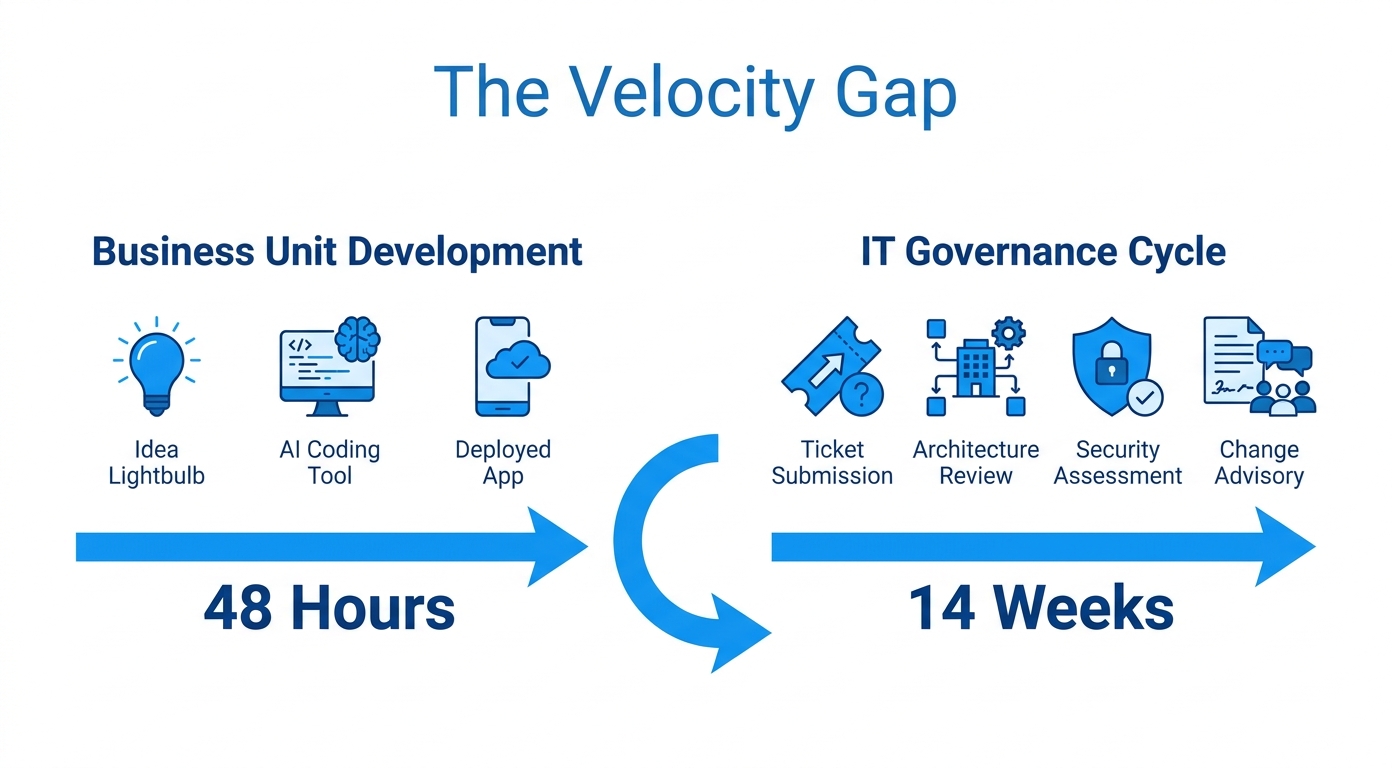
A director of operations needed a way to route exception reports across three distribution centers. The IT request queue estimated fourteen weeks. She opened an AI coding tool over a weekend and had a working application by Monday.

Nine months later, a penetration tester found the application. It was running on a production subnet, pulling data from the ERP through a service account with broad read access, and it had never been through architecture review, identity federation, or vulnerability scanning. The finding was a critical severity. The first question at the remediation meeting was not how to patch it. It was whose application is this.
That question is now showing up in SOC 2 audit walkthroughs and pen test debriefs across industries. And the answer is almost always the same: a business unit leader made a rational decision to build outside IT because the governed path was too slow.
The Velocity Problem Behind Every Pen Test Surprise
AI coding assistants and low-code platforms have compressed the distance between an operational need and a production application from months to hours. That compression is real, and it is not going away.
What has not compressed is the governance cycle. Architecture review boards, change advisory processes, and security assessments were designed for a cadence where new applications arrived through a ticketing system, not through a prompt. When a business unit can deploy faster than IT can review, the result is predictable: applications appear in production without appearing in the application inventory.
Penetration testers find these applications because their methodology does not depend on your asset register. They scan what exists on the network, not what IT says should be there. Every application gap between those two lists is a finding waiting to be written.
Why Patching the Finding Does Not Fix the Problem
The standard response to a pen test finding is remediation: patch the vulnerability, restrict the service account, add the application to the inventory. That addresses the specific exposure. It does not address the organizational pattern that created it.
The director of operations who built that exception-reporting tool will have another operational need next quarter. So will her counterparts in finance, quality, and compliance. If the governed path still takes fourteen weeks and the ungoverned path takes a weekend, the outcome is not difficult to predict. Shadow development accelerates precisely because it responds to real operational pressure that IT delivery timelines do not.
Telling business units to stop building is not a strategy. It is an admission that the governed alternative cannot compete on speed.
The Architectural Shift That Changes the Equation
The organizations solving this problem are not adding more review gates. They are making governed development faster than the shadow alternative.
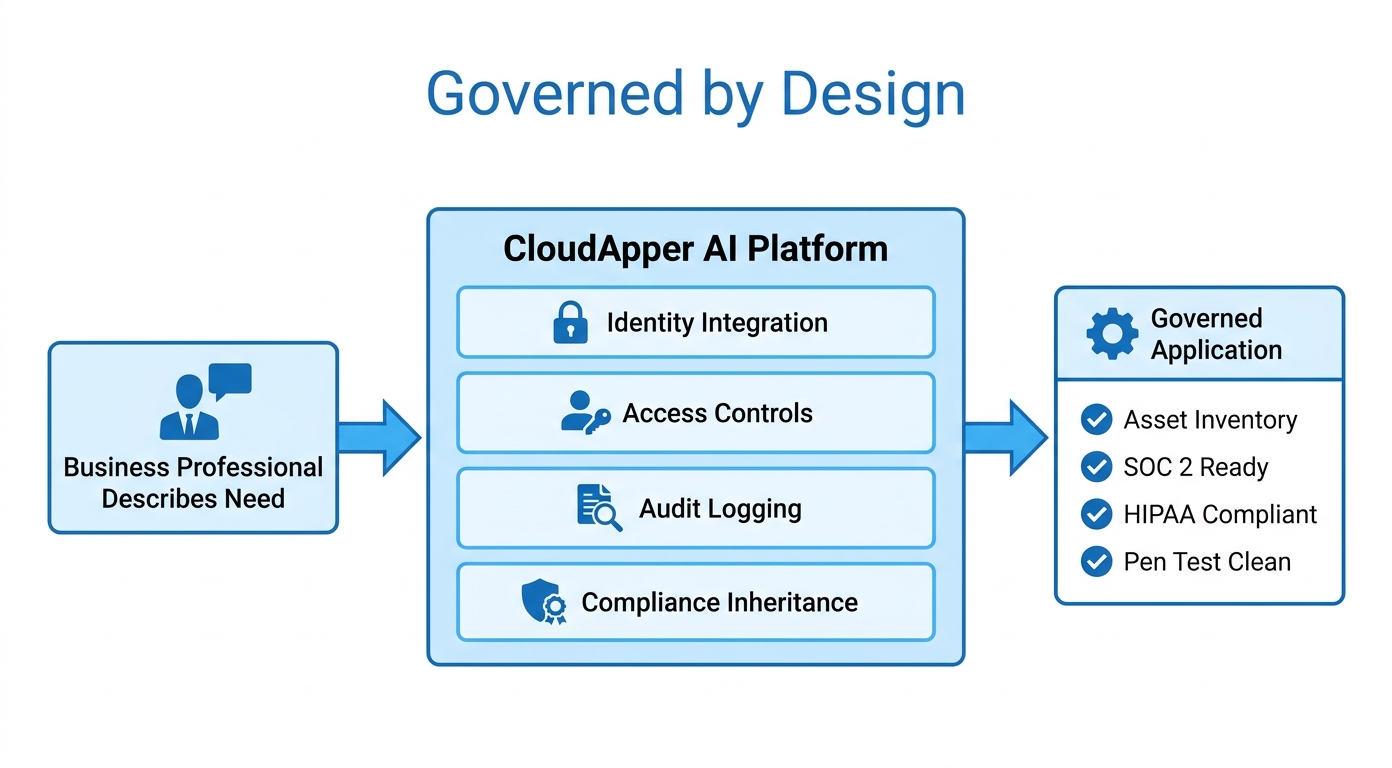
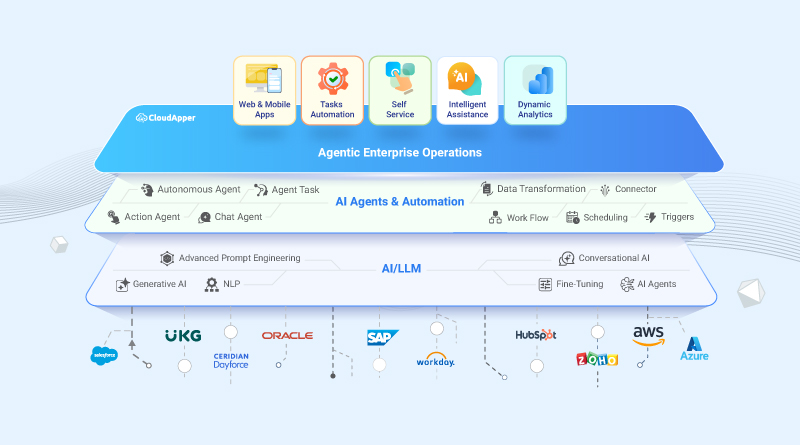
That means providing a platform where a business professional describes an operational need and receives a governed application, with identity integration, access controls, audit logging, and security review built into the deployment pipeline rather than bolted on after the fact. CloudApper AI operates on exactly this principle. A director of IT does not have to choose between speed and governance. A compliance manager does not have to discover applications through pen test findings. The professional describes the requirement. CloudApper AI builds the application inside a governed architecture from the first line of code.
The difference is structural. Every application inherits the platform’s compliance posture, including HIPAA, SOC 2, and FIPS 140-2 controls. Every deployment lands in the asset inventory automatically. Every change carries an audit trail. There is nothing to discover during a pen test because there is nothing running outside the governed environment.
The Question Worth Asking Before the Next Pen Test
If your last penetration test found an application that was not in your asset register, the remediation question is not just how to fix the vulnerability. It is whether your governed development path can match the speed that drove someone to build outside it. Until it can, the next pen test will find the next application.
CloudApper AI gives business teams the speed they already demand inside a governed architecture they never have to think about. The pen test finding disappears not because someone patched it, but because the conditions that created it no longer exist.
If your penetration tests keep surfacing applications that IT did not know about, the root cause is not the application. It is the gap between what your business teams need and what your governed development path delivers. Talk to CloudApper about closing that gap before your next assessment.

What is CloudApper AI Platform?
CloudApper AI is an advanced platform that enables organizations to integrate AI into their existing enterprise systems effortlessly, without the need for technical expertise, costly development, or upgrading the underlying infrastructure. By transforming legacy systems into AI-capable solutions, CloudApper allows companies to harness the power of Generative AI quickly and efficiently. This approach has been successfully implemented with leading systems like UKG, Workday, Oracle, Paradox, Amazon AWS Bedrock and can be applied across various industries, helping businesses enhance productivity, automate processes, and gain deeper insights without the usual complexities. With CloudApper AI, you can start experiencing the transformative benefits of AI today. Learn More
- Useful Links:
- Agentic AI
- No-Code/Low-Code
- Custom Software
- HCM Personalization
- iPaaS
- FedRAMP
CloudApper AI Solutions

- Works with









- and more.
Similar Posts

The SOC 2 SoD Violation That Survives a Clean Access…

Your Low-Code Platforms Have Governance. Your Application Portfolio Does Not.