Hours of rest for vessel crews are easy to define and hard to prove at sea. Learn how recording work and rest as it happens, on a tablet that works without a signal, keeps rolling totals visible and gives the office clean records once the vessel is back in port.

TL;DR
- Record work and rest as each period starts and stops, so nothing is rebuilt from memory at the end of a watch.
- Check rolling totals against the 10-hour and 77-hour minimums while the vessel is still at sea.
- Store every entry on the tablet so recording works with no signal and syncs once the boat reaches port.
- Set your flag state's rest rules once so every vessel in the fleet follows the same limits.
- Send clean rest and hours records to payroll and the office without retyping paper logs.
Table of Contents
- Why rest records fall apart at sea
- Hours of rest for vessel crews: how offline recording works
- How CloudApper AI TimeClock records work and rest on a vessel
- Keeping rest records complete from first watch to the dock
Hours of rest for vessel crews are simple to define and hard to prove. A tug gets called out twice in one night, the paper log is filled in later from memory, and by then the signal is gone and the crew change is under way. The fix is to record work and rest as each period starts and stops, on a device that works without a connection and syncs once the boat reaches port. The master then sees a running rest total for every crew member, and the office gets a clean record with no re-keying. Time tracking software built for this stores each entry on the device and warns before anyone drops under the minimum. CloudApper AI TimeClock does this alongside Workday, UKG, Oracle and Dayforce, and it runs on iPads and Android tablets.
Why rest records fall apart at sea
Most rest logs on tugs, ferries and supply boats are still paper or a spreadsheet updated at the end of a shift. Crew remember roughly when they stopped, the master signs the estimate, and afterward nobody can say whether a rest period was nine hours or ten. A crew member called out twice in a night has a rest period split in two, and the log shows one. Rolling totals are hard to work out by hand at 2 a.m., and anything that needs a connection waits for the dock, so problems surface during an inspection or after an incident.

Hours of rest for vessel crews: how offline recording works
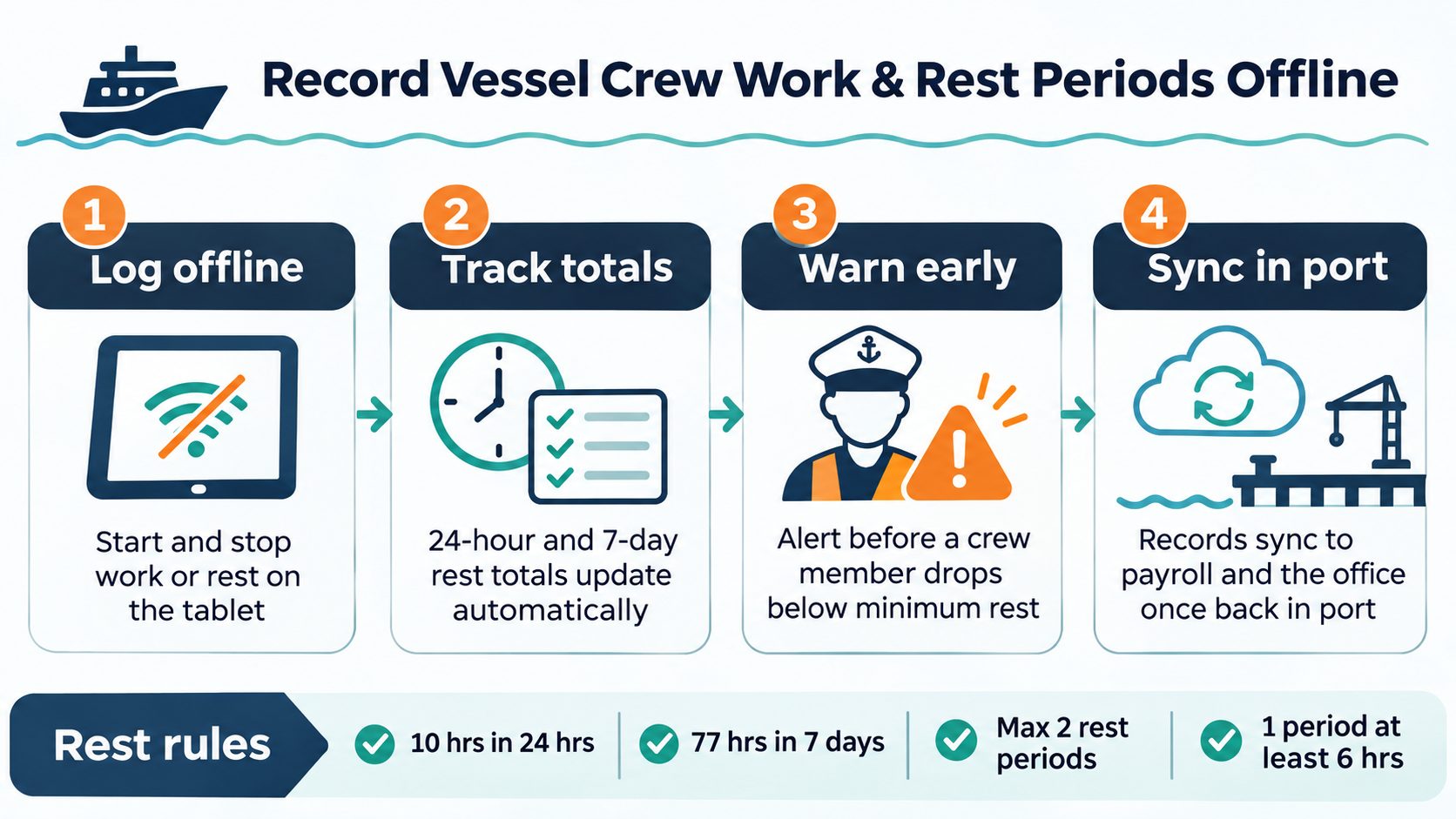
Under STCW and the Maritime Labour Convention, 2006, watchkeepers and crew with safety duties need at least 10 hours of rest in any 24-hour period and 77 hours in any seven days, split into no more than two periods, one of them at least six hours long. Your flag state decides how the limits apply to your vessels, so confirm the regime first.
Accuracy is the weak point. The ITF, citing World Maritime University research, reports that 64% of seafarers have adjusted or falsified their work and rest records. Entries made as work starts and stops leave far less room for changes after the fact.
Each crew member records work and rest on a shared tablet. The tablet runs time tracking software that stores every entry on the device, calculates rolling totals against the 24-hour and seven-day limits, and flags anyone about to drop under the minimum so the master can change the watch plan in time. Once the vessel is back in port and the tablet reconnects, the records sync to the office, the same approach behind offline-capable time clocks.
Because the rules live in one configuration instead of each master’s notebook, three tugs or thirty follow the same limits and record format. That suits ferry operators, tug and barge fleets, offshore supply vessels and the inventory management providers that supply offshore bases.
How CloudApper AI TimeClock records work and rest on a vessel
CloudApper AI TimeClock is time tracking software that turns an everyday tablet into a time clock for the wheelhouse or crew mess. Crew punch with a PIN, badge, QR code or Face ID, and the tablet keeps running without Wi-Fi, holds each punch and sends everything on once it reconnects. A whole watch can punch together with group punches at handover, and employee time tracking stays tied to each crew member’s own profile. A marine towing company already uses the tablet clock for its crews, and a new vessel follows the same rollout checklist as a new location.
Everyday tablets keep costs down, a damaged one is swapped for a spare in minutes, and adding a vessel means adding another tablet. They suit tugs, ferries and supply boats that spend long stretches out of range.
Keeping rest records complete from first watch to the dock
Rest records fail at sea for ordinary reasons: logs written from memory, split rest periods nobody notices, and no signal until the dock. STCW and the Maritime Labour Convention set the limits and your flag state decides how they apply, so the practical job is capturing work and rest as it happens and checking running totals while the vessel is still out. A tablet that records offline, applies your rest rules and syncs in port does that without extra paperwork, and entries made as work starts and stops are harder to adjust later. Because it runs on iPads and Android tablets, the hardware is cheap to add and easy to swap, and the records flow into Workday, UKG, Oracle or Dayforce so payroll and compliance teams review one clean set of hours. To see how this would run on your own vessels, ask our team for a demo.
Frequently asked questions
How many hours of rest do vessel crews need under STCW and MLC?
Watchkeepers and crew with safety duties need at least 10 hours of rest in any 24-hour period and 77 hours in any seven days. Rest can be split into no more than two periods, and one must be at least six hours long. Under the Maritime Labour Convention, a flag state can instead set maximum work limits of 14 hours in 24 and 72 hours in seven days. Your flag state’s rules decide which version applies to your vessels.
Can crew record hours of rest without a signal at sea?
Yes. The tablet stores every work and rest entry on the device and calculates running totals there. When the vessel reaches port and the tablet reconnects, the records sync to the office.
Who is responsible for keeping hours of rest records on a vessel?
The shipowner, the employer and the master share responsibility for making sure crew get the minimum rest, and the master usually handles day-to-day monitoring. Records are kept on board, and crew are entitled to a copy of their own record. Check your flag state’s rules for the details.
Does this work on small vessels such as tugs and ferries?
Yes. The tablet needs power and a place to mount it, and the rest rules are set to match the regime your vessels follow. Small and domestic vessels often follow national rules instead of STCW and MLC, so confirm which one applies before you set the limits.
How do rest records reach payroll and the office?
Once the tablet reconnects in port, the records sync to your payroll and HR systems and to the office for review, so nobody retypes entries from paper.

What is CloudApper AI Platform?
CloudApper AI is an advanced platform that enables organizations to integrate AI into their existing enterprise systems effortlessly, without the need for technical expertise, costly development, or upgrading the underlying infrastructure. By transforming legacy systems into AI-capable solutions, CloudApper allows companies to harness the power of Generative AI quickly and efficiently. This approach has been successfully implemented with leading systems like UKG, Workday, Oracle, Paradox, Amazon AWS Bedrock and can be applied across various industries, helping businesses enhance productivity, automate processes, and gain deeper insights without the usual complexities. With CloudApper AI, you can start experiencing the transformative benefits of AI today. Learn More
- Useful Links:
- Agentic AI
- No-Code/Low-Code
- Custom Software
- HCM Personalization
- iPaaS
- FedRAMP
Brochure
CloudApper AI TimeClock
For accurate & touchless time capture experience.
Download Brochure
CloudApper AI Solutions for HR


- Works with








- and more.
Similar Posts

Portal-to-Portal Pay for Underground Miners: Recording Shift Time Where Signal…
Split-Shift and Spread-of-Hours Pay: When a Long Span or Unpaid…