Eleven US cities and states fine employers who post schedules late, with penalties reaching $50 per worker per day. See the advance notice deadlines, penalty amounts, and what actually prevents violations across all 11 jurisdictions.
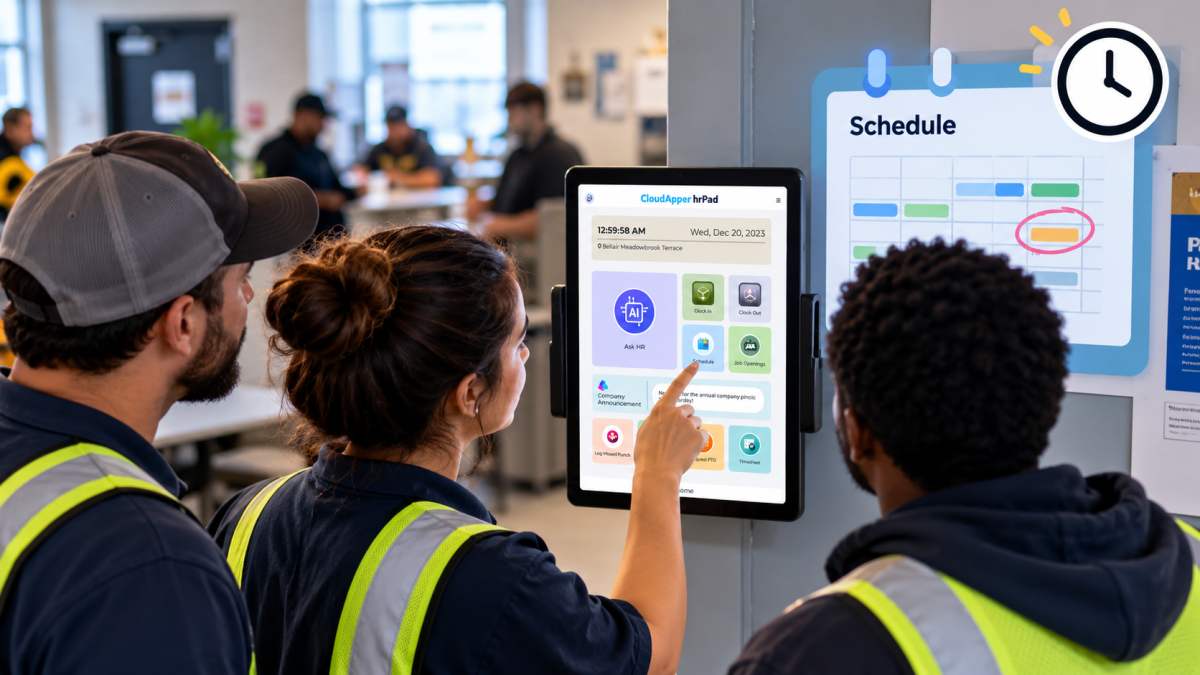
Table of Contents
A missed schedule posting in Berkeley can cost $50 per employee, per day, until the problem is fixed. A restaurant with 40 hourly workers who didn’t get their schedule 14 days out? That’s $2,000 a day.

Berkeley isn’t alone. Eleven US jurisdictions now have laws that tell employers how far ahead they need to post work schedules. The fines are different everywhere. New York City charges $10 to $75 per worker per violation. Philadelphia adds a $40 fee every time someone works a “clopening” shift — closing one night and opening the next morning without enough rest.
The US Department of Labor recovered $259 million in back wages in fiscal year 2025 across wage and hour cases. Schedule posting violations are a growing part of that number.
Most employers get caught not because they broke the rules on purpose, but because they didn’t know the rules existed or were tracking everything on spreadsheets nobody kept up with.
Schedule posting rules by city and state
One thing to know: “500+ employees globally” means your whole company, not just workers in that city. A chain with 600 people total and three Oregon locations is covered even if only 30 work there.
Also, several of these are in California, and they stack. Stores in Berkeley and Los Angeles face two different penalty rules for the same kind of mistake.
Where employers get caught
Three problems come up again and again across these 11 places.
Late posting. A manager puts out the schedule 11 days early instead of 14 because someone called in sick and the grid changed. Nobody tracked that the new version went up late. Fines hit for every worker on that schedule.
Shift changes with no record. A shift lead texts a worker to come in early. They agree. Nobody writes it down. That swap triggers a pay penalty or a consent rule under every one of these laws.
Not enough rest between shifts. An employee closes at 11 PM and opens at 7 AM. That’s 8 hours between shifts. Most of these laws need at least 10. In Oregon, hours worked inside that window get paid at 1.5x. In Philadelphia, the employer owes $40. In Chicago, the worker has to give written consent first.
These problems happen because paper schedules, group texts, and spreadsheets can’t track posting times, consent forms, or rest gaps.
How to stay out of trouble
The fix isn’t another tool only managers log into. It’s putting schedule access where workers already are.
An employee self-service kiosk solution like hrPad turns any tablet into a shared station in the breakroom or warehouse floor. Workers see the posted schedule, acknowledge shift changes on screen, and the system time-stamps everything — when the schedule went up, when it changed, and who saw it.
When a manager updates the schedule through UKG, Workday, or ADP, the kiosk shows it right away. If a shift change creates a rest period conflict, the system flags it before it becomes a violation. One device handles the time clock, the schedule board, and the consent forms.
Employers running multiple locations with gaps in attendance tracking are the ones who struggle most. A kiosk at each site gives every location the same audit trail without depending on each manager to do the paperwork right.
Frequently asked questions
Does federal law require schedule posting in advance?
No. There is no federal scheduling law. All 11 rules come from state or local governments. Oregon is the only statewide law.
What is the biggest fine for posting schedules late?
Berkeley at $50 per employee per day. For a location with 40 workers, that’s $2,000 daily until it’s fixed.
Do these laws cover salaried workers?
Usually not. Most apply to hourly workers in retail, food service, and hospitality. Check the rules in each city where you have locations.

What is CloudApper AI Platform?
CloudApper AI is an advanced platform that enables organizations to integrate AI into their existing enterprise systems effortlessly, without the need for technical expertise, costly development, or upgrading the underlying infrastructure. By transforming legacy systems into AI-capable solutions, CloudApper allows companies to harness the power of Generative AI quickly and efficiently. This approach has been successfully implemented with leading systems like UKG, Workday, Oracle, Paradox, Amazon AWS Bedrock and can be applied across various industries, helping businesses enhance productivity, automate processes, and gain deeper insights without the usual complexities. With CloudApper AI, you can start experiencing the transformative benefits of AI today. Learn More
- Useful Links:
- Agentic AI
- No-Code/Low-Code
- Custom Software
- HCM Personalization
- iPaaS
- FedRAMP
Brochure
CloudApper hrPad
Empower Frontline Employees with an AI-Powered Tablet/iPad Solution
Download Brochure
CloudApper AI Solutions for HR

- Works with







- and more.
Similar Posts
Return-to-Office Attendance Tracking: What Employers Get Wrong in 2027
Badge vs. PIN vs. Face Scan: Time Clock Authentication Guide