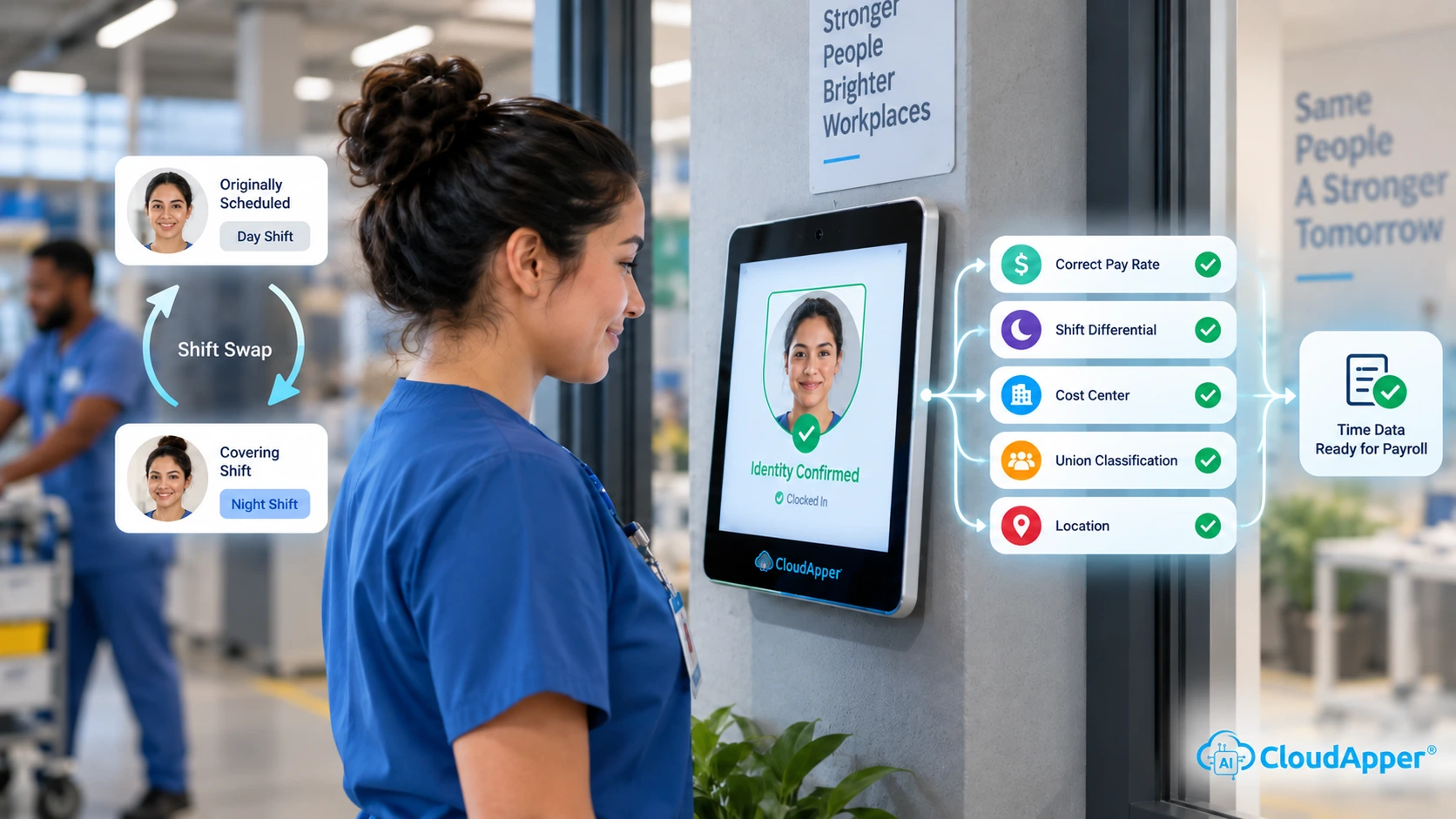
Manual HR processes slow teams down and increase compliance risks. AI-powered HR assistance helps eliminate repetitive tasks, automate workforce management, and improve employee self-service. In this article, discover how CloudApper hrPad reduces HR workload, enhances compliance, and transforms service delivery without replacing your existing HCM systems.

Table of Contents
- Why Manual HR Processes Break at Scale
- What Are Manual HR Bottlenecks?
- How AI-Powered HR Assistance Eliminates Bottlenecks
- Seamless Integration Without System Disruption
- From Reactive HR to Strategic HR
- Why AI-Powered HR Service Delivery Is Becoming Essential
- The Bottom Line
Manual HR processes quietly drain productivity. Missed punches. Endless email threads. Compliance anxiety. Disconnected systems. Delayed responses to employee questions.
As organizations grow more complex and frontline workforces expand, traditional HR workflows simply cannot keep up. The result is operational friction, disengaged employees, and HR teams stuck in reactive mode.

This is where AI-powered HR service delivery becomes transformative.
CloudApper hrPad is designed to eliminate manual HR bottlenecks by adding intelligent automation, self-service capabilities, and seamless integration to your existing HCM systems—without replacing them. Instead of forcing another system overhaul, hrPad enhances what you already use and turns everyday HR touchpoints into efficient, AI-driven workflows.
TL;DR
-
Manual HR processes create bottlenecks, errors, and compliance risks as organizations scale.
-
Repetitive tasks like missed punches, PTO approvals, and HR email overload slow productivity.
-
AI-powered HR assistance automates time tracking, employee queries, and workforce workflows.
-
Centralized, integrated systems reduce data silos and improve regulatory compliance.
-
Employee self-service kiosks empower frontline workers without requiring email or desktop access.
-
Real-time analytics enable data-driven HR decisions and proactive workforce management.
-
CloudApper hrPad enhances existing HCM systems—without replacing them.
-
The result: lower HR workload, higher efficiency, stronger compliance, and improved employee experience.
Why Manual HR Processes Break at Scale
Most HR departments today are juggling four persistent challenges:
1. Fragmented systems and data silos
Organizations often rely on multiple HCM platforms such as UKG, Workday, and Oracle PeopleSoft. While powerful, these systems can create operational gaps when employees lack direct, intuitive access—especially in deskless environments.
2. Compliance complexity
Regulations evolve constantly. Labor laws, overtime calculations, and data privacy requirements like General Data Protection Regulation (GDPR) increase risk exposure when HR processes are manual or inconsistent.
3. HR inbox overload
Studies consistently show that HR teams spend a significant portion of their time answering repetitive questions—PTO balances, schedule changes, pay inquiries—rather than focusing on strategic initiatives.
4. Frontline access gaps
Many employees do not sit behind a desk or check email regularly. When HR access depends on portals designed for office staff, adoption drops and errors increase.
Manual workflows might work for 50 employees. They break at 500. They collapse at 5,000.
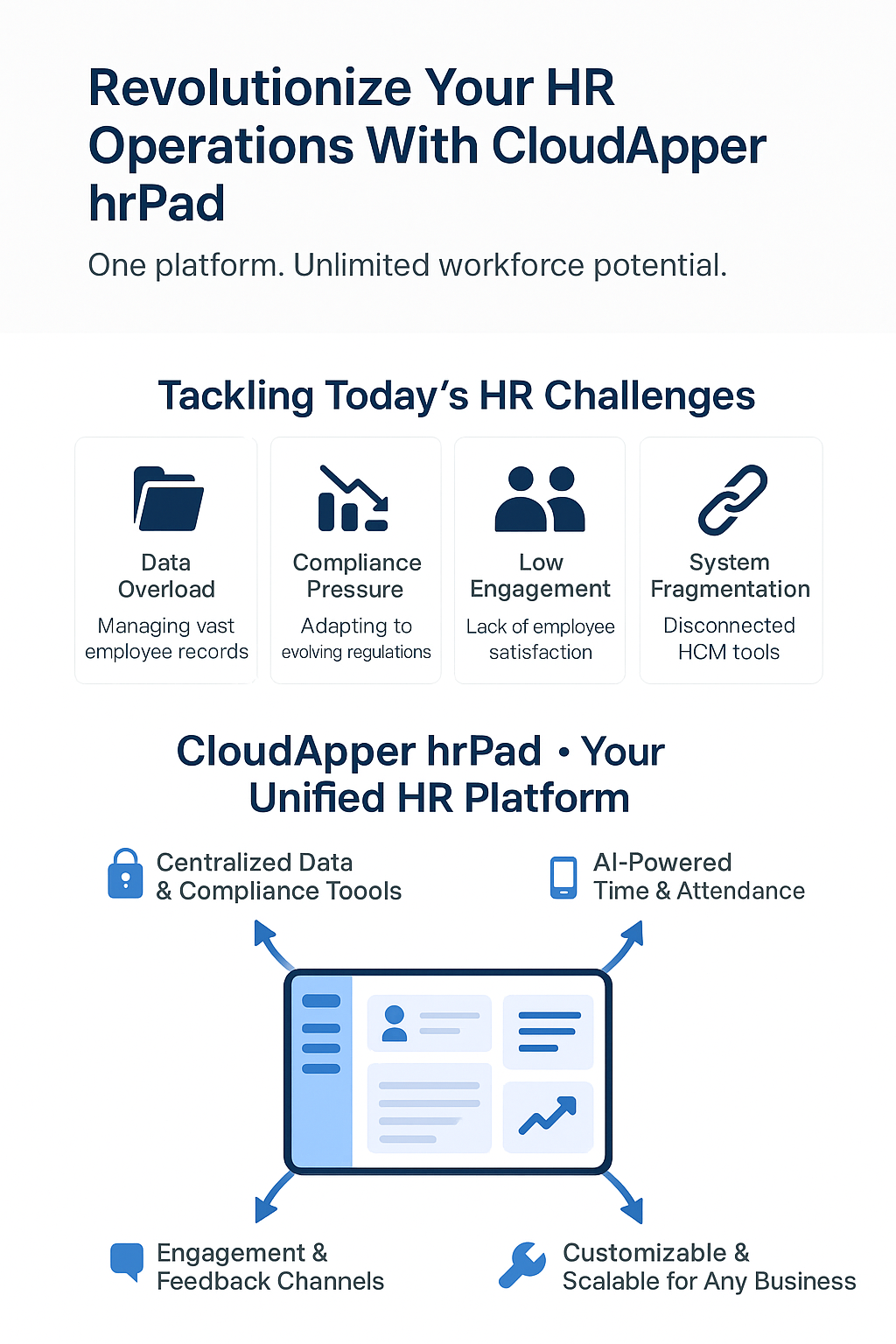
Discover how CloudApper hrPad addresses today’s toughest HR challenges with a unified, customizable platform built for compliance, engagement, and efficiency.
What Are Manual HR Bottlenecks?
From an operational standpoint, manual HR bottlenecks typically include:
- Time tracking corrections and missed punches
- Manual PTO approvals and accrual calculations
- Shift scheduling conflicts
- Paper-based or email-based employee queries
- Delayed compliance documentation
- Redundant data entry across systems
Each of these slows down decision-making and increases the risk of errors. Even small inefficiencies compound into measurable costs. According to industry research, administrative HR tasks can consume up to 40% of an HR team’s time in mid-sized organizations.
AI-powered assistance targets these friction points directly.
How AI-Powered HR Assistance Eliminates Bottlenecks
CloudApper hrPad transforms manual workflows into automated, self-service-driven processes. Rather than replacing your HCM, it layers intelligence and accessibility on top of it.
1. Automating Time Tracking and Workforce Management
Manual timekeeping leads to payroll errors and compliance risks. hrPad automates time capture, reduces missed punches, and synchronizes in real time with your HCM system.
Organizations that digitize time tracking often report significant reductions in payroll adjustments and administrative corrections. By automating clock-ins, overtime calculations, and cost center transfers, HR teams eliminate recurring bottlenecks before they escalate.
The result is accurate payroll, fewer disputes, and stronger workforce accountability.
2. AI-Powered HR Assistance for Instant Answers
Employees no longer expect to “email HR and wait.” They expect immediate responses.
hrPad includes a 24/7 AI HR assistant capable of answering policy-based questions instantly—based on your organization’s rules and documentation. Instead of generating tickets, employees receive contextual answers at the point of need.
This reduces repetitive inquiries, improves employee satisfaction, and frees HR professionals to focus on strategic workforce planning rather than administrative triage.
3. Centralized Data and Compliance Assurance
Compliance failures often stem from inconsistent processes and scattered data. hrPad centralizes employee interactions, records digital acknowledgments, and synchronizes updates directly with your core HCM platform.
By digitizing workflows such as PTO requests, attendance management, and policy confirmations, organizations strengthen audit readiness and reduce regulatory risk.
For HR leaders, this means less firefighting and more confidence in data accuracy.
4. Empowering the Deskless Workforce
Frontline employees represent a large portion of the global workforce, yet many HR tools are designed for desktop access.
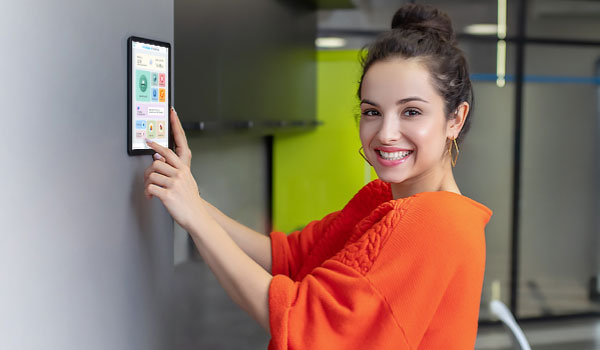
hrPad addresses this gap by transforming tablets or shared devices into secure employee self-service kiosks. Employees can clock in, submit requests, check accrual balances, and access HR assistance—without requiring email or laptop access.
This physical HR touchpoint improves adoption rates and creates a more inclusive workforce experience.
Seamless Integration Without System Disruption
One of the biggest concerns organizations face when modernizing HR is system replacement. Large-scale migrations are costly and disruptive.
hrPad integrates directly with major HCM systems—including UKG, Workday, and Oracle platforms—enhancing functionality without replacing existing infrastructure.
This interoperability ensures:
- Real-time data synchronization
- Elimination of duplicate data entry
- Minimal training requirements
- Faster time-to-value
For organizations seeking modernization without overhaul, this integration-first approach significantly reduces risk.
From Reactive HR to Strategic HR
When repetitive tasks are automated and employee queries are resolved instantly, HR shifts from reactive problem-solving to proactive workforce strategy.
With built-in analytics and reporting, hrPad provides visibility into workforce metrics such as attendance patterns, overtime trends, and engagement signals. These insights help leaders:
- Identify retention risks early
- Improve scheduling efficiency
- Monitor compliance indicators
- Make data-driven workforce decisions
AI-powered assistance does not replace HR expertise—it amplifies it.
Why AI-Powered HR Service Delivery Is Becoming Essential
The modern workforce demands speed, transparency, and personalization. Employees compare workplace technology to consumer apps. Delayed responses and manual workflows erode trust quickly.
AI-enabled HR platforms address this shift by:
- Delivering instant, contextual responses
- Reducing administrative overhead
- Improving compliance accuracy
- Enhancing frontline accessibility
- Increasing engagement through self-service
Organizations that modernize HR service delivery consistently report improved efficiency and stronger employee satisfaction metrics.
The Bottom Line
Manual HR bottlenecks are not sustainable in a fast-moving, compliance-driven, multi-generational workforce.
Solving them requires more than digitization—it requires intelligent automation layered onto existing systems.
CloudApper hrPad enables organizations to streamline workforce management, reduce repetitive administrative work, strengthen compliance, and empower employees with AI-powered self-service tools.
Instead of overhauling your HR infrastructure, you enhance it—transforming HR operations into a more efficient, responsive, and strategic function. In a landscape where workforce agility determines competitive advantage, AI-powered HR assistance is no longer optional. It is foundational.
What is CloudApper AI Platform?
CloudApper AI is an advanced platform that enables organizations to integrate AI into their existing enterprise systems effortlessly, without the need for technical expertise, costly development, or upgrading the underlying infrastructure. By transforming legacy systems into AI-capable solutions, CloudApper allows companies to harness the power of Generative AI quickly and efficiently. This approach has been successfully implemented with leading systems like UKG, Workday, Oracle, Paradox, Amazon AWS Bedrock and can be applied across various industries, helping businesses enhance productivity, automate processes, and gain deeper insights without the usual complexities. With CloudApper AI, you can start experiencing the transformative benefits of AI today. Learn More
- Useful Links:
- Agentic AI
- No-Code/Low-Code
- Custom Software
- HCM Personalization
- iPaaS
- FedRAMP
Brochure
CloudApper hrPad
Empower Frontline Employees with an AI-Powered Tablet/iPad Solution
Download Brochure
CloudApper AI Solutions for HR
- Works with






- and more.
Similar Posts
Stop Piece-Rate Pay Disputes on Payday: Let Workers Confirm Daily…
Certified Payroll Compliance: Why Davis-Bacon Failures Start at the Time…