- What Actually Happens With AI-Generated Code and Injection Risk
- The Black-Box Problem Specifically
- Prompt Injection: The Vulnerability Class Most Enterprise Teams Aren’t Ready For
- How the Vulnerability Surface Compounds at Enterprise Scale
- What a Runtime-Level Defense Actually Looks Like
- The Access Control Dimension
- The Specific Risks for Healthcare, Manufacturing, and Logistics
- What Security Teams Should Be Asking Right Now
- The Architecture That Removes the Category of Risk
- Talk to CloudApper About Your AI Application Security
There’s a category of security problem that enterprise teams have managed reasonably well for years: the known vulnerability. SQL injection, cross-site scripting, broken access control — these are documented, testable, and addressable with mature tooling and established processes. Your team knows what to look for. Your scanners know what to flag.
AI-generated code introduces a different kind of problem. Not just known vulnerability classes appearing in generated output — though that happens too — but a structural opacity that makes the normal vulnerability management process harder to run reliably.

When a developer writes code, they made every decision in it. They can explain the authentication logic. They can trace the data access path. They can describe what happens when input validation fails. When an AI generates the same code, nobody made those decisions consciously. The logic exists. It probably works. Whether it’s secure in the specific context of your enterprise environment, against your threat model, with your data — that’s a question that requires much more careful evaluation than most teams are doing before they deploy.
That gap between “it works” and “it’s secure” is where injection vulnerabilities live.
What Actually Happens With AI-Generated Code and Injection Risk
Injection vulnerabilities — SQL injection, OS command injection, LDAP injection, XML injection — remain consistently near the top of OWASP’s list of critical web application security risks. They’re not new. They’re well understood. Most experienced developers know how to avoid them.
AI coding models know how to avoid them too, most of the time. The problem is “most of the time.”
Research into AI-generated code security has documented that models generating code in pattern-heavy contexts — API layers, database access, web application logic — show elevated vulnerability introduction rates compared to their overall averages. The reason is structural: AI models generate code by pattern completion. In scenarios where the pattern is common and the security boundary is complex, the model optimizes for plausible output rather than secure output. It produces code that looks right. A reviewer who is moving quickly, or who isn’t deeply familiar with the specific vulnerability class, may not catch it.
The result is injection-vulnerable code entering production in enterprise systems — systems that handle patient records, financial data, supply chain information, employee data — not because anyone made a careless decision, but because the normal signals that would prompt a more careful review weren’t there.
The Black-Box Problem Specifically
The term “black-box code” gets used loosely, but in the context of AI-generated enterprise applications it has a specific meaning that matters for security teams.
When AI generates a complete application — not just a snippet, but a working application with authentication, data access, business logic, and error handling — the team deploying it has limited visibility into how each component was constructed. They can read the code. They can run tests. What they often can’t do is reconstruct the decision logic the way they could with code a developer wrote and explained.
This creates three specific security problems:
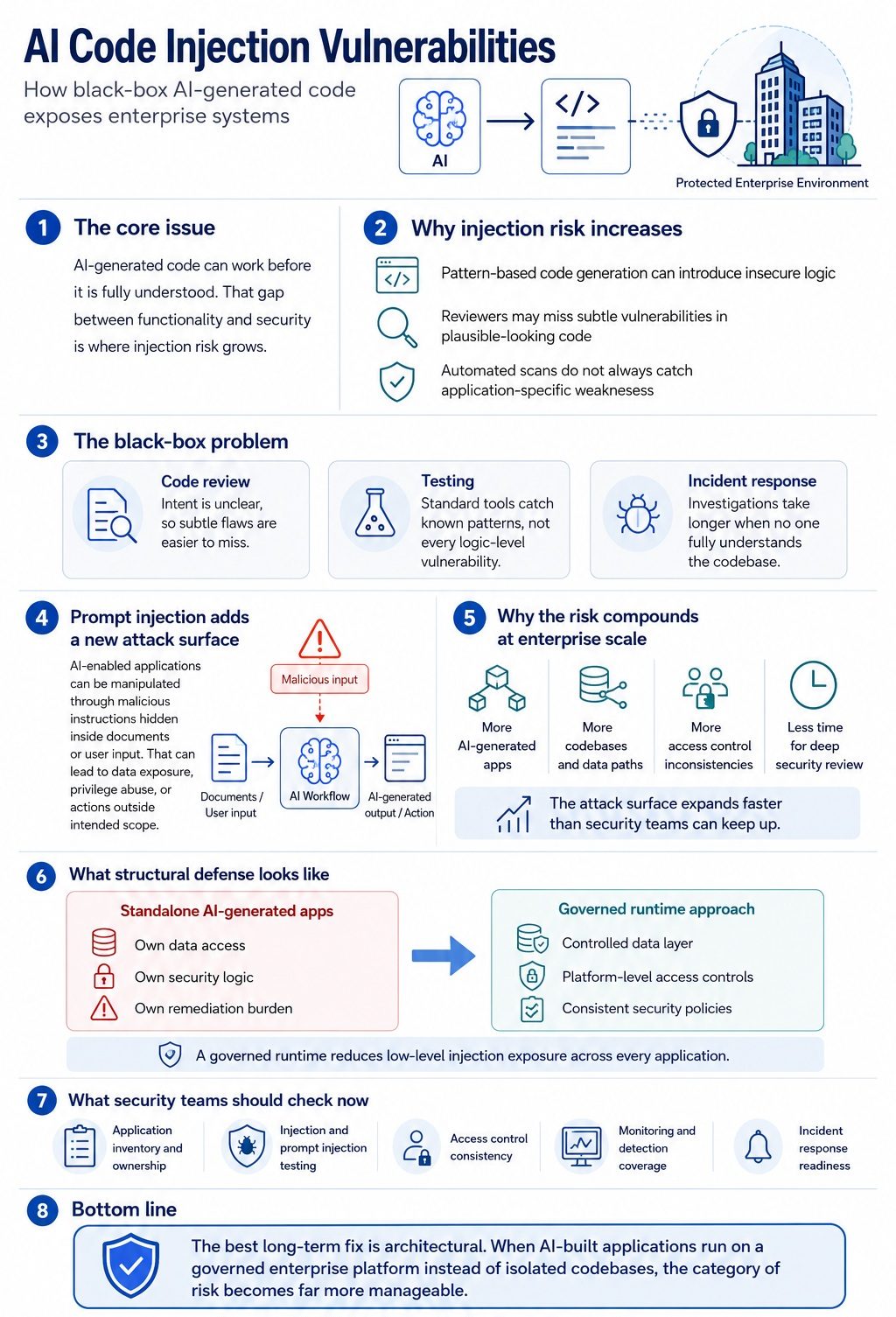
The review problem: Security code review works best when the reviewer understands the intent behind the code, not just its behavior. “This function validates user input” is easier to review securely when you know what inputs are expected, what edge cases were considered, and what failure modes were anticipated. With AI-generated code, that context often doesn’t exist. The reviewer is working from the output alone, which makes it easier to miss subtle vulnerabilities that only surface under specific conditions.
The testing problem: Automated security testing catches known patterns well. It’s weaker against application-specific logic vulnerabilities — the kind that depend on understanding how this specific application handles this specific data flow. AI-generated applications, with their unique logic structures, can have vulnerability patterns that don’t match the signatures in standard scanning tools. They pass automated scans and then fail in production.
The incident response problem: When a security incident occurs in an AI-generated application, the investigation starts from an unusual position. The incident responder needs to understand code logic that nobody fully owned — tracing an injection exploit through AI-generated data access code, reconstructing the attack path through authentication logic that wasn’t designed with a clear security model in mind. That investigation takes longer, and the remediation is harder, because the codebase isn’t understood the way a hand-written codebase would be.
Prompt Injection: The Vulnerability Class Most Enterprise Teams Aren’t Ready For
Beyond traditional code injection vulnerabilities, AI-generated applications introduce a newer and less-understood attack surface: prompt injection.
Prompt injection occurs when an attacker manipulates input to an AI-powered application in a way that overrides the application’s intended behavior. In an enterprise context, this matters because AI-generated applications frequently incorporate LLM-based components for things like natural language queries, document processing, and automated decision support.
A well-documented example: an enterprise application uses an AI component to process and respond to employee requests. An attacker embeds instructions in a document submitted to the application — instructions that, when processed by the AI component, cause it to exfiltrate data, bypass access controls, or perform actions outside its intended scope. The attacker didn’t exploit a code vulnerability in the traditional sense. They exploited the fact that the AI component can’t reliably distinguish between data it’s processing and instructions it should follow.
This attack class has been documented across major AI development platforms including GitHub Copilot, Amazon Q Developer, and others. It’s not a theoretical risk. Security researchers have demonstrated practical exploits that achieve privilege escalation, data exfiltration, and unauthorized system access through prompt injection in enterprise AI applications.
For enterprise security teams that inherited AI-generated applications built by development teams focused on functionality, prompt injection is often a blind spot. The application wasn’t built with a prompt injection threat model. The input validation doesn’t address it. The monitoring doesn’t detect it.
How the Vulnerability Surface Compounds at Enterprise Scale
A single AI-generated internal application with code injection vulnerabilities is a manageable risk. You identify it, patch it, add it to your remediation cycle.
The problem that actually confronts enterprise security teams is different in scale. Development teams using AI coding tools can generate multiple applications per month. Each application has its own codebase, its own data access patterns, its own authentication implementation, its own exposure to the vulnerability classes described above. The security team’s capacity to review, test, and monitor hasn’t scaled at the same rate.
The result is an expanding attack surface that the security function can’t keep pace with using traditional approaches. You can’t do thorough security review on applications that are generated faster than review capacity can absorb. You can’t run comprehensive penetration testing on every new application. You can’t maintain visibility into every authentication implementation and data access layer across a growing portfolio of AI-generated applications.
This is the structural vulnerability that enterprise security leaders should be thinking about — not just whether any individual AI-generated application has injection vulnerabilities, but whether the overall security architecture can handle the pace at which AI development creates new applications to secure.
What a Runtime-Level Defense Actually Looks Like
The standard defense against injection vulnerabilities is application-level: input validation, parameterized queries, output encoding, least-privilege data access. All of these are correct and necessary. None of them address the structural problem described above — the fact that AI-generated applications are being built faster than application-level security can be consistently applied.
The defense that actually works at enterprise scale is architectural: ensuring that AI-generated applications run within a controlled environment where critical security controls are enforced at the infrastructure level, not at the application level.
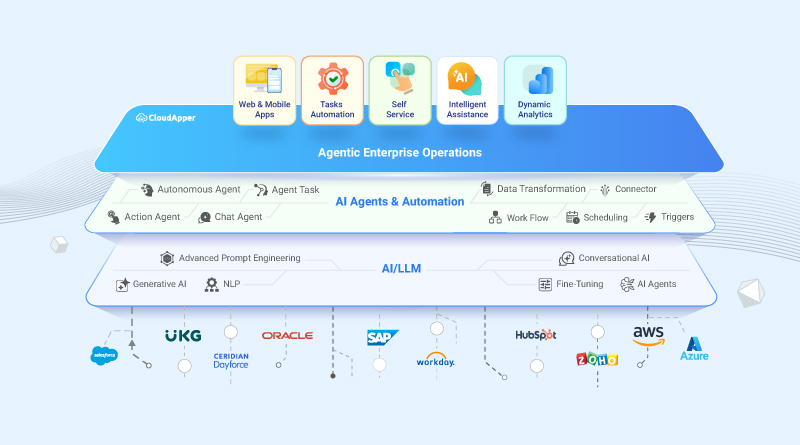
This is what CloudApper’s platform was designed to address. Rather than generating raw source code that each application team then has to secure individually, CloudApper generates governed application blueprints that execute on a certified runtime. The runtime enforces access controls, data governance, and security policies uniformly across every application built on it. An application built on CloudApper doesn’t have its own data access layer that might be vulnerable to SQL injection — it accesses data through a controlled, governed layer that enforces enterprise data policies.
The practical implication for security teams: the vulnerability surface of each individual application is dramatically reduced, because the application isn’t making low-level security decisions that could be vulnerable. The runtime makes those decisions, using controls that have been independently assessed and certified.
This also addresses the prompt injection problem directly. Applications that don’t process arbitrary input at the infrastructure level, that run within a defined execution environment with enforced boundaries, are significantly more resistant to prompt injection attacks than applications where the AI component has broad access to system functions and data.
You can read more on how CloudApper’s enterprise AI security posture handles these threat categories — the architecture answers are specific and documented, not aspirational.
The Access Control Dimension
Injection vulnerabilities get the attention. Broken access control is consistently ranked as the number one web application security risk by OWASP, and it’s directly relevant to the AI-generated code problem.
Every application an AI coding tool generates makes access control decisions. Who can see this data? Who can modify this record? What happens when a user tries to access something outside their role? In a hand-written application built by a team that understands the organization’s access control model, these decisions are made deliberately. In an AI-generated application, they’re made by a model that has no knowledge of your specific access control requirements.
The result is frequently inconsistent access control — not obviously broken, but not aligned to your organizational policy either. An employee can see records they probably shouldn’t. A role has more permissions than it needs. An API endpoint doesn’t properly validate that the calling user has rights to the data it returns.
These aren’t dramatic vulnerabilities that jump out in a code review. They’re subtle misalignments that only become visible when someone looks carefully, or when they’re exploited.
CloudApper’s architecture addresses this at the platform level: access controls are defined and enforced by the runtime, not implemented per-application. Every application inherits the same access control model. A user’s permissions are consistent across every application in the environment. There’s no per-application implementation that might diverge from organizational policy.
This is what truly secure enterprise AI integration looks like in practice — security controls that are structural rather than applied after the fact.
The Specific Risks for Healthcare, Manufacturing, and Logistics
The vulnerability categories above apply broadly, but the specific exposure varies by industry in ways worth noting.
Healthcare: Applications that process PHI — patient intake, clinical workflow tools, employee scheduling in clinical settings — are subject to HIPAA’s security requirements and are high-value targets for attackers. Code injection in a healthcare application can mean unauthorized access to patient records. Broken access control can mean a non-clinical employee viewing clinical data. The consequences extend beyond the technical breach to notification obligations, OCR investigation, and potential civil penalties.
Manufacturing: Internal applications in manufacturing environments frequently connect to operational technology (OT) networks, production systems, and supply chain data. Code injection vulnerabilities in a manufacturing application can be a pathway into systems that control physical processes. Supply chain data exposed through broken access control is valuable for competitive intelligence and targeted attacks on suppliers.
Logistics and supply chain: Applications that handle shipment tracking, vendor management, and compliance documentation often integrate with customer systems and third-party platforms. Injection vulnerabilities in these applications can expose customer data held under contractual obligations. Broken access control can expose vendor pricing, contract terms, and operational data that competitors and bad actors would pay for.
In each of these industries, the consequence of a security incident in an AI-generated application isn’t just a technical remediation exercise. It’s a business event with legal, contractual, and reputational dimensions. The enterprise application development approach your organization chooses determines whether those dimensions are manageable or significant.
What Security Teams Should Be Asking Right Now
If your organization has AI-generated applications in production or in active development, these questions are worth working through before an incident forces them:
Inventory and ownership:
- Do you have a complete list of AI-generated applications currently running in your environment?
- Does each application have a designated owner responsible for its security posture?
- Do you know which AI tools were used to build each application?
Injection vulnerability coverage:
- Has each AI-generated application undergone security testing specifically for injection vulnerability classes?
- Are your automated scanning tools configured to catch application-specific logic vulnerabilities, or just known patterns?
- Have applications that include AI/LLM components been assessed for prompt injection specifically?
Access control consistency:
- Have the access control implementations in AI-generated applications been reviewed against your organizational policy?
- Are there applications where role-based access was implemented by the AI tool without explicit alignment to your RBAC model?
Monitoring and detection:
- Do AI-generated applications generate security events in formats your SIEM can process?
- Would your detection rules identify an injection attack against a non-standard AI-generated application?
Incident response readiness:
- If an injection vulnerability were exploited in an AI-generated application today, does your IR team have enough documentation to scope the incident?
- Is there someone on your team who understands each AI-generated application well enough to support a forensic investigation?
Most security teams working through this list will find at least a few gaps. That’s not a failure — it reflects how fast AI development adoption has moved relative to security program adaptation. The useful outcome is knowing where the exposure is before someone else finds it first.
The Architecture That Removes the Category of Risk
The most durable solution to the AI code injection problem isn’t better scanning or more thorough review — though both matter. It’s building AI-generated applications in an environment where the vulnerability categories don’t exist in the same form.
When applications run on a certified, governed runtime rather than as standalone codebases, the attack surface for injection vulnerabilities is fundamentally different. Data access goes through a controlled layer that enforces parameterized queries and enterprise data policies — not through application-specific implementations that might be vulnerable. Authentication is handled by the platform, not implemented fresh in each application. Input handling follows platform-enforced patterns, not whatever the AI model generated.
CloudApper’s DevOps-inclusive platform approach means security updates at the platform level propagate to all applications without per-application remediation cycles. When a new injection attack class is identified and the platform is patched, every application benefits automatically. Security teams aren’t chasing vulnerabilities across a portfolio of individually-maintained AI-generated codebases.
That’s not a minor operational improvement. For enterprise security teams managing growing portfolios of AI-generated applications, it’s the difference between a sustainable security posture and a permanent catch-up game.
Talk to CloudApper About Your AI Application Security
If your team is running AI-generated applications in production and you want a clear view of the specific vulnerability exposure, CloudApper can walk through your environment against the threat categories covered in this article.
Schedule a conversation with the CloudApper team →
Bring your current application inventory and your active AI tooling. The conversation will focus on your specific threat surface, not a general security overview.

What is CloudApper AI Platform?
CloudApper AI is an advanced platform that enables organizations to integrate AI into their existing enterprise systems effortlessly, without the need for technical expertise, costly development, or upgrading the underlying infrastructure. By transforming legacy systems into AI-capable solutions, CloudApper allows companies to harness the power of Generative AI quickly and efficiently. This approach has been successfully implemented with leading systems like UKG, Workday, Oracle, Paradox, Amazon AWS Bedrock and can be applied across various industries, helping businesses enhance productivity, automate processes, and gain deeper insights without the usual complexities. With CloudApper AI, you can start experiencing the transformative benefits of AI today. Learn More
- Useful Links:
- Agentic AI
- No-Code/Low-Code
- Custom Software
- HCM Personalization
- iPaaS
- FedRAMP