- The incident pattern that keeps repeating
- What the investigation reveals
- The questions leadership asks that IT needs to be able to answer
- The governance lessons that come too late
- Getting ahead of the lesson
- What the post-incident governance program has that the pre-incident program lacked
- The Bottom Line
Security incidents have a way of making abstract governance conversations concrete very quickly.
Before the incident, the conversation about governing the internal development pipeline was a medium-priority agenda item. Something the IT organization knew it should address, had put on the roadmap, and kept deferring because more urgent things kept arriving. The existing process seemed like it was probably good enough. Nobody had raised a formal concern. There had been no findings in the last audit.

After the incident, the governance conversation was no longer abstract. There was a specific failure mode to examine, a specific set of process gaps that had created the conditions for the incident, and a very concrete set of questions from leadership about how this had been allowed to happen and what was going to prevent it from happening again.
This is the experience that has driven governance investment in internal development pipelines at a significant number of enterprise organizations. Not the theoretical risk assessment, not the audit finding, not the vendor briefing about emerging threats — but the actual encounter with what ungoverned internal development looks like when something goes wrong.
This article is about what those incidents typically reveal, what the organizations that go through them learn, and — more importantly — what the organizations that haven’t gone through them yet can learn from those that have without having to pay the same tuition.
The incident pattern that keeps repeating
Enterprise security incidents involving internally built applications don’t follow a single template, but they cluster around a small number of root cause patterns that appear consistently across industries and organization types.
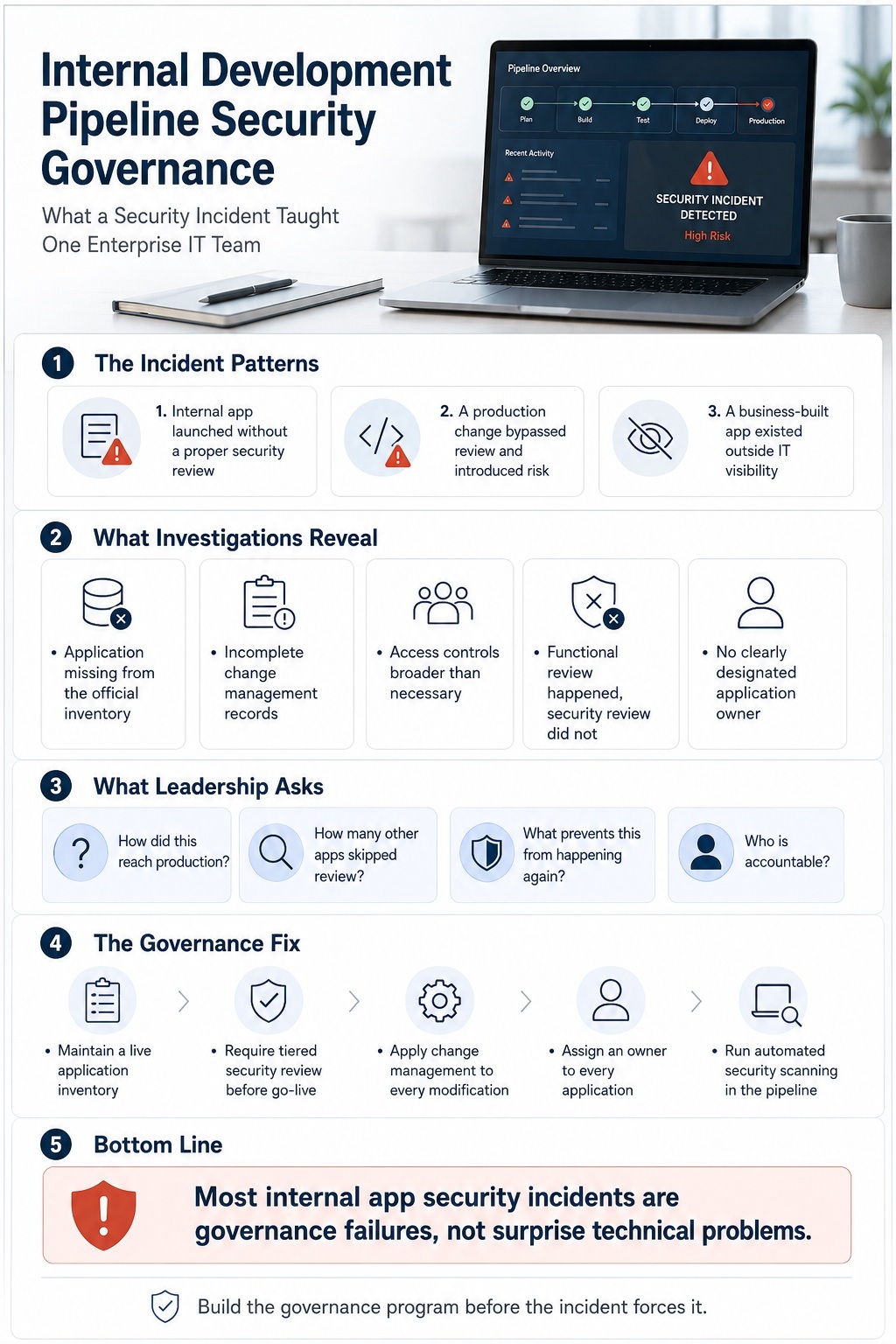
The most common pattern: an internal application that handles sensitive data was built quickly — often with AI assistance or low-code tools — by a small team under time pressure. The application went through an informal review process that confirmed it was functionally correct. It did not go through a security review that would have been calibrated to identify the specific vulnerability it contained. The vulnerability stayed latent in production for months, sometimes longer, before being discovered through an external penetration test, a compliance audit, or an actual breach.
The second most common pattern: an internal application was modified — a quick fix, a new feature, a configuration change — without going through the same review process that governed the original build. The modification introduced a vulnerability or a misconfiguration. Because the change bypassed the review process, nobody with security expertise looked at it before it reached production. The exposure window was open from the moment the change was deployed.
The third pattern, increasingly common as development has accelerated: an internal application was built by a business team without IT involvement. When the incident investigation traced back to the application, the IT organization discovered for the first time that it existed, what systems it connected to, and what data it had been handling. The incident was the discovery mechanism.
In all three patterns, the technical details of the vulnerability vary. The root cause is the same: the organization’s development process did not reliably produce a security review before code reached production — and when something reached production without a security review, there was no mechanism to catch it before it caused a problem.
What the investigation reveals
Security incident investigations involving internally built applications almost always produce the same set of uncomfortable findings, regardless of the technical specifics of the incident itself.
The application wasn’t in the official inventory: Either the application was built by a business team that didn’t go through IT, or it was built by IT under a project that was closed out and the application wasn’t formally added to the systems inventory after go-live. The incident investigation is the first time anyone produces a complete picture of what the application does, what it connects to, and who has access to it.
The change management records are incomplete: The version of the application running in production when the incident occurred may not be the version that went through whatever review process the organization had in place. Changes were made after the initial deployment — through a different, less formal process, or through no process at all. The investigation can’t reconstruct the full change history because the records don’t exist.
Access controls are broader than they should be: The investigation finds that the application grants access to data or functionality to a wider set of users than the documented business case requires. This is almost always explained by the access model being configured during development and never formally reviewed for production — what made sense as a development configuration was carried forward into production because nobody reviewed it at the deployment stage.
The security review step was skipped or was inadequate: The development team will typically report that code review happened. What the investigation finds is that the review was focused on functional correctness, not security. Nobody looked for the specific vulnerability class that caused the incident, either because the reviewers weren’t looking for it or because the review criteria weren’t defined clearly enough to require it.
No one knew who owned the application: The incident response team needed to make decisions about taking the application offline, rolling back changes, and notifying affected parties. Determining who had the authority to make those decisions took longer than it should have because the application didn’t have a formally designated owner with defined authority over it.
Each of these findings is individually correctable. Together, they describe an organization that has been building and deploying internal applications without the governance infrastructure to know what it has, control how it changes, or respond effectively when something goes wrong.
The questions leadership asks that IT needs to be able to answer
The aftermath of a security incident involving an internally built application generates a specific set of questions from leadership, boards, and regulators. These questions are worth examining before the incident, because they reveal exactly what governance infrastructure needs to exist.
How did this application get into production without going through a security review?
This question has one of two answers. Either the organization has a defined security review requirement that was not followed in this case — which is a process enforcement failure and a accountability question. Or the organization does not have a consistent security review requirement for internal applications — which is a governance design failure and a systemic question. Both answers are uncomfortable. The second is harder to defend to a regulator or a board, because it implies the incident wasn’t an anomaly — it was the predictable outcome of an absent control.
How many other internally built applications haven’t gone through a security review?
This is the question that IT leaders who haven’t thought through their development governance find most difficult to answer accurately. The honest answer, at most organizations that haven’t inventoried and risk-tiered their internal application portfolio, is: we don’t know. That answer is deeply unsatisfying to everyone who asks it. Preparing for it in advance — by having done the inventory and the risk tiering — is significantly better than producing it under post-incident scrutiny.
What is the process for ensuring this doesn’t happen again?
This question requires a specific, credible answer. Not “we’re reviewing our processes” or “we’re working with our security team to improve our review procedures.” A specific answer: here is the governance framework we are putting in place, here are the elements it covers, here is the timeline for implementation, and here is how you will know it’s working. Organizations that haven’t thought through the governance answer before the incident find themselves designing it under crisis conditions, which produces frameworks that are reactive rather than well-designed.
Who is accountable for internal application security?
Security incidents surface accountability gaps as clearly as they surface technical gaps. If the answer to this question is ambiguous — if it’s genuinely unclear whether the CISO, the CIO, the application development team, or individual business unit leaders are accountable for the security of internally built applications — that ambiguity will be resolved in the incident’s aftermath, usually in a way that is less favorable to everyone involved than a clear accountability structure established in advance.
The governance lessons that come too late
Organizations that have been through a significant security incident involving an internally built application consistently describe the same set of changes they made in the aftermath. These changes are not novel or particularly complex. They’re the governance elements that most IT professionals would recognize as standard practice. The question they raise is why those elements weren’t in place before the incident.
The honest answer is usually some combination of: development moved faster than governance kept up with, the specific risk seemed abstract until it became concrete, and competing priorities kept pushing governance investment down the list. These are not reckless organizational choices. They’re normal prioritization under resource constraints. The incident changes the prioritization calculation — abruptly and at significant cost.
The governance elements that organizations consistently implement after an incident:
A formal inventory of internally built applications with documented ownership, data handling, and system connectivity for each. Not a one-time audit but a maintained inventory that is updated as applications are built, modified, and decommissioned.
A tiered security review requirement that applies to all internally built applications before production deployment, calibrated to the application’s risk profile. Higher-risk applications get more intensive review. Lower-risk applications get lighter review. All applications get some review that is documented and creates a record.
A change management process that applies to modifications of production applications as consistently as it applies to initial deployments. The most common failure mode — a modification that bypasses the review process — is addressed by making the change management requirement explicit and enforced, not advisory.
Designated ownership for every application in the portfolio, with defined accountability for security maintenance, access review, and incident response. When the next incident occurs — and organizations that have been through one are usually realistic that there will be a next one — the response time is measured in minutes rather than hours, because the authority and accountability structure exists.
Automated security scanning integrated into the development pipeline, running against every code change before it reaches production. Not as a replacement for human security review on higher-risk applications, but as a baseline that catches common vulnerability classes before they require human attention.
These elements are not difficult to understand. They are difficult to prioritize before an incident makes the cost of not having them visible.
Getting ahead of the lesson
The value of understanding what security incidents teach is that the lesson is available without the tuition. The governance framework that organizations implement in the aftermath of an incident is the same governance framework they would have implemented before it — if the abstract risk had been weighted the same as the concrete post-incident pressure.
That reweighting is the exercise that IT leaders can do proactively. Not by catastrophizing, but by working through the incident scenario analytically: if an internally built application in this organization experienced a security incident today, what would the investigation find? What questions would leadership ask that we couldn’t answer clearly? What governance elements are currently absent that the incident would reveal?
The answers to those questions describe the governance gaps that exist right now — the same ones that a future incident would expose. Addressing them before the incident is faster, less expensive, and significantly less disruptive than addressing them after.
The organizations that have gone through security incidents involving internal applications don’t look back on the incident as the moment they learned something surprising about application security. They look back on it as the moment the cost of a known gap became impossible to defer. The gap was always there. The incident was the deadline.
What the post-incident governance program has that the pre-incident program lacked
The single most consistent observation from IT leaders who have built governance programs in the aftermath of a security incident is that the program they built after is not structurally different from what they would have built before. The elements are the same. What’s different is the organizational will to implement them.
Post-incident, the governance program gets executive sponsorship, budget, and organizational priority that pre-incident conversations about development governance almost never achieve. The abstract risk becomes a concrete recent event that everyone in the organization wants to not repeat. The friction that governance introduces — the review steps, the documentation requirements, the ownership assignments — is accepted because the alternative has been experienced.
The lesson for organizations that haven’t experienced that incident yet is that the organizational will required to implement governance doesn’t have to come from an incident. It can come from an honest, well-documented assessment of what an incident would cost and what governance would prevent. For CIOs and IT directors who have been trying to get governance investment prioritized against other competing demands, the incident scenario is often the most effective frame — not as a fear tactic, but as a concrete cost-benefit analysis that gives leadership something to weigh.
The governance program that prevents the incident is the same program that responds to it. The only difference is when it gets built.
The Bottom Line
Security incidents involving internally built applications are almost never caused by novel technical vulnerabilities or sophisticated attacks. They’re caused by the absence of governance infrastructure that would have caught a known vulnerability class before it reached production, enforced a change management process that would have documented the modification that introduced the problem, or maintained an application inventory that would have surfaced the existence of the application before an incident revealed it.
The organizations that build governance programs in response to incidents learn the same lessons at higher cost than the organizations that build them in anticipation of what an incident would reveal. The lessons are not different. The timing and the cost are.
The governance gap that an incident would expose exists now, in the current development pipeline, in the current application portfolio. The question is whether it surfaces on the organization’s terms or on the terms of the incident that reveals it.
CloudApper helps enterprise organizations build internal development pipeline governance that closes the gaps security incidents reveal — before the incident that would reveal them. Automated audit trails, enforced change management, security-integrated development environments, and complete application portfolio visibility. Contact us to see how organizations in your industry are approaching development pipeline governance.

What is CloudApper AI Platform?
CloudApper AI is an advanced platform that enables organizations to integrate AI into their existing enterprise systems effortlessly, without the need for technical expertise, costly development, or upgrading the underlying infrastructure. By transforming legacy systems into AI-capable solutions, CloudApper allows companies to harness the power of Generative AI quickly and efficiently. This approach has been successfully implemented with leading systems like UKG, Workday, Oracle, Paradox, Amazon AWS Bedrock and can be applied across various industries, helping businesses enhance productivity, automate processes, and gain deeper insights without the usual complexities. With CloudApper AI, you can start experiencing the transformative benefits of AI today. Learn More
- Useful Links:
- Agentic AI
- No-Code/Low-Code
- Custom Software
- HCM Personalization
- iPaaS
- FedRAMP