- Why manufacturing is particularly exposed
- The shop floor analogy that explains the governance gap
- What ungoverned internal app development looks like in manufacturing
- The frameworks that manufacturing IT needs to address
- What a governed development environment looks like on the manufacturing floor
- The competitive dimension
- The Bottom Line
Walk into any serious manufacturing operation and you will find quality control infrastructure everywhere. Inspection checkpoints on the line. Calibration records for measurement equipment. Documented procedures for every production process. Traceability systems that can tell you which batch of raw material went into which finished product and when. Statistical process control charts on the wall.
Manufacturing organizations figured out decades ago that speed without quality control is not actually speed. It is the illusion of speed that eventually becomes a recall, a safety incident, a regulatory finding, or a customer defection. The discipline of building quality into the process rather than inspecting it in at the end is one of the foundational principles of modern manufacturing management.

Most of those same organizations have not applied that discipline to their internal software development.
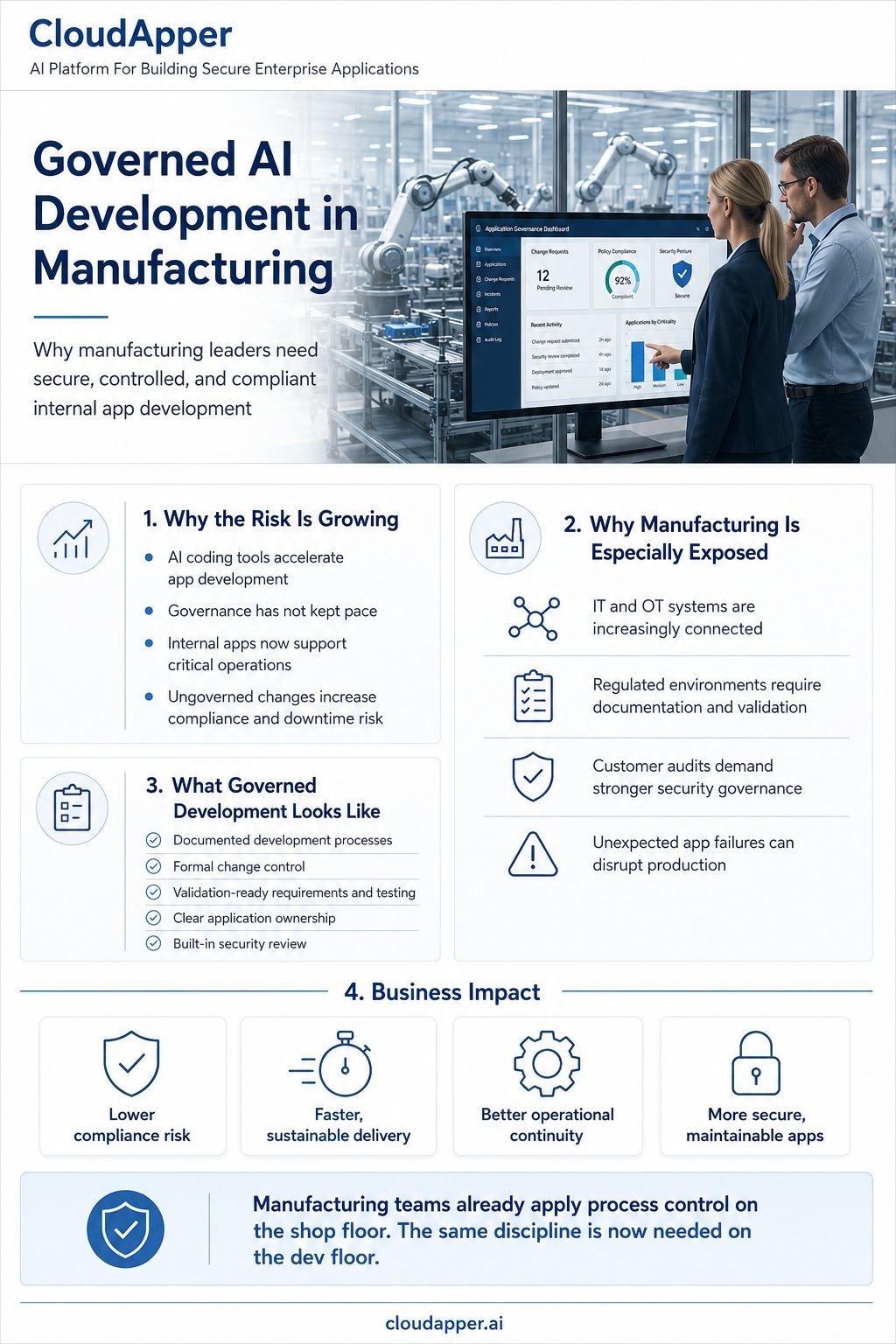
The internal applications that manufacturing IT teams build — production tracking systems, quality management tools, supply chain dashboards, maintenance scheduling applications, compliance reporting workflows — are becoming as operationally critical as the physical processes they support. When a production tracking application gives incorrect data, the downstream effects are the same as a measurement instrument that’s out of calibration. When an internal app goes down, the operations team it supports stops having the information it needs to run the floor.
The difference is that manufacturing organizations have rigorous governance for their measurement equipment and minimal governance for the software that depends on it.
That gap is growing. AI coding tools and low-code platforms have accelerated internal software development in manufacturing the same way they’ve accelerated it everywhere else. The applications are being built faster. The governance infrastructure has not kept pace. And the operational and compliance risks that come with ungoverned software development are accumulating in organizations that would never tolerate the equivalent on the production line.
Why manufacturing is particularly exposed
Manufacturing organizations have a specific set of characteristics that make ungoverned internal app development riskier than it might be in other industries.
Operational technology convergence. The boundary between information technology and operational technology in manufacturing has been narrowing for years. Internal applications increasingly connect to plant floor systems, SCADA environments, ERP platforms, and supply chain networks. An application that was built informally to handle scheduling or quality data may have connections to operational systems that the IT team doesn’t fully understand. When that application has a defect or a security vulnerability, the blast radius is larger than it would be for a purely administrative tool.
Regulatory requirements across multiple frameworks. Manufacturing organizations frequently operate under multiple overlapping compliance frameworks simultaneously. Food and beverage manufacturers deal with FDA requirements, FSMA, and food safety certifications. Pharmaceutical and biotech manufacturers operate under FDA 21 CFR Part 11, GMP requirements, and validation obligations. Industrial manufacturers may face ISO quality management standards, environmental compliance requirements, and customer-driven security audit requirements. Each of these frameworks has something to say about how software that supports regulated processes should be developed, validated, and changed.
Supply chain accountability. Large customers in manufacturing supply chains increasingly require suppliers to demonstrate security and quality governance as a condition of doing business. Automotive OEMs, aerospace primes, and large retail buyers have supplier qualification processes that include IT security assessments. An internal application that handles order data, quality records, or production information may fall within the scope of those assessments — and informal development practices that can’t be documented will generate findings.
Operational continuity sensitivity. Manufacturing operations don’t have much tolerance for unexpected downtime. An internal application that fails because an untested change was deployed to production doesn’t just create an IT problem. It creates an operations problem that may stop a production line, delay shipments, or cause quality escapes. The cost of ungoverned development in manufacturing is measured in operational downtime, not just IT remediation hours.
The shop floor analogy that explains the governance gap
The reason the governance gap exists in manufacturing IT is not that manufacturing organizations don’t understand the value of process control. They understand it better than almost any other industry. The gap exists because software development has historically been categorized as an intellectual activity rather than a production process — and intellectual activities don’t naturally attract the same process discipline that physical production does.
On the production floor, the relationship between process and outcome is visible and immediate. If the welding process is out of specification, the weld fails. If the coating thickness is wrong, the part fails inspection. The feedback loop is tight and the consequence of process deviation is concrete.
In software development, the relationship between process and outcome is less visible and often delayed. Code that doesn’t go through a proper review can work perfectly for months before a defect surfaces. An application that was deployed without a change management record can run in production without incident until an auditor asks for documentation that doesn’t exist. The feedback loop is long and the consequence of process deviation is abstract until it suddenly isn’t.
Manufacturing organizations have learned to govern even processes where the feedback loop is long and the consequences of deviation are delayed. Statistical process control exists precisely because you can’t always see a problem in individual units — you need systematic monitoring to catch drift before it becomes a defect. Environmental monitoring exists because contamination isn’t always immediately visible. Document control exists because the consequences of using an outdated procedure may not show up until months later.
The same logic applies to software development governance. You can’t always see the problem in individual applications. You need systematic monitoring, control infrastructure, and documentation discipline to catch issues before they become operational incidents, security vulnerabilities, or compliance findings.
The manufacturing organizations that have made this connection are the ones closing the governance gap. The ones that haven’t made it are still treating software development as a fundamentally different kind of activity — one that doesn’t need the process discipline that everything else in their operation requires.
What ungoverned internal app development looks like in manufacturing
The pattern is consistent enough that it reads like a case study template.
A plant manager or operations team identifies a problem that software could solve. Maybe it’s the quality inspection process, which is still being tracked on paper and spreadsheets. Maybe it’s maintenance work order management, where the current system can’t handle the volume or complexity of the operation. Maybe it’s supply chain visibility, where the team is getting information too late to respond effectively.
The IT team builds something. With AI coding tools, they build it fast — weeks instead of months. The application gets deployed and used. It works. Operations depends on it.
Then something changes. The business process it supports evolves. A regulatory requirement changes. A security audit finds that the application connects to an OT system in a way that wasn’t fully reviewed. A key developer leaves and nobody else fully understands how the application works. The application needs to be modified, and the modification breaks something because there’s no documentation of how the original was built or what testing was done.
Or nothing breaks, and the problem surfaces during an audit. A customer security assessment asks about the application. An FDA inspector asks about software validation for a process it supports. An ISO auditor asks about change management records. The documentation doesn’t exist in the form the auditor needs, and what should have been a straightforward review becomes an extended remediation exercise.
None of this is unique to manufacturing. What’s specific to manufacturing is the operational consequence when it does go wrong, and the density of regulatory and customer requirements that create multiple independent pathways to a governance-related finding.
The frameworks that manufacturing IT needs to address
Manufacturing organizations dealing with internal app development governance are typically managing requirements from several directions simultaneously. The specific frameworks vary by industry segment, but the themes are consistent.
Software validation for regulated processes. In pharmaceutical, medical device, food, and other regulated manufacturing environments, software that supports regulated processes needs to go through a validation process that demonstrates it does what it’s supposed to do and continues to do so reliably. This isn’t optional and it isn’t informal. It requires documented specifications, test protocols, test execution records, and ongoing monitoring. When AI-assisted development builds or modifies software that falls into this category, the validation requirements don’t change — but the development process needs to be structured to produce the evidence that validation requires.
Change control for production-connected systems. Any application that connects to production systems or influences production decisions should have a formal change control process. Changes need to be evaluated for potential impact on connected systems, tested in a non-production environment, approved before deployment, and documented with enough detail that the change can be understood and reversed if necessary. This is standard practice in OT/IT convergence environments — it’s less consistently applied to internal applications that don’t look like OT but effectively are.
Security requirements from customer audit programs. Major manufacturing customers in automotive, aerospace, defense supply chain, and consumer goods have supplier security programs with specific requirements. These programs increasingly include questions about application security, software development governance, and vulnerability management. The manufacturing supplier that can demonstrate governed development practices has a competitive advantage in customer qualification processes. The one that can’t is creating procurement risk.
ISO quality management extension to software. ISO 9001 and industry-specific quality management standards don’t explicitly require software development governance, but they do require that processes affecting product quality are controlled and documented. When internal software affects production quality — through inspection management, process control, or data handling for quality records — the quality management system should logically extend to the software development process that produces and maintains it. Many manufacturing organizations haven’t made that extension explicit.
What a governed development environment looks like on the manufacturing floor
The manufacturing organizations that have solved this problem have done so by treating internal software development with the same process discipline they apply to production operations. That means specific things in practice.
Development processes are documented and followed consistently. Just as production processes have documented standard operating procedures, the development process has defined stages, defined criteria for moving between stages, and documented records of what happened at each stage. This doesn’t have to be bureaucratic. It has to be consistent and traceable.
Change control applies to software as well as physical processes. Any change to an application that affects production, quality, or regulatory compliance goes through a documented change control process. The change is evaluated for impact before implementation, tested before deployment, approved by someone with authority to authorize production changes, and documented with enough detail for future reference. The records from this process are maintained in a way that makes them retrievable during audits.
Validation requirements are defined before development begins. For applications that support regulated processes, the validation requirements are established as part of the requirements phase — before the application is built. The development process is designed to produce the evidence the validation requires: documented requirements, test protocols, test execution records, and change control records for subsequent modifications. AI-assisted development doesn’t exempt an application from validation requirements, but it can accelerate the development of a validation-ready application if the governance infrastructure is in place.
Applications have designated owners who understand their operational and compliance context. Every internal application that affects production or compliance has a designated owner — someone who understands what the application does, what it connects to, and what the compliance requirements are for maintaining it. When changes are needed, the owner is part of the process. When auditors ask questions, the owner has answers.
Security review is part of the development process, not an afterthought. Applications that connect to OT systems, handle production data, or process quality records get security review before they go to production. The review criteria are defined and consistent. The results are documented. Findings are tracked and resolved.
The competitive dimension
Manufacturing organizations that get this right gain something beyond compliance. They gain development velocity that is genuinely sustainable.
The complaint that governance slows development down is usually true of governance designed as a separate phase — something that happens after development is done, before deployment, and creates a bottleneck. It’s not true of governance designed as infrastructure — something embedded in the development process that produces required documentation and artifacts as a byproduct of normal development activity.
Manufacturing organizations that have built development governance as infrastructure can deploy a new internal application or a significant modification in days rather than weeks, because the approval process is defined and predictable, the documentation requirements are met as development progresses, and the security review criteria are clear enough that most things pass on the first submission. The process is fast because it’s designed to be fast, not because corners are being cut.
The organizations that don’t have this infrastructure take longer, paradoxically, because they’re either moving fast without governance and then spending time in remediation, or they’re moving carefully without a defined process and creating delays through uncertainty rather than through required review steps.
For manufacturing organizations competing on operational efficiency, this distinction matters. The development velocity that AI tools make possible is available to the organizations that have built the governance infrastructure to use it responsibly. For those that haven’t, the productivity gains come with operational and compliance debt that eventually offsets them.
The Bottom Line
Manufacturing organizations have spent decades building quality and process control into their production operations. The same discipline has not been consistently applied to the internal software development that increasingly supports those operations.
AI coding tools have accelerated internal app development in manufacturing significantly. That acceleration is valuable. It becomes a liability when the development process doesn’t have the governance infrastructure to ensure that what gets built is secure, documented, and maintainable — and that it meets the regulatory and customer requirements that manufacturing organizations operate under.
The case for governed AI development in manufacturing is not a compliance argument. It is an operational argument. The shop floor runs better when processes are controlled and documented. The dev floor does too.
CloudApper helps manufacturing and industrial organizations build governed AI development environments where internal applications are built quickly, documented automatically, and maintained to the quality and compliance standards that manufacturing operations require. Contact us to see how manufacturing enterprises are applying operational discipline to their internal software development programs.

What is CloudApper AI Platform?
CloudApper AI is an advanced platform that enables organizations to integrate AI into their existing enterprise systems effortlessly, without the need for technical expertise, costly development, or upgrading the underlying infrastructure. By transforming legacy systems into AI-capable solutions, CloudApper allows companies to harness the power of Generative AI quickly and efficiently. This approach has been successfully implemented with leading systems like UKG, Workday, Oracle, Paradox, Amazon AWS Bedrock and can be applied across various industries, helping businesses enhance productivity, automate processes, and gain deeper insights without the usual complexities. With CloudApper AI, you can start experiencing the transformative benefits of AI today. Learn More
- Useful Links:
- Agentic AI
- No-Code/Low-Code
- Custom Software
- HCM Personalization
- iPaaS
- FedRAMP