AI-generated code doesn't automatically meet FDA electronic records requirements. This article examines where AI-generated internal applications fail 21 CFR Part 11, why the risk compounds across pharma and medical device IT organizations, and what a governed approach to internal app development looks like before the next inspection.

TL;DR
AI coding tools generate functional applications quickly, but functional and Part 11-compliant are not the same thing. AI-generated internal apps in pharma and medical device environments commonly fail on four fronts: incomplete audit trails, weak electronic signature binding, coarse access control, and missing validation documentation, gaps that don't show up until an FDA inspector asks for them. The risk compounds as more internal applications get built by different teams using different AI tools with no consistent compliance approach. A governed development model routes every regulated application through the same audit trail, access control, and validation architecture, so the organization can answer an inspector's questions with one consistent model instead of a patchwork of one-off justifications. For senior IT and quality leaders, the takeaway is that Part 11 compliance needs to be built into the development platform itself, not retrofitted onto each application after the fact.
Table of Contents
- Why AI-Generated Code and Part 11 Don’t Mix by Default
- Where CloudApper Fits Before the Inspection, Not After
- The Specific Ways AI-Generated Apps Fail Part 11
- Why This Gets Worse at Scale
- The Difference Between Passing an Audit and Surviving One
- What a Governed Approach Looks Like in Practice
- What Enterprise IT and Quality Teams Should Do Now
A pharma company’s IT team prompts an AI coding assistant to build an internal application for tracking deviation reports. It works. It’s fast. Nobody asks, before it goes live, whether the record-keeping behavior underneath it would survive an FDA inspection.

That gap is becoming common across pharmaceutical, biotech, and medical device companies, and it’s a different kind of risk than the security vulnerabilities most enterprise AI governance conversations focus on. Part 11 doesn’t care whether your code has a SQL injection flaw. It cares whether your electronic records are trustworthy, attributable, and unalterable in ways that hold up to an auditor asking pointed questions about a system nobody on the current team actually built.
Why AI-Generated Code and Part 11 Don’t Mix by Default
21 CFR Part 11 sets requirements for electronic records and electronic signatures in FDA-regulated environments: audit trails that capture who changed what and when, validation that the system does what it’s supposed to do, access controls that tie actions to individuals, and record retention that survives system changes. None of that is optional for systems touching manufacturing records, clinical data, complaint handling, or deviation and CAPA tracking.
AI coding tools generate functional applications quickly, but functional and compliant are not the same thing. An AI-assisted developer can build a deviation-tracking app that works perfectly for its intended purpose and still fails Part 11 on delivery, because the audit trail wasn’t a requirement anyone specified in the prompt. The timestamp logging might be incomplete. The access control might not distinguish between roles with the granularity an auditor expects. The system might allow a record to be edited without leaving a trace of the prior value.
This is exactly the failure mode AI-generated code in the enterprise is fast to build and expensive to trust describes, and in a Part 11 environment “expensive” has a specific meaning: a 483 observation, a warning letter, or a validation effort that costs more than building the system correctly the first time would have.
Where CloudApper Fits Before the Inspection, Not After
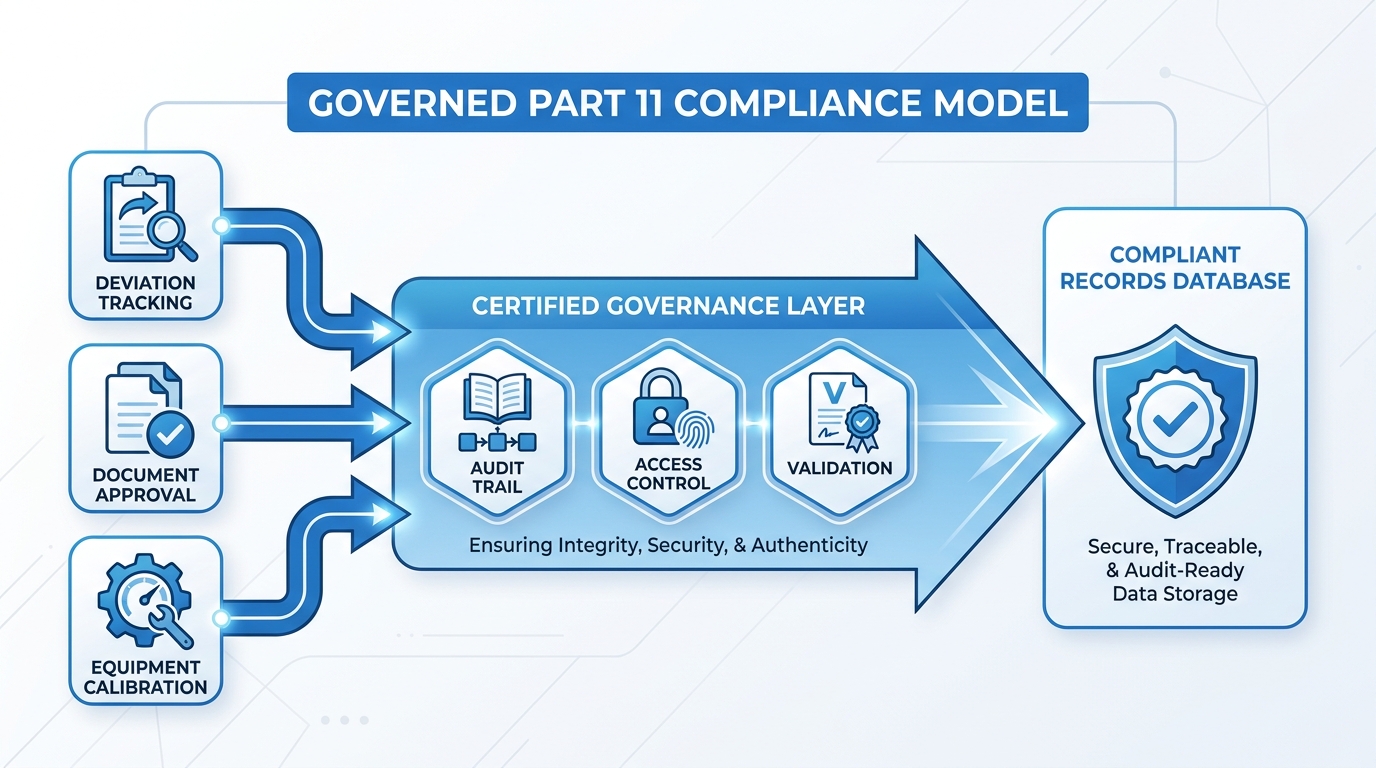
CloudApper eliminates the security, compliance, and maintenance risks of AI-generated code by generating governed application definitions rather than raw source code, which means the audit trail, access control, and validation posture aren’t things a developer has to remember to add. They’re inherited from the platform’s certified runtime the same way every application built on it inherits them, whether the app is tracking deviations, managing document approvals, or logging equipment calibration.
That distinction matters specifically for Part 11 because the standard doesn’t just ask whether a control exists. It asks whether the control is consistent, documented, and demonstrable across every system that touches regulated records. An organization running a dozen AI-generated internal tools, each with its own ad hoc approach to audit logging, cannot produce that consistency on demand. An organization running those same tools on a governed platform can, because the control lives at the infrastructure layer instead of being re-implemented, or forgotten, in every individual app.
The Specific Ways AI-Generated Apps Fail Part 11
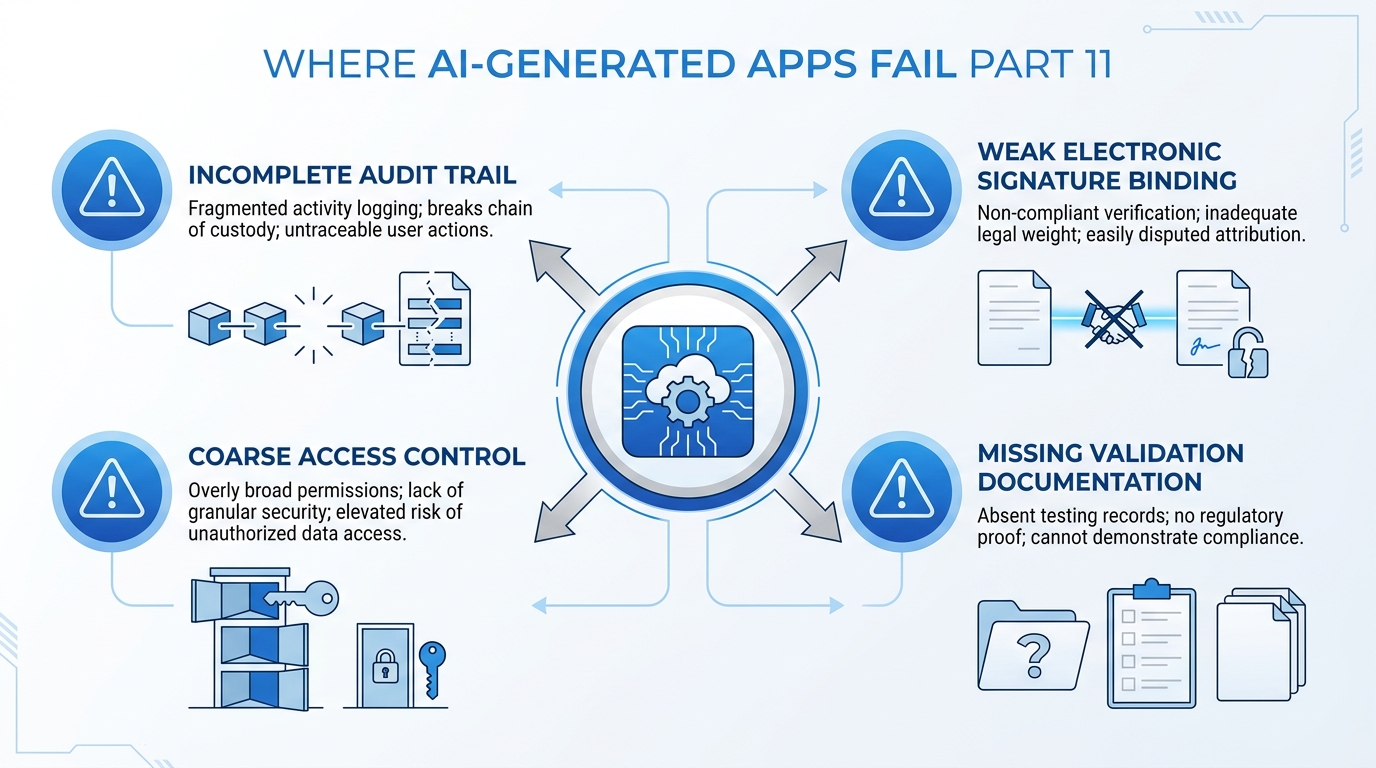
Audit trail completeness is the most common gap. Part 11 requires a secure, computer-generated, time-stamped audit trail that captures the who, what, and when of any change to an electronic record, and that trail has to be independent of the user’s ability to alter it. AI-generated code frequently implements logging as an afterthought, because the prompt that generated the app was focused on functionality, not the specific FDA requirement for tamper-evident history. A developer who didn’t think to ask for immutable audit logging usually doesn’t get it by default.
Electronic signature binding is the second gap. Part 11 requires that an electronic signature be permanently linked to its corresponding record, so the signature can’t be copied, transferred, or otherwise used to falsely authenticate a different record. This is a specific technical requirement that most general-purpose AI coding output doesn’t address unless someone explicitly engineers for it, and most internal developers building a quick approval workflow app are not FDA compliance specialists.
Access control granularity is the third. Part 11 expects role-based restrictions that map to actual job function and responsibility, not a generic admin/user split. AI-generated apps tend to default to whatever access model is fastest to build, which is rarely the level of granularity a Part 11 audit expects to see documented and justified.
Validation documentation is the fourth, and it’s less about the code itself than about what has to exist around it. Part 11 systems require documented validation: evidence that the system does what it claims to do, tested and recorded. AI-generated code that changes with every prompt iteration makes this significantly harder, because validation has to be redone or re-justified every time the underlying application changes in ways nobody tracked systematically.
Why This Gets Worse at Scale
A single ungoverned internal app is a manageable risk. The problem compounds when Part 11 covers dozens of systems across manufacturing, quality, clinical operations, and complaint handling, and each one was built by a different team using a different AI coding tool with a different, informal approach to compliance.
Shadow IT is back, and this time it’s AI, and in a regulated pharma or medical device environment, shadow AI development isn’t just a security or governance headache. It’s a direct compliance exposure, because every one of those systems is a potential audit finding waiting for an inspector to ask the question nobody on the development team was equipped to answer: can you show me the validation record for this system, and can you demonstrate the audit trail is tamper-evident?
Every generated app creates its own logic, its own data handling pattern, and its own compliance posture, which means every generated app also needs its own validation effort, its own audit trail review, and its own answer to an FDA inspector. That doesn’t scale, and it’s exactly the kind of fragmentation a practical AI coding governance framework is built to prevent, whether the driving compliance standard is SOC 2, HIPAA, or Part 11.
The Difference Between Passing an Audit and Surviving One
Passing a Part 11 audit on paper and surviving one under real scrutiny are different bars. An auditor reviewing an AI-generated system doesn’t just want to see that an audit trail exists. They want to understand how it was built, who validated it, whether the underlying code has changed since validation, and whether the same standard applies consistently across every regulated system in the organization, not just the one currently under review.
SOC 2 auditors are already asking questions internal teams can’t answer about AI-assisted development, and Part 11 auditors are positioned to ask harder versions of the same questions, because the standard is older, more specific, and tied directly to patient safety and product quality rather than general information security. An organization that can’t produce a clear validation history for an AI-generated deviation tracker is not going to have an easier conversation about a system touching manufacturing batch records.
What a Governed Approach Looks Like in Practice
The fix isn’t slower development. Pharma and medical device companies don’t have the luxury of choosing between speed and compliance, because both regulatory pressure and competitive pressure are real and simultaneous. The fix is making sure speed and compliance aren’t in tension in the first place, which requires the compliance posture to be built into the platform generating the applications rather than bolted onto each one after the fact.
Under a governed model, every internal application, whether it’s tracking deviations, managing supplier qualification, or logging equipment maintenance, inherits the same audit trail architecture, the same access control granularity, and the same validation approach. When an FDA inspector asks how the organization ensures Part 11 compliance across its internally built systems, the answer isn’t “it depends on which developer built which app.” It’s a single, demonstrable model applied consistently, because the applications are running on a certified runtime rather than existing as independent, one-off codebases.
This is the model CloudApper applies to internal application development in regulated pharma and medical device environments specifically. Rather than generating raw code that a quality team then has to independently validate and audit, the platform produces governed application definitions that execute inside infrastructure already built around consistent access control, audit logging, and change tracking, which means the compliance conversation starts from a much stronger position than “we’ll review it and get back to you.”
What Enterprise IT and Quality Teams Should Do Now
Start with an inventory, the same way any AI governance conversation should start. Most pharma and medical device IT organizations cannot currently list every AI-generated internal application touching regulated records, who built each one, and whether any of them have been through a formal validation process. That inventory has to exist before a Part 11 risk assessment means anything.
From there, the priority is establishing a consistent standard for how new internal applications get built, validated, and maintained before the next one ships, not after an inspector flags the third one as an observation. AI coding tools are not going away from pharma and medical device IT departments; they’re too useful and too fast to abandon. The choice these organizations actually face is whether that speed runs through a governed, auditable platform or through a scattered collection of one-off applications that each carry their own undocumented compliance risk.
CloudApper helps pharmaceutical, biotech, and medical device IT teams build internal applications that inherit consistent audit trails, access controls, and validation posture from day one, without slowing down the development speed AI coding tools made possible. If your organization needs a governance model for internal app development that holds up under an FDA inspection, reach out to CloudApper to talk through what that looks like for your environment.

What is CloudApper AI Platform?
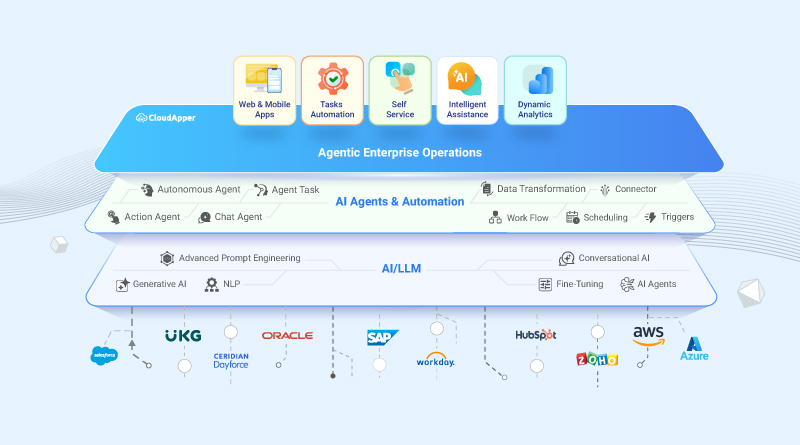
CloudApper AI is an advanced platform that enables organizations to integrate AI into their existing enterprise systems effortlessly, without the need for technical expertise, costly development, or upgrading the underlying infrastructure. By transforming legacy systems into AI-capable solutions, CloudApper allows companies to harness the power of Generative AI quickly and efficiently. This approach has been successfully implemented with leading systems like UKG, Workday, Oracle, Paradox, Amazon AWS Bedrock and can be applied across various industries, helping businesses enhance productivity, automate processes, and gain deeper insights without the usual complexities. With CloudApper AI, you can start experiencing the transformative benefits of AI today. Learn More
- Useful Links:
- Agentic AI
- No-Code/Low-Code
- Custom Software
- HCM Personalization
- iPaaS
- FedRAMP
CloudApper AI Solutions
- Works with







- and more.
Similar Posts

Legacy Modernization Transition: The Compliance Gap That Opens When Both…

Outsourced Legacy Systems: Why Vendor Exit Costs More Than the…