Oracle ERP rarely does everything enterprises need it to do. When IT teams try to extend it through APEX, custom modules, or middleware, they discover a pattern of governance gaps and technical debt. Here is what that looks like in practice — and how a governed platform changes the outcome.

TL;DR
Enterprises running Oracle ERP consistently encounter the same problem: the platform handles core operations well but cannot accommodate everything the business needs. Attempting to fill that gap through APEX, custom modules, or middleware produces fragmentation, technical debt, and compliance exposure that accumulates over time. The governance questions that surface during audits — access controls, change history, data handling — are rarely answered by Oracle-native customization approaches. CloudApper AI offers a governed alternative: a platform that sits alongside Oracle, integrates through a managed iPaaS layer, and produces compliance artifacts as a byproduct of normal development rather than requiring them to be retrofitted afterward.
Table of Contents
- The APEX Decision and What Comes After It
- What the Custom Module Path Actually Costs
- The Middleware Dependency That Grows in the Background
- Where Compliance Pressure Changes the Calculus
- The Business Team That Started Building on Its Own
- What a Governed Extension Model Actually Looks Like
- The Question Worth Asking Before the Next Oracle Project
Oracle ERP sits at the operational core of thousands of enterprises — managing financials, procurement, supply chain, and HR across industries where the margin for error is measured in dollars per second. For most organizations running it, Oracle is not going anywhere. It is infrastructure, in the truest sense of the word: load-bearing, deeply integrated, and expensive to touch.
That permanence is also what makes the conversation around custom application development so uncomfortable. Because once the ERP is stable, the business starts asking for things it cannot do. A procurement workflow that needs an approval layer Oracle doesn’t support out of the box. A shop floor data capture form that needs to write back to Oracle but also communicate with a separate quality system. A vendor portal that needs to surface Oracle data without exposing the ERP itself to external users. The list grows, and it always grows faster than IT can address it through standard Oracle configuration.

What enterprise IT leaders consistently discover when they try to extend Oracle — through APEX, through custom modules, through middleware stacks assembled over time — is that the path to “just build it” is longer, more expensive, and more fragile than it initially appears. And for organizations with real compliance obligations, it carries risks that don’t show up in the initial project estimate.
CloudApper AI was purpose-built for exactly this scenario: enterprises that need to build governed, enterprise-grade applications that extend, integrate, or work alongside core systems like Oracle without replicating their technical debt or creating new exposure.
The APEX Decision and What Comes After It
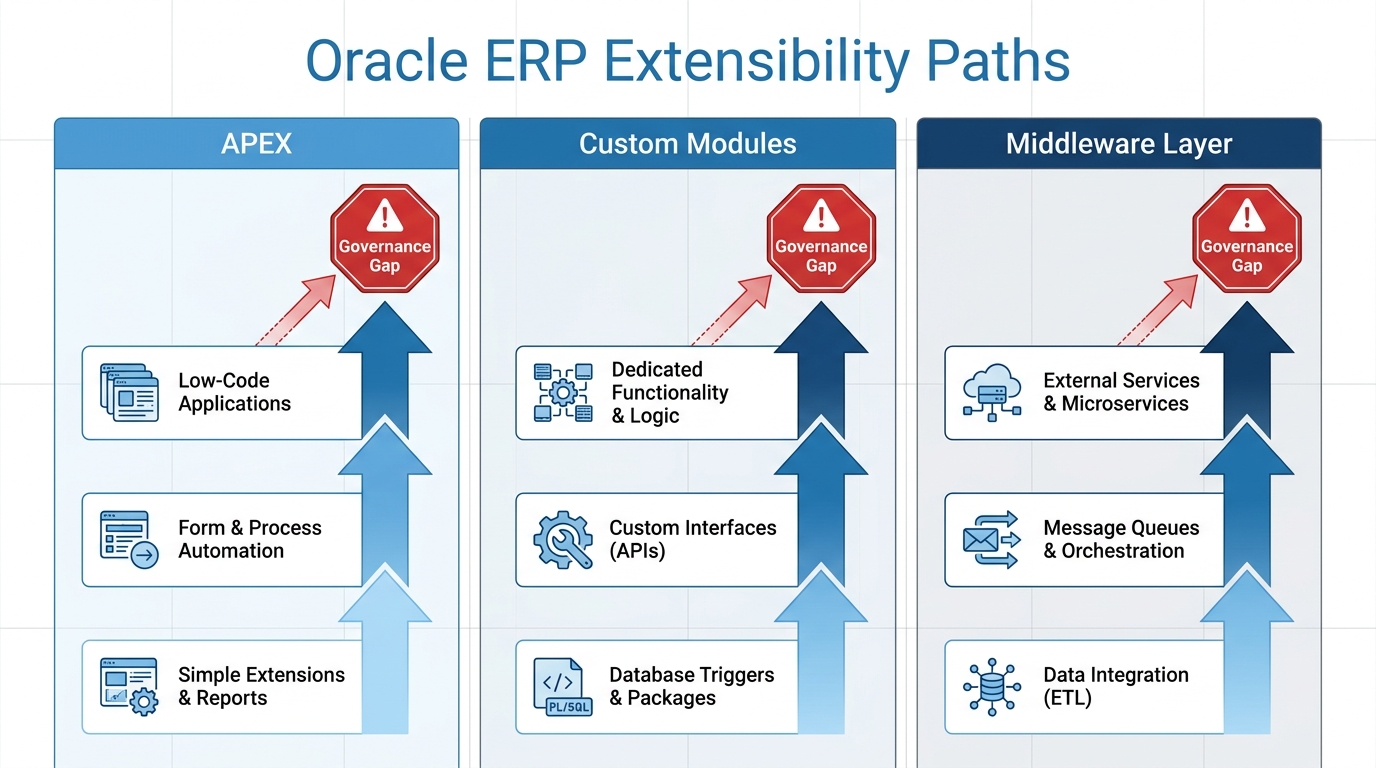
Oracle Application Express (APEX) is the platform’s native low-code development environment, and it is genuinely capable for specific use cases. IT teams that evaluate it seriously often get partway down the road before they run into the constraints that matter most.
APEX works well when you are building something that lives entirely within Oracle’s data model and doesn’t need to talk to anything outside it. The moment a requirement involves an external system — a third-party HR platform, a customer-facing layer, a logistics API — the architecture gets complicated. APEX was designed to extend Oracle, not to serve as an enterprise application platform in its own right. Using it that way requires bridging tools, custom REST services, and integration logic that has to be built, tested, and maintained by someone.
The other constraint is operational. APEX applications run inside the Oracle database environment, which means their uptime is tied to Oracle’s uptime, their performance is shaped by Oracle’s resource allocation, and their governance model is inherited from whatever IT has set up around the ERP itself. For organizations that need to demonstrate access controls, audit trails, and deployment governance to compliance teams, the Oracle-native path requires additional instrumentation that rarely comes pre-built.
The teams that recognize these limits early tend to move to a hybrid approach: APEX for lightweight internal tooling, and a separate application layer for anything customer-facing, compliance-sensitive, or integration-heavy. That hybrid model is defensible, but it multiplies the platforms IT has to govern.
What the Custom Module Path Actually Costs
For organizations that have been on Oracle long enough, there is usually a layer of custom modules sitting between the standard ERP functionality and what the business actually uses. Some of these were built during the original implementation. Others were added over the years by internal developers, consultants, or former employees whose institutional knowledge is now partially or entirely gone.
This is the institutional knowledge problem in its most acute form: custom code that the business depends on, written to specifications that no longer exist in documentation, by people who are no longer available to explain the decisions they made. When Oracle releases a major update, these modules have to be tested against the new version. When something breaks, the diagnostic process is often archaeological.
The cost is not just the hours spent on maintenance. It is the organizational risk created by dependence on undocumented logic running inside a system that IT is simultaneously trying to keep stable. Teams running Oracle custom modules often describe a quiet paralysis around upgrades: the upgrade is necessary, the custom layer makes it dangerous, and neither the business nor IT can agree on how to move forward without breaking something critical.
None of this is Oracle-specific. Enterprises running SAP encounter the same pattern when they try to build custom applications around the platform — a combination of native tooling that covers most but not all ground, and custom code that accumulates over time into something difficult to govern or evolve. The ERP itself is not the problem. The problem is building outside it without a governed framework.
The Middleware Dependency That Grows in the Background
Most enterprises running Oracle for more than a decade have some form of middleware between the ERP and the rest of their application landscape. In the early years, this is usually a single integration layer handling a small number of data flows. Over time, it becomes something else: a sprawling dependency graph of point-to-point integrations, each one built to solve a specific problem at a specific moment, none of them designed to be managed as a coherent system.
The result is integration fragility. When Oracle changes an API endpoint, or a downstream system updates its schema, or a new application needs to be wired in, IT has to trace a chain of dependencies that often has no current documentation. The people who built the original integrations may be gone. The logic governing data transformation may exist only in code comments that were last updated years ago.
This is the environment into which new custom application requests land. Every new application that needs to read from or write to Oracle adds another node to this graph. Every node is a potential failure point. Every failure point has to be monitored, diagnosed, and maintained by a team that is already managing everything else.
For IT leaders evaluating how to approach the next custom application request, the question is not just “can we build this?” It is whether the way they build it will make the underlying integration problem better or worse. The build vs. platform decision is rarely just about development cost — it is about the total operational footprint the new application creates.
Where Compliance Pressure Changes the Calculus
For most enterprises with Oracle at the center, compliance is not a background concern. Manufacturing companies operating under ISO and OSHA requirements, healthcare organizations subject to HIPAA, financial services firms under SOC 2 or PCI DSS — these organizations cannot treat custom application development as a purely technical decision. Every application that touches Oracle data or business processes is, from a compliance standpoint, a potential audit finding.
The specific questions that come up during audits around custom Oracle applications are consistent: Who has access to this application, and is that access governed through a formal process? Can you show the change history for this application’s code? If this application processes sensitive data, where is that data stored and who can see it? What controls exist to prevent unauthorized modifications to the application logic?
These questions are answerable — but only if the development process was designed from the start to produce answers. Custom Oracle modules built by individual developers on tight deadlines rarely produce the kind of documentation, access logging, and change tracking that compliance teams require. APEX applications built by internal teams often have the same gap: the functionality exists, but the governance artifact around it does not.
This is where the evaluation criteria for enterprise application platforms changes fundamentally when compliance is non-negotiable. The question shifts from “what can we build?” to “what governance does the platform produce as a byproduct of normal development?”
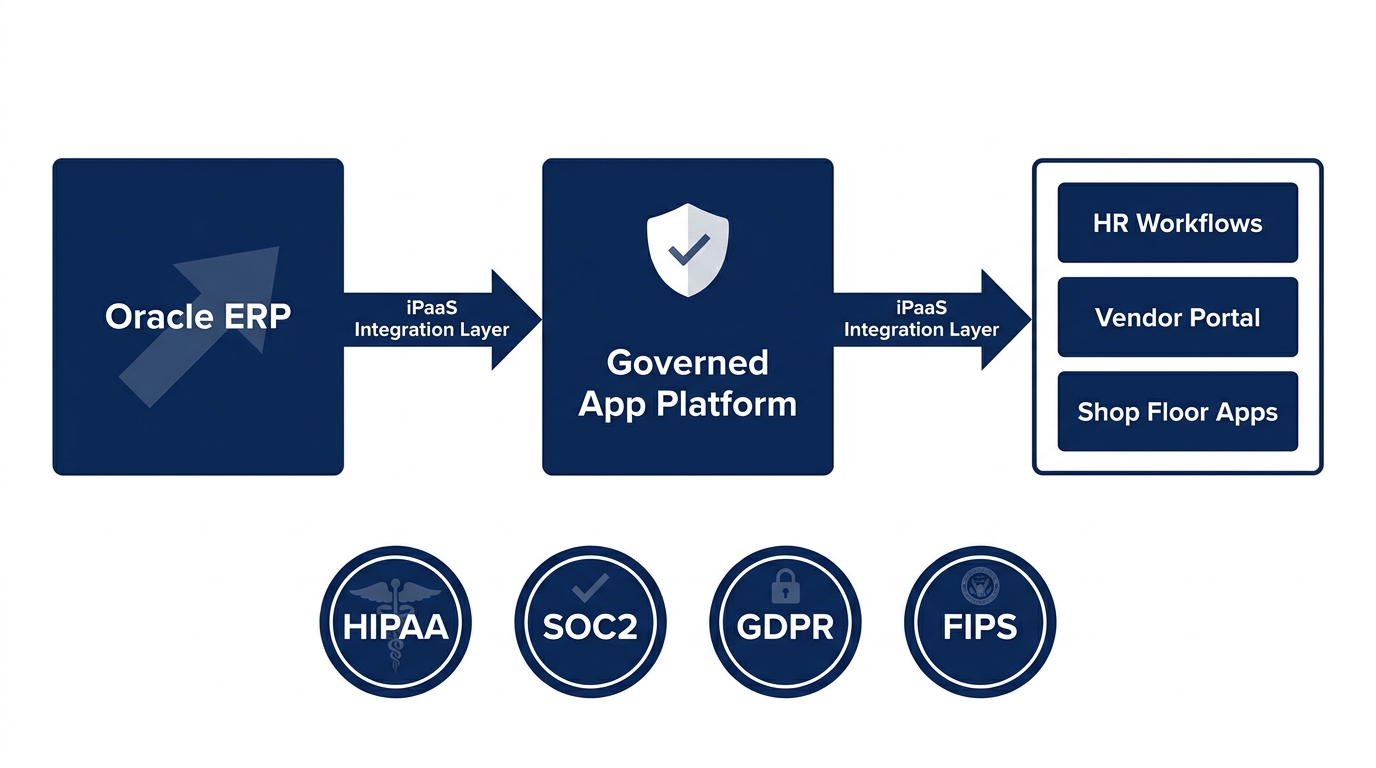
CloudApper AI’s architecture is designed specifically around this requirement. Applications built on the platform inherit security controls, access management, audit trails, and compliance certifications — including HIPAA, SOC 2, GDPR, CCPA, and FIPS 140-2 — at the platform level. The compliance work does not have to be retrofitted after the application is built. It is embedded in the way the platform operates.
The Business Team That Started Building on Its Own
There is a second version of the Oracle extensibility problem that IT leaders encounter less visibly until it has already grown: the business team that stopped waiting for IT and started solving the problem themselves.
It usually starts with a spreadsheet. The operations team needs a way to track something Oracle doesn’t track. They build a spreadsheet, share it via email, and handle the manual export from Oracle to keep it populated. Then someone automates the export with a macro. Then someone else builds a Power App on top of it. Then the spreadsheet becomes a database somewhere, and the Power App becomes a business process that three departments depend on, and IT finds out about it during an audit.
This is what happens when every department becomes a software vendor — and it is a direct consequence of the gap between what Oracle provides out of the box and what the business actually needs. The speed is real, the productivity gain is real, and the compliance and data governance risk is also real.
The answer is not to ban business-led development. The answer is to provide a governed channel that is fast enough to compete with the spreadsheet-and-macro approach. When IT can say “we can build this for you in a governed environment in two weeks,” the incentive to go around IT diminishes. When the governed channel takes six months and involves an Oracle implementation partner, it does not.
What a Governed Extension Model Actually Looks Like
For enterprises running Oracle, the practical alternative to accumulated custom modules and informal point solutions is an application platform that sits alongside the ERP, integrates with it through a managed iPaaS layer, and provides governed development without the overhead of Oracle’s own tooling.
CloudApper AI connects to Oracle through its integration layer, allowing applications built on the platform to read from and write to Oracle data without creating new, unmanaged integration dependencies. The integration logic is managed within the platform rather than scattered across custom scripts and point-to-point connectors. When Oracle changes, the integration layer can be updated in one place rather than traced across a web of dependencies.
The development model supports both IT-led and business-led application building within the same governance framework. Applications can be built without deep development expertise, but they are deployed under the same access controls, audit logging, and change management that compliance teams require. The DevOps overhead — infrastructure provisioning, patching, runtime management — is handled at the platform level, not pushed down to the team building each individual application.
For IT leaders who have spent years managing the accumulation of Oracle customizations, this is a different way of thinking about extensibility. The goal is not to build fewer things — the business needs what it needs. The goal is to build in a way that does not create a new generation of undocumented, ungoverned technical debt sitting on top of the ERP that is already difficult enough to maintain.
The enterprises that have made this transition describe a specific shift in how IT is perceived internally: from a bottleneck to a platform provider. The business still gets what it needs. IT retains the governance that compliance demands. The Oracle core stays stable because the extension activity is happening in a governed layer above it, not inside it.
The Question Worth Asking Before the Next Oracle Project
The next time a business unit comes to IT with a custom Oracle requirement, the first question worth asking is not “how do we build this in Oracle?” It is “what platform are we building this on, and what governance does that platform produce?”
For organizations that have answered that question informally — using whatever tool the last developer was comfortable with — the answer is usually fragmentation, technical debt, and compliance gaps that surface at the worst possible moment. For organizations that have made a deliberate decision to route extension activity through a governed platform, the answer is a development environment that can be justified to an auditor without reconstructing the history of every decision made along the way.
Oracle is not going to shrink its functional scope to eliminate the need for custom development. The gap between what the ERP provides and what enterprises actually need is structural. How organizations fill that gap — with governed platforms or with accumulated customization — determines whether extensibility becomes a competitive capability or a liability.
CloudApper AI gives enterprises running Oracle a governed path to build, extend, and integrate applications without creating the technical debt that standard customization approaches produce. If your team is navigating an Oracle extension challenge, reach out to learn how CloudApper approaches enterprise application development for Oracle environments.

What is CloudApper AI Platform?
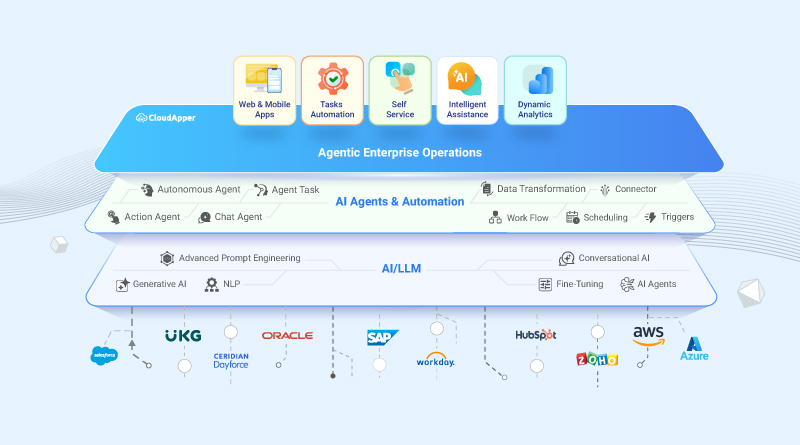
CloudApper AI is an advanced platform that enables organizations to integrate AI into their existing enterprise systems effortlessly, without the need for technical expertise, costly development, or upgrading the underlying infrastructure. By transforming legacy systems into AI-capable solutions, CloudApper allows companies to harness the power of Generative AI quickly and efficiently. This approach has been successfully implemented with leading systems like UKG, Workday, Oracle, Paradox, Amazon AWS Bedrock and can be applied across various industries, helping businesses enhance productivity, automate processes, and gain deeper insights without the usual complexities. With CloudApper AI, you can start experiencing the transformative benefits of AI today. Learn More
- Useful Links:
- Agentic AI
- No-Code/Low-Code
- Custom Software
- HCM Personalization
- iPaaS
- FedRAMP
CloudApper AI Solutions


- Works with








- and more.
Similar Posts

Legacy Database Migration Blocked by Stored Procedures: What Enterprise IT…

Windows Server 2016 End of Support: What to Do When…