Most UKG customers eventually build outside the platform. The ones who do it without a governance framework in place pay for it later — in audit findings, remediation costs, and compliance exposure that outlasts the original build. Here's what enterprise IT needs in place before the first extension project begins.

TL;DR
UKG is a capable HCM platform, but every large enterprise eventually hits its configuration limits and begins building around it. Most teams respond by building ungoverned extensions that create separate compliance surfaces, disconnected access controls, and fragmented data architectures that complicate every subsequent audit. Adding AI agents to a UKG environment raises the stakes further, requiring governance over agent decisions, not just application code. CloudApper provides a governed extension layer purpose-built for UKG customers, allowing custom applications and AI agents to inherit compliance rather than require it from scratch.
Table of Contents
- The Extension Instinct and Its Hidden Costs
- What “Extending UKG” Actually Requires
- The AI Agent Question
- Why HCM Gaps Carry a Specific Risk Profile
You already know the moment. A department head submits a request that UKG can’t fulfill out of the box — a custom scheduling rule tied to a specific union agreement, a compliance reporting workflow that doesn’t map cleanly to any standard module, an AI assistant that frontline managers need that isn’t available in the UKG marketplace. The IT team evaluates every native configuration option. They run out of road. And then a conversation begins that most enterprise IT leaders recognize on sight: how do we build this without creating a mess that takes years to clean up?
UKG is one of the most capable human capital management platforms available to large enterprises. That’s precisely why organizations with complex, multi-site, compliance-heavy workforces choose it. But capability and completeness are two different things. No HCM platform — regardless of how extensive its module set — can anticipate the operational specifics of every hospital system, distribution network, or manufacturing environment it serves. The gaps aren’t platform failures. They’re the natural consequence of building a product for tens of thousands of customers simultaneously. Every large UKG customer eventually hits a wall, and how they respond to that wall determines whether their extension strategy becomes a structural advantage or a compliance liability that takes years to surface.
The Extension Instinct and Its Hidden Costs
When enterprise IT teams first encounter a UKG gap, the most common response is to reach for existing development resources. A few engineers spin up a side project. A low-code tool gets evaluated. Someone suggests using an AI coding assistant to accelerate the build. Within weeks, a custom application exists that touches UKG data — and within months, that application has accumulated problems that weren’t in the original scope.
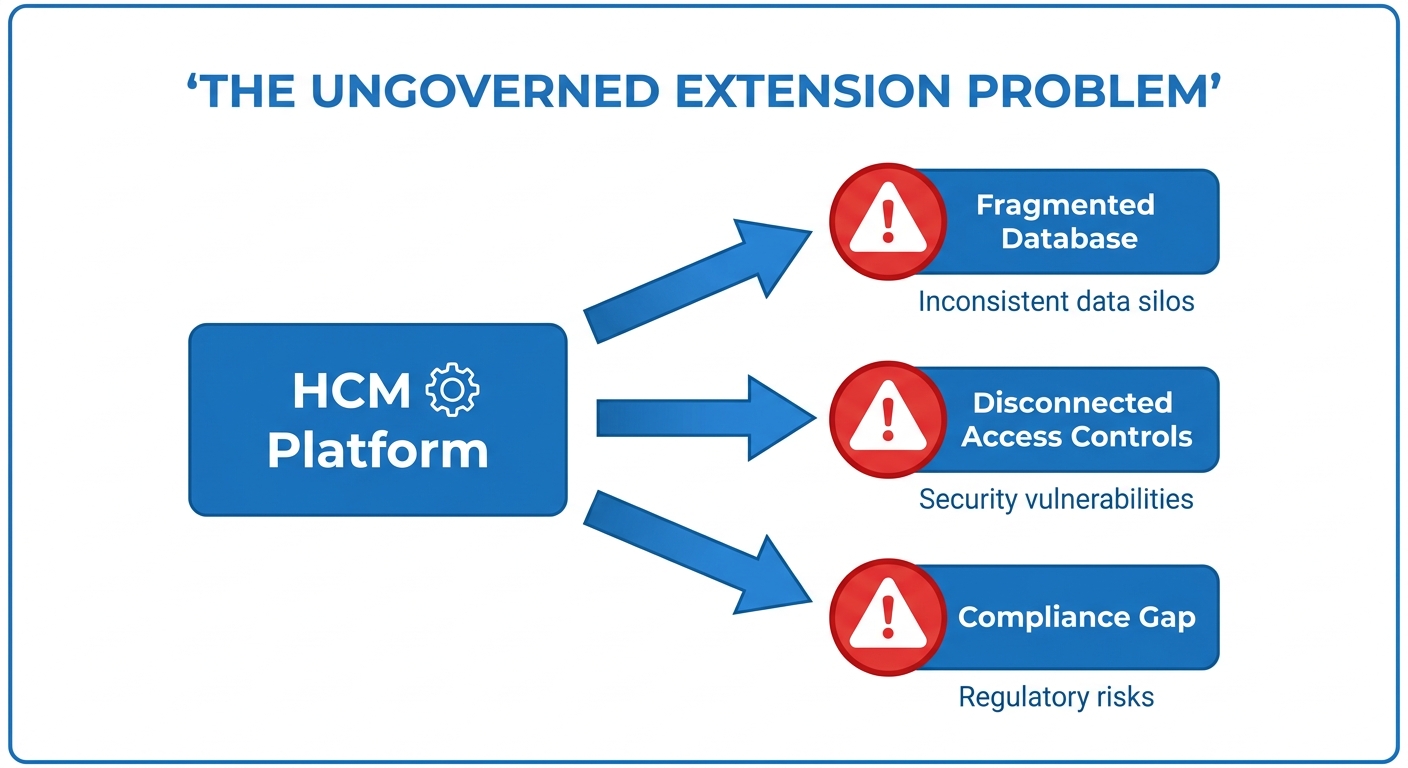
Data now lives in a separate database. The application follows its own access control logic, disconnected from the identity policies that govern the rest of the UKG environment. Nobody has audited the code. The HIPAA, SOC 2, or state labor law controls that apply to the primary HCM platform don’t automatically extend to what was built around it. The engineer who built it has moved to a different team.

This pattern — well-intentioned extensions creating ungoverned technical islands — is one of the most predictable failure modes in enterprise HCM management. It doesn’t happen because IT teams are careless. It happens because the tools most teams reach for when they need to extend a platform were never designed with platform governance in mind. As covered in detail when examining how enterprises build internal apps with AI without creating compliance liabilities, speed and compliance don’t self-organize — they have to be structurally enforced from the moment a project starts.
This is precisely the gap CloudApper was built to close. As an AI platform for secure enterprise applications with a purpose-built UKG integration layer, CloudApper gives UKG customers a governed path to extend the platform without accumulating the technical and compliance debt that standard custom development produces.
What “Extending UKG” Actually Requires
The phrase gets used loosely in IT conversations, but the operational requirements behind it are specific. Any application that touches UKG data — reads from it, writes to it, triggers workflows within it, or surfaces it to users in a different context — needs to satisfy several conditions that have nothing to do with whether the application functions correctly.
First, data access has to be governed through the same policies that govern UKG itself. If UKG applies role-based access controls that restrict which managers can view which employee records, a custom application built around UKG can’t run a separate access model. The moment data flows through a parallel pipeline with looser controls, the governance surface of the entire environment expands — and so does audit exposure. This is not theoretical risk. SOC 2 auditors and HIPAA compliance reviewers routinely examine applications that touch regulated data, regardless of whether those applications were built by the platform vendor or constructed internally. The questions SOC 2 auditors ask that most internal dev teams aren’t prepared to answer extend naturally to every application that sits adjacent to the governed core system.
Second, the application needs to be maintainable without depending on whoever built it. One of the persistent costs of custom development around enterprise platforms is what happens when institutional knowledge exits the organization. The engineers who understood exactly how the custom scheduling tool interacted with UKG’s payroll integration eventually move on. The documentation they left behind is incomplete. The institutional knowledge problem in enterprise software is well-documented — but it’s particularly acute for HCM extensions because the integration dependencies are complex and the consequences of a broken payroll or scheduling workflow are immediate and visible to every affected employee.
Third, and most critically, the extension needs to inherit compliance. This is where most custom development approaches fundamentally break down. Building a HIPAA-compliant application is not the same as building an application that a healthcare organization happens to use. The compliance status of an application is determined by its architecture — how data is stored, transmitted, accessed, and logged — not by the organization that deployed it. When teams build custom UKG extensions using AI coding tools or general-purpose low-code platforms, they start from zero on compliance. CloudApper’s architecture solves this structurally: compliance is inherited at the platform level, meaning applications built on it don’t require separate per-application certification cycles. Zero audits per app is the operational result — compliance is a property of the platform, not a project the development team has to complete after the fact.
The AI Agent Question
UKG customers are asking a more specific version of the extension question with increasing frequency: can we build AI agents that interact with our UKG environment? The answer is yes, but the governance requirements are more demanding than they are for traditional custom applications, and most enterprises aren’t thinking them through before they start building.
An AI agent operating in an HCM context — answering manager questions about scheduling, surfacing employee data for HR workflows, handling time-off approvals, or escalating compliance exceptions — is not a passive reporting tool. It takes actions. It makes decisions based on data it accesses in real time. It may interact with multiple systems simultaneously. The governance question shifts from “is this application compliant?” to “who is accountable for what this agent decides, and how is that decision auditable?”
The governance gap in enterprise multi-agent orchestration is one of the harder unsolved problems in regulated environments right now. When an AI agent operates inside a governed platform with a defined data model, centralized access controls, and logged decision trails, the auditability question has an answer. When an AI agent is built outside that structure — using a general-purpose AI framework, calling UKG APIs directly, storing intermediate state in a separate database the IT team didn’t provision — the answer to “who governs this agent” is effectively nobody.
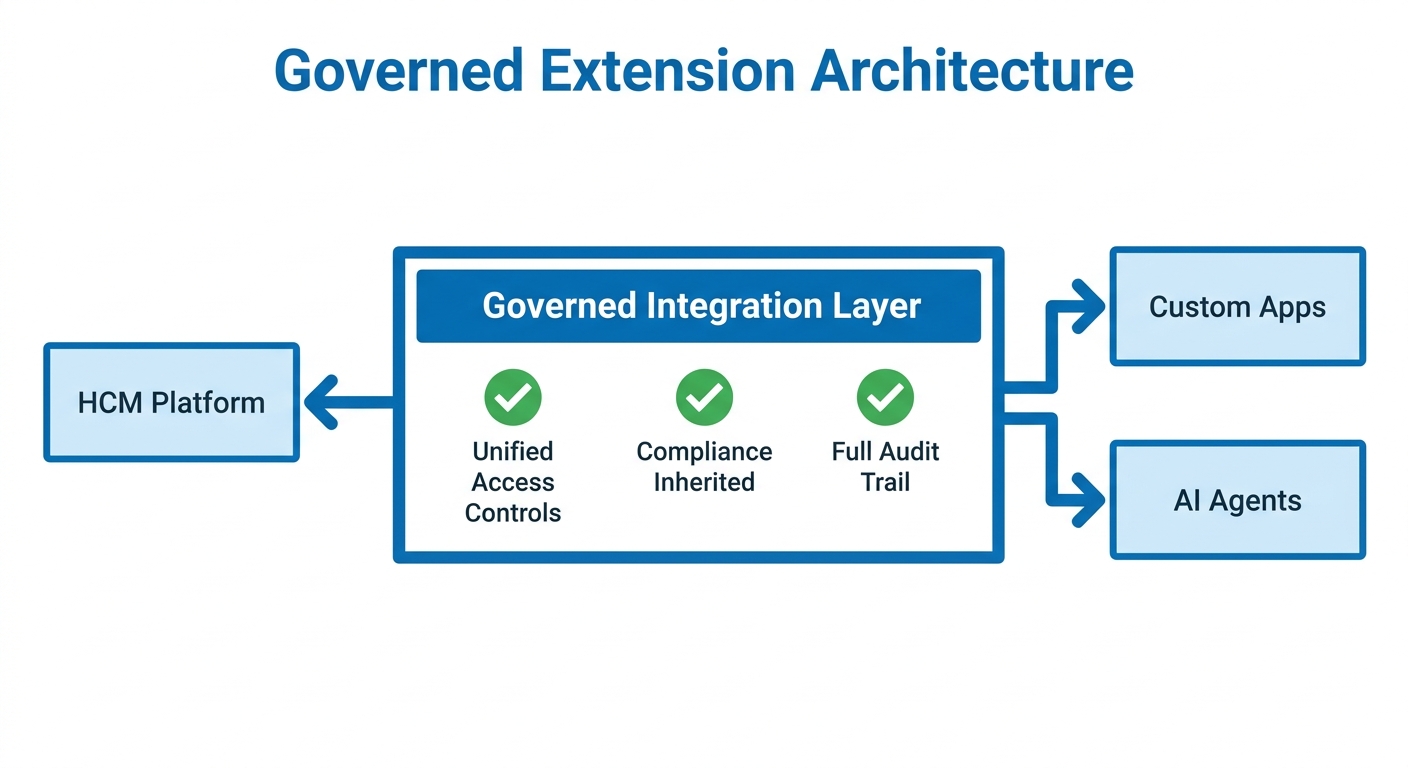
CloudApper’s AI agents for UKG operate within the same governed environment as every other application built on the platform. They access UKG data through the same integration layer, apply the same role-based access controls, and log activity in a format that satisfies the audit requirements of HIPAA, SOC 2, and other frameworks relevant to the industries where UKG is most heavily deployed. This isn’t incidental to the design — it’s the structural difference between AI agents that can operate in a regulated enterprise environment and AI agents that technically work until an auditor asks about them.
Why HCM Gaps Carry a Specific Risk Profile
Enterprise IT teams manage extension gaps in ERP systems, CRM platforms, and supply chain tools regularly. HCM gaps carry a different risk profile that makes ungoverned extensions particularly expensive to remediate. Employee data is among the most regulated data an enterprise handles. Payroll records, benefits enrollment, scheduling data, performance history, and in many cases health information are all subject to overlapping federal and state requirements. Any application that touches this data — even tangentially — inherits exposure to those requirements.
This is categorically different from extending a CRM system, where the primary risk of a poorly governed custom build is data quality degradation or sales process disruption. The risk profile of an ungoverned UKG extension includes HIPAA exposure, state labor law violations, payroll compliance failures, and audit findings that carry direct regulatory consequences for the organization’s leadership, not just its IT team.
The case for extending rather than replacing a capable HCM platform like UKG is well-established — why HCM platforms will never fully cover every operational need is a structural reality every enterprise IT leader eventually accepts. But the extension strategy has to match the compliance weight of the system being extended. A patchwork of ungoverned custom builds that touch UKG data doesn’t reduce the platform’s limitations — it transfers the compliance risk from the vendor to the IT organization that built around it.
UKG customers who have gone through this cycle describe a consistent pattern: the application works without incident for six to twelve months, then a compliance review or audit surfaces it, and the remediation costs more than building correctly would have at the outset. The remediation effort isn’t purely technical — it includes documentation preparation, audit evidence reconstruction, access control reconciliation, and in some cases, retroactive review of data that the application accessed during its ungoverned period. The engineering time alone is significant; the compliance exposure during that period is harder to quantify.
What Governed Extension Looks Like in Practice
CloudApper’s UKG extension model works through a purpose-built integration layer that connects to UKG’s data model without replicating it outside the governance boundary. Applications and AI agents built on CloudApper access UKG data through this layer, which means they operate within the same access control framework, generate the same audit trail, and inherit the same compliance posture as the core UKG environment. Nothing the extended application does creates a separate governance problem.
The operational consequence is that a custom scheduling application built for a specific union contract, an AI agent that helps frontline supervisors manage time-off queues, or a compliance reporting workflow that UKG’s standard configuration doesn’t support — all of these can be built without creating a parallel compliance exposure. The zero DevOps overhead model that CloudApper operates on means IT teams don’t manage infrastructure, patching, or runtime maintenance for the applications they build on the platform. The extension adds capability without adding operational burden.
The UKG and Dayforce ecosystems have both surfaced this challenge at scale. The way Dayforce customers hit the limits of native configuration when they try to extend the platform follows the same structural pattern UKG customers face — and the organizations that establish a governed extension framework before their first build tend to move faster in the long run, because they’re not stopping to remediate the ungoverned projects that preceded it.
CloudApper serves UKG customers running UKG Pro, UKG Ready, and UKG Dimensions across healthcare, manufacturing, retail, and logistics. These organizations share one characteristic regardless of industry: their UKG deployment is mission-critical and their compliance exposure is real. The extensions they build around the platform carry the same stakes as the platform itself. The governance framework has to match.
The Decision That Precedes the Build
Before any UKG extension project is scoped, the governance question has to be answered — not deferred to the post-launch phase. That means identifying where the application will store data relative to UKG’s data boundary, how access to that data will be controlled and logged, how the application’s activity will be documented for compliance purposes, and who owns ongoing maintenance when the original development team is no longer available.
These are not post-launch questions. They are pre-build constraints that determine which platforms and development approaches are viable in a regulated environment. If the answers to those questions can’t be satisfied by the development approach under consideration, the extension will eventually require remediation. The cost of that remediation — in engineering time, compliance preparation, audit exposure, and in some cases regulatory consequence — consistently exceeds the cost of building on a governed platform from the beginning.
CloudApper gives UKG customers a path to extend the platform that starts from governance and builds outward, rather than starting from the application and retrofitting compliance afterward. For enterprises running UKG in environments where compliance is non-negotiable, that order of operations isn’t a preference. It’s the difference between an extension strategy that compounds platform value and one that compounds risk.
CloudApper works directly with UKG customers to scope governed extension projects — custom applications, AI agents, and workflow tools — that expand what the platform can do without expanding compliance exposure. If your organization has reached the limits of native UKG configuration, connect with the CloudApper team to discuss your specific use case.

What is CloudApper AI Platform?
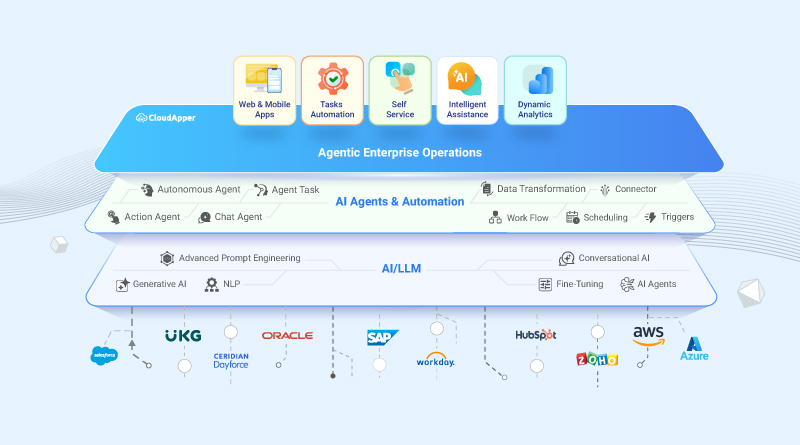
CloudApper AI is an advanced platform that enables organizations to integrate AI into their existing enterprise systems effortlessly, without the need for technical expertise, costly development, or upgrading the underlying infrastructure. By transforming legacy systems into AI-capable solutions, CloudApper allows companies to harness the power of Generative AI quickly and efficiently. This approach has been successfully implemented with leading systems like UKG, Workday, Oracle, Paradox, Amazon AWS Bedrock and can be applied across various industries, helping businesses enhance productivity, automate processes, and gain deeper insights without the usual complexities. With CloudApper AI, you can start experiencing the transformative benefits of AI today. Learn More
- Useful Links:
- Agentic AI
- No-Code/Low-Code
- Custom Software
- HCM Personalization
- iPaaS
- FedRAMP
CloudApper AI Solutions
- Works with







- and more.
Similar Posts

Microsoft Access Modernization: Why the Technical Migration Is the Easy…

When the ISV Disappears: Managing an Orphaned Windows Application With…