Selecting a Canadian cloud region answers where data rests, not whose law reaches it. Canadian privacy law is shifting toward documented risk assessment rather than hard localization, while contracts and segmented networks impose harder constraints. The durable answer is an application that can relocate without being rebuilt.

TL;DR
Choosing a Canadian cloud region establishes residency but not sovereignty, because the CLOUD Act reaches data held by providers subject to US jurisdiction regardless of where the servers sit. Canadian privacy law is moving toward accountability rather than localization: PIPEDA never mandated Canadian storage, and Bill C-36 tabled in June 2026 would require assessing and mitigating transfer risk instead. Quebec Law 25 is the requirement most often missed, since its section 17 obligations attach to transfers outside Quebec rather than outside Canada, making a move to Ontario a compliance event. The binding constraints are frequently contractual or physical rather than statutory, including customer-imposed sovereignty terms and segmented operational networks that cannot reach a hosted service. CloudApper treats deployment target as a runtime property, so a changed requirement becomes a relocation rather than a re-platforming project.
Table of Contents
- Residency Is a Location. Sovereignty Is a Jurisdiction.
- What Canadian Law Actually Requires
- The Requirements That Have Nothing to Do With Privacy Law
- Portability Is the Only Durable Answer
- How to Establish a Defensible Data Residency Position
- What Changes When Deployment Location Stops Being a Constraint
- Frequently Asked Questions
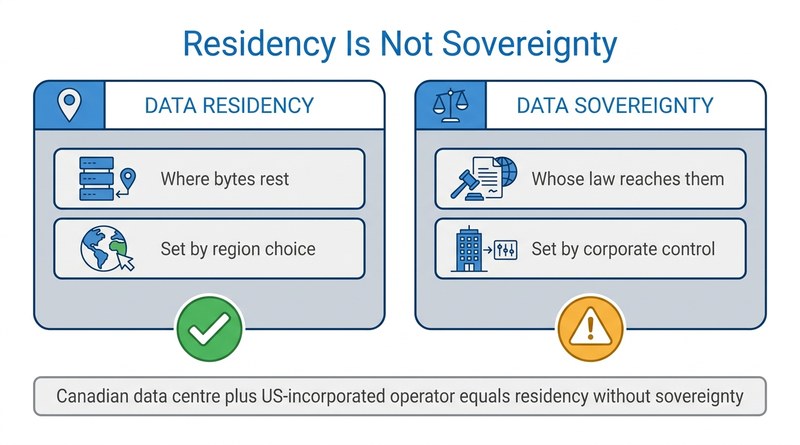
Picking a Canada Central cloud region settles where data sits. It does not settle the data residency requirements Canada’s regulators and customers care about, because residency also means whose law can reach the data.
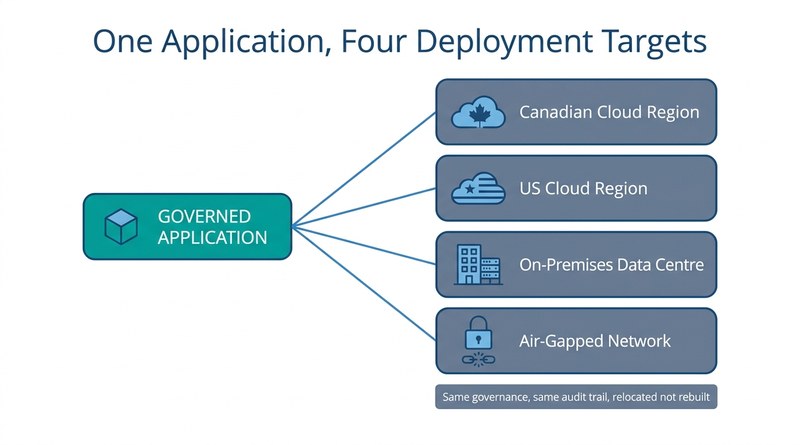
Those two questions have different answers, and the space between them is where many Canadian compliance positions fall apart. Deployment location has also stopped being a procurement detail and become an architectural commitment, since applications built for one hosting model often cannot move to another. CloudApper is designed so applications run across any cloud, on-premises, or on air-gapped infrastructure with no outbound connection, so where an application runs is never a decision you make once and live with forever.
Residency Is a Location. Sovereignty Is a Jurisdiction.
The distinction is not academic and it has a specific legal mechanism behind it.
The US CLOUD Act reaches data held by providers subject to US jurisdiction regardless of where that data physically sits. If the operating company is US-incorporated, a valid US legal process can compel production of data stored in a Toronto facility, and it does so without going through Canadian authorities. The physical location of the server is not the operative fact. Corporate control is.

Run that through a common enterprise setup. Your records are in a Canadian region. The provider is a US parent company. You have residency. You do not have sovereignty. Contract language does not repair this, because a commercial commitment cannot override a valid court order in the provider’s home jurisdiction, and any vendor that promises otherwise is describing an intention rather than a capability.
None of that makes US-operated cloud unusable, and pretending otherwise would be unhelpful to anybody actually running an enterprise. Most organizations will keep using it for most workloads, correctly. What it does mean is that residency and sovereignty need to be tracked as two separate facts about every system, because a board asking about data sovereignty is not asking which region you selected.
What Canadian Law Actually Requires
Here is where most internal discussions carry an outdated premise. The following is context rather than legal advice, and your counsel should own the conclusions for your organization.
At the federal level, PIPEDA has never imposed a localization mandate. It is accountability-based: you may transfer personal information outside Canada provided you remain responsible for it and ensure comparable protection. Bill C-36, the Protecting Privacy and Consumer Data Act, was tabled on June 15, 2026 and would replace PIPEDA, and it continues in that direction rather than reversing it. Organizations would be required to transfer personal information outside Canada only after assessing and mitigating the privacy risks of doing so. It is worth being precise about status here: the bill received first reading and is not law. Planning around it as though it were is a mistake in one direction, and ignoring the policy signal it carries is a mistake in the other.
Quebec is the requirement most often missed, and the one most likely to surprise an IT team. Section 17 of Law 25 requires a privacy impact assessment before personal information is transferred outside Quebec, confirmation that the destination affords adequate protection, and a written agreement with the recipient. Read that boundary carefully. It is Quebec, not Canada. A Montreal manufacturer moving employee records to a data centre in Ontario has performed a transfer outside Quebec and owes the assessment. Interprovincial architecture is a compliance event, and a lot of Canadian deployments were designed on the assumption that staying inside the country was sufficient.
Public sector rules moved in the permissive direction. British Columbia’s FIPPA once required public bodies to store and access personal information only in Canada, and that restriction was repealed effective November 25, 2021, replaced by an assessment obligation for sensitive information. Nova Scotia still restricts cross-border storage by public bodies under PIIDPA, with those restrictions folding into modernized access and privacy legislation effective April 1, 2027. For enterprises this matters indirectly but concretely, because Canadian universities, school boards, and health authorities are public bodies, and if you sell to them or partner with them their obligations arrive in your contract.
The practical consequence of all of this is not a map of where data must live. It is an evidentiary standard. Modern Canadian privacy law asks you to demonstrate that you assessed the risk of a transfer and mitigated it. That is a documentation requirement, and documentation requirements are only satisfiable if somebody knows, per application, where the thing actually runs.
The Requirements That Have Nothing to Do With Privacy Law
Privacy statutes are the most discussed driver of deployment constraints and frequently not the binding one.
Manufacturing and utilities run operational networks that are deliberately segmented from the internet. A plant-floor application that supports a production line, an equipment inspection workflow, a lockout-tagout record: these cannot depend on an outbound connection to a hosted service, not for compliance reasons but because the network is designed to prevent exactly that connection. Air-gapped is not a preference in those environments. It is the control.
Canadian operations add a geographic version of the same problem. Remote mine sites, northern energy infrastructure, and rural utility operations run on intermittent satellite links where a cloud-dependent application is unusable during the hours it is most needed. Teams in those settings do not need a service level agreement. They need software that keeps working when the link drops and reconciles when it returns.
Then there is the constraint that arrives from customers. Enterprises impose residency and sovereignty terms on their own suppliers, which means a Canadian subsidiary of a global manufacturer can find itself contractually committed to a hosting posture that its parent’s standard platform does not support. The requirement is real, enforceable, and has no relationship to any statute. It came from a purchase order.
Departmental procurement compounds all three. When a business unit signs up for a hosted tool to solve an urgent problem, nobody asks which jurisdiction the vendor is incorporated in. This is the same dynamic described in how enterprises lose control of internal application development, with a residency dimension layered on top. The inventory problem and the sovereignty problem are the same problem.
Portability Is the Only Durable Answer
Given that the requirements move, the wrong response is to pick the hosting model that satisfies today’s constraint and build against it.
Every application built to a single deployment assumption becomes a re-platforming project the moment that assumption changes. A new provincial obligation, a customer contract with sovereignty terms, an acquisition that brings a different security posture, a board decision after an incident somewhere else in the industry: each one turns a working application into a migration with a budget and a timeline. That is the shape of lock-in described in the vendor lock-in trap in legacy modernization, arriving through infrastructure rather than through a vendor relationship.
This is the specific reason CloudApper treats deployment target as a runtime property rather than an architectural decision. An application built on the platform can run in a Canadian region, in a US region, on hardware in your own facility, or on a segmented network with no outbound path, without being rewritten for each. The same application, the same governance model, the same audit trail, relocated because a requirement changed rather than rebuilt because a requirement changed.
The operational side of that promise is the part worth scrutinizing when you evaluate any platform making it. On-premises deployment historically meant your team inherited the runtime: patching, upgrades, certificate rotation, penetration test remediation, and the compliance evidence that goes with all of it. A four-person applications team cannot absorb that for a portfolio of internal apps, which is why removing DevOps overhead from internal app development is not a convenience feature in this context. It is what makes a sovereign deployment sustainable past the first year. The evaluation criteria in choosing a development platform when compliance is non-negotiable apply directly, with portability added as a line item most checklists still omit.
Integration is the other half. An application that runs on a segmented network still needs data from systems that do not, and the integration layer that bridges modern platforms and older systems is what keeps a sovereign deployment from becoming an island. Portability without integration just relocates the silo.
How to Establish a Defensible Data Residency Position
For teams that need to answer a board question or a customer questionnaire with something more than a region name, the sequence below produces a position you can evidence.
- Inventory each application against two separate facts. Record where the data physically resides and which jurisdiction the operating entity is subject to. Most inventories capture the first and omit the second, which is why they cannot answer a sovereignty question.
- Identify every Quebec data flow, including interprovincial ones. Any transfer of personal information outside Quebec triggers the Law 25 assessment obligation, so a move to Ontario counts. Find these before an auditor does.
- Separate statutory constraints from contractual ones. Pull the residency and sovereignty clauses out of your customer agreements and compare them against your actual hosting posture. Contractual terms are frequently stricter than any statute that applies to you.
- Document the assessment, not just the conclusion. Canadian privacy law increasingly asks what risk you evaluated and how you mitigated it. A record showing you selected a Canadian region satisfies almost nothing on its own.
- Test whether each application can actually move. Ask what a mandated relocation to on-premises or to a Canadian-controlled provider would cost in weeks and dollars. That number is your real exposure, and for most portfolios nobody has ever calculated it.
- Set the deployment requirement before the next application is built. Decide now which internal applications must be relocatable, and make portability a build-time requirement rather than a migration project you will fund later.
What Changes When Deployment Location Stops Being a Constraint
Organizations that solve this stop treating jurisdiction as a reason not to do things.
A Canadian subsidiary can pursue a contract with sovereignty terms because meeting them is a configuration rather than a capital project. A hospital network can extend an application to a facility with unreliable connectivity without building a second version of it. A manufacturer can put a real application on the plant floor instead of the clipboard that has been standing in for one, because the segmented network stopped being a disqualifier. The economics of that shift are the ones examined in the real total cost of internal app development, and deployment flexibility changes the calculation more than most build-versus-buy analyses account for.
There is also a quieter benefit, which is that the compliance conversation stops being adversarial. When IT can state per application where it runs, whose law applies, and what it would take to change either, security and privacy teams stop functioning as an approval gate and start functioning as a design input. That shift is worth more than any individual control, and it depends entirely on whether the facts are recorded. The broader version of that argument appears in working through data and privacy challenges in enterprise AI.
The organizations that will struggle are the ones treating sovereignty as a question about geography. It has not been a geography question since the CLOUD Act, and the requirements will keep moving regardless of what any single statute says next year. What protects an enterprise is not choosing the right region. It is being able to change the answer without rebuilding the application.
Frequently Asked Questions
Does Canadian law require personal data to be stored in Canada?
Generally no. PIPEDA is accountability-based rather than localization-based, permitting transfers outside Canada where the organization remains responsible and ensures comparable protection. Bill C-36, tabled in June 2026 to replace PIPEDA, continues that approach by requiring risk assessment and mitigation before a transfer rather than mandating Canadian storage. Specific sectoral and public sector rules can be stricter.
Does storing data in a Canadian region protect it from US government access?
Not by itself. Under the CLOUD Act, data held by a provider subject to US jurisdiction can be compelled regardless of the physical location of the servers, so a Canadian data centre operated by a US-incorporated company gives you residency without sovereignty. Contractual assurances cannot override a valid court order in the provider’s home jurisdiction.
What is the difference between data residency and data sovereignty?
Residency is where data physically sits. Sovereignty is which country’s laws can compel access to it, which follows the corporate control of the operator rather than the location of the hardware. The two need to be tracked as separate facts because satisfying one does not satisfy the other.
Does Quebec Law 25 apply to transfers within Canada?
Yes. Section 17 governs transfers of personal information outside Quebec, not outside Canada, so moving records from Montreal to a facility in Ontario is a transfer requiring a privacy impact assessment, confirmation of adequate protection, and a written agreement with the recipient.
Is British Columbia still requiring public bodies to keep data in Canada?
No. The FIPPA provision requiring Canadian storage and access for public bodies was repealed effective November 25, 2021, replaced by an assessment obligation for sensitive personal information. Nova Scotia continues to restrict cross-border storage by public bodies, with those rules moving into modernized legislation effective April 1, 2027.
Can enterprise applications run on an air-gapped network?
Some can and most hosted software cannot, which is the practical constraint in manufacturing, utilities, and remote operations where the operational network is deliberately segmented. The requirement to evaluate is whether the platform treats deployment target as a runtime property, so the same application can run in a cloud region, in your own facility, or with no outbound connection, without being rebuilt for each.
CloudApper is the process layer that closes the gaps enterprise software cannot, across HR, ERP, CRM, and the internal applications your team builds around them, on any cloud, on-premises, on any device, and in weeks rather than quarters. If a residency or sovereignty requirement would currently force you to rebuild an application rather than relocate it, talk to us about building the next ones so location stays a setting.

What is CloudApper AI Platform?
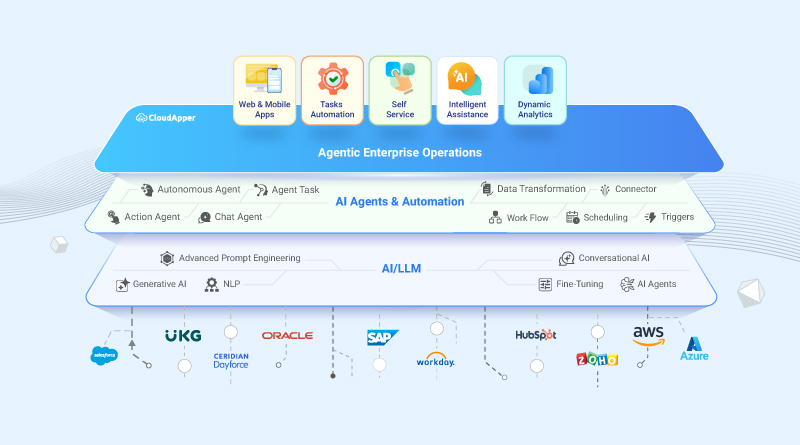
CloudApper AI is an advanced platform that enables organizations to integrate AI into their existing enterprise systems effortlessly, without the need for technical expertise, costly development, or upgrading the underlying infrastructure. By transforming legacy systems into AI-capable solutions, CloudApper allows companies to harness the power of Generative AI quickly and efficiently. This approach has been successfully implemented with leading systems like UKG, Workday, Oracle, Paradox, Amazon AWS Bedrock and can be applied across various industries, helping businesses enhance productivity, automate processes, and gain deeper insights without the usual complexities. With CloudApper AI, you can start experiencing the transformative benefits of AI today. Learn More
- Useful Links:
- Agentic AI
- No-Code/Low-Code
- Custom Software
- HCM Personalization
- iPaaS
- FedRAMP

CloudApper AI Solutions

- Works with







- and more.
Similar Posts

The Service Account Audit Nobody Runs: When AI-Built Apps Turn…

AI Agent Over-Permission: The Access Control Problem Nobody Scoped When…