Enterprise application security reviews averaging 60-94 days are not a capacity problem but a design failure. When review is a gate at the end of development, teams route around it. The fix is security as a platform property — so applications arrive with their posture already established, and review takes days, not months.

TL;DR
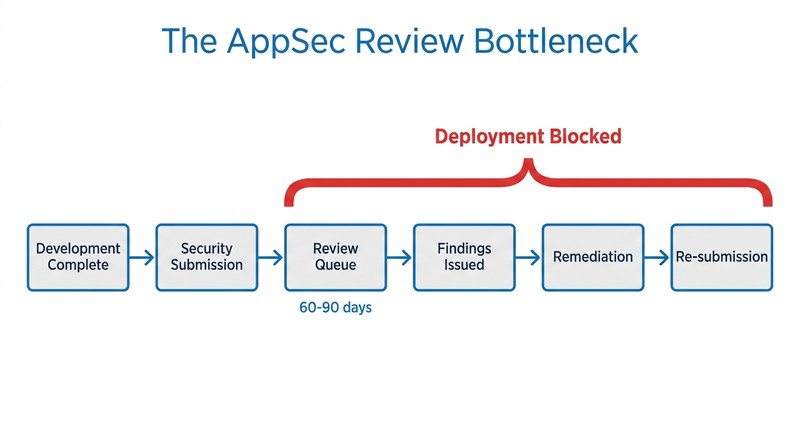
Enterprise application security review cycles averaging 60-94 days are not a capacity problem — they are a structural design failure. When review is positioned as a gate at the end of development, teams build workarounds into their project plans and route applications around the process, expanding the ungoverned application estate rather than shrinking it. The fix is not a faster gate: it is treating security as a property of the development platform itself, so that applications arrive at review with their security posture already established and evidenced. Organizations that make this shift find that review cycles compress from months to days — not because standards drop, but because the discovery phase that drives most delays is eliminated at the platform level.
Table of Contents
- Why the Queue Fills and Stays Full
- What Long Cycles Produce That Organizations Don’t Track
- The Design Problem: Review as a Gate
- Security as a Platform Property, Not a Review Outcome
- What the Redesign Actually Requires
- How to Redesign Application Security Review When the Queue Is Already Broken
- Frequently Asked Questions
Why Application Security Review Is the Deployment Bottleneck Nobody Admits To
When an enterprise application security review process takes 94 days and every team plans for it, teams stop treating review as a control and start routing around it. In one case, a department head asked to use the app in staging during the wait, and three weeks later production data was flowing through staging. The review was still pending when the SOC 2 auditor asked for the application inventory the next year.
That is a failure of incentive design, and the security team owns the outcome without authority over the decision. Platforms like CloudApper exist because the answer to a long review cycle is security built into the application before review begins.
Why the Queue Fills and Stays Full
Application security review takes as long as it does because most applications arrive at the security team without the documentation the review actually requires. The security reviewer needs to understand the application’s architecture, data flows, authentication model, access control implementation, third-party dependencies, and deployment configuration. In most enterprises, none of this is documented in a form the security team can evaluate without doing their own investigation.
The result is a discovery phase embedded in every review. The security team reads the code, schedules interviews with developers, maps data flows from integration configuration, and reconstructs the authentication model from the deployment environment. Each gap in the documentation becomes a clarification request. Each clarification request adds a cycle of back-and-forth before review can continue. For a straightforward internal application, this adds two to three weeks. For an application with EHR feeds, ERP write-backs, or payroll system integrations, it adds months.

The development team, meanwhile, learns the rule: document more, and the review gets shorter. So they spend pre-submission time producing architecture diagrams, data flow maps, and access control matrices. This helps at the margins but does not fix the underlying problem, because the documentation they produce describes the application as it was designed, not as it was built. The security reviewer still has to verify the implementation against the documentation, and the gaps between design and build are usually where the findings live.
The net result is a review cycle that organizations accept as fixed. Three months becomes the baseline. Teams plan for it. And then they build workarounds into their plans because the baseline is too long for the delivery timelines the business actually expects.
What Long Cycles Produce That Organizations Don’t Track
The most visible consequence of long security review cycles is the workaround: the staging environment that becomes a production environment, the limited pilot that quietly expands to the full user base, the application that gets deployed ahead of approval with a verbal commitment to complete the review afterward. These workarounds are easy to spot in retrospect but hard to govern in real time, because the team making the decision is not trying to bypass security — they are responding rationally to an incentive structure that rewards delivery speed over process compliance.
The less visible consequence is the application that never enters the review queue at all. Shadow IT and shadow AI development exist partly because formal development channels are too slow, but they also exist because teams have learned that submitting an application for security review triggers a process with an uncertain outcome and a certain delay. The rational response is to find a path that avoids the trigger: a SaaS tool provisioned outside IT, a low-code app built on a platform that doesn’t require central review, or an automation that runs in a personal account connected to enterprise systems.
None of these paths are more secure than a reviewed application. Most are considerably less secure. The risks created when developers build outside a governance framework compound every time a team makes the rational decision to route around a slow control. The security team is held accountable for the outcome while having no authority over the inputs that produce it.
There is also a compliance dimension that organizations rarely quantify until an audit forces them to. When department teams become application builders, the application inventory expands faster than any review process can track it. An auditor asking for the application inventory is not asking for the list of applications that completed security review. They are asking for the list of applications that access, process, or store enterprise data — and the two lists look very different in organizations where the review cycle has trained teams to route around it.
The Design Problem: Review as a Gate
The structural reason security review creates bottlenecks is that it is designed as a gate: a binary pass/fail event positioned at the end of the development cycle, after the application is built and before it is deployed. Gate design made sense when applications took months to build and the security review was a proportionally short fraction of total development time. It makes progressively less sense as development timelines compress and internal applications are built in weeks rather than months.
Gate design has a second problem. When security review is positioned at the end of development, the reviewer has no leverage over the decisions that determine how much work the review will require. The authentication model was chosen eight weeks ago. The third-party dependencies were locked in six weeks ago. The data storage design was finalized four weeks ago. By the time the application arrives at the security team, the decisions that drive most of the review findings — and most of the remediation cycles — are already implemented and tested. Changing them is expensive. Organizations frequently accept a known risk rather than incur the remediation cost, which means the gate is not preventing the deployment of applications with security issues. It is documenting them.
The technical debt that accumulates in applications built without security governance is not primarily in the code. It is in the architecture decisions made early in development that the security review identified but the organization chose not to remediate. Those decisions compound. Each workaround builds on the last one. Two years after deployment, the application is either a security incident waiting to happen or a modernization project that nobody wants to fund because the cost of untangling the original decisions has grown beyond what the business value justifies.
Security as a Platform Property, Not a Review Outcome
The alternative to gate design is to treat security as a property of the development platform rather than an outcome of the review process. This is not a new idea in principle — it is the logic behind certified cloud infrastructure, SOC 2-audited hosting providers, and FedRAMP-authorized platforms. The security reviewer does not audit Amazon’s data center every time an organization deploys a workload there. The data center’s security posture is established once, documented thoroughly, and inherited by every workload running on it.
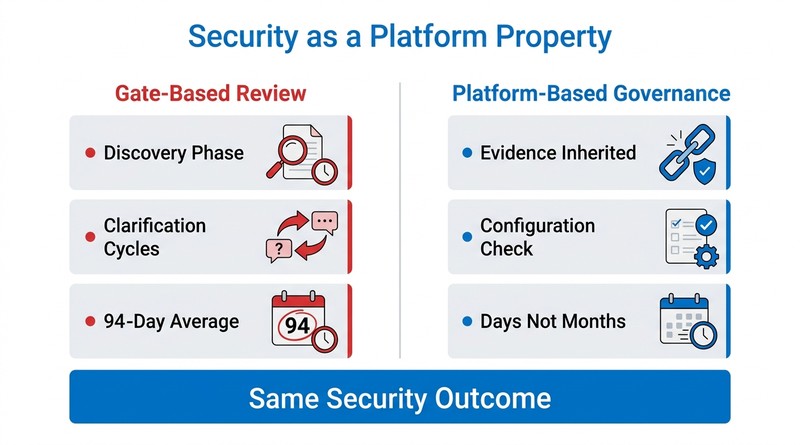
The same logic applies to enterprise application development platforms. When applications are built on a platform that enforces security architecture by construction — consistent access control patterns, governed data handling, audit logging built into the runtime, integration through controlled API layers rather than direct database connections — the security review changes in character. The reviewer is not discovering what the application does and whether it is safe. The reviewer is confirming that the application was built on the governed platform and confirming whether any application-specific configuration introduces risk beyond the platform baseline.
CloudApper is built on this model. Applications built on CloudApper operate within a security architecture certified to HIPAA, SOC 2, FIPS 140-2, and OWASP ZAP standards. Access control is enforced at the platform level. Audit logging is automatic. Integration with external systems runs through a governed iPaaS layer rather than ad-hoc API connections. The security reviewer reviewing a CloudApper application does not need to reconstruct the authentication model from the code — the platform’s documented security architecture establishes it. Review becomes a configuration check rather than a discovery process.
The practical consequence is a review cycle measured in days rather than months. Not because the security team is doing less work, but because the application arrives with its security properties already established and evidenced. The clarification cycle that adds weeks to traditional review is absent because the questions the clarification cycle answers were answered at the platform level before development began.
Zero DevOps in enterprise application development is the operational parallel: when infrastructure management is handled at the platform level, operations teams are not managing individual application runtime environments. The same structural shift applies to security review. When security is a platform property, security teams are not reviewing individual application implementations. They are maintaining the platform standard that governs all of them.
What the Redesign Actually Requires
Moving from gate-based security review to platform-based security governance requires two changes that most organizations treat as separate problems: a platform decision and a process redesign. They are not separate. The process redesign only works if the platform can actually provide the security evidence that makes lightweight review possible. And the platform decision only delivers value if the review process is updated to take advantage of what the platform provides.
The organizations that succeed in shortening security review cycles are the ones that connect these two changes explicitly. They evaluate enterprise application development platforms on the basis of what security evidence they produce — not just what compliance certifications they hold, but what documentation they generate about each application’s security posture and how that documentation maps to the review team’s actual questions. And they redesign the review process to use that documentation as input rather than asking review teams to generate it from scratch for each application.
The 94-day review cycle is not an unavoidable feature of enterprise security governance. It is a symptom of a design pattern that places security review at the end of a process that was never designed to produce reviewable applications. Organizations that fix the design pattern find that the review cycle shortens, the shadow deployment problem diminishes, and the compliance audit becomes a documentation exercise rather than a reconstruction project. The security team gets its authority back — not by slowing things down, but by being positioned earlier in the process where the decisions that determine security outcomes are still open.
How to Redesign Application Security Review When the Queue Is Already Broken
The following steps address organizations with an existing backlog and a review cycle that is already causing deployment workarounds. This is a practical governance framework — the timelines and specific review requirements vary by organization, industry, and applicable compliance standards.
- Audit the current application inventory against the review queue. Identify applications that are deployed and in use but have not completed security review. This is the population that represents actual risk exposure — not the queue, but the gap between the queue and the deployed estate. The size of that gap tells you how much the review process has already failed to govern.
- Classify the review backlog by application risk tier. Not every internal application requires the same depth of review. Applications that handle sensitive data, integrate with core enterprise systems, or are accessible to external parties represent a different risk profile than internal productivity tools with no external data exposure. A tiered review model lets the security team allocate depth proportionally rather than applying the same process to every submission regardless of risk.
- Identify the documentation gaps that generate the most clarification cycles. In most organizations, 80 percent of review delays come from the same recurring gaps: undocumented authentication models, unspecified data retention policies, missing third-party dependency inventories, and unclear access control scope. Standardizing a pre-submission documentation package that addresses these gaps reduces clarification cycles immediately, regardless of what platform the application was built on.
- Establish a fast-track review path for governed platform applications. Applications built on a platform with documented security certifications and a known architecture pattern do not require the same discovery-phase review as custom-built applications. Create a separate review track that accepts the platform’s security documentation as evidence of the platform-managed controls and focuses review effort on application-specific configuration. This track should target a review cycle measured in days, not weeks.
- Define clear criteria for what requires re-review after deployment. Most organizations have no formal policy for when a change to a deployed application triggers a new security review. This ambiguity produces either under-review (significant changes deployed without review) or over-review (minor configuration changes triggering full review cycles). A change classification policy reduces both failure modes and gives development teams a predictable answer to the question of what requires resubmission.
- Connect platform selection criteria to review process requirements. When evaluating development platforms for new internal application programs, make security evidence generation an explicit evaluation criterion. Specifically: what documentation does the platform produce about each application’s security posture, and does that documentation match the evidence package your security review process requires? Platforms that produce the right evidence by default are not just faster to review — they eliminate the clarification cycle that drives most review delays.
Frequently Asked Questions
Why do enterprise application security reviews take so long?
Most enterprise application security reviews are slow because applications arrive at the review queue without the documentation the review requires. Security teams must reconstruct architecture, data flows, access controls, and dependency inventories from code review and developer interviews. Each gap triggers a clarification cycle that adds days to weeks of delay. The review itself is not slow; the discovery phase embedded in every review is what consumes the time.
What is the difference between gate-based security review and platform-based security governance?
Gate-based review positions security assessment at the end of the development cycle, after the application is built. The reviewer discovers what the application does and decides whether it is safe to deploy. Platform-based governance treats security as a property of the development environment itself — access controls, audit logging, and data handling patterns are enforced by the platform before any application-specific review begins. Review under the platform model confirms configuration rather than discovering implementation.
How do shadow IT and shadow deployments relate to long security review cycles?
Long review cycles create rational incentives for teams to avoid the review process. When developers and business units know that submitting an application for review triggers a multi-month delay, they find paths that don’t trigger the delay: SaaS tools provisioned outside IT, low-code platforms without central governance requirements, or informal deployments to environments that aren’t formally classified as production. The result is an application estate that is less governed than it would be if the review cycle were shorter — the opposite of the outcome the review process was designed to produce.
Can a platform-based approach actually shorten the security review cycle?
Yes, and the mechanism is straightforward. When an application is built on a governed platform with documented security certifications, the security reviewer already has evidence for the controls the platform manages. The authentication model is documented in the platform specification. The audit logging behavior is part of the platform’s SOC 2 report. The data encryption configuration is part of the FIPS 140-2 certification. Review becomes a check of application-specific configuration against the platform standard rather than a discovery of the application’s security posture from scratch.
What should be in a pre-submission security documentation package?
At minimum: a data flow diagram showing where sensitive data enters, traverses, and exits the application; an access control matrix specifying which roles can access which data and functions; a complete third-party dependency inventory with versions; a description of the authentication mechanism and session management; the deployment environment and any inherited security controls from the hosting platform; and a list of any known security gaps the team identified during development. Applications that arrive with this documentation complete the review cycle significantly faster than those that do not.
How should organizations handle applications that were deployed before completing security review?
Rather than retroactively running the full review process — which is expensive and often produces findings the organization is not prepared to remediate — organizations should first conduct a risk triage: classify each unreviewed application by data sensitivity and integration scope, then prioritize review based on risk tier. High-risk applications (those touching sensitive data or core enterprise systems) should go through expedited review immediately. Lower-risk applications can be addressed through a structured remediation schedule. The goal is to close the gap between the deployed estate and the governed estate, not to run the same failed process faster.
The patterns described in this article reflect common structures in enterprise IT security governance programs. Specific review requirements and compliance obligations vary by organization, industry, and applicable regulatory standards.
Organizations redesigning their internal application security governance can connect with the CloudApper team to discuss how a governed development platform changes the security evidence available at review time — and what that means for deployment cycle speed and compliance posture.

What is CloudApper AI Platform?
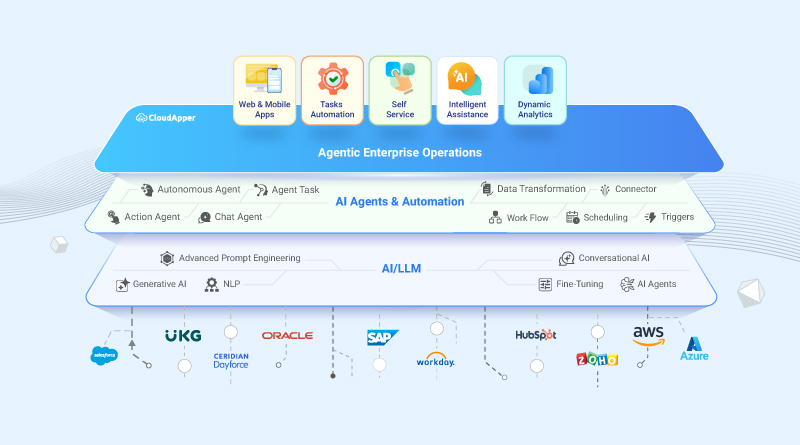
CloudApper AI is an advanced platform that enables organizations to integrate AI into their existing enterprise systems effortlessly, without the need for technical expertise, costly development, or upgrading the underlying infrastructure. By transforming legacy systems into AI-capable solutions, CloudApper allows companies to harness the power of Generative AI quickly and efficiently. This approach has been successfully implemented with leading systems like UKG, Workday, Oracle, Paradox, Amazon AWS Bedrock and can be applied across various industries, helping businesses enhance productivity, automate processes, and gain deeper insights without the usual complexities. With CloudApper AI, you can start experiencing the transformative benefits of AI today. Learn More
- Useful Links:
- Agentic AI
- No-Code/Low-Code
- Custom Software
- HCM Personalization
- iPaaS
- FedRAMP
CloudApper AI Solutions

- Works with








- and more.
Similar Posts

The Service Account Audit Nobody Runs: When AI-Built Apps Turn…

AI Agent Over-Permission: The Access Control Problem Nobody Scoped When…