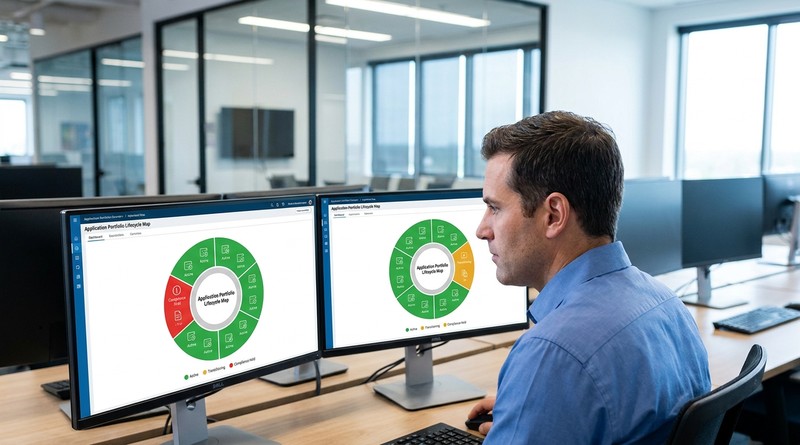
AI transformation programs routinely launch without a governed enterprise application inventory — and fail mid-execution when the dependency surfaces. Here is why rational actors avoid building the inventory, what it must actually contain, and how a governed development platform closes the gap.

TL;DR
Most AI transformation programs fail before they scale because they are built on top of an enterprise application portfolio that nobody has fully documented, governed, or classified for AI readiness. The gap is not technical — it is organizational: business units treat applications as departmental assets rather than enterprise infrastructure, which means that application inventories are politically inconvenient even when they are technically straightforward to build. CloudApper AI removes this constraint by generating a governed application inventory automatically as a byproduct of the development, deployment, and extension process — so the inventory stays current without requiring a separate, politically costly exercise. CIOs who want to use AI to modernize, extend, or build on their application estate need an authoritative baseline before they can have a credible roadmap, and a governed development platform is what produces that baseline.
Table of Contents
- The Prerequisite Nobody Puts in the Roadmap
- Why Enterprises Launch AI Transformation Without the Inventory
- What the Inventory Actually Needs to Contain
- How a Governed Development Platform Maintains the Inventory
Most enterprise AI programs assume a current, governed application inventory already exists, and that assumption is the most common place AI readiness breaks down. It surfaces eight or ten months in, when pilots are committed and timelines are public, instead of at planning, where it would be cheap to fix.
In one program, a warehouse management application processing hundreds of thousands of records a week turned up with a business owner but no service catalog entry, no data classification and no security review. CloudApper AI, a governed platform for building and extending enterprise applications, is built to close that inventory gap before AI work depends on it.
The Prerequisite Nobody Puts in the Roadmap
AI transformation roadmaps follow a recognizable pattern: define use cases, prioritize by business value and feasibility, pilot with a quick win, scale. This structure is reasonable for managing executive attention and demonstrating momentum. What it consistently omits is the upstream condition that determines whether any of those stages actually succeeds: the organization must know what applications exist, who owns them, what data they hold, and how they connect to the business processes the AI use case will touch.
Without that knowledge, a demand-forecasting AI model cannot be scoped accurately because the applications supplying the data have not been inventoried or classified. An AI agent for employee onboarding cannot be governed appropriately because the HR applications it will integrate with have never been through formal data classification review. A modernization initiative cannot sequence its work because nobody has produced an authoritative account of which applications are still active, which are deprecated but still running, and which are duplicates serving the same function.

This is the default state of most non-software enterprises that have spent a decade acquiring SaaS applications, building internal tools, and extending ERP and HCM systems without centralizing portfolio governance. Shadow IT — which has re-emerged through AI-assisted business-unit development — adds a layer of applications that never went through formal intake at all, and therefore appear nowhere in any governance record the AI program can access.
Enterprises building on CloudApper AI have a structural advantage here: the platform generates an authoritative inventory entry for every application deployed through it — including owner, data classification, business process documentation, and compliance inheritance — as an output of the deployment process rather than a retroactive exercise. For the rest of the application estate, the inventory work has to be approached directly, and that work has organizational dynamics that most AI program plans do not account for.
Why Enterprises Launch AI Transformation Without the Inventory
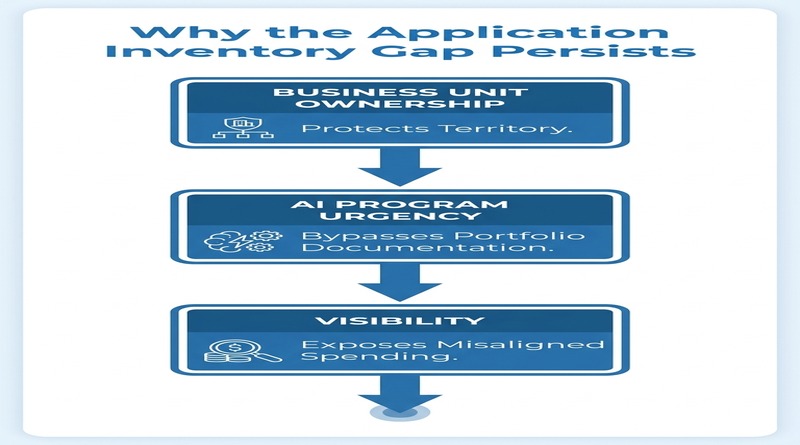
The application inventory gap is not primarily a technical problem. Most enterprises have some version of a CMDB, service catalog, or IT asset management system. What they lack is a current, complete, governed version of that inventory — and the reason it does not exist is not ignorance. It is that maintaining one requires organizational visibility that is, in practice, politically inconvenient.
Application ownership at the business-unit level is a form of organizational power. A VP of Operations who controls an undocumented supply chain application controls a budget allocation, a vendor relationship, and a piece of business process that nobody else can touch without permission. A governed inventory makes that ownership visible — and potentially subject to rationalization, consolidation, or reallocation. Business-unit leaders who publicly support AI transformation initiatives are frequently the same leaders who quietly resist the portfolio visibility that would expose overlapping investments or underutilized systems.
AI transformation programs are often launched with urgency precisely because urgency provides cover. A board-approved initiative with a 12-month timeline moves fast enough to skip the slower, more political work of portfolio documentation and rationalization. The program can promise AI-driven efficiency across the enterprise while deferring the question of what applications those efficiencies will actually flow through — and who will authorize data access for the AI layer.
The evidence the board eventually asks for — which AI applications are in production, what data they process, who is accountable for their governance — requires exactly the application inventory the program bypassed at the beginning. By the time an audit committee formalizes that question, the AI program has been running for a year on an estate that was never fully documented. The missing stakeholder in most AI transformation plans is the functional leader whose department runs applications that the CIO does not formally own. Their cooperation is required for any meaningful inventory effort. Their incentives, without organizational pressure, point toward opacity.
What the Inventory Actually Needs to Contain
An application inventory built for administrative purposes — software license management, vendor renewals, hardware asset tracking — is not sufficient for AI transformation governance. The inventory an AI program requires contains different fields: data classification for each application, business process dependencies, integration points with other systems, risk tier, owner documentation at both the IT and business-unit level, and AI-readiness status for the specific use cases under consideration.
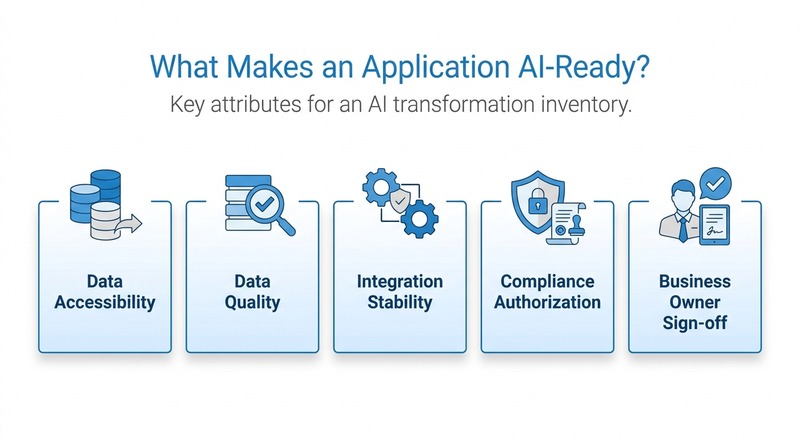
AI-readiness status deserves a working definition. An application is AI-ready for a given use case when its data is accessible and classified; when the integration points are documented and stable; when the business owner has explicitly authorized data use for AI purposes; and when the compliance controls that govern that data are understood and can be inherited by the AI layer. Most applications in an undocumented portfolio fail at least one of these conditions — and the failure is not always fixable quickly.
Applications built by teams who have since left the organization may have integration patterns that nobody currently employed can document accurately. An AI use case scoped against such an application is not just delayed — it is mispriced from the outset, because the cost of establishing the governance baseline was not included in the program budget.
This is also why the inventory is a continuous requirement rather than a one-time project. The internal app estate generates new entries every time a business unit deploys an automation or a developer ships an application outside the formal intake process. An inventory built at the start of an AI program begins to degrade within months if there is no mechanism for capturing new deployments in real time. The AI program’s risk assessment becomes stale at the same rate.
How a Governed Development Platform Maintains the Inventory
The structural problem with application inventories is that they require ongoing maintenance, and maintenance requires accountable ownership. In most enterprises, that accountability lands with IT operations — which does not have visibility into business-unit development activity — or with a project management office — which captures what was approved but misses what was deployed without approval. Neither approach produces a current, complete record.
CloudApper AI approaches this differently. When internal applications are built, extended, or modernized on CloudApper’s governed platform, the inventory entry — including owner, data classification, business process documentation, integration map, and compliance inheritance from the platform’s certified environment — is a structural output of the deployment process. An application cannot go live without producing a governance record. That record does not require a separate IT operation to maintain, because it is generated and updated through the same workflow that generates and updates the application.
For enterprises navigating the gap between platform engineering velocity and governance requirements, this design eliminates the most common failure mode: applications that reach production before governance catches up. The inventory reflects the current state of the application estate because the governed platform is what the applications are built on.
For enterprises deploying AI agents that orchestrate across multiple applications, the inventory becomes a runtime requirement rather than a planning artifact. An agent operating across four applications needs current documentation on all four — owner, data classification, integration status — and any change to one application affects the agent’s compliance posture. A platform that maintains this documentation automatically is what makes multi-agent deployments governable at scale.
How to Build the Application Inventory Your AI Program Needs
Step 1: Define scope that includes undocumented and business-unit-built applications
Start from the assumption that your current CMDB or service catalog captures significantly less than the actual application estate. Extend scope to include SaaS applications procured by individual departments, internally built tools created by business units using AI coding assistants or low-code builders, integrations that connect systems but were never formally registered, and any applications that process business-critical data but were not submitted through IT intake. The AI governance inventory is not bounded by what IT formally owns — it is bounded by what processes business data.
Step 2: Classify each application by data sensitivity and business process criticality
For each application in scope, document the categories of business data it processes, the business function it supports, and how critical that function is to operations. Data classification does not need to be exhaustive at the start — it needs to be accurate enough to identify which applications carry compliance obligations (HIPAA, SOC 2, PCI, GDPR, CCPA, FIPS) and which AI use cases those applications can and cannot support. Regulatory frameworks like DORA already require formal ownership and classification for applications supporting business-critical functions — an AI-readiness classification adds a layer to a framework that should already be in place.
Step 3: Document AI-readiness attributes for each application being considered for augmentation
For each application in scope for AI use cases, document: data accessibility (can the AI layer reach the data it requires?), data quality (is the data structured, consistent, and current enough to support model training or agent operation?), integration stability (are the APIs or data connections documented and reliable?), and compliance authorization (has the business owner explicitly authorized data use by an AI system?). An application that fails on any of these four criteria is not AI-ready for that use case, regardless of how strategically important the use case is. Documenting the failure is more valuable than deferring it — it produces a realistic program scope before commitments are made.
Step 4: Assign and confirm application ownership across IT and business units
Every application in the inventory needs a documented owner who is accountable for its data classification, its compliance posture, and the authorization of AI data use. For applications owned by business units, this requires a formal assignment process — not an assumption based on who historically managed the system. The business-unit leader who benefits from application opacity will not voluntarily document ownership without an organizational requirement to do so. That requirement should come from the AI program governance structure, not from IT operations alone.
Step 5: Implement a maintenance process that captures new applications at deployment
A point-in-time inventory degrades within months if there is no process for registering new applications as they are deployed. In organizations using a governed development platform, this capture is structural — new deployments produce inventory records. In organizations without one, the maintenance process requires active outreach to business-unit teams on a scheduled basis, which is sustainable only when there is organizational authority behind the requirement and a defined escalation path when teams do not comply. The maintenance process is where most inventory programs fail; designing it before the inventory is built prevents the most common outcome, which is a well-constructed baseline that becomes stale within a quarter.
Frequently Asked Questions
Why is a governed enterprise application inventory critical to AI transformation and AI governance?
An AI transformation program depends on knowing which applications supply training data, which applications AI agents will integrate with, and which applications are being extended or modernized. Without an authoritative inventory of those applications — including their data classifications, ownership records, and integration maps — AI programs are scoped against assumptions. When those assumptions turn out to be wrong, which happens reliably, the program timeline, risk assessment, and compliance documentation all require revision. A governed inventory eliminates that revision cycle by making the application estate visible before use cases are scoped and commitments are made.
How should CIOs assess AI readiness when their organization lacks a current, governed inventory of enterprise applications?
Begin with discovery rather than documentation. Run a structured intake across business units to identify applications that process data relevant to the first set of AI use cases, then prioritize documentation for those specific applications. This produces a working inventory for the program’s first phase without requiring a complete portfolio exercise before any AI work can begin. The working inventory should be treated as a live document with a named owner and a defined update cycle — not a project deliverable that gets filed when the phase closes.
What is the difference between an AI inventory and an enterprise application inventory?
An AI inventory catalogs AI tools, models, agents, and AI-assisted applications — what AI capabilities are in use, who is using them, and what data they access. An enterprise application inventory catalogs the underlying business applications that AI systems interact with, are built on top of, or are designed to augment. Both are required for AI governance. The application inventory is the foundation, because AI systems can only be governed effectively when the applications they operate on are documented and classified. An AI inventory without an underlying application inventory creates a governance record that stops at the AI layer and does not reach the business data underneath — which is where most compliance obligations actually attach.
What minimum data should the application inventory capture to support AI transformation?
At minimum: application name and purpose, business process supported, data categories processed, business owner and IT owner, applicable compliance frameworks, integration points, and AI-readiness status for the use cases under consideration. Secondary fields that accelerate AI program governance include last security review date, infrastructure owner, and access control documentation. The inventory does not need to be exhaustive before AI work can begin — it needs to be accurate for the applications in scope for the first use cases, with a process in place to extend coverage as the program scales.
How does a governed development platform help maintain an accurate enterprise application inventory for AI governance?
A governed development platform generates inventory records as a structural output of the development and deployment process. When a new application is built on CloudApper AI, the platform assigns an owner, documents data classification and business process, records compliance posture through platform certification inheritance, and creates an inventory entry before the application goes live. Applications extended or modified on the platform update their records through the same process. This means the inventory reflects the current state of the application estate continuously, without a separate maintenance program or periodic audits to stay current — which is the only maintenance model that actually keeps pace with how fast internal application estates change.
If your AI transformation program is running against an application inventory that does not exist in the form it needs to — or discovering mid-program that key applications were never documented — CloudApper AI provides the governed development platform that makes application inventory a structural byproduct of how your applications are built and deployed. Reach out to learn how it works in practice.

What is CloudApper AI Platform?
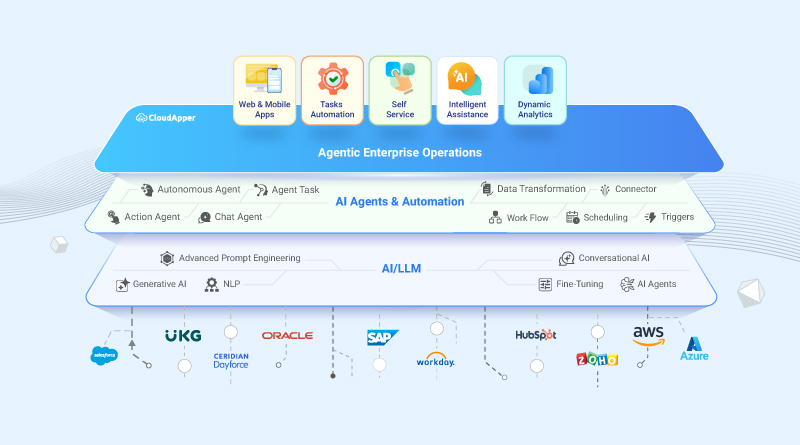
CloudApper AI is an advanced platform that enables organizations to integrate AI into their existing enterprise systems effortlessly, without the need for technical expertise, costly development, or upgrading the underlying infrastructure. By transforming legacy systems into AI-capable solutions, CloudApper allows companies to harness the power of Generative AI quickly and efficiently. This approach has been successfully implemented with leading systems like UKG, Workday, Oracle, Paradox, Amazon AWS Bedrock and can be applied across various industries, helping businesses enhance productivity, automate processes, and gain deeper insights without the usual complexities. With CloudApper AI, you can start experiencing the transformative benefits of AI today. Learn More
- Useful Links:
- Agentic AI
- No-Code/Low-Code
- Custom Software
- HCM Personalization
- iPaaS
- FedRAMP
CloudApper AI Solutions


- Works with







- and more.
Similar Posts

What Your AI Development Platform Vendor’s Security Review Should Actually…

SR 11-7 Wasn’t Written for This: AI-Assisted Internal App Development…