When your last COBOL developer retires, the undocumented business logic retires with them. This is not a staffing problem — it is a risk event that belongs on your risk register, not your hiring plan.
TL;DR
When a legacy SME retires without a successor, the undocumented business logic they hold converts a staffing gap into a material weakness on your risk register. Documentation plans fail structurally because the retiring developer cannot articulate what they do not know they know. The viable path runs through the system itself — production logs, data lineage, and AI-assisted code analysis — not through exit interviews. CloudApper extracts and rebuilds that logic as governed, compliance-certified enterprise applications before the knowledge walks out the door.
Table of Contents
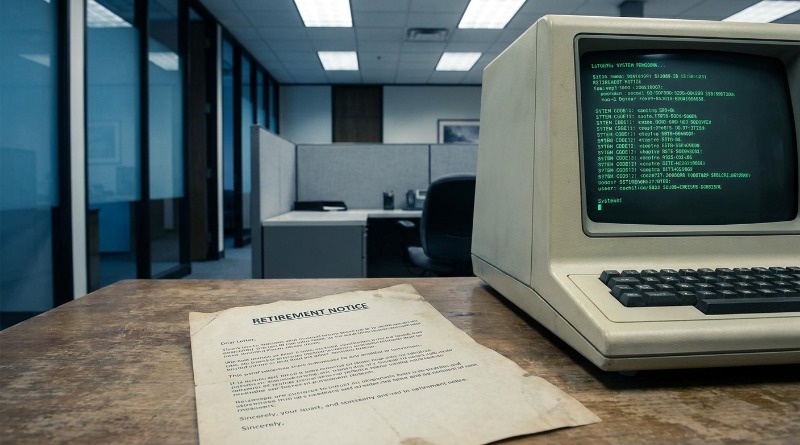
The 90-day notice arrives on a Tuesday. Not a resignation — a retirement. The senior developer who has maintained your core legacy system for nineteen years has submitted the paperwork. You always knew this was coming. The average active COBOL developer is now 58 years old. Fewer than 500 new COBOL developers are entering the North American workforce annually. The talent cliff was always a forecast. Now it is a notice on your desk.

The temptation is to route this through HR. That is the wrong office. What you have on your desk is not a staffing event — it is a risk event, and it belongs on your risk register.
The Difference Between a Staffing Problem and a Risk Event
A staffing problem can be solved by finding someone else. This one cannot be. The people who know COBOL at the depth your retiring developer knows it are not on the market — they are three months from their own retirement notices. The enterprise developer shortage has reached the point where specialized legacy knowledge is not scarce — it is nearly gone.
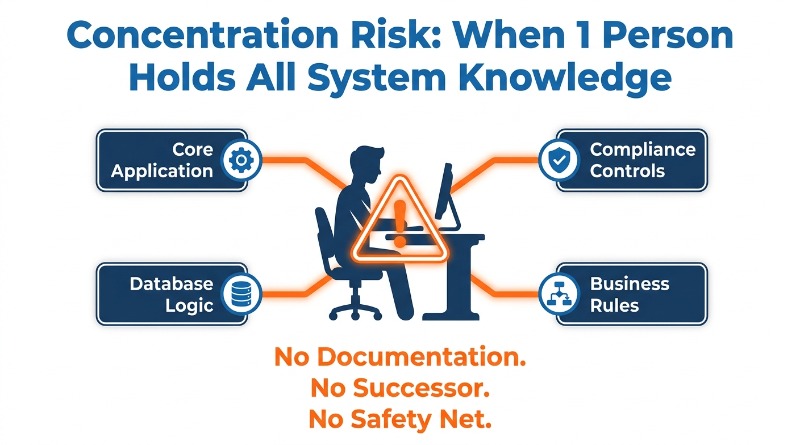
When one person holds the operational knowledge of how a system calculates your core business logic, that is concentration risk. When that person announces retirement and there is no successor, concentration risk converts into unhedgeable operational exposure. Your external auditor’s IT-risk partner has a line item for this. Your CRO has a framework for it. The CIO who routes this conversation through IT budget channels is misrouting it.
What the Auditor Will Find That IT Won’t Say Out Loud
Legacy systems maintained by one or two people carry undocumented logic — not because anyone was careless, but because the system was built in an era when documentation lived in the developer’s head. When that developer leaves, what remains is executable code and institutional memory that retires with them.
An external auditor who opens a SOC 2 or HIPAA review and finds a production system with no succession plan, no documented business logic, and no audit trail for its core calculations does not categorize that as a staffing gap. They categorize it as a control deficiency. In some frameworks, that is a material weakness — language that travels from the audit report to the board’s risk committee.
The real cost of maintaining an unsupported legacy system compounds when the last person who understood it retires. The CIO who frames this to the CFO as “we need to modernize eventually” is using language that does not survive the auditor’s finding.
The Plan That Sounds Reasonable and Will Not Work
The most common response to a retiring legacy SME is documentation. Sit with the developer before they leave. Record walkthroughs. Write runbooks. This plan sounds responsible. It fails structurally because the developer cannot tell you what they do not know they know — the edge cases discovered over fifteen years, the business logic embedded in a 2007 workaround that everyone else has forgotten. None of that surfaces in an exit interview.
Any modernization plan that requires the retiring developer’s cooperation to succeed has built its dependency on the person who is leaving. The viable path runs through the system itself. Production logs, data lineage, transaction histories — these contain the behavioral record of what the system actually does, independent of what anyone remembers. Moving fast on modernization without a governance structure creates the next version of the same problem, and legacy modernization without proper governance tends to surface the debt at audit time, not before.
Moving Before the Clock Runs Out
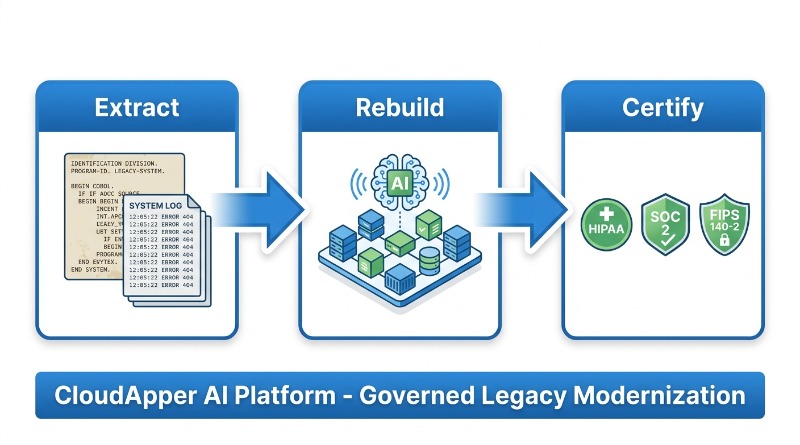
The practical window is the 90 days before departure — not for documentation, but for scoped modernization. Not a full replacement. A governed extraction of the business logic that is undocumented and operationally critical, deployed on a platform that your compliance team can audit without specialized COBOL knowledge.
CloudApper’s AI-driven legacy modernization extracts business logic from existing systems — including COBOL and mainframe code — and rebuilds it as governed enterprise applications that are HIPAA, SOC 2, and FIPS 140-2 certified. The process does not depend on the retiring developer staying to explain the system. It starts with the system itself: the code, the logs, the data lineage. The first step in any serious modernization program is a complete inventory of what exists and who currently owns the knowledge of how it works — and CloudApper helps CIOs build that inventory before the knowledge walks out the door.
The retirement notice is the forcing function. The question it forces is not “how do we backfill this position?” It is “what does the auditor find if this developer walks out the door today?” The CIO who answers that question first is the one who controls the response.
If a legacy SME retirement is forcing a modernization decision at your organization, CloudApper can help you start that conversation — with a governed path that does not depend on the person leaving.

What is CloudApper AI Platform?
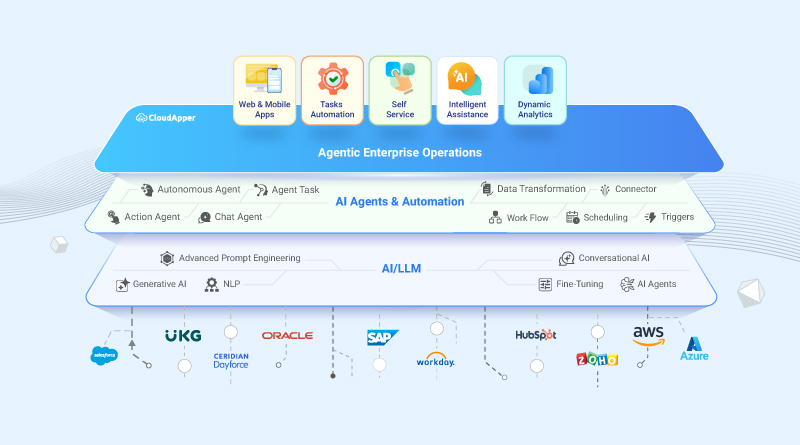
CloudApper AI is an advanced platform that enables organizations to integrate AI into their existing enterprise systems effortlessly, without the need for technical expertise, costly development, or upgrading the underlying infrastructure. By transforming legacy systems into AI-capable solutions, CloudApper allows companies to harness the power of Generative AI quickly and efficiently. This approach has been successfully implemented with leading systems like UKG, Workday, Oracle, Paradox, Amazon AWS Bedrock and can be applied across various industries, helping businesses enhance productivity, automate processes, and gain deeper insights without the usual complexities. With CloudApper AI, you can start experiencing the transformative benefits of AI today. Learn More
- Useful Links:
- Agentic AI
- No-Code/Low-Code
- Custom Software
- HCM Personalization
- iPaaS
- FedRAMP
CloudApper AI Solutions

- Works with







- and more.
Similar Posts
When the HIPAA Compliance Deadline Arrives Before Your EHR Modernization…

Legacy Modernization Transition: The Compliance Gap That Opens When Both…