Enterprise IT teams running legacy applications inside VDI environments frequently discover that the infrastructure layer provides no compliance governance for the applications it hosts. When audit findings land in the application governance column, the infrastructure budget no longer tells the whole story.

TL;DR
Enterprise IT teams running legacy applications inside VDI environments frequently discover that the infrastructure layer provides no compliance governance for the applications it hosts. Audit logs, access controls, change records, and DR evidence must come from the application itself, not from Citrix or the VDI platform. When those artifacts are missing, the finding lands in the application governance column regardless of where the budget lives. The practical path forward is replacing VDI-dependent legacy applications with governed alternatives before the next renewal or audit cycle forces the issue.
Table of Contents
The question came from the third item on the auditor’s list.

“Who is responsible for access control on the Citrix-hosted application?”
The infrastructure manager pointed to IT operations. The application owner pointed back to infrastructure. The compliance lead looked at both of them. No one had an answer that matched what the access log actually showed.
This is the room most legacy VDI conversations eventually produce, if they run long enough.
What VDI Does to Application Ownership
Virtual desktop infrastructure was designed to solve a delivery problem, not an application governance problem. When a decade-old Windows application cannot be rehoused or replatformed on a reasonable budget, VDI offers a pragmatic middle path: keep the application, move the session. The infrastructure team maintains the image, the user population connects, and the business unit continues its workflows.
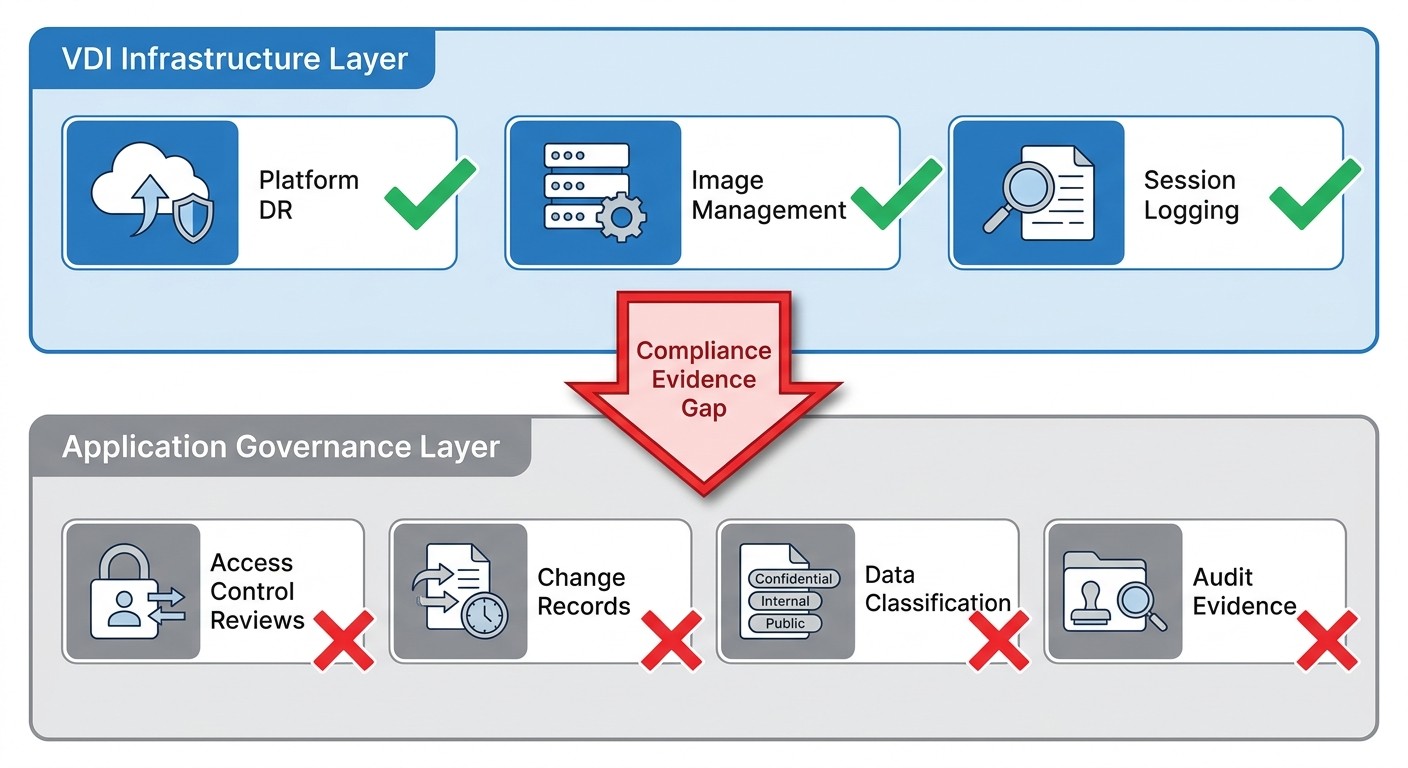
What VDI does not provide is a structured governance layer for the application itself. Audit logging belongs to whatever the legacy application was built to generate, which is often minimal. Change management applies to the VDI image, not to the application logic running inside it. Access controls are frequently scoped at the virtual machine level rather than the data or function level. When the next audit cycle arrives, these gaps surface in the findings, not in the infrastructure team’s project plan.
For organizations already managing deferred compliance exceptions on legacy systems, the VDI layer adds a structural problem: the application’s governance deficiencies become invisible inside the infrastructure budget until an auditor puts them on the table. This is the distinction CloudApper AI is built around — a governed application platform where access controls, audit logs, and change records are part of the architecture from the first deployment, not assembled before the next finding.
The Costs That Do Not Appear in the Platform Budget
VDI licensing, compute, storage, and image management cycles are relatively straightforward to calculate. What does not appear in that budget is the operational load specific to legacy applications running inside the VDI environment. Application packaging and compatibility remediation with each image update. Performance troubleshooting caused by application behavior that was never designed for virtualized I/O. Security exception documentation maintained for applications that fail controls they predate.
Organizations dealing with patching risk on legacy Windows applications often discover that VDI extends rather than resolves this problem. An unpatched dependency inside a Citrix image requires the same remediation work as on a physical machine, with the added complexity of image lifecycle management on top of it.
Disaster recovery is worth examining separately. VDI environments typically carry well-documented DR for the platform itself. Legacy applications running inside those environments frequently do not have separately validated DR evidence, which is what regulators expect as a distinct artifact. The untested DR gap in legacy application environments does not disappear when those applications are hosted in Citrix.
What Auditors Are Actually Looking For
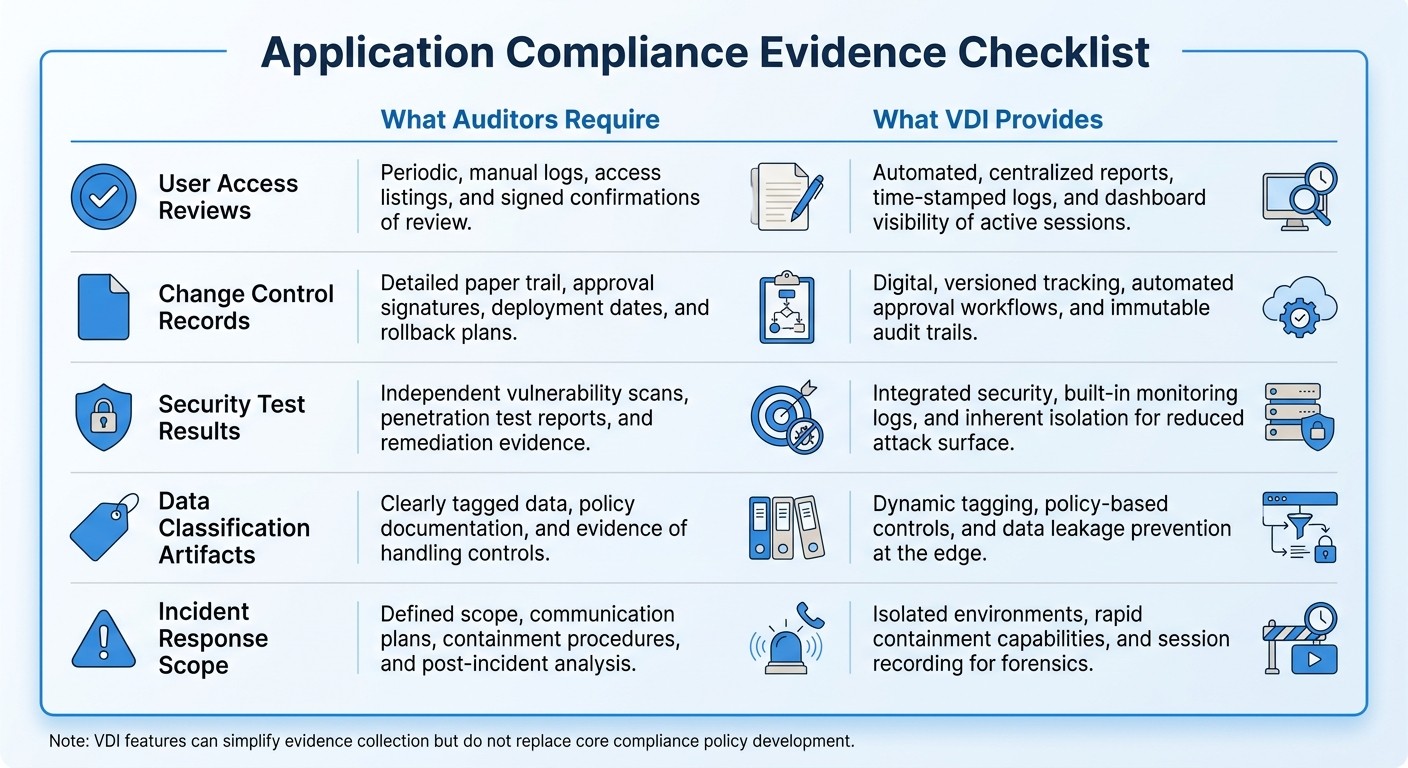
The regulatory exposure here is evidentiary, not primarily financial. A HIPAA audit, a SOX ITGC walkthrough, or a SOC 2 assessment for an application running in VDI will expect user access reviews, change records, security test results, data classification artifacts, and incident response scope documentation.
VDI does not generate most of these on behalf of the applications it hosts. The change freeze that protects a legacy system from breaking is not a documented change control process. An access log that records session connections is not an access control review. A Citrix performance report is not application security evidence.
This is where the budget optics of VDI and the compliance reality of the applications inside it diverge most sharply. VDI appears in the infrastructure column. The audit finding lands in the application governance column.
When the Renewal Is the Wrong Conversation
Directors of IT who arrive at a VDI renewal without a current count of which applications depend on Citrix for basic operation, and what the compliance posture of each one actually is, are making a capital allocation decision without the information it requires. The business case for legacy modernization looks very different once the compliance and operational costs embedded in the VDI layer are made visible.
VDI has a legitimate role as a temporary containment layer during a modernization transition. The problem is when the temporary layer becomes a permanent replacement for the modernization decision itself, accumulating compliance debt that the infrastructure budget obscures rather than surfaces.
Organizations that have worked through this pattern describe a consistent shift: from managing a VDI layer around legacy applications to defining what those applications actually need to do, then building governed replacements. A director of IT at a manufacturing company recently described exactly this. She outlined the functional requirements for an aging Citrix-hosted inventory exception tool and used CloudApper AI to build a governed replacement. The compliance evidence her auditors expected, including access controls, audit logs, and change records, was part of the platform architecture from the start, not remediated after a finding.
The Citrix renewal is a simpler conversation when the application it is keeping alive has already been replaced.
CloudApper AI builds governed enterprise applications from plain-language descriptions of what a business process needs. For enterprise IT teams managing legacy applications inside VDI and facing upcoming audits or infrastructure renewal decisions, the conversation starts at cloudapper.ai/contact.

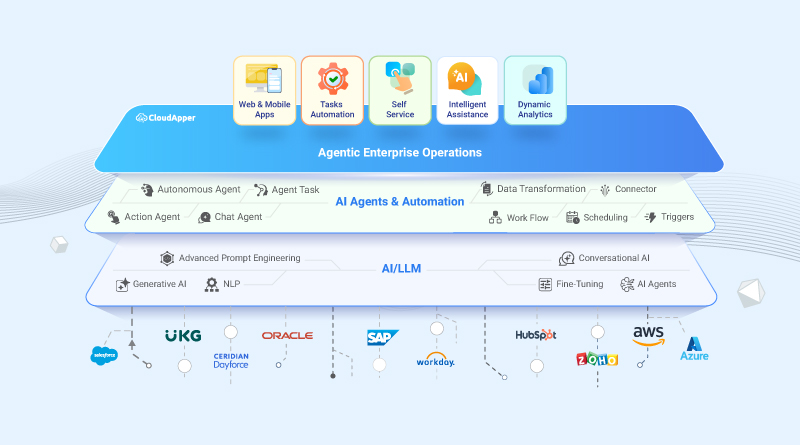
What is CloudApper AI Platform?
CloudApper AI is an advanced platform that enables organizations to integrate AI into their existing enterprise systems effortlessly, without the need for technical expertise, costly development, or upgrading the underlying infrastructure. By transforming legacy systems into AI-capable solutions, CloudApper allows companies to harness the power of Generative AI quickly and efficiently. This approach has been successfully implemented with leading systems like UKG, Workday, Oracle, Paradox, Amazon AWS Bedrock and can be applied across various industries, helping businesses enhance productivity, automate processes, and gain deeper insights without the usual complexities. With CloudApper AI, you can start experiencing the transformative benefits of AI today. Learn More
- Useful Links:
- Agentic AI
- No-Code/Low-Code
- Custom Software
- HCM Personalization
- iPaaS
- FedRAMP
CloudApper AI Solutions

- Works with







- and more.
Similar Posts
How to Keep Up With Labor Law Changes Your HR…
Your SAST Tool Scanned It. Your DAST Tool Tested It.…