Workday Payroll records tip earnings and handles tax reporting, but tip credit shortfalls, pooled tip distribution errors, and overtime miscalculations on tipped wages hide in the gap between POS systems and payroll close. Learn where the audit exposure sits and how to close it.

TL;DR
Workday Payroll correctly records and taxes tip earnings, but the compliance calculations that create DOL audit exposure, including per-employee tip credit shortfall detection, tip pool distribution by job type and shift, and overtime premium recalculation using the full minimum wage as the regular rate, happen outside the system. These gaps typically live in spreadsheets between POS and payroll close. CloudApper Tip Management automates those upstream calculations alongside Workday, syncing validated results with a time-stamped audit trail that can reconstruct any pay period's tip distributions without re-keying data.
Table of Contents
- How Tip Credit Errors and Pooling Mistakes Compound
- What Workday Payroll Handles for Tipped Workers
- Configuration Checks Worth Running Today
- Where the Liability Lives: POS Data to Payroll Close
Three West Michigan taco restaurants paid $823,000 in back wages and damages to 177 workers after a Department of Labor investigation uncovered tip pool violations, minimum wage failures, and overtime calculated at the wrong tip credit rate. For organizations running tipped employee payroll in Workday, the lesson is direct: Workday Payroll correctly records tip wage earnings and handles tip tax reporting, but the calculations that determine whether every tipped worker actually received minimum wage after tip credits, whether pooled tips were distributed lawfully, and whether overtime premiums used the right regular rate happen largely outside the system. CloudApper Tip Management sits alongside Workday as the automation layer that closes those gaps before they become audit findings.
How Tip Credit Errors and Pooling Mistakes Compound
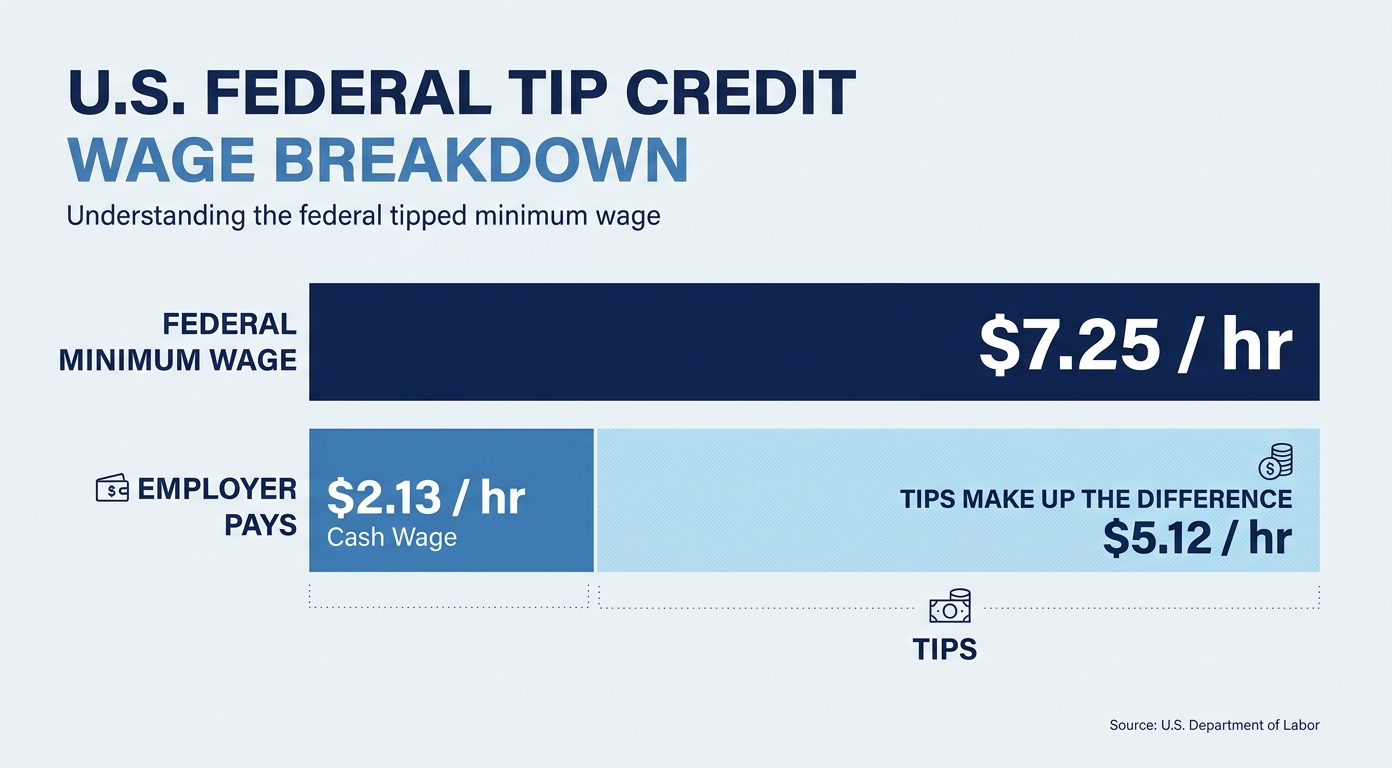
Federal law allows employers to pay tipped employees a direct cash wage as low as $2.13 per hour, claiming a tip credit of up to $5.12 per hour against the $7.25 federal minimum wage. State rules vary widely: some states ban tip credits entirely, others cap them at different rates, and a growing number require higher cash minimums. The math itself is simple per employee per workweek. The failure mode is volume: a 200-location restaurant group running weekly payroll for 4,000 tipped workers must validate that each worker’s direct wages plus eligible tips met or exceeded the applicable minimum wage in every single workweek. When the check fails, the employer owes the shortfall.

Tip pooling adds a second layer. Under the 2021 DOL final rule, employers may include back-of-house workers in pools only if they do not claim a tip credit. Mixing that up, even for one pay period, violates the FLSA. Overtime raises the stakes further. The regular rate for a tipped employee includes the full minimum wage, not just the cash wage. The overtime premium is 1.5 times that regular rate minus the tip credit. Many payroll configurations that handle regular rate adjustments for bonuses miss this calculation entirely. A 2022 DOL case in Pittsburgh found exactly this error and recovered $39,000 in back wages for 41 workers.
What Workday Payroll Handles for Tipped Workers
Workday Payroll processes two categories of tip income. Employer-controlled tips flow through as paid earnings and are taxed normally. Employee-reported tips are recorded for tax withholding, FICA, and OASDI calculations. The “Create Earnings for Tips (USA)” task configures tip earning types, and “Edit Pay Accumulation” adds employer-controlled tips to gross pay. Workday also reports uncollected tip taxes in boxes 12A and 12B on the W-2 when net pay is insufficient. This is solid infrastructure for recording and taxing tips. It is not a tip credit compliance engine.
Configuration Checks Worth Running Today
Start with your tip earning types. Confirm that employer-controlled and employee-reported tips are mapped to separate earnings with correct tax treatment. Review your time entry codes to ensure tipped and non-tipped hours are tracked separately, since dual-job workers must have their hours split for tip credit purposes. Check that your pay accumulation includes tip earnings so gross-to-net calculations reflect total compensation.
These checks help validate what Workday records. They do not validate what happens upstream.
Where the Liability Lives: POS Data to Payroll Close
The calculations that create back-pay exposure sit between the POS system and Workday. Tip pooling distributions are calculated in spreadsheets or POS back-office tools, not inside Workday. The per-employee, per-workweek minimum wage validation that triggers a shortfall obligation does not run automatically. And the regular rate recalculation for overtime on tipped wages requires logic that crosses multiple pay components and state-specific rules in ways that standard configurations do not cover. This is where CloudApper Tip Management fits: it automates tip pool distribution rules across job types, shifts, and locations, then reconciles POS tip data against Workday timecards before payroll closes.
Closing the Audit Gap with CloudApper Tip Management
CloudApper Tip Management runs alongside Workday Payroll as a dedicated calculation and audit layer. It captures tip and time data from POS systems, applies your pooling rules automatically, flags minimum wage shortfalls by employee and workweek, and calculates overtime premiums using the legally required regular rate. The results sync to Workday timecards with a complete, time-stamped audit trail.
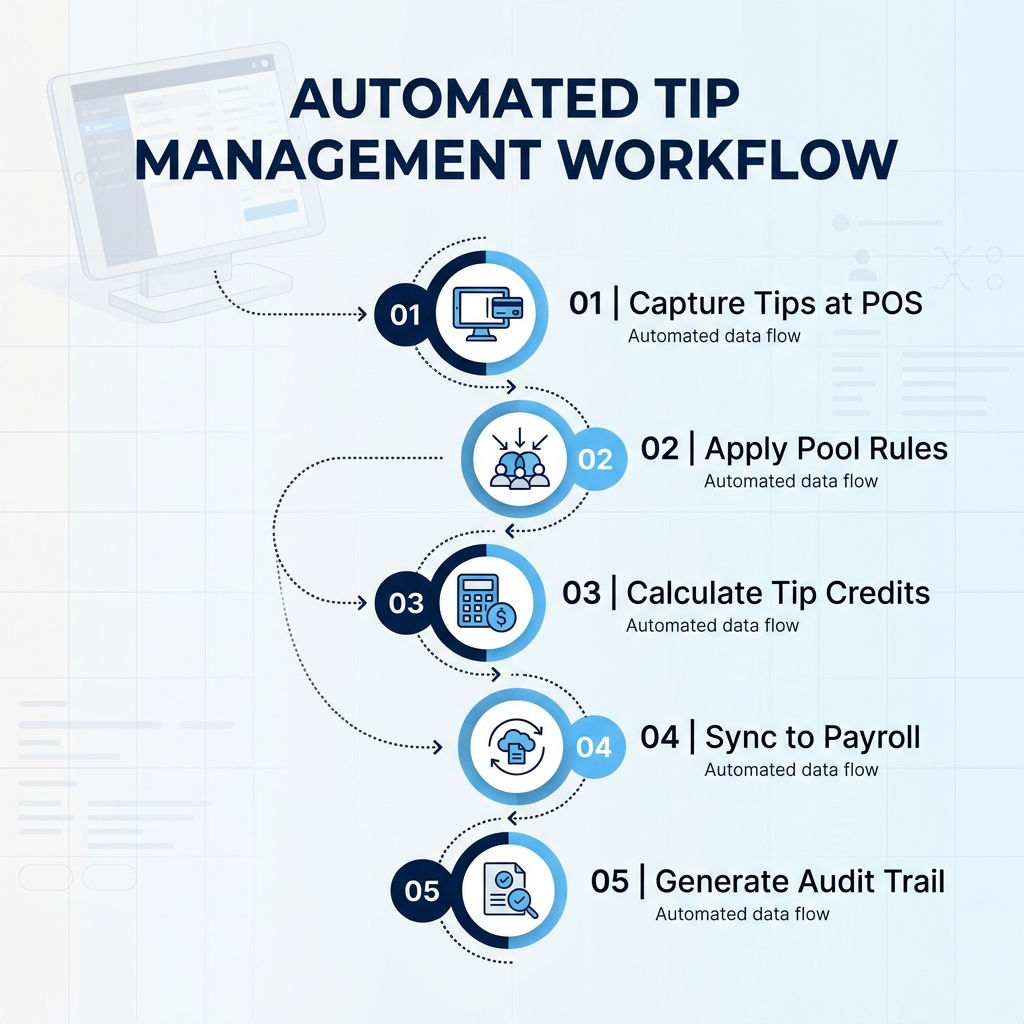
For a Payroll Director facing a DOL information request, this means every tip pool distribution and shortfall calculation for any pay period can be reconstructed without re-keying data from spreadsheets. That audit readiness is the difference between a routine response and a multi-year back-pay assessment. Organizations running tipped employee payroll across multiple states face compounding jurisdiction-specific rules that make manual validation untenable at scale. The same payroll audit exception reports that catch frontline time data errors do not catch tip credit shortfalls, because those shortfalls originate in data Workday never receives.
If your tip pooling rules, POS reconciliation, or overtime calculations for tipped workers still run in spreadsheets, contact CloudApper to see how the Tip Management layer works alongside your Workday tenant.
Frequently Asked Questions
Q: Does Workday Payroll calculate tip credits and detect minimum wage shortfalls for tipped employees?
Workday Payroll records tip earnings and handles tip tax withholding, FICA, and OASDI calculations. The per-employee, per-workweek tip credit validation that detects whether direct wages plus tips met the applicable minimum wage is not a native automated check. Organizations typically handle this outside Workday or through custom reporting.
Q: How is overtime calculated for tipped employees under the FLSA?
The regular rate for a tipped employee is the full federal minimum wage ($7.25), not the reduced cash wage. The overtime rate is 1.5 times the regular rate minus the tip credit. Payroll systems that calculate overtime on the cash wage alone underpay the worker and create back-pay liability.
Q: Can Workday handle tip pooling distribution calculations?
Workday Payroll does not include a native tip pooling engine. Tip pool distributions based on job type, shift, hours worked, or location are typically calculated in POS back-office systems or spreadsheets and then entered into Workday as adjusted earnings. CloudApper Tip Management automates these calculations and syncs results to Workday timecards.
Q: What happens during a DOL audit if tip credit records are incomplete?
The DOL requires employers claiming a tip credit to retain records of reported tips, the tip credit amount claimed, hours worked in tipped and non-tipped roles, and corresponding wages. Incomplete records shift the burden of proof to the employer, often resulting in back-pay assessments covering multiple years.
Q: How does CloudApper Tip Management work with Workday?
CloudApper Tip Management operates alongside Workday as a dedicated tip calculation layer. It captures POS and time data, applies pooling and shortfall rules, and pushes validated results into Workday timecards with a time-stamped audit trail. Workday remains the system of record for payroll processing.
Q: Which industries face the highest risk for tipped employee payroll violations?
Restaurants, hotels, casinos, and food and beverage operations carry the highest enforcement volume. The DOL Wage and Hour Division consistently targets hospitality for tip credit, tip pooling, and overtime violations, with recent cases producing six-figure back-pay assessments.
Q: Do state tip credit rules override the federal rate in Workday?
Yes. States like California, Oregon, and Washington ban tip credits entirely, requiring the full state minimum wage before tips. Other states set their own cash wage floors. Workday payroll configurations must reflect the applicable state rule, and organizations operating across multiple jurisdictions need per-state validation of every tipped employee’s total compensation each workweek.

What is CloudApper AI Platform?
CloudApper AI is an advanced platform that enables organizations to integrate AI into their existing enterprise systems effortlessly, without the need for technical expertise, costly development, or upgrading the underlying infrastructure. By transforming legacy systems into AI-capable solutions, CloudApper allows companies to harness the power of Generative AI quickly and efficiently. This approach has been successfully implemented with leading systems like UKG, Workday, Oracle, Paradox, Amazon AWS Bedrock and can be applied across various industries, helping businesses enhance productivity, automate processes, and gain deeper insights without the usual complexities. With CloudApper AI, you can start experiencing the transformative benefits of AI today. Learn More
- Useful Links:
- Agentic AI
- No-Code/Low-Code
- Custom Software
- HCM Personalization
- iPaaS
- FedRAMP
Brochure
CloudApper AI TimeClock
For accurate & touchless time capture experience.
Download Brochure
CloudApper AI Solutions for Workday


- Works with








- and more.
Similar Posts

Workday Seniority Date vs. Continuous Service Date: Which One Drives…

Workday Time Entry Cost Center Override: Why Hours Post to…