Six governance artifacts -- access provisioning records, change logs with approvals, data classification, vulnerability baselines, succession records, and compliance inheritance documentation -- that any enterprise AI platform should produce automatically for every application it builds.

TL;DR
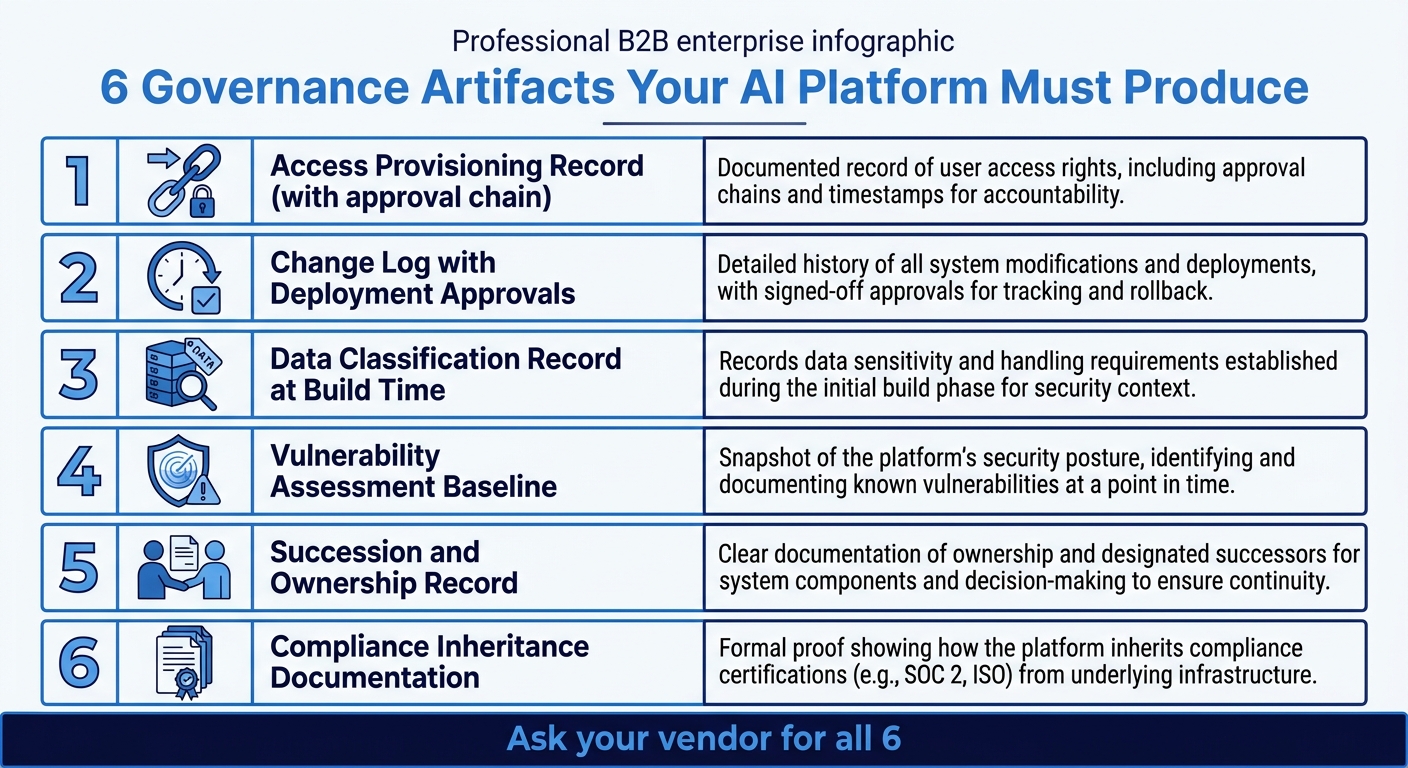
Enterprise AI platforms should produce six governance artifacts automatically for every application they build: a dated access provisioning record with approval chains, a change log with deployment authorizations, a data classification record created at build time, a vulnerability assessment baseline tied to the platform architecture, a succession and ownership record at the role level, and a compliance inheritance document mapping platform certifications to each application. These artifacts must exist without being requested -- not as exports generated on demand. The practical test is straightforward: ask your vendor to surface each one during the demo. If they cannot, the platform was not designed to produce it. CloudApper AI generates all six as structural build outputs for every application on the platform.
Table of Contents
- 1. A Dated Access Provisioning Record for Every Application
- 2. A Change Log With Approval Records for Every Deployment
- 3. A Data Classification Record Created at Build Time
- 4. A Vulnerability Assessment Baseline for Every Application
- 5. A Succession and Ownership Record for Every Application
- 6. A Compliance Inheritance Record Linking the Application to the Platform’s Certifications
- The Standard Is Automatic, Not on Request
The demo goes well. The UI is clean, the AI builds the app fast, and the sales engineer answers every question about integrations and deployment options. Then someone from IT asks: “Can you show us the access provisioning record for an application built on your platform?” The sales engineer pauses. They pull up the admin console. What they can show is a list of current users. What they cannot show is who approved each one, when, under what authorization, and whether any have been reviewed since.

That pause is the answer.
A governed enterprise AI platform does not produce compliance evidence on request — it produces it continuously, as a structural output of every application it builds. The governance record exists because the platform was designed to generate it, not because someone filed a ticket to create it after an audit request arrived. If a vendor needs time to find that record, the platform was not designed to produce it.
What follows are six governance artifacts any enterprise AI platform should be able to surface immediately for any application built on it. These are the questions to bring to your next vendor demo — or to ask about the platform you are already using. CloudApper AI produces all six as default platform outputs, not add-on configuration.
1. A Dated Access Provisioning Record for Every Application
Ask your vendor: “For any application built on your platform, can you show me who has access, what role they were assigned, who approved that assignment, and when it was last reviewed?”
A governed platform generates this record at provisioning time — not on export request. Each access grant is an event: who requested it, who approved it, what role it assigned, when it took effect, and whether a review date was set. This is the evidence SOC 2 CC6.1 and HIPAA require. If the platform shows a user list without approval chains and review dates, the provisioning record does not exist. The access control gaps that surface when an AI-built app scales are almost always traceable to a platform that tracked presence but not provenance.
2. A Change Log With Approval Records for Every Deployment
Ask your vendor: “For the last three changes deployed to any application on your platform, can you show me the change request, who approved it, what was tested, and who signed off on the deployment?”
Change management evidence is a SOC 2 CC8.1 and SOX ITGC requirement. A platform that uses a git log as its change record does not meet this bar — a git log shows what changed, not who authorized it. A governed platform attaches an approval chain to every deployment: the request, the review, the test artifacts, and the authorization. When a SOX auditor scopes an internally built application, the first evidence request is the change management record. The platform either produces it automatically or the application does not have one.
3. A Data Classification Record Created at Build Time
Ask your vendor: “When an application is built on your platform, where does the data classification record live — the one that documents what categories of data the application processes, where it is stored, and what retention schedule applies?”
This record must exist at the moment the application processes its first record, not at the moment a compliance team asks for it. GDPR, HIPAA, and CCPA obligations attach to data at first processing — not at first audit. A platform that asks builders to fill in a data classification form after go-live is not producing the artifact; it is producing documentation of a documentation exercise. The classification must be part of the build workflow, not a post-deployment checklist.
4. A Vulnerability Assessment Baseline for Every Application
Ask your vendor: “For applications built on your platform, what is the vulnerability baseline — the set of security controls applied by default, and where is the documentation showing those controls were validated?”
This is not a request for a penetration test report on a specific application. It is a request for the platform’s security architecture documentation: what OWASP controls are enforced at the blueprint level, what dependency scanning happens at build time, what the platform’s own compliance certifications cover, and where that documentation lives. What a vendor’s security review should actually cover is architecture-level evidence, not a demo of the UI’s security settings panel. If the vendor points to their SOC 2 report as the answer to an application-level security question, that is the wrong document.
5. A Succession and Ownership Record for Every Application
Ask your vendor: “If the person who built an application on your platform left the organization tomorrow, where does the platform record who the designated successor is, and what documentation exists for the next owner to maintain it?”
Application succession is an audit requirement under SOC 2 and ISO 27001. A platform that assigns ownership to a user account rather than a role creates the same orphaned-application problem as an unmanaged spreadsheet. The orphaned application problem is not a Power Apps or low-code problem specifically — it is a platform design problem. A governed platform records application ownership at the role level, with succession procedures that survive the departure of any individual, as a structural output of the initial application setup.
6. A Compliance Inheritance Record Linking the Application to the Platform’s Certifications
Ask your vendor: “For an application built on your platform, what compliance certifications does it inherit, and where is that inheritance documented in a form an auditor can review?”
This is the artifact that collapses the most work for enterprise IT. A governed platform with HIPAA, SOC 2, and FedRAMP certifications should be able to produce a document showing which platform-level controls each application inherits by default — and which controls are the application owner’s responsibility. The governance framework for AI-built enterprise applications rests on this inheritance model. If the vendor says “our platform is SOC 2 certified” without being able to show how that certification maps to a specific application’s control environment, the inheritance is marketing, not documentation.
The Standard Is Automatic, Not on Request
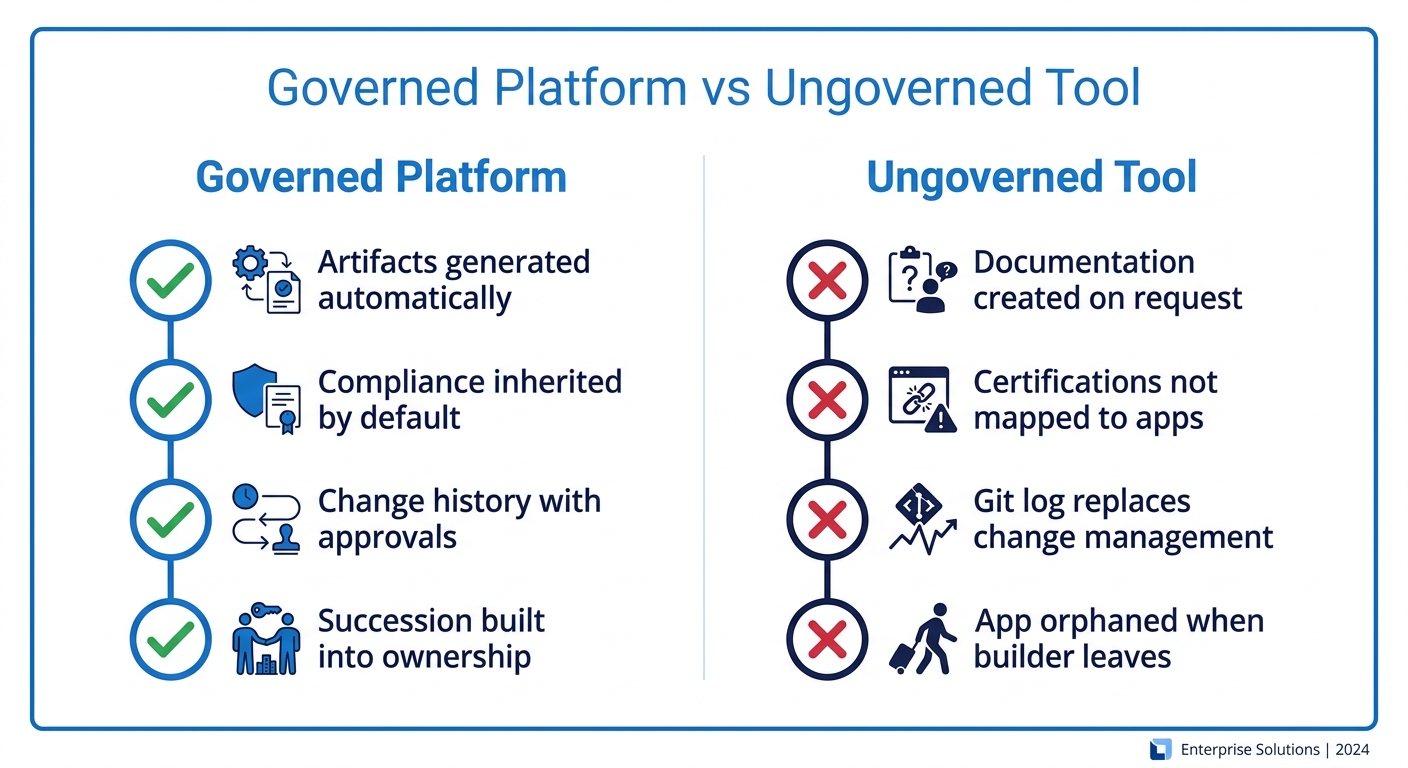
Each of these six artifacts has the same requirement: it must exist without being asked for. A platform that produces governance documentation when IT requests it is not a governed platform — it is a build tool with a documentation feature. The difference is structural. Governed platforms generate compliance evidence as a continuous output of the development and deployment process. Ungoverned tools generate it as a project.
When enterprise leaders describe what they need to CloudApper AI, the six artifacts above are outputs of the build process, not outputs of a compliance remediation effort. The access provisioning record, change log, data classification, vulnerability baseline, succession record, and compliance inheritance documentation exist for every application, from the first deployment, because the platform was designed to produce them. Evaluating enterprise AI platforms when compliance is non-negotiable starts with this list.
If your current AI development platform cannot produce these six artifacts on demand for any application it has built, that is the conversation worth having before the next audit cycle begins. Talk to the CloudApper AI team.

What is CloudApper AI Platform?
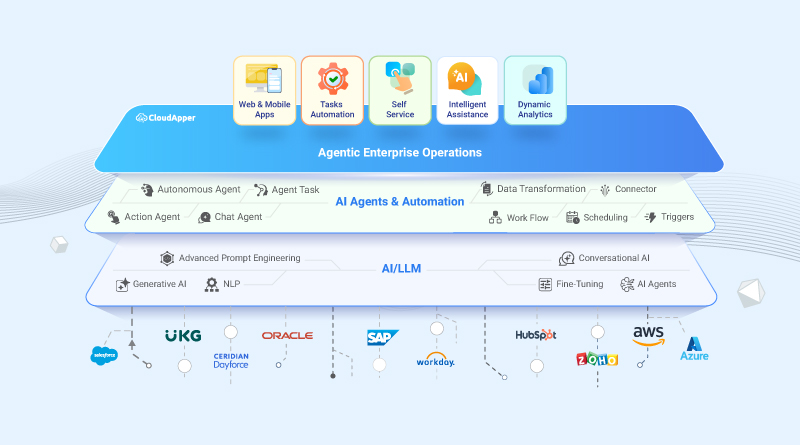
CloudApper AI is an advanced platform that enables organizations to integrate AI into their existing enterprise systems effortlessly, without the need for technical expertise, costly development, or upgrading the underlying infrastructure. By transforming legacy systems into AI-capable solutions, CloudApper allows companies to harness the power of Generative AI quickly and efficiently. This approach has been successfully implemented with leading systems like UKG, Workday, Oracle, Paradox, Amazon AWS Bedrock and can be applied across various industries, helping businesses enhance productivity, automate processes, and gain deeper insights without the usual complexities. With CloudApper AI, you can start experiencing the transformative benefits of AI today. Learn More
- Useful Links:
- Agentic AI
- No-Code/Low-Code
- Custom Software
- HCM Personalization
- iPaaS
- FedRAMP
CloudApper AI Solutions
- Works with









- and more.
Similar Posts

5 HCM Capability Gaps That Keep Landing in IT’s Queue
8 Signals That Mean Your Legacy Application Modernization Is No…