Before an AI agent touches your HCM or payroll data, run seven checks: permissions, data boundaries, audit logs, human approval, model choice, incident response and generated code. Use this checklist to test what a vendor shows you, not what it promises.



TL;DR
- Give each AI agent its own identity and only the permissions its job needs.
- Draw data boundaries that follow your HCM's rules, and confirm what leaves your environment.
- Keep an audit log you can trace from trigger to result for every agent action.
- Put a named human in front of any action that moves money, changes pay or deletes records.
- Settle model choice, the incident plan and review of generated code before go-live.
Table of Contents
An AI agent that can read a customer record, update a payroll entry or call an internal API is not a chatbot with a longer reach. It acts, and every action carries the access of whoever gave it permission. Teams that skip the questions about enterprise AI agent security tend to meet them again at the final approval stage, when a security review stops the deal. The seven checks below cover permissions, data boundaries, audit logs, human approval, model choice, incident response and generated code.

Your agent may touch data held in Workday, UKG or Oracle, systems built to be the authoritative record for people, pay and finance, each with an access model the agent should respect. Verify these seven points before go-live. A governed platform like CloudApper AI is built to answer them, because an AI agent is not a chatbot.
Enterprise AI agent security: seven checks before an agent touches your data
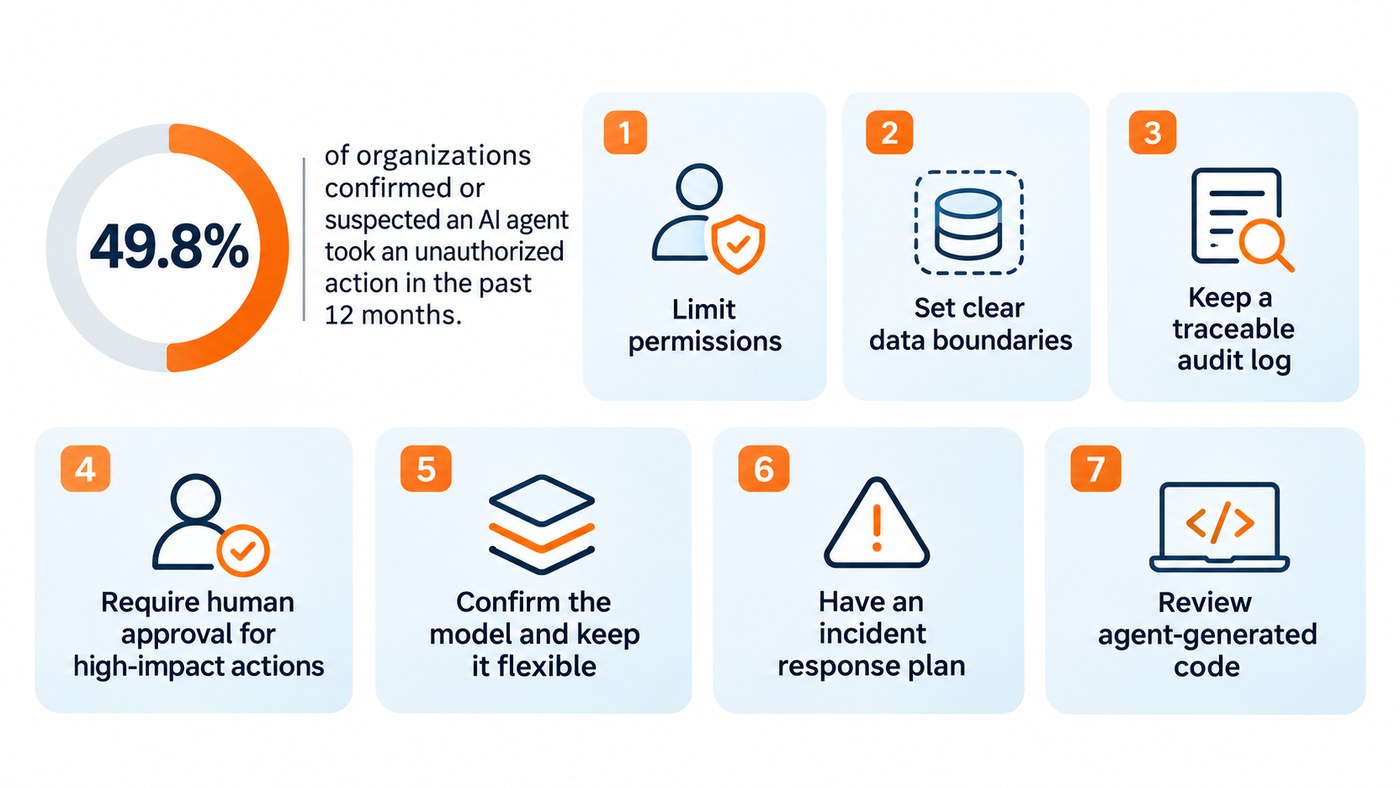
Salt Security’s 2H 2026 survey found that 49.8% of respondents confirmed or suspected an AI agent took an action their organization did not intend, expect or authorize in the past 12 months. Treat each check below as a test you run, not a box the vendor ticks.
1. Does the agent have only the permissions its job needs?
Start with what the agent can reach. An agent that inherits a service account with broad rights is the classic over-permissioned setup. Give each agent its own identity, scope it to one job and one set of systems, and confirm it cannot grant itself more access. Ask the vendor to show the permission list, not describe it.
2. Where do the data boundaries sit?
List which records the agent can read, which it can write and which it must never see, such as salary, health or legal data. Your HCM already applies that governance to people data, so the agent should inherit those rules instead of holding a copy. Confirm what leaves your environment, what is stored and whether prompts are retained.
3. Can you reconstruct every action from the audit log?
A log that says an agent ran is not enough. You need what triggered it, the data it read, the action it took and the result, kept long enough for your auditors. Test it by picking one agent action from last week and asking the vendor to trace it from start to finish.
4. Which actions need a human to approve them?
Separate reading from acting. Anything that moves money, changes pay, deletes records or messages a customer should wait for a named approver. The same applies when agents supervise other agents, since approval cannot rest on another agent’s judgment. Check that the agent cannot skip the approval step itself.
5. Which model runs the agent, and can you change it?
Ask which model handles your data, where it runs and whether your prompts train anything. A platform that offers model choice through services such as Bedrock lets you swap models when requirements or risk change, without rebuilding the agent. Get the answer in the contract, not on a sales call.
6. What happens when an agent goes wrong?
Plan the incident before it happens. You need a way to stop one agent immediately, revoke its access, roll back what it changed and notify the right people. Ask for the runbook and ask who is on call. If the kill switch is a support ticket, it is not a kill switch.
7. Who reviews the code the agent generates?
Some agents write code or workflows that then run against your data. Ungoverned code generation skips the review, testing and change history your own developers go through, so treat its output like any other release. Require the same review under a framework your security team has signed off, with a record of what was deployed, by whom and when.
How to approve an AI agent with confidence
Seven checks decide whether an AI agent is ready for enterprise data. Give each agent narrow permissions, draw data boundaries that follow the rules your HCM already applies, and keep an audit log you can trace end to end. Put a named human in front of high-impact actions, confirm which model handles your data and rehearse the incident plan before you need it. Treat generated code like any other release. CloudApper AI builds agents on an agentic AI platform that runs in a dedicated environment, in a private cloud such as AWS or Azure or on-premises, with Amazon Bedrock development for model access. That keeps your data under your control and gives your team one governed place to answer these questions instead of piecing answers together from ungoverned code generation. If you want to test an agent against all seven, you can book a demo.
Frequently asked questions
What is enterprise AI agent security?
Enterprise AI agent security is the set of controls that limit what an AI agent can access, change and send, and that record what it did. It covers agent permissions, data boundaries, audit logs, human approval steps, model choice and incident response.
What is the difference between AI agent security and AI agent governance?
AI agent security stops an agent from doing harm, through access limits, monitoring and a way to shut it down. AI agent governance sets the rules around it, such as who owns each agent, which actions need approval and how changes are reviewed and recorded.
What is an agentic AI platform?
An agentic AI platform is software for building and running AI agents that can take actions across business systems, not just answer questions. A good one adds permissions, audit logs, approval steps and model choice so each agent works within limits your team controls.
Should a human approve every AI agent action?
No. Approval should follow risk. Reading low-risk data can run on its own, while actions that move money, change pay, delete records or contact customers should wait for a named approver. Review the split regularly as you learn how each agent behaves.
What should an AI agent audit log include?
It should show what triggered the agent, which data it read, what action it took, what the result was, and the time and identity involved. Keep it long enough for audits and make sure one action can be traced from start to finish.

What is CloudApper AI Platform?
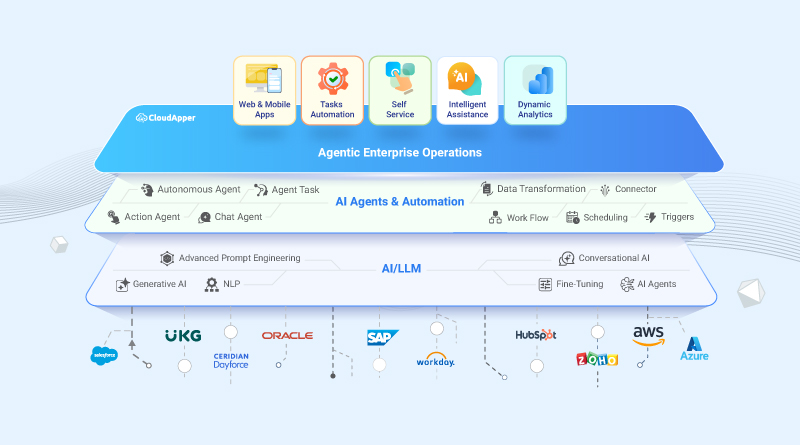
CloudApper AI is an advanced platform that enables organizations to integrate AI into their existing enterprise systems effortlessly, without the need for technical expertise, costly development, or upgrading the underlying infrastructure. By transforming legacy systems into AI-capable solutions, CloudApper allows companies to harness the power of Generative AI quickly and efficiently. This approach has been successfully implemented with leading systems like UKG, Workday, Oracle, Paradox, Amazon AWS Bedrock and can be applied across various industries, helping businesses enhance productivity, automate processes, and gain deeper insights without the usual complexities. With CloudApper AI, you can start experiencing the transformative benefits of AI today. Learn More
- Useful Links:
- Agentic AI
- No-Code/Low-Code
- Custom Software
- HCM Personalization
- iPaaS
- FedRAMP
CloudApper AI Solutions
- Works with









- and more.
Similar Posts

5 Signs the Vibe-Coded App Already Running in Your Enterprise…

7 Questions to Ask Before Choosing a Legacy Application Modernization…