Five HCM capability gaps -- non-standard approval workflows, field data capture, compliance export mismatches, cross-system workflows, and role-specific interfaces -- that generate recurring IT tickets across Workday, UKG, Dayforce, SAP, and Oracle HCM.


TL;DR
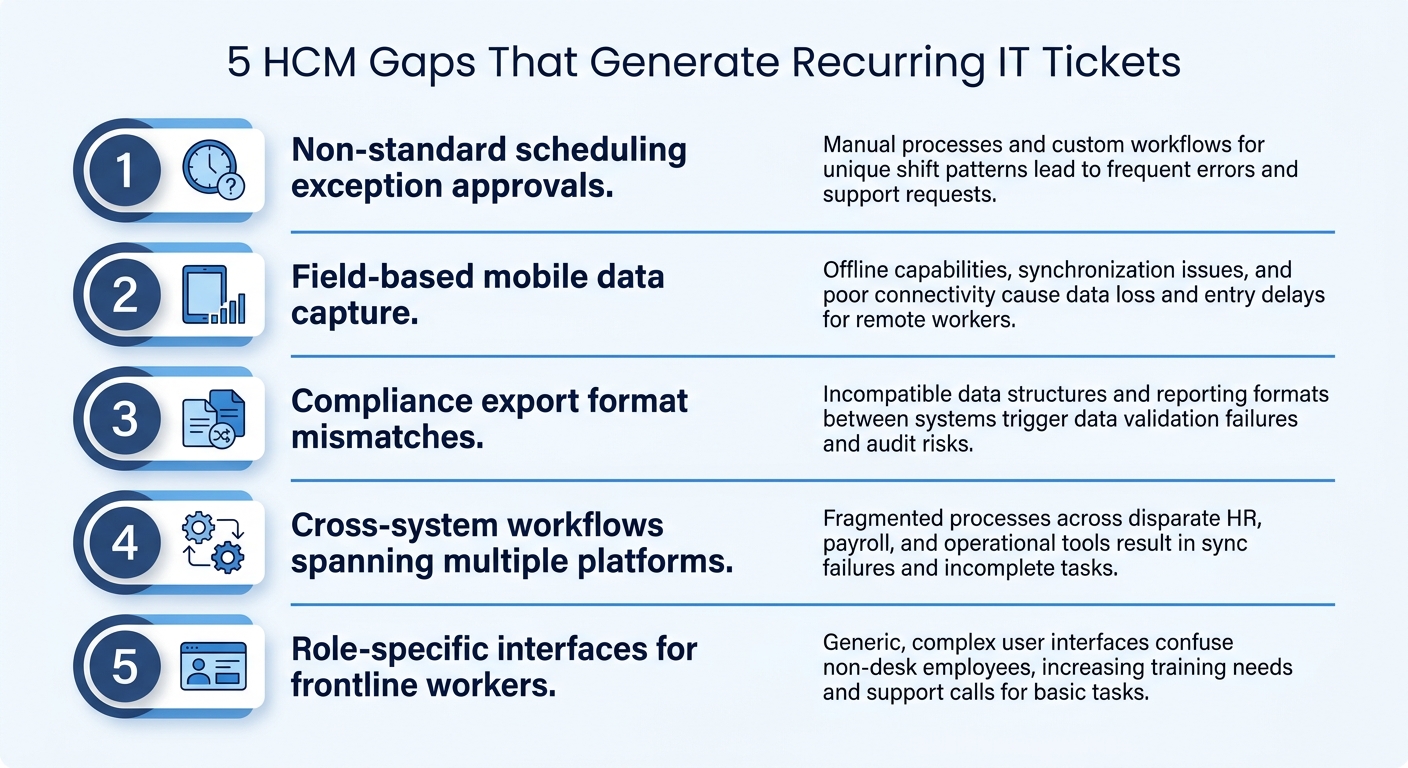
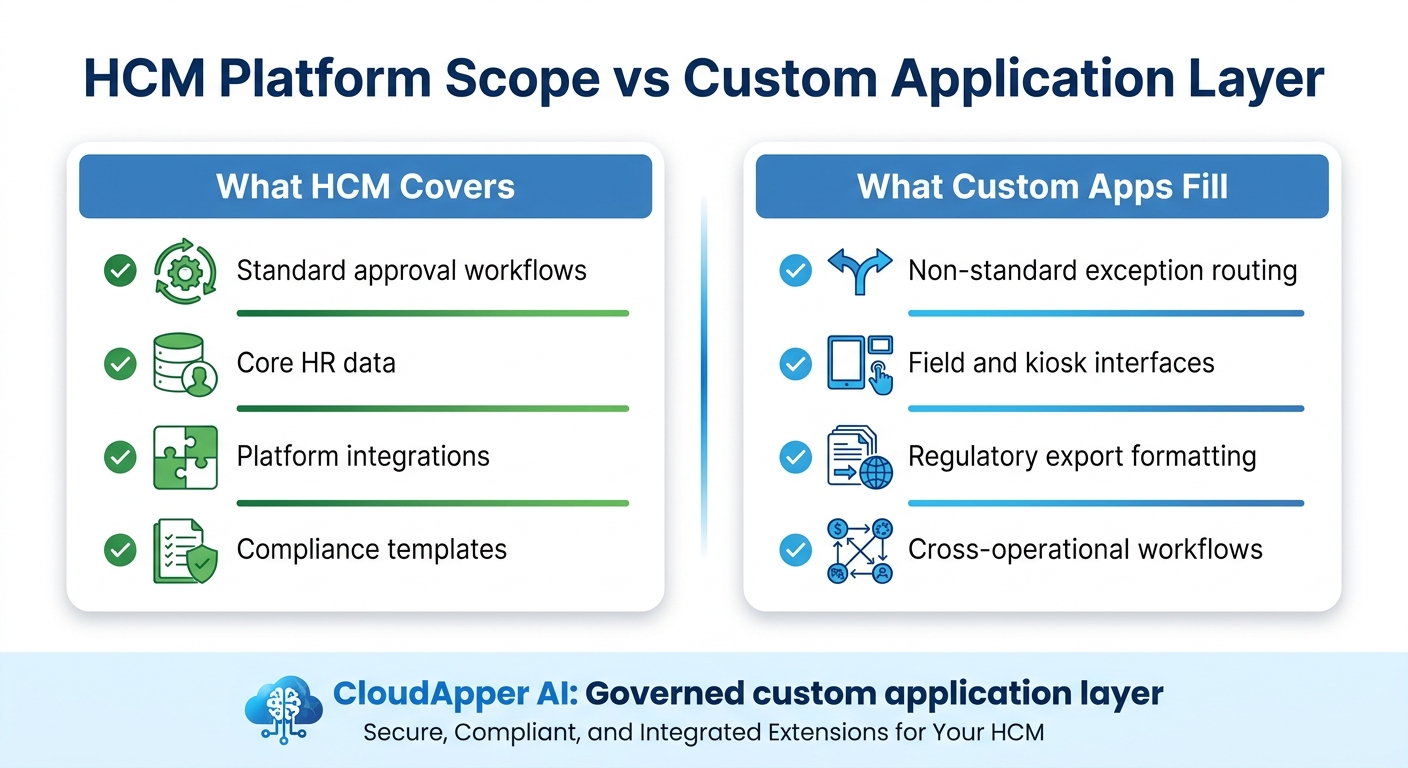
Enterprise HCM platforms cover approximately 80% of core HR capability by design; the 20% that keeps generating IT tickets is a structural scope boundary, not a platform defect. Five recurring categories consistently fill the gap: non-standard approval workflows for scheduling exceptions, field-based mobile data capture for environments the HCM mobile app was not built for, compliance reporting exports in formats that differ from regulatory requirements, cross-system workflows that require data from operational platforms the HCM does not connect to natively, and role-specific interfaces for frontline workers who cannot navigate the full HCM module. Each category is a custom development request, not a configuration task. The question is not whether these gaps will generate requests -- they will -- but what governs the custom applications that fill them. CloudApper AI builds governed custom applications on a platform where compliance evidence, access controls, and change management are structural defaults that survive HCM vendor upgrades.
Table of Contents
- 1. Non-Standard Approval Workflows for Scheduling and Exceptions
- 2. Field-Based Data Capture That the Mobile HCM App Doesn’t Cover
- 3. Compliance Reporting Exports in Formats the Platform Doesn’t Generate
- 4. Cross-System Workflows That Require Data From More Than One Platform
Friday afternoon. IT is reviewing the open ticket queue before the weekend. Five new requests came in since Wednesday, all from different business units, all variations of the same ask: they need something their HR system cannot do. One is a custom approval workflow for shift exceptions that Workday’s standard scheduling module doesn’t support. One is a mobile data capture tool for pre-hire field assessments that the HCM onboarding flow skips entirely. One is a compliance reporting export the system generates in a format nobody downstream can actually use.

The tickets are polite. The business units are patient. But this is the third quarter in a row the same five categories have appeared, and IT knows by now that none of them has a roadmap fix coming from the platform vendor.
HCM platforms like Workday, UKG, Dayforce, SAP HCM, and Oracle HCM were built to cover 80% of enterprise HR capability. That coverage is real and substantial. The 20% that keeps landing in IT’s queue is not a vendor failure — it is a deliberate scope boundary. The platform vendors made design decisions about what belongs in core HCM and what belongs in adjacent custom capability. What follows are five of the most consistent categories in that 20% gap.
1. Non-Standard Approval Workflows for Scheduling and Exceptions
Every enterprise has scheduling and exception-handling rules that deviate from the HCM platform’s standard workflow engine. Union agreements with specific deviation approval chains. Multi-site operations where exceptions require sign-off from regional managers and HR business partners simultaneously. Seasonal workforce rules that apply only during specific calendar windows. The platform’s workflow module handles the standard cases. The non-standard cases generate tickets.
The pattern is consistent: a business unit submits an exception manually, IT gets asked to build a workaround, and the workaround gets adopted as a process until the next contract renegotiation changes the rule again. Extending UKG with custom applications for exception handling is one of the most common IT development requests from UKG customers precisely because the platform’s native workflow engine was not designed to cover every deviation scenario a 2,000-person manufacturing operation runs.
2. Field-Based Data Capture That the Mobile HCM App Doesn’t Cover
HCM mobile apps are built for desk-adjacent workers: an employee submitting PTO, a manager approving a timesheet, a recruiter reviewing a candidate profile. They are not built for the data capture scenarios that happen on job sites, in distribution centers, loading docks, or clinical environments where the work happens away from a desk and the HCM interface is too slow, too complex, or too data-hungry for field conditions.
The requests that land in IT’s queue here are specific: a lightweight mobile form for pre-shift safety certifications, a photo-capture tool for equipment inspection tied to a worker’s HCM profile, a kiosk interface for shift sign-in in a warehouse where employees don’t carry personal devices. What enterprise IT needs before extending Workday into field-data scenarios is a governed custom application layer — not a workaround built in a spreadsheet that HR owns until it breaks.
3. Compliance Reporting Exports in Formats the Platform Doesn’t Generate
Every HCM platform generates compliance reports. OSHA logs, EEO-1 submissions, FLSA overtime summaries, state-specific leave tracking exports. What the platform generates and what a specific regulatory authority, state agency, or audit committee actually accepts are frequently different things. Field names differ. Date formatting differs. The structure of multi-jurisdiction exports differs from what the platform assumes.
IT gets pulled in to build a transformation layer — typically a script that takes the platform export and reformats it to match the regulatory template. The script gets maintained quietly by one person, runs before every compliance deadline, and is never formally documented. What enterprise IT discovers when extending Dayforce is that the compliance reporting gap is almost always the first custom development request and the one that never fully goes away, because regulatory formats change independently of the HCM vendor’s release cycle.
4. Cross-System Workflows That Require Data From More Than One Platform
Enterprise operations rarely live entirely inside one platform. A new hire workflow touches the HCM, the identity management system, the access provisioning tool, the payroll system, and sometimes a facilities management or asset tracking platform. The HCM vendor’s integration tools connect to major downstream systems through standard connectors. The edge cases — the manufacturing plant that uses a custom inventory system, the healthcare network with a credentialing database the HCM has never heard of — generate IT tickets.
The ask is usually framed as “can you connect X to our HCM?” but the actual need is a workflow that spans systems, validates data from each, and routes outcomes back to the right place. The cross-system workflow gap is structural — HCM platforms are designed around HR data, not operational data. When operational data is what drives the HR decision, the platform boundary becomes the ticket.
5. Role-Specific Interfaces the HCM UI Was Not Designed For
The HCM UI is built for HR professionals and managers who use it regularly, understand its navigation, and work at a desk. The workers who need to interact with their own HR data — submitting a schedule preference, confirming a compliance training, updating an emergency contact — often do so infrequently, on a mobile device, in an environment with poor connectivity, using a system whose interface was never designed for their context.
IT gets requests for simplified interfaces: a single-purpose screen for frontline workers to submit one type of request, a kiosk application for a lobby or break room, a manager dashboard that surfaces the three data points a shift supervisor needs without requiring them to navigate the full HCM module. What hospital IT teams build when the record system can’t hold the work is exactly this — role-specific interfaces that surface the right data for the right person in the right context, without asking a charge nurse or a warehouse supervisor to become an HCM power user.
The Pattern Behind All Five
None of these five gaps are signs that the HCM platform is broken. They are signs that the platform was built for a scope, and the enterprise has needs that sit at the edge of that scope. The platform vendors know this. It is why every major HCM platform has an extension marketplace, an API layer, and a partner ecosystem. The question is not whether these gaps will generate custom development requests — they will. The question is what governs the custom development that fills them.
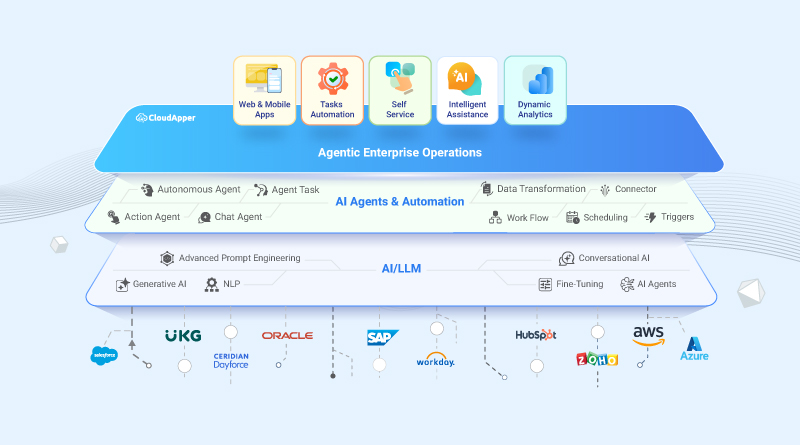
When enterprise HR and operations leaders describe what they need to CloudApper AI, the custom capability gets built on a governed platform where access controls, data classification, and change management are structural defaults — not afterthoughts. The upgrade cost of ungoverned HCM customization compounds every time the core platform changes and the custom layer breaks. Building on a governed AI platform separates the custom capability from the HCM vendor’s release cycle, so the five recurring ticket categories become solved problems rather than permanent queue items.
If your IT queue carries the same HCM extension requests quarter after quarter, the solution is not a better workaround. It is a governed custom application layer designed to outlast the next vendor upgrade. Talk to the CloudApper AI team.

What is CloudApper AI Platform?
CloudApper AI is an advanced platform that enables organizations to integrate AI into their existing enterprise systems effortlessly, without the need for technical expertise, costly development, or upgrading the underlying infrastructure. By transforming legacy systems into AI-capable solutions, CloudApper allows companies to harness the power of Generative AI quickly and efficiently. This approach has been successfully implemented with leading systems like UKG, Workday, Oracle, Paradox, Amazon AWS Bedrock and can be applied across various industries, helping businesses enhance productivity, automate processes, and gain deeper insights without the usual complexities. With CloudApper AI, you can start experiencing the transformative benefits of AI today. Learn More
- Useful Links:
- Agentic AI
- No-Code/Low-Code
- Custom Software
- HCM Personalization
- iPaaS
- FedRAMP
CloudApper AI Solutions

- Works with









- and more.
Similar Posts

8 Signals That Mean Your Legacy Application Modernization Is No…

6 Governance Artifacts Your Enterprise AI Platform Should Produce Without…