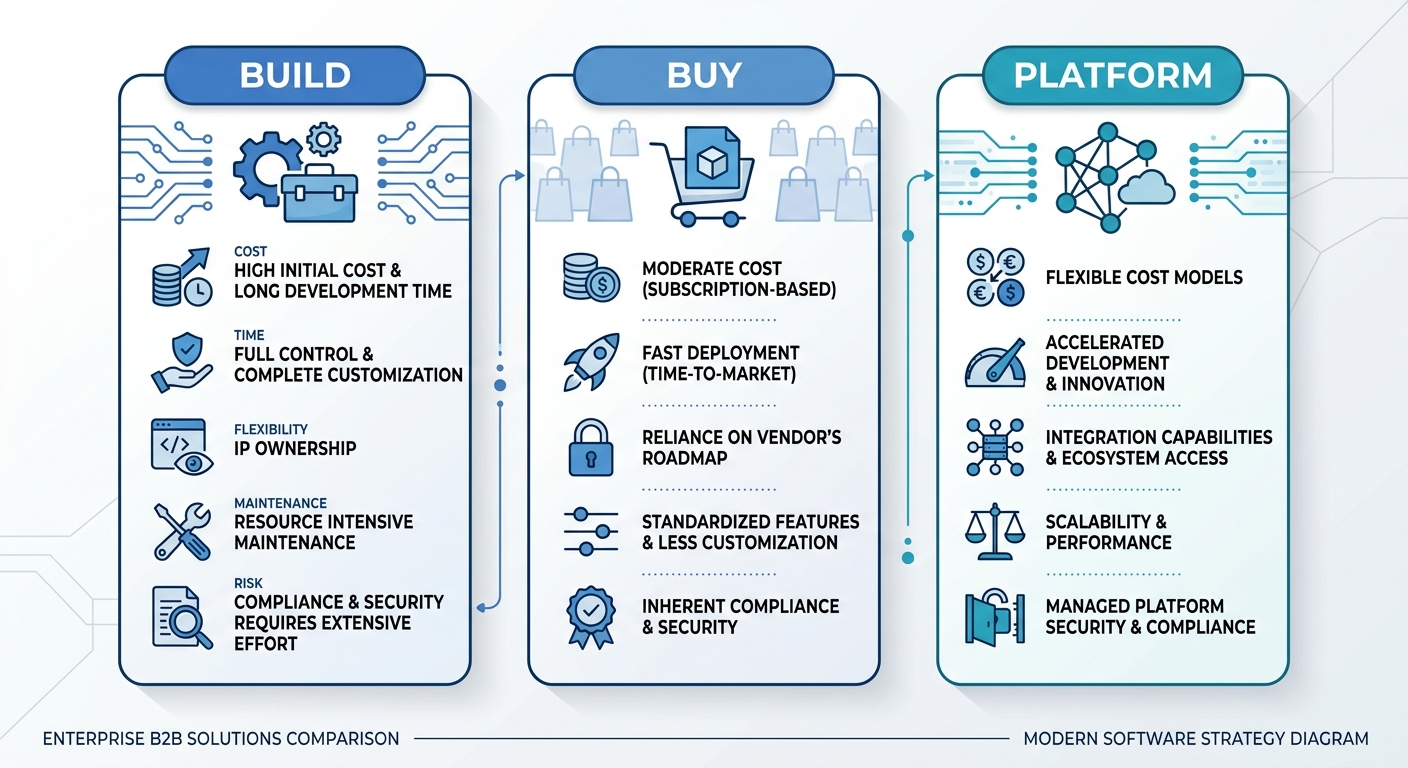
When a business unit needs a new internal application, enterprise IT faces three paths: build it, buy it, or configure it on a governed platform. The right answer depends on regulatory exposure, integration complexity, and total cost of ownership — and the compliance overlay changes the calculation entirely.

TL;DR
Enterprise IT teams choosing between building, buying, or using a governed platform for internal applications face a risk management decision, not just a procurement one. Custom builds carry maintenance debt and AI-generated code vulnerability rates of 40-45%. Off-the-shelf SaaS leaves configuration gaps and shifts compliance responsibility to the vendor. Governed platforms like CloudApper offer a third path: certified environments where applications can be configured and deployed with compliance controls inherited from the platform itself. The right choice depends on regulatory exposure, integration complexity, requirement stability, and five-year total cost of ownership — not just initial delivery speed.
Table of Contents
- The Build Argument — and Where It Usually Breaks Down
- The Buy Argument — and What It Assumes About Your Requirements
- Where the Platform Option Has Changed the Calculation
- When Compliance Changes the Calculation Entirely
Most enterprise IT teams treat build vs buy vs platform as a procurement question, when it is really a risk decision. For internal app development, the wrong choice is expensive to reverse: custom builds grow into maintenance burdens, off-the-shelf software leaves gaps that teams patch with workarounds, and platforms differ widely in how much governance and integration control they give IT.
AI coding tools have made the choice harder. Teams can generate code faster, but faster output is not safer output, and the compliance questions arrive months later. CloudApper AI Platform takes a different route, giving enterprise IT a governed environment to configure, integrate and deploy compliant applications without raw development overhead or rigid SaaS constraints. Each path deserves an honest look.
The Build Argument — and Where It Usually Breaks Down
Custom development has real advantages. You get exactly what you specify, the application integrates with your existing systems on your terms, and you retain full ownership of the codebase. For IT teams with strong internal developers and a clear, stable requirement set, building still makes sense in a narrow set of circumstances.
The problem is that those circumstances are rarer than they used to be, and the cost structure of building has shifted in ways that make the business case harder to defend.

First, the actual cost of building extends well past the initial delivery date. Maintenance, patching, infrastructure management, and the recurring cost of updating the application when your underlying platforms change — these are often underestimated at the point of the decision and always underestimated in the budget. The hidden cost of maintaining systems that your vendor no longer supports applies to internal custom builds just as readily as it does to vendor-supplied software: once the developer who built it moves on, the knowledge embedded in that codebase begins to erode.
Second, AI-assisted development has changed the risk profile without eliminating it. A team using GitHub Copilot or similar tools can produce applications faster than ever. But AI-generated code carries documented vulnerability rates — independent research and Anthropic’s own published findings put the figure at 40 to 45 percent of AI-generated code containing at least one security flaw. For a healthcare organization building an internal patient scheduling tool, or a financial services firm building a reporting application that touches regulated data, that vulnerability rate is not a minor concern. It is a potential audit finding, a breach liability, and a compliance failure waiting to surface. The hidden security risks of AI coding assistants without a governance framework do not disappear because the development moved faster.
Third, build decisions made at the team level have a way of proliferating. Once one department gets approval to build its own tool, others follow. The result is a fragmented application landscape, inconsistent security posture, and the shadow IT problem that most enterprise IT organizations spent the last decade trying to eliminate — now returning in a new form.
The Buy Argument — and What It Assumes About Your Requirements
Buying established software is, in most cases, the lower-friction path. Vendor-hosted SaaS means no infrastructure to manage, no patching burden, and a development roadmap someone else is paying for. For common use cases — CRM, ITSM, expense management — there are mature products with strong compliance documentation, active vendor relationships, and large implementation communities.
The buy argument gets harder when your requirements diverge from the standard use case. Enterprise organizations — particularly those in regulated industries — frequently need internal applications that reflect how their specific operations run, not how a vendor assumes they should run. A logistics company that needs to track specialized compliance data tied to shipment records will not find that capability in an off-the-shelf tool designed for a general warehouse management use case. A healthcare system that needs to connect patient scheduling to its UKG workforce management instance in a specific way is not going to find a pre-built integration that matches that workflow precisely.
When requirements don’t fit, the standard response is customization. And customization of bought software comes with its own cost structure: implementation fees, custom development on top of a vendor platform, upgrade risk when the vendor’s next release breaks your customizations, and dependency on the vendor’s roadmap for features that your business needs now. HCM systems — and most enterprise software categories — will never do everything an organization needs, which is why the buy path often leads directly to the same place the build path started: a custom development project, now constrained by someone else’s architecture.
There is also a compliance consideration that the buy argument sometimes glosses over. SaaS software means your data is leaving your environment, hosted on infrastructure you do not control, governed by the vendor’s security practices, and subject to a BAA or DPA that may or may not align with your regulatory requirements. For organizations under HIPAA, SOC 2, PCI DSS, or sector-specific frameworks, the vendor’s compliance posture becomes your compliance posture. The due diligence burden is real, and it does not go away just because you did not write the code yourself.
Where the Platform Option Has Changed the Calculation
The third path — governed application platforms — has matured considerably over the last several years, and the organizations that have adopted it most successfully are those that recognized what the build vs. buy framing was missing: the ability to move at development speed without taking on development risk.
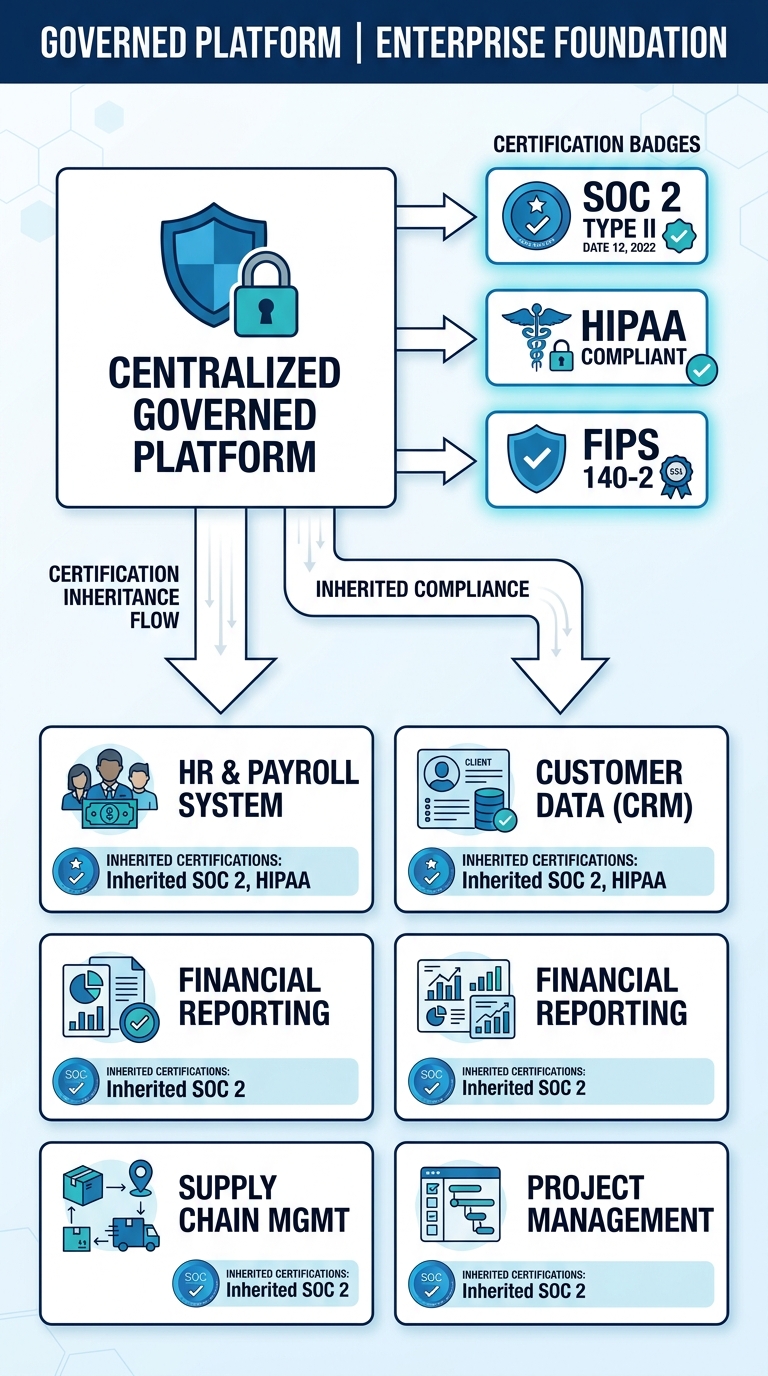
A governed platform gives enterprise IT a structured environment in which applications can be configured, deployed, and integrated without requiring teams to write and own raw code. The distinction matters for compliance reasons. When an enterprise builds on a platform that holds its own certifications — HIPAA, SOC 2, GDPR, FIPS 140-2 — those certifications extend to applications built within it, rather than requiring each new application to go through its own audit cycle. The platform’s security controls, access management, and audit logging become the application’s controls by inheritance, not by manual implementation.
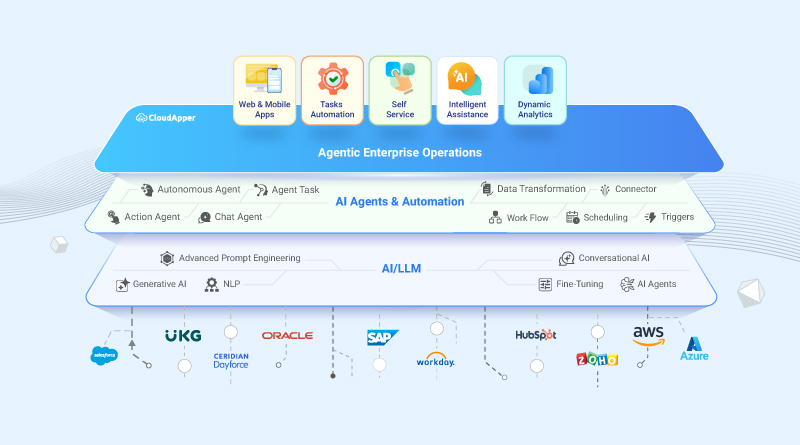
This is the model CloudApper AI Platform operates on. Organizations using CloudApper to build internal applications, extend existing HCM and ERP systems, or modernize legacy tools are not starting from a blank development environment. They are building within a platform that is already HIPAA, SOC 2, GDPR, CCPA, FERPA, and FIPS 140-2 certified, and that runs on AWS infrastructure with zero DevOps overhead — meaning the team deploying the application does not need to manage runtime environments, patching cycles, or infrastructure scaling. Removing infrastructure overhead from internal app development is not a minor operational improvement; it eliminates an entire category of cost and risk that custom builds carry by default.
The iPaaS integration layer CloudApper includes is worth addressing specifically, because integration is where platform options have historically fallen short. A platform that can configure an application but cannot connect it to your Workday, UKG, Oracle, or SAP environment without custom middleware does not solve the problem — it moves it. CloudApper’s integration layer connects to existing enterprise systems directly, which means the applications built on the platform can exchange data with the systems that already hold the source of record, without creating duplicate data stores or integration debt.
When Compliance Changes the Calculation Entirely
For many enterprise IT teams, the build vs. buy vs. platform question has a compliance overlay that effectively narrows the options before any evaluation begins.
If your organization is active under HIPAA and needs an internal application that handles PHI, you are immediately constrained: the application must run in an environment with appropriate technical safeguards, the vendor or platform must be willing to sign a BAA, and the application’s development history must be auditable. A team building quickly with AI coding tools may not be able to demonstrate that the code it shipped was reviewed against OWASP Top 10. A SaaS vendor whose compliance documentation does not cover your specific use case may not be willing to execute the BAA you need. Building internal enterprise apps without creating a compliance liability requires, at minimum, knowing which path you are on before you start.
The same dynamic applies under SOC 2. SOC 2 auditors are asking questions about internal app development that many IT teams are not prepared to answer: What controls govern who can commit code to internal applications? How is access to sensitive data within internal tools reviewed and recertified? What is the retention policy for application logs? When the answer to those questions involves a custom build with no defined SDLC documentation, the audit conversation gets difficult quickly.
Platform-based development changes this dynamic because the governance questions have answers by default. The platform defines the SDLC. The platform enforces access controls. The platform maintains the audit log. The compliance team’s questions about a new internal application built on CloudApper point back to the platform’s existing certification documentation — not to a custom codebase that needs to be reviewed from scratch.
Making the Decision: A Practical Framework
The build vs. buy vs. platform question benefits from being structured around a few specific variables rather than treated as an open-ended strategic discussion.
Start with regulatory exposure. If the application will handle data governed by HIPAA, SOC 2 scope, PCI DSS cardholder data environments, or sector-specific regulations, filter your options against compliance inheritance first. Custom builds require you to establish and document every control. SaaS software requires vendor due diligence. Certified platforms shift that burden significantly.
Next, assess integration complexity. If the application needs to exchange data with core enterprise systems — payroll, ERP, HCM, CRM — evaluate whether your chosen path has a credible integration story before you commit. Integration is almost always underestimated at the decision stage and becomes the primary source of schedule delay and cost overrun after it.
Then consider the requirement stability. Applications with stable, well-understood requirements that map closely to existing SaaS products are reasonable buy candidates. Applications with volatile requirements, high customization needs, or workflows specific to your organization’s operations are better candidates for platform-based configuration. Requirements that are genuinely novel — no existing product covers them — are the remaining case for custom builds, with full awareness of the maintenance and governance overhead that comes with it.
Finally, factor in the total cost of ownership across a five-year horizon, not just the initial delivery cost. The real cost comparison between maintaining an existing system and investing in modernization consistently shows that total cost of ownership for custom builds drifts upward over time in ways that are hard to forecast at the point of the decision. Platform-based development tends to produce more predictable cost trajectories because the infrastructure and maintenance overhead is absorbed by the platform, not the internal team.
What “Platform” Actually Means in Practice
The platform category is not homogeneous. Low-code tools aimed at business users, developer-facing application frameworks, and enterprise-grade governed platforms represent meaningfully different options, and evaluating them on the same criteria produces misleading comparisons.
The distinction that matters most for compliance-active enterprises is governance depth. A low-code tool that lets a business analyst build a workflow application in an afternoon may be valuable for certain use cases, but if that tool does not enforce access controls, does not maintain an audit trail that satisfies your compliance team, and does not carry certifications that extend to the applications built within it, it is effectively the shadow IT problem in a friendlier interface. Shadow IT has returned through AI and low-code tools, and the speed advantage disappears when the compliance finding arrives.
An enterprise-grade platform like CloudApper sits in a different category: it is designed for organizations that need both speed and governance, where the platform’s architecture enforces the controls that compliance requires rather than leaving them as optional configurations. The no-code/low-code interface is the delivery mechanism; the governed blueprint architecture is what makes the output trustworthy for enterprise deployment. For organizations evaluating vendors in this space, the right questions are about certification coverage, audit log architecture, data residency, integration depth, and the platform’s own security review history — not just the speed of the demo.
If your organization is working through an internal application decision and needs to understand how a governed enterprise AI platform fits into that evaluation, CloudApper’s team is available to walk through specific use cases, compliance requirements, and integration scenarios. The conversation starts at cloudapper.ai/contact-us.

What is CloudApper AI Platform?
CloudApper AI is an advanced platform that enables organizations to integrate AI into their existing enterprise systems effortlessly, without the need for technical expertise, costly development, or upgrading the underlying infrastructure. By transforming legacy systems into AI-capable solutions, CloudApper allows companies to harness the power of Generative AI quickly and efficiently. This approach has been successfully implemented with leading systems like UKG, Workday, Oracle, Paradox, Amazon AWS Bedrock and can be applied across various industries, helping businesses enhance productivity, automate processes, and gain deeper insights without the usual complexities. With CloudApper AI, you can start experiencing the transformative benefits of AI today. Learn More
- Useful Links:
- Agentic AI
- No-Code/Low-Code
- Custom Software
- HCM Personalization
- iPaaS
- FedRAMP
CloudApper AI Solutions

- Works with







- and more.
Similar Posts

CMMC Level 2 and Internally Built Applications: The Evidence Gap…

Vendor-Built Internal Applications: The Governance Gap Enterprise IT Inherited From…